WIPO's 2026 Global Innovation Index Finds R&D Spending Rising, but Researcher Density Still Differs Nearly 50-Fold by Region
The 19th edition of the Global Innovation Index, released 29 September 2026 alongside new UNESCO research-workforce data, ranks 139 economies while showing how unevenly research capacity is still spread.
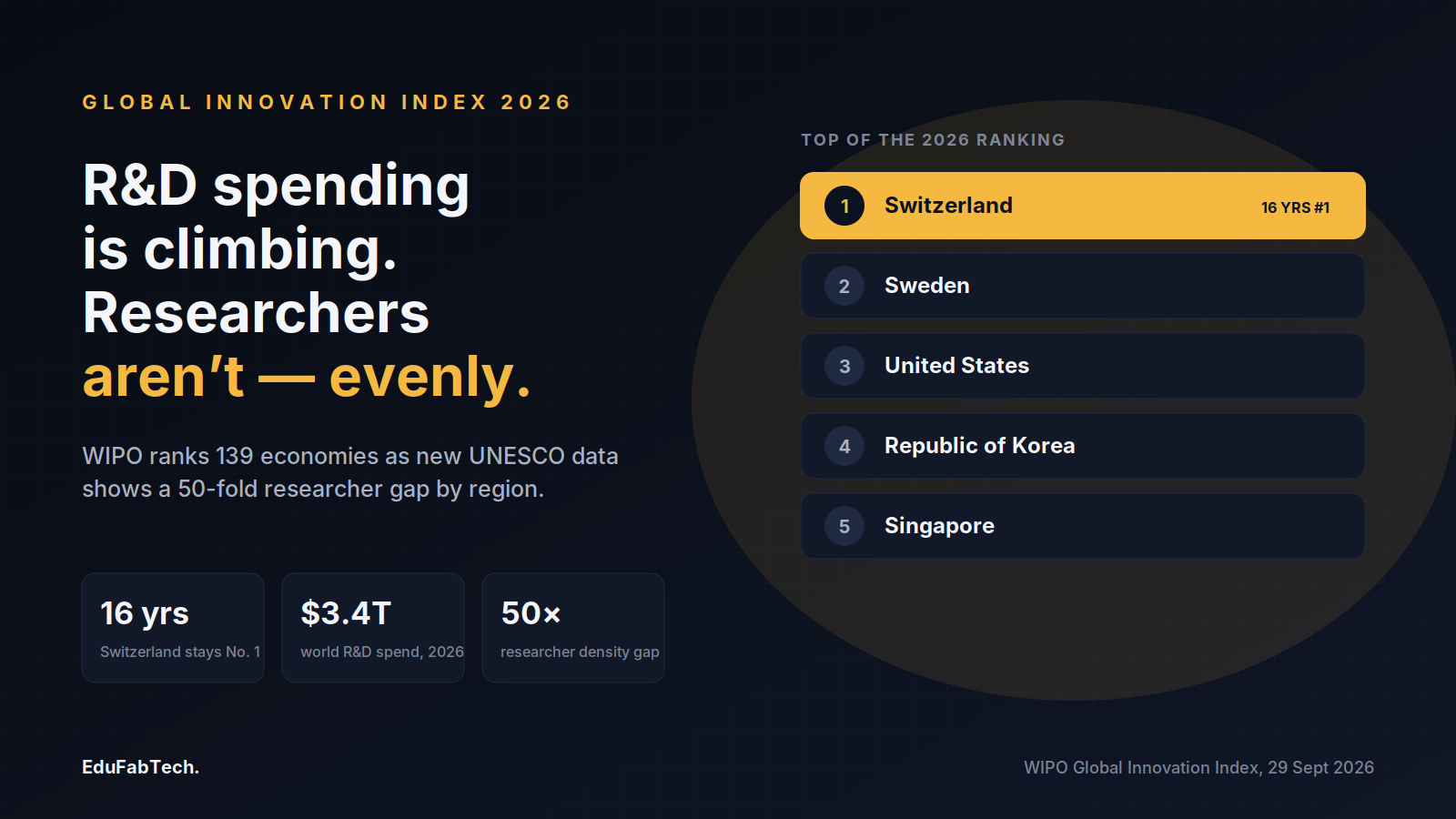
The World Intellectual Property Organization released the 19th edition of its Global Innovation Index on 29 September 2026, ranking 139 economies on their innovation performance using 79 indicators grouped into inputs — institutions, human capital and research, infrastructure, market sophistication, business sophistication — and outputs — knowledge and technology, and creative outputs. Switzerland topped the overall ranking for the 16th consecutive year, followed by Sweden, the United States, the Republic of Korea, Singapore, the United Kingdom, the Netherlands, Finland, Denmark and China, according to the report's results.
Behind the ranking sits a spending story. Global research and development expenditure grew more than 3.3% in real terms in 2025 and is projected to expand 3.6% in 2026 to reach $3.4 trillion, WIPO reports. Corporate R&D reached a record $1.5 trillion in 2025, up 5.8%, driven largely by software, AI and defence-related spending. WIPO notes that growth is increasingly concentrated in a group of middle-income economies — Egypt, Indonesia, Malaysia and Viet Nam among them — rather than only in the traditional research powers at the top of the table.
Where research capacity actually sits
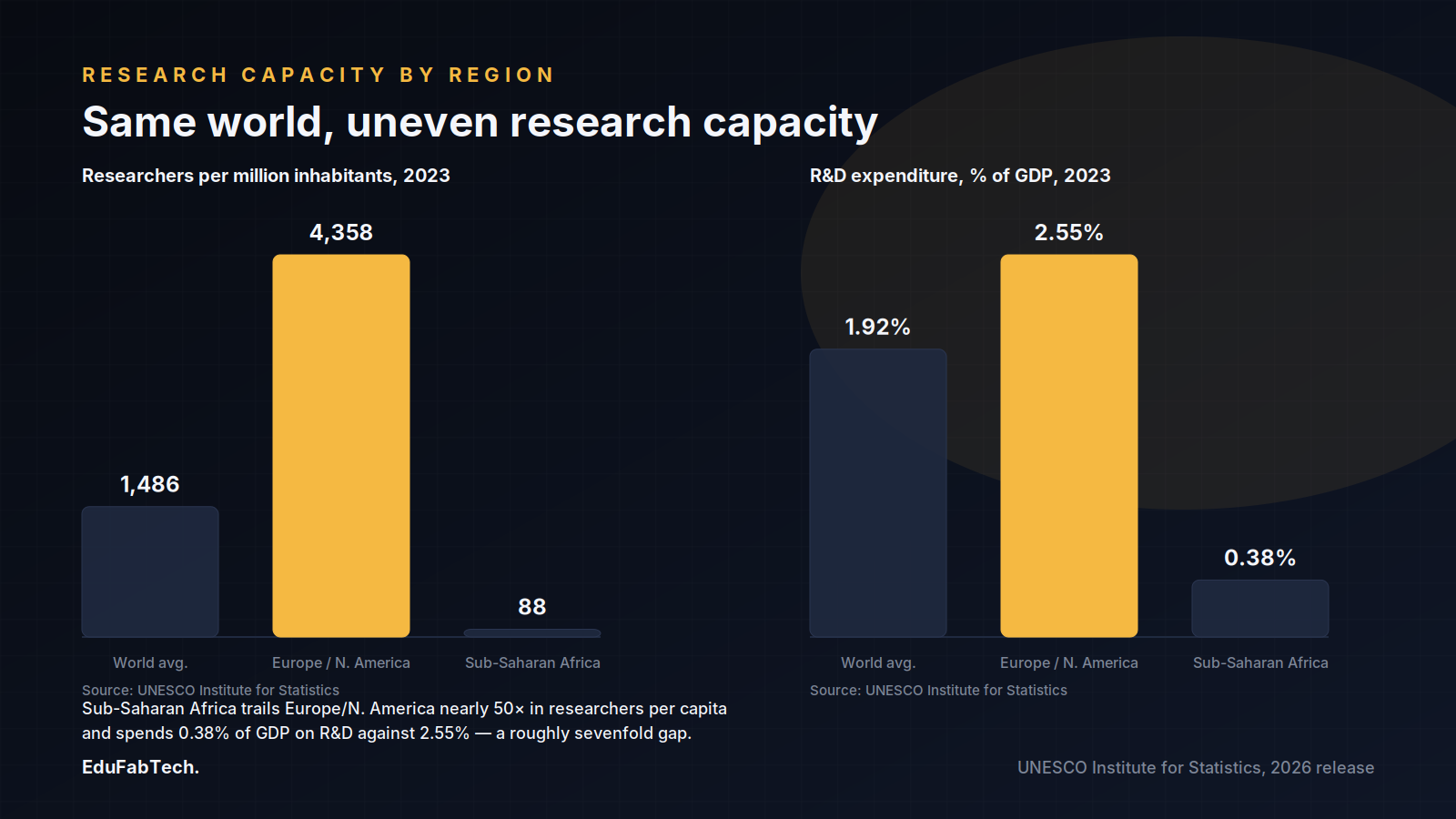
A separate 2026 data release from the UNESCO Institute for Statistics, covering 43 countries' latest R&D surveys, puts numbers on how unevenly that capacity is distributed. Global R&D spending rose from 1.71% of GDP in 2015 to 1.92% in 2023, but the institute notes that 73% of countries still invest less than 1% of GDP in R&D. Europe and Northern America reported the highest regional spending, at 2.55% of GDP, against 0.38% in Sub-Saharan Africa — a gap of roughly seven times.
The researcher workforce shows a similar split. Worldwide, the number of researchers rose from 1,141 per million inhabitants in 2015 to 1,486 in 2023, per UNESCO. But Europe and Northern America counted 4,358 researchers per million inhabitants against 88 per million in Sub-Saharan Africa — a nearly 50-fold difference. Women made up 31.4% of researchers globally in 2023, up from 29.5% in 2013, with Central Asia, Northern Africa, and Latin America and the Caribbean the regions closest to parity, at roughly 45%.
What the "human capital" pillar picks up
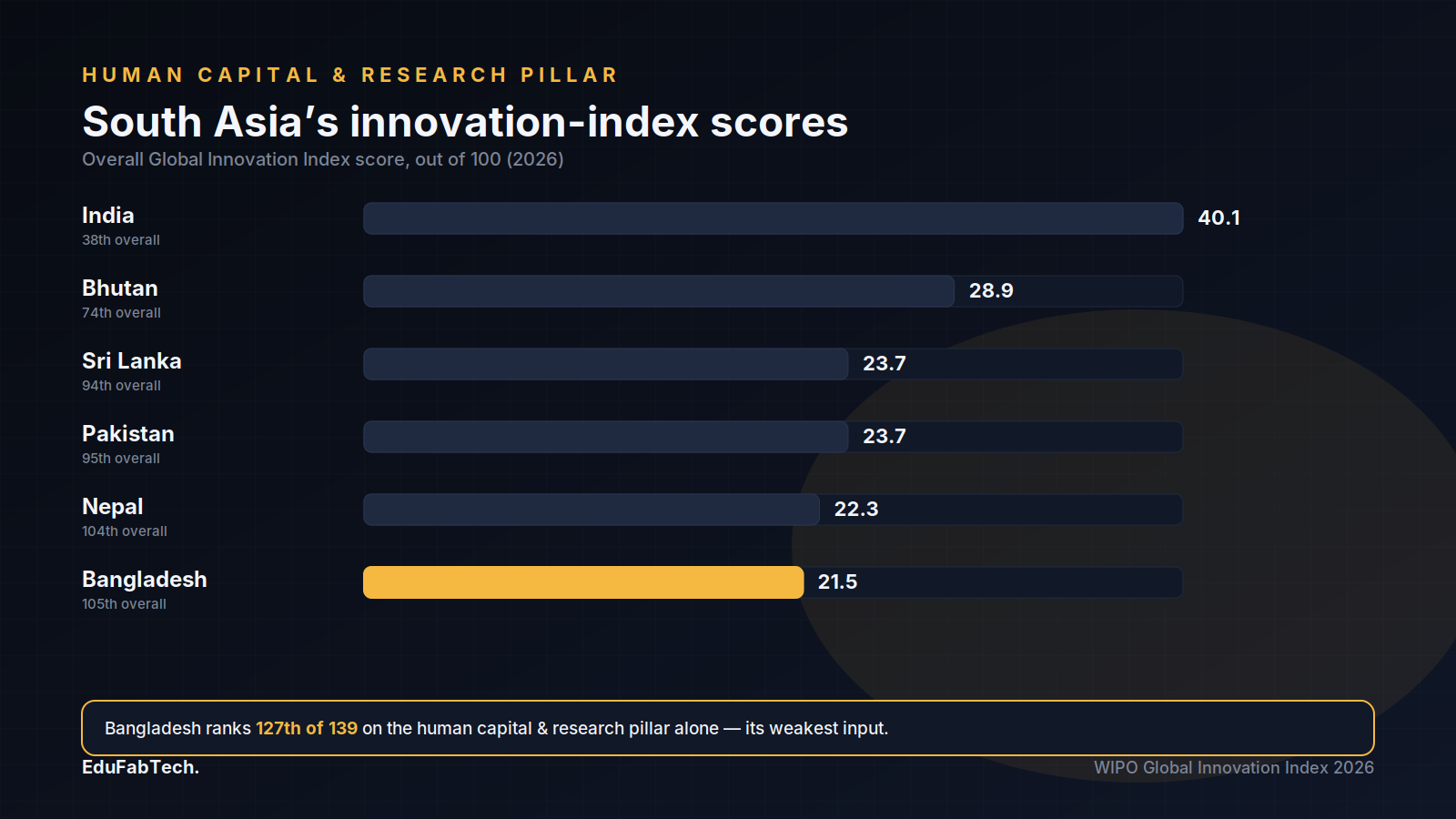
Inside the Global Innovation Index, the pillar most directly tied to education — "human capital and research" — combines spending on schooling, tertiary enrolment and quality, and researcher numbers. It is also where gaps between otherwise similarly ranked economies tend to show up most starkly. In South Asia, for instance, reporting on the 2026 results found Bangladesh ranked 127th of 139 economies specifically on that pillar — its weakest input category — even though it performed comparably better on innovation outputs.
| Economy | Overall rank (of 139) | Overall score (/100) |
|---|---|---|
| India | 38 | 40.1 |
| Bhutan | 74 | 28.9 |
| Sri Lanka | 94 | 23.7 |
| Pakistan | 95 | 23.7 |
| Nepal | 104 | 22.3 |
| Bangladesh | 105 | 21.5 |
Middle-income "overperformers"
WIPO also tracks economies that score above what their income level would predict. India and Viet Nam have now done so for 16 consecutive years, the longest active streak in the index. Sub-Saharan Africa hosts the largest number of such overperformers of any region — seven, including South Africa for a ninth consecutive year — while Brazil remains the only overperforming economy in Latin America and the Caribbean. Twenty-one economies overperform in total, WIPO reports, a sign that innovation capacity is not moving in lockstep with GDP per capita everywhere.
AI's footprint on early-stage research
The 2026 edition's thematic chapter tracks "deep science" startups — ventures in semiconductors, robotics, quantum computing, life sciences, space and advanced materials — mapping more than 30,000 of them with a combined valuation of $7.6 trillion, up 23% from 2024. The United States leads with 12,752 such firms, followed by China (3,466) and the United Kingdom (2,133), but growth is fastest elsewhere: Central and Southern Asia (118%), Latin America (71%) and Sub-Saharan Africa (65%). Venture capital overall rose 28% to $510 billion in 2025, with AI accounting for 53% of deal value that year and 77% in the first half of 2026, according to WIPO.
Taken together, the two datasets released this year point in the same direction: aggregate figures for global R&D spending and startup formation are climbing, but the underlying capacity to do research — trained people, GDP share, tertiary-level investment — remains concentrated in a small number of regions, even as a handful of middle-income economies close the gap faster than their peers.
- World Intellectual Property Organization. WIPO Global Innovation Index 2026: Switzerland, Sweden, US, Republic of Korea and Singapore Top Ranking; AI Reshaping Innovation Investments as Deep Science Startups Top $7.6 Trillion. WIPO, 2026. link
- World Intellectual Property Organization. Global Innovation Index 2026 – Results. WIPO, 2026. link
- UNESCO Institute for Statistics. 2026 R&D Data Release. UNESCO Institute for Statistics, 2026. link
- The Business Standard. Global Innovation Index 2026: Bangladesh slips to bottom of South Asia as Nepal overtakes it. The Business Standard, 2026. link