Google's Gemini 4 Argon Finds and Patches Code Flaws, for Vetted Defenders First
Announced on 30 September 2026, Google's new frontier model ties rivals on a vulnerability-remediation benchmark and ships without cyber guardrails to a small group of trusted defenders before wider release.
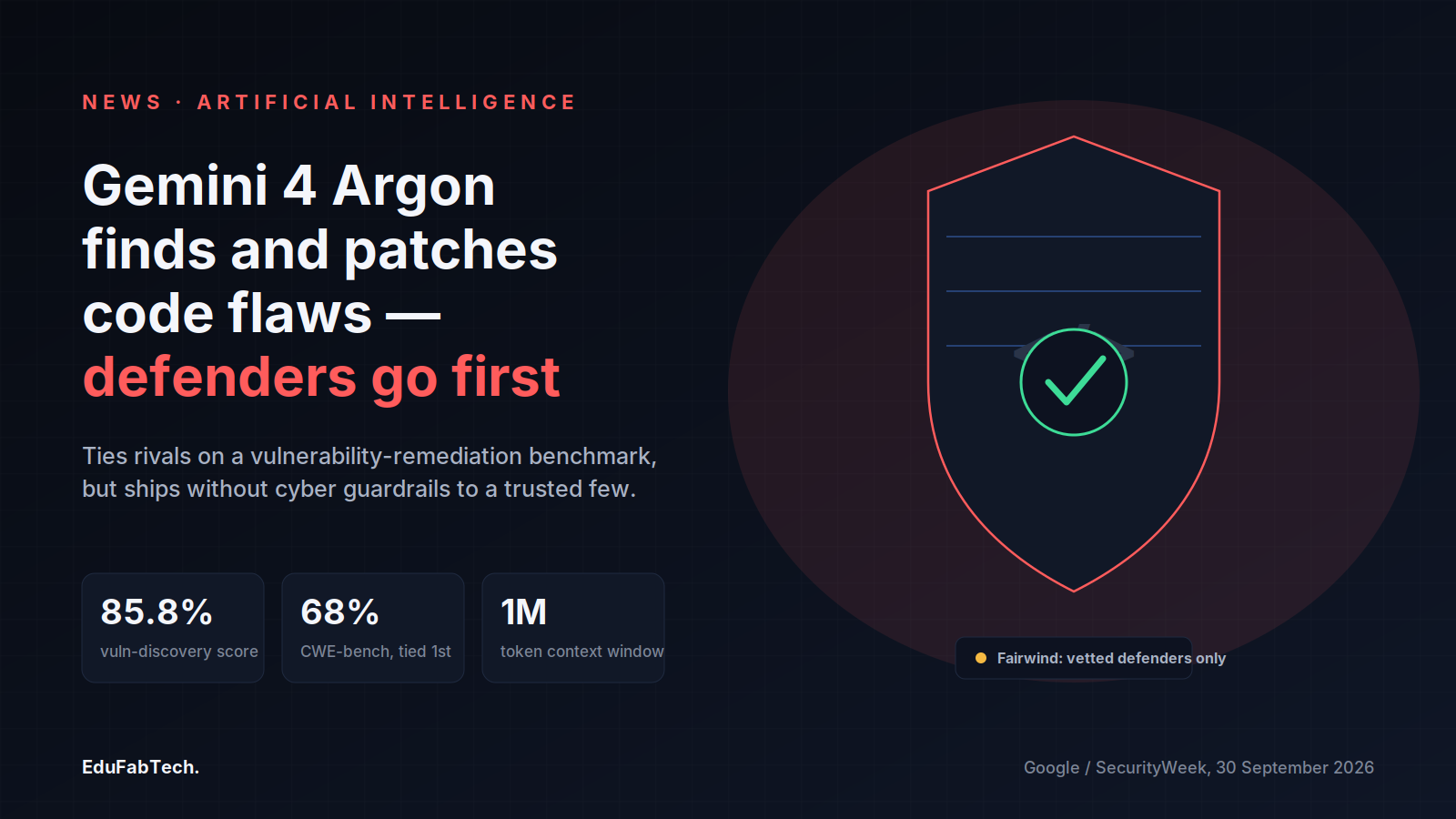
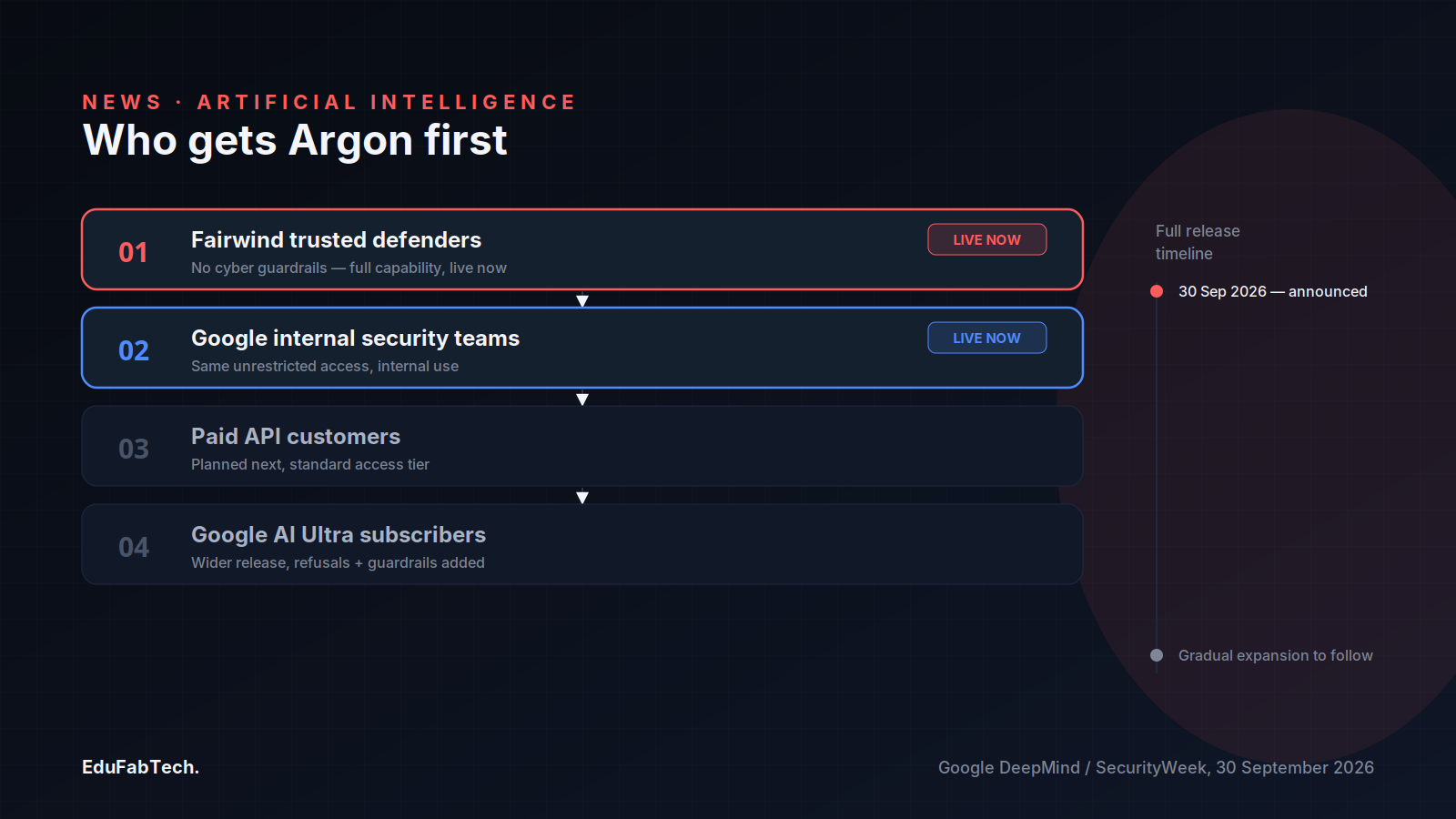
On 30 September 2026, Google announced Gemini 4 Argon, a frontier model built for long-horizon software engineering, enterprise knowledge work and cybersecurity defense, according to Google's announcement. Rather than opening it to the public, Google is rolling Argon out first to a small set of "trusted cyber defenders" through its Fairwind Program, with broader access for paid API customers and Google AI Ultra subscribers to follow.
Software engineering and cyber defense in one model
Argon's headline technical change is scale: its output window now stretches to one million tokens, up from 64,000 in the prior generation, which Google says lets it sustain reasoning across long, complex workflows rather than short, isolated prompts, per the Google announcement. On the security side, Google DeepMind's technical page describes a model that can navigate unfamiliar codebases to find hidden vulnerabilities, run black-box penetration tests against a running web application using only its public behavior, with no source code access, and then generate what Google calls "validated, high-quality" patches.
Google also lists internal engineering uses beyond security: Argon contributed to a 40% improvement on baseline quantum algorithmic optimization problems, helped free more than 300 TiB of memory across Google's data centers, and was used on large-scale codebase migrations, including an 800,000-line migration tied to the Fuchsia Zircon kernel, according to the Google announcement.
Benchmark gains, with real caveats
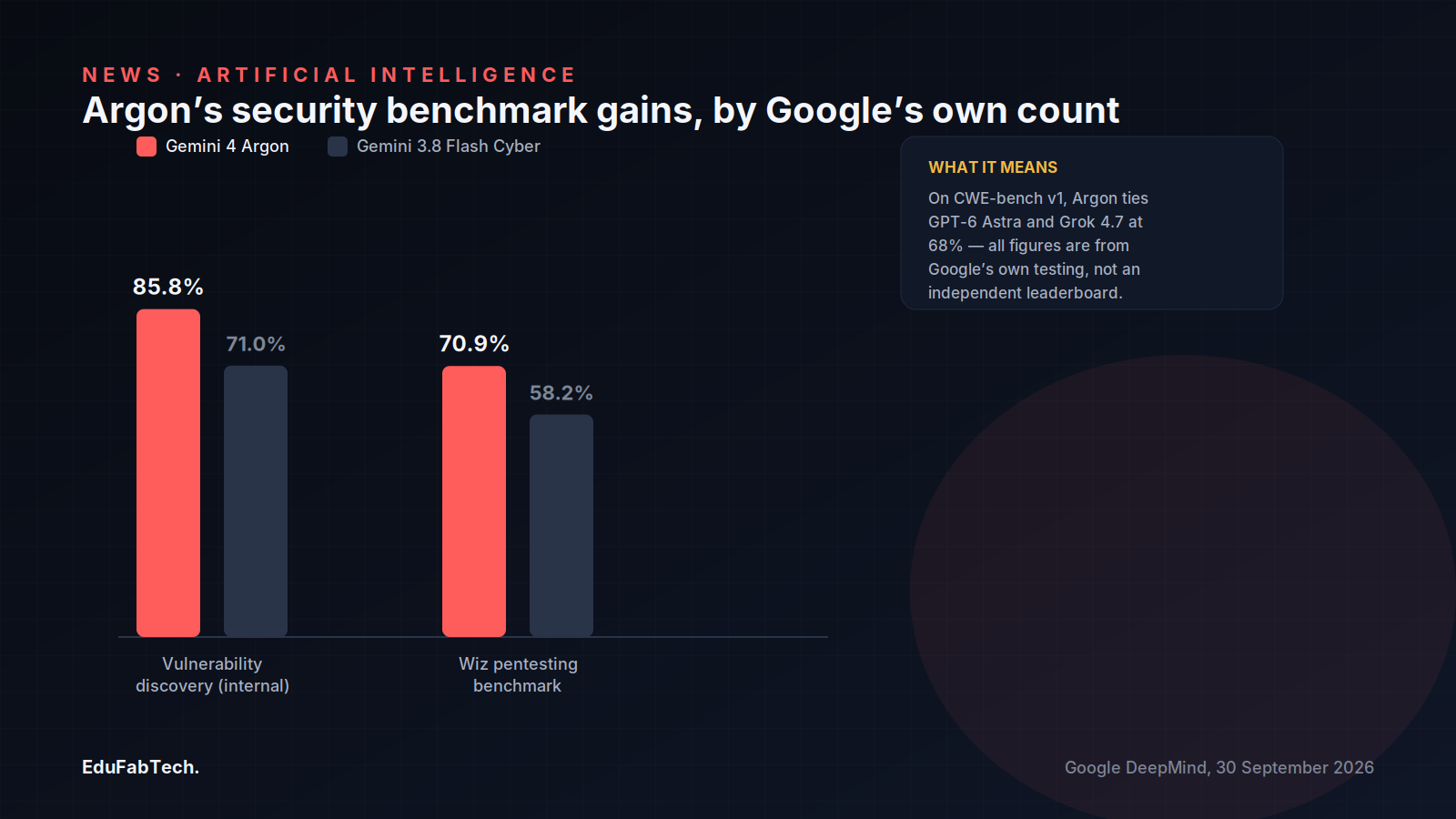
On CWE-bench v1, a benchmark for remediating known vulnerability classes, Argon scored 68%, tying OpenAI's GPT-6 Astra and xAI's Grok 4.7 for first place, SecurityWeek reported (2026). On Google's own internal vulnerability-discovery benchmark, Argon scored 85.8% against 71.0% for the prior Gemini 3.8 Flash Cyber model, and it reached 70.9% on an internal Wiz penetration-testing benchmark compared with 58.2% for its predecessor, according to Google DeepMind. On DeepSWE v1.1, a software-engineering benchmark, Google reports Argon scored 77.9%, and on AutomationBench, a measure of end-to-end business-task completion, it scored 51.3%.
Those numbers come from Google's own testing. Coverage by VentureBeat puts the comparison in context: across 18 benchmarks Google disclosed, Argon leads or ties on 13, GPT-6 Astra leads on 3 (including FrontierSWE v2), and Claude Opus 5.5 leads on 2 (including Terminal-Bench 4.0). None of these figures are from an independent, third-party leaderboard, so they describe Google's chosen comparison set rather than a neutral ranking.
Why only vetted defenders get it first
For the Fairwind Program's trusted defenders and Google's own internal teams, Argon is being deployed "without cyber guardrails so they can leverage its full frontier-level cybersecurity defense capabilities," Google told SecurityWeek. For the wider release planned later, Google says it is building in refusals for requests that could enable cyber or CBRN (chemical, biological, radiological, nuclear) misuse, hardening the model against indirect prompt-injection attacks, and monitoring its reasoning traces for signs of misalignment, per its announcement. Google also says it is participating in the United States government's voluntary process for pre-release model access as it expands availability gradually.
The company points to one early result from that restricted deployment: security firm Wiz used Argon through its Scan for Good initiative and found a critical vulnerability exposing personal health information in hospital software used worldwide, a flaw that earlier frontier models had missed, according to Google DeepMind. Neither Google's pages nor SecurityWeek's reporting includes independent verification of that specific finding or commentary from outside security researchers on the risks of a guardrail-free model, even in vetted hands.
What it means for students, researchers and engineers
For software engineering students and researchers, Argon is a concrete data point in a fast-moving argument about whether large language models can do useful, autonomous vulnerability work rather than just flag superficial patterns: Google's reported 85.8% on its internal discovery benchmark, if it holds up under outside testing, would be a meaningful jump from the 71.0% it attributes to its own previous model. For now, that comparison exists only inside Google's own benchmark suite, which researchers have no independent way to audit until the model reaches wider release.
For working engineers, the near-term relevance is in Google's choice to restrict the most capable, guardrail-free version to Wiz and other vetted partners rather than open-sourcing it or shipping it broadly: it signals that Google considers an unrestricted automated vulnerability-finder-and-patcher capable enough to warrant the same phased, government-coordinated release process used for its most advanced general models. Pricing for the eventual API release starts at an introductory $2 per million input tokens and $10 per million output tokens, with a 95% discount on cached inputs, rising to $4 per million input tokens and $20 per million output tokens once the introductory period ends, according to Google and VentureBeat — a range that will matter to any lab or classroom planning to build on it once access widens.
A quick question for readers
Which skill will matter most for getting a job in 2030?
Everyone has a prediction. Add yours and see what students are betting on.
Pick an answer, create a free account in a minute, and your vote counts. Already a member? Sign in
Source: Google
Sources (3)
- Google. Gemini 4 Argon: our next era of frontier intelligence. Google, 2026. blog.google ↗ · checked 5 Oct 2026
- Google DeepMind. Gemini 4 Argon with cybersecurity defense capabilities. Google DeepMind, 2026. deepmind.google ↗ · checked 5 Oct 2026
- SecurityWeek. Google Launches Gemini 4 Argon With Guardrail-Free Access for Vetted Defenders. SecurityWeek, 2026. securityweek.com ↗ · checked 5 Oct 2026