ILO's 2026 Youth Employment Report Finds Unemployment Rising in Most of the World's Subregions
The International Labour Organization's latest tracking of youth labour markets found unemployment climbing in 105 countries between 2023 and 2025, with entry-level and middle-skill jobs hit hardest.
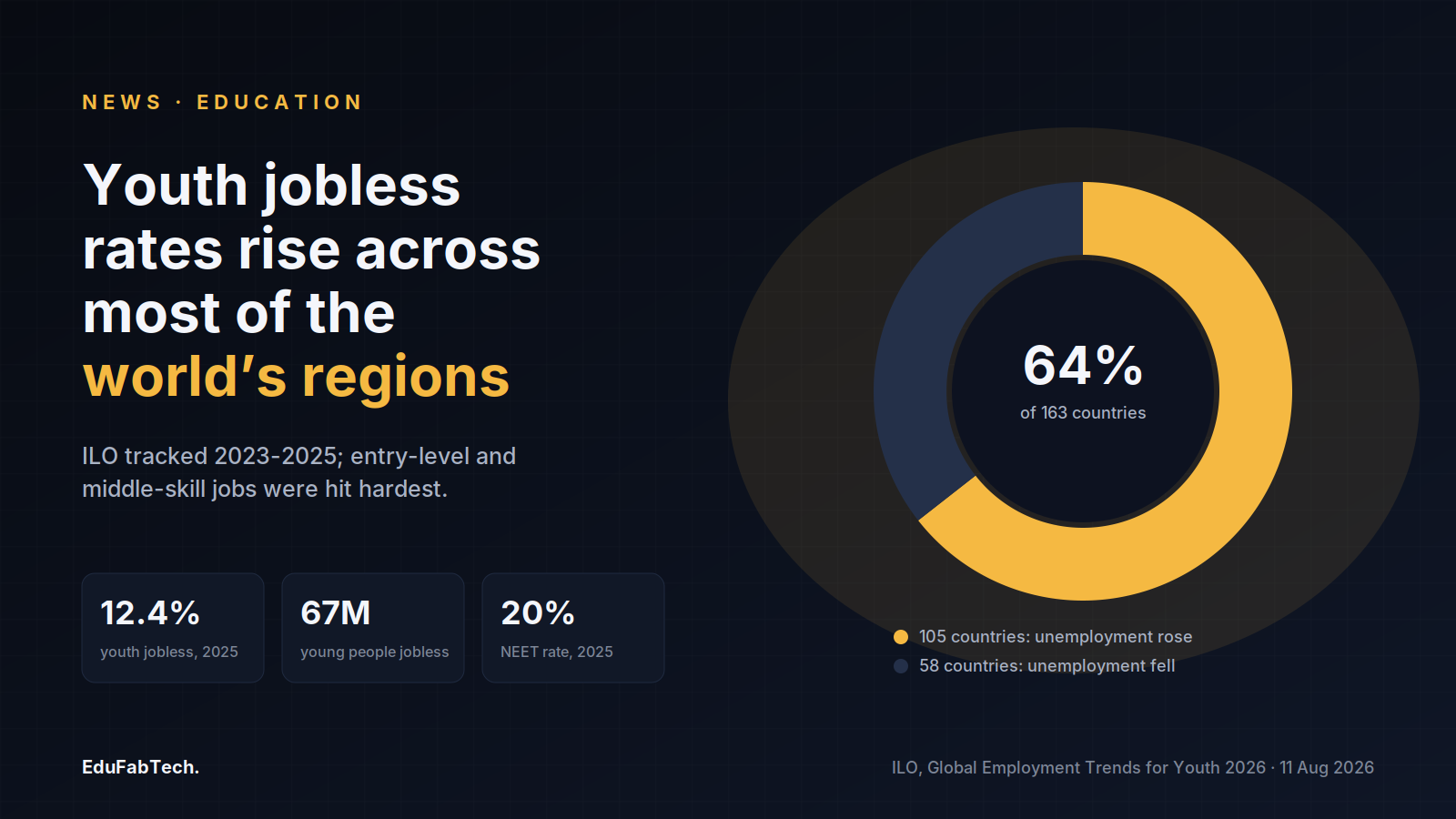
The International Labour Organization released Global Employment Trends for Youth 2026: Back to the future on 11 August 2026, and the headline number is a reversal: the global youth unemployment rate rose from 12.3% in 2023 to 12.4% in 2025, equivalent to 67 million unemployed people aged 15 to 24. It is a small shift in percentage terms, but the ILO frames it as the end of the post-pandemic recovery in youth labour markets.
The report also tracks a wider measure: the share of young people not in employment, education or training, known as NEET. That figure rose to 20% in 2025, up from 19.7% in 2023, and now covers roughly 257 million people worldwide — a group that is neither working nor building qualifications through study or training.
What makes this edition notable is its geographic spread. Between 2023 and 2025, youth unemployment increased in 105 countries and fell in only 58, according to the ILO, and worsened or stagnated in eight of the world's eleven subregions. The deterioration is not confined to low-income economies: some of the sharpest increases were recorded in higher-income countries where young people are, on paper, better qualified than any previous generation.
Where the numbers move the most
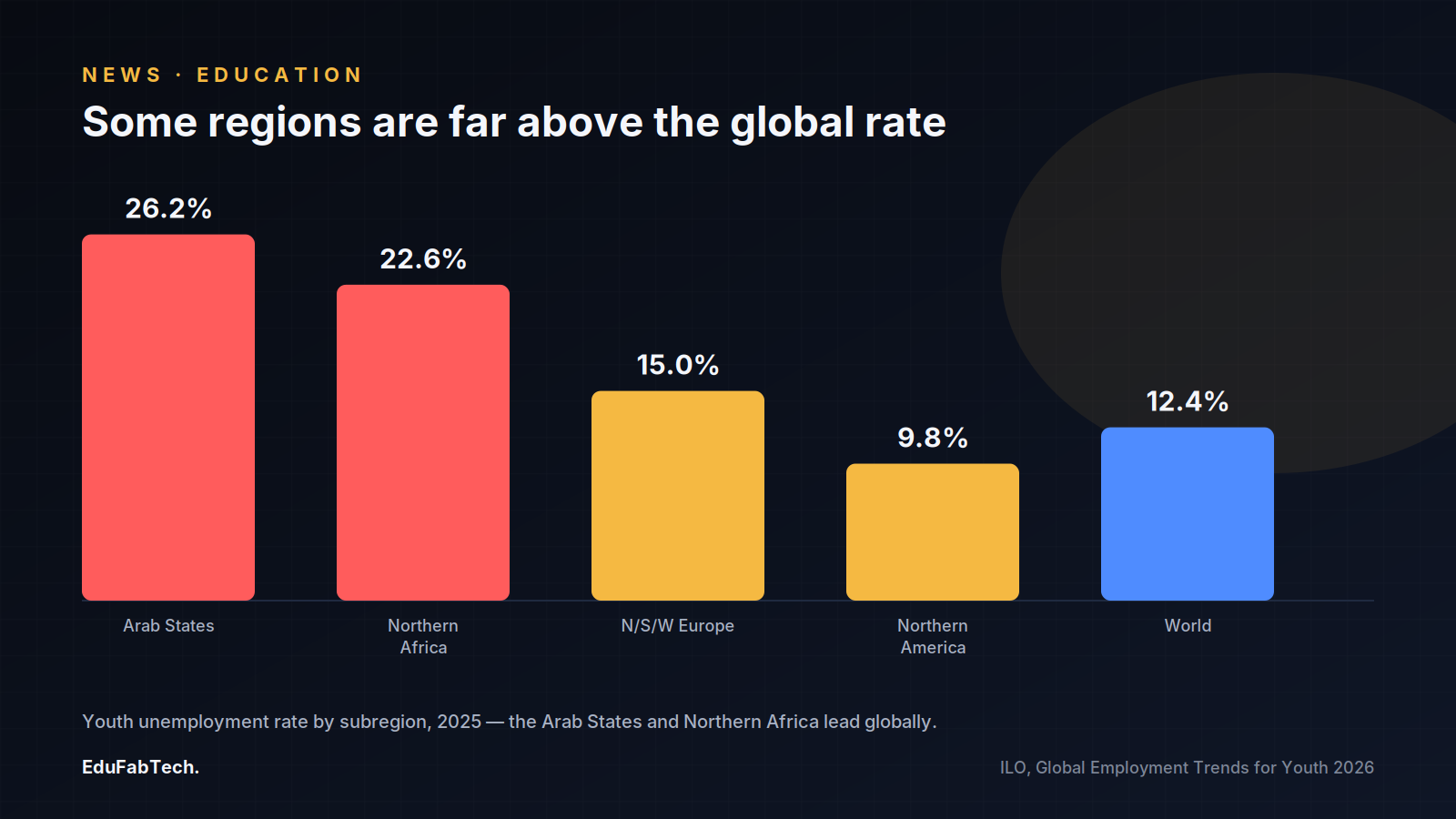
Regional rates still vary enormously. The Arab States recorded the highest youth unemployment rate in the report, at 26.2% in 2025, followed by Northern Africa at 22.6%. Northern, Southern and Western Europe combined sat at 15%, with the ILO noting that 20 of the 29 countries in that subregion reported weaker job opportunities for young people than two years earlier. Northern America saw one of the steepest relative increases, climbing from 8.3% in 2023 to 9.8% in 2025.
| Region | Youth unemployment rate, 2025 | Change since 2023 |
|---|---|---|
| Arab States | 26.2% | Among the highest globally |
| Northern Africa | 22.6% | Among the highest globally |
| Northern, Southern & Western Europe | 15% | 20 of 29 countries weaker than 2023 |
| Northern America | 9.8% | Up from 8.3% in 2023 |
The report also flags a divide in job quality rather than just job counts. In low- and lower-middle-income countries, the ILO estimates that nearly nine in ten young workers aged 15 to 29 are in informal employment — work without a contract, social insurance or reliable pay, as reported in Down To Earth's coverage of the report. In wealthier economies, the problem is less about informality and more about a shrinking supply of the entry-level roles young people traditionally used to gain their first foothold in a career.
The skills and education angle
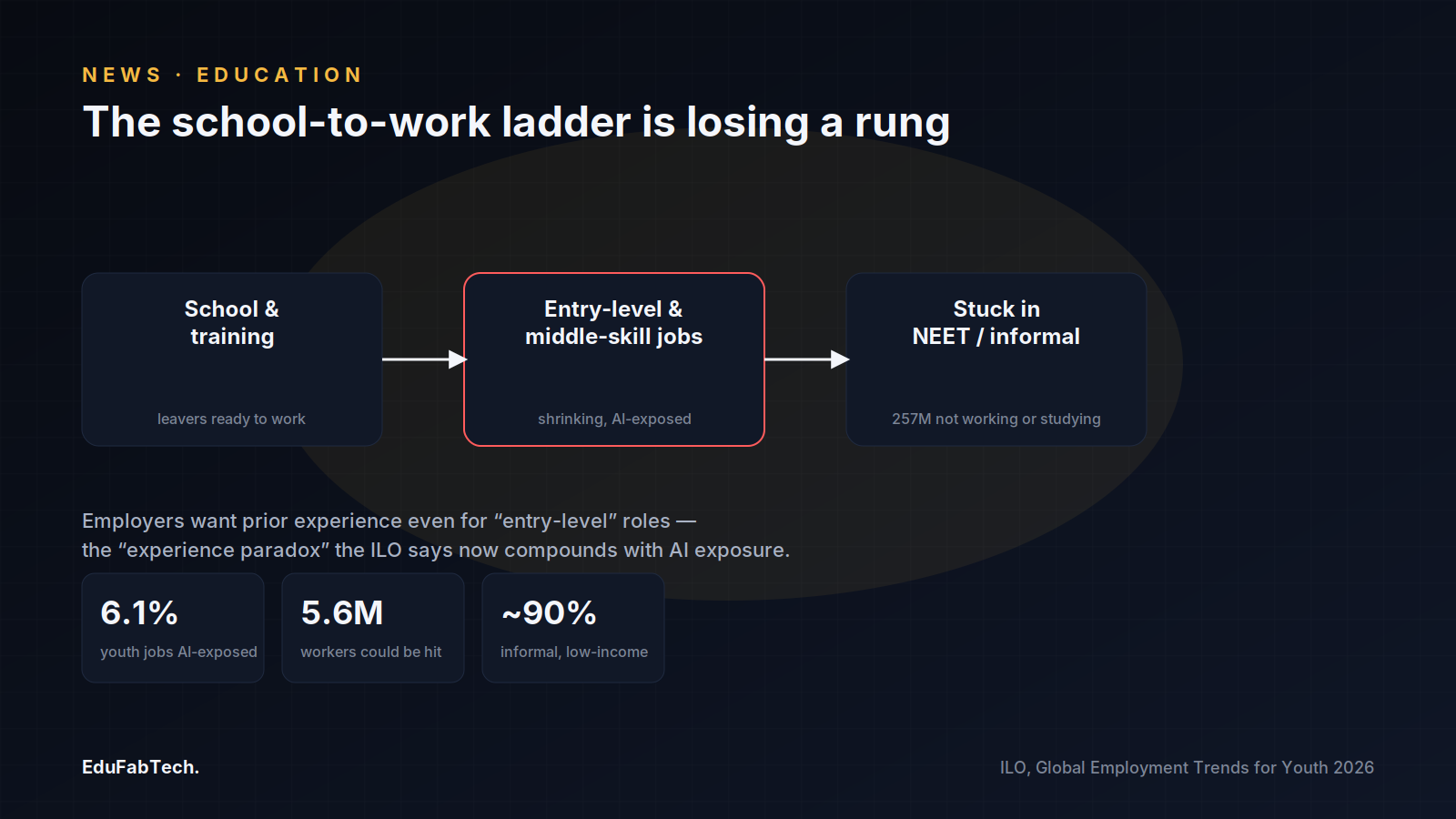
The ILO singles out the erosion of middle-skilled work — clerical, administrative, sales and manufacturing roles — as a structural problem rather than a cyclical one. These jobs have historically absorbed school and vocational-training leavers who are not yet ready for highly specialised positions. As they shrink, the report argues, the labour market loses a rung on the ladder that used to connect education systems to stable employment, leaving graduates competing for a narrower band of entry points.
Compounding this is what the ILO calls an "experience paradox": employers increasingly ask for prior experience even in roles labelled entry-level, a demand that recent graduates and school leavers by definition cannot meet. The report links this pattern to weaker hiring by employers who, facing slower economic growth, prefer to bring in workers who need no training investment.
Artificial intelligence adds a newer pressure
The 2026 edition is the first in the series to quantify AI exposure directly. It finds that 6.1% of jobs held by people aged 15 to 29 are in occupations highly exposed to AI-driven task replacement. The ILO's own modelling suggests that if just 10% of those exposed jobs were automated away, around 5.6 million young workers could be affected — a scenario the report treats as a plausible near-term risk rather than a prediction.
"A generation that cannot find decent work cannot build its future with confidence," said ILO Director-General Gilbert F. Houngbo, adding that investment in youth employment is "one of the smartest investments a country can make."
The report does not treat AI exposure as evenly distributed: it lands disproportionately on the same administrative, clerical and routine-cognitive tasks that already make up the shrinking pool of middle-skilled jobs, meaning the two trends compound rather than offset each other.
What the ILO recommends
The report's policy chapter focuses on three areas rather than a single fix:
- Active labour market policies, including subsidised training and apprenticeship schemes targeted at young people rather than the workforce generally.
- Reskilling programmes aimed specifically at occupations exposed to AI-driven automation, rather than generic digital-literacy training.
- Stronger social protection coverage for young workers in informal employment, who currently fall outside most unemployment insurance and training subsidy schemes.
The ILO forecasts that global youth unemployment will roughly flatline near 12.3% through 2026 and 2027 rather than continue rising sharply — a plateau, not a recovery. For education and training systems, the report's underlying argument is that the school-to-work transition itself has become longer and less predictable across a majority of the economies it tracks, regardless of how those systems are structured nationally.
- International Labour Organization. Global Employment Trends for Youth 2026: Back to the future. International Labour Organization, 2026. link
- International Labour Organization. Youth unemployment rises as young people face a harder road to decent work. International Labour Organization, 2026. link
- UN News. After post-pandemic improvement, youth unemployment is rising again. United Nations, 2026. link
- Down To Earth. Global youth jobs in jeopardy as unemployment rises and middle-skilled work shrinks: ILO. Down To Earth, 2026. link