US Appeals Court Rules AI Code Generation Does Not Violate Copyright Management Law
The Ninth Circuit's first appellate ruling on generative AI and the DMCA found that Copilot and Codex produce new works rather than stripping attribution from old ones, though separate contract claims survive.
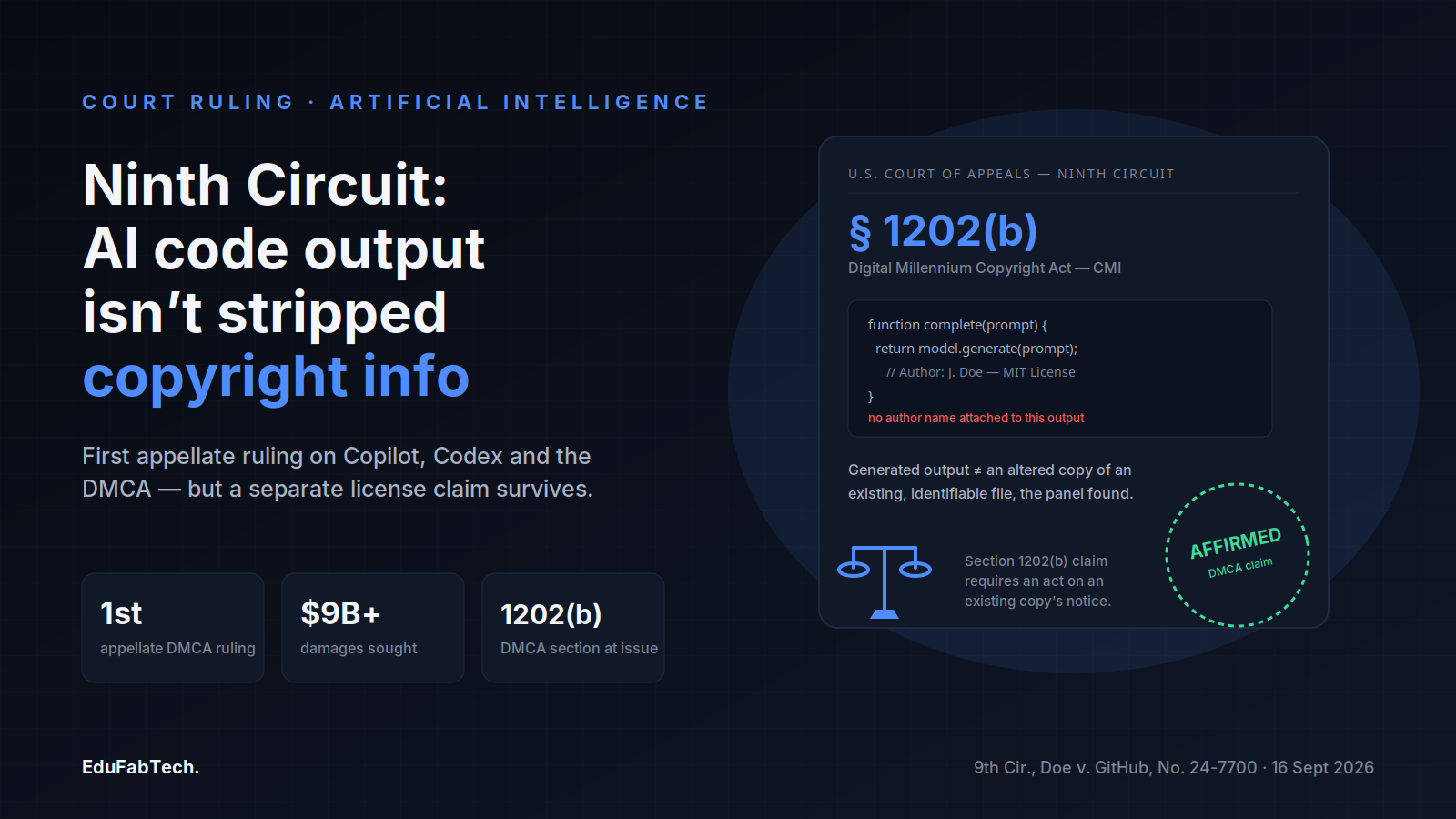
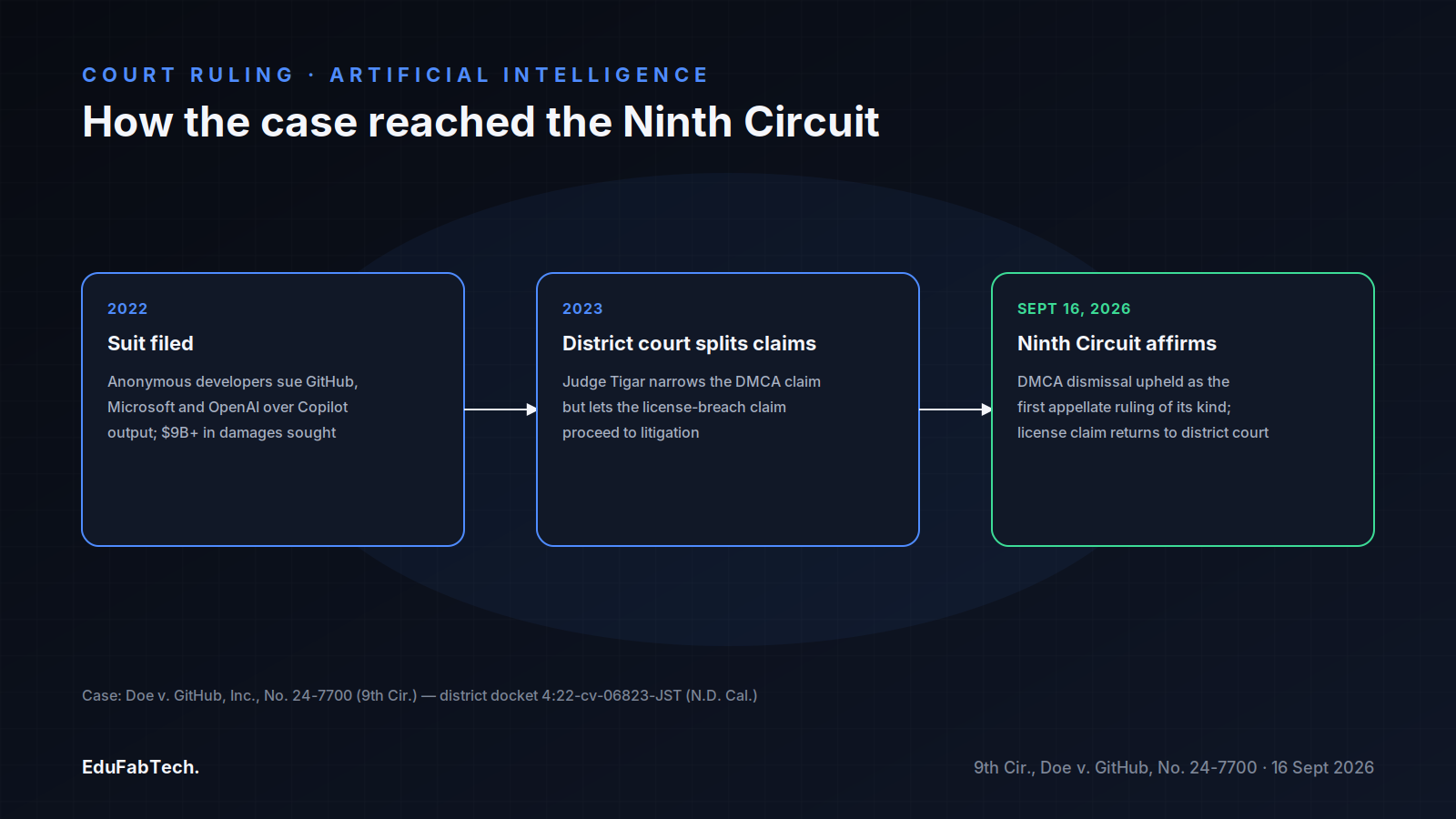
On September 16, 2026, a three-judge panel of the United States Court of Appeals for the Ninth Circuit affirmed the dismissal of copyright management information claims brought by a group of anonymous programmers against GitHub, Microsoft and OpenAI over the output of GitHub Copilot and OpenAI Codex. The decision in Doe v. GitHub, Inc., No. 24-7700, is the first published appellate ruling in the United States to address whether the Digital Millennium Copyright Act applies to code generated by an AI model trained on copyrighted work.
What the court decided
The case turned on Section 1202(b) of the DMCA, a provision written for a pre-AI internet: it bars removing or altering "copyright management information" (CMI) — author names, license terms, notices — from an existing work, or distributing a work knowing that CMI has been stripped from it. The plaintiffs, developers whose code sat in Copilot's training set, argued that when Copilot generates a snippet resembling their code but without their name or license, it has effectively removed that CMI.
The panel rejected that theory for the claims before it. According to Gibson Dunn's summary of the opinion, the court held that Section 1202(b) requires an affirmative act directed at CMI attached to an existing, identifiable copy — and that "simply alleging that a similar or derivative work lacks the original's author or licensing information does not establish that the information was removed or altered." Because Copilot's output is generated probabilistically rather than copied wholesale from a stored file, the court found it closer to producing a new work than to stripping a notice off an old one.
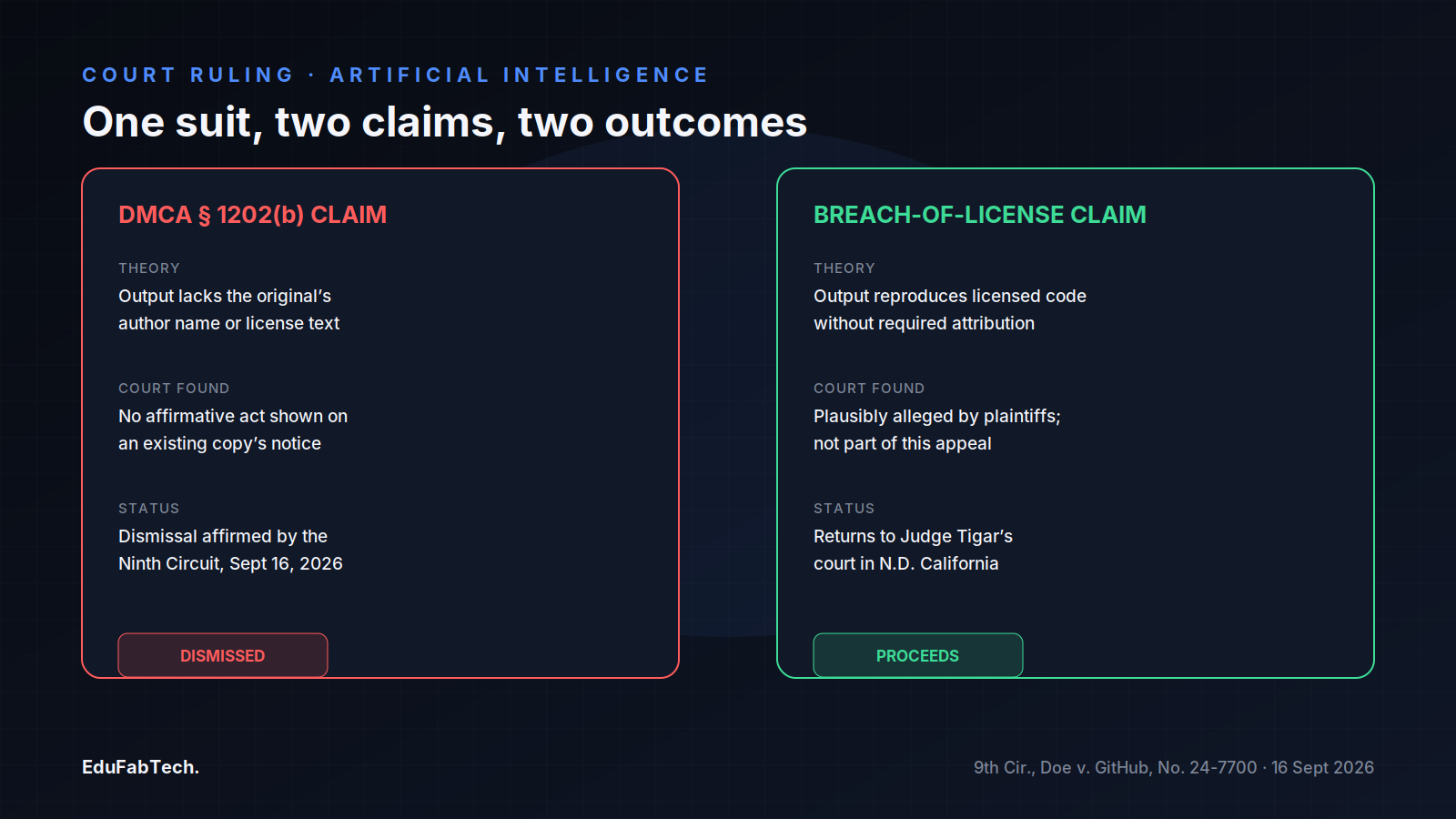
The court also drew a line between two ways such a claim could be framed: an input-based theory, challenging removal of CMI when code was ingested into the training pipeline, and an output-based theory, challenging the absence of CMI in what the model produces. Only the output-based version was properly before the panel, since, per Gibson Dunn's account, the plaintiffs had not preserved the training-stage argument at the district court. On the theory it did reach, the panel wrote that it would "decline plaintiffs' invitation to transform run-of-the-mill copyright-infringement claims into DMCA claims," a phrase Courthouse News quotes directly from the opinion.
Why it does not end the case
The ruling does not clear GitHub, Microsoft or OpenAI of the underlying dispute. The district court, presided over by Judge Jon S. Tigar in the Northern District of California under docket 4:22-cv-06823-JST, had already allowed a separate breach-of-license claim to proceed, finding the plaintiffs plausibly alleged that Copilot can reproduce licensed code as output without the attribution, copyright notice or license terms those licenses require. That claim was not part of this appeal and now returns to the district court, according to reporting from PPC Land, which also reports that the original 2022 putative class action had sought more than $9 billion in statutory damages, a figure built on the DMCA's per-violation penalty structure rather than the lower per-work cap that applies to ordinary infringement claims.
The panel — Circuit Judge Eric Miller, Senior Circuit Judge Sidney Thomas, and District Judge Stanley Blumenfeld Jr. sitting by designation — was careful to note that the ruling does not immunize substantial copying. The opinion states, as summarized by Gibson Dunn, that "minor cosmetic changes do not necessarily protect a defendant who substantially reproduces a protected work and removes its CMI," meaning a claim combining near-verbatim reproduction with stripped CMI could still survive on different facts. What the plaintiffs could not do here was treat any output lacking attribution as automatic evidence of removal.
Why this matters beyond one lawsuit
Section 1202 claims have become a recurring line of attack in US litigation against AI companies precisely because they carry statutory damages that do not require proving actual market harm, unlike ordinary copyright infringement. A ruling narrowing that theory for code-generation tools removes one of the more aggressive legal levers available to plaintiffs suing AI vendors, without resolving the broader question — still open in cases including the New York Times' suit against OpenAI — of whether training a model on copyrighted material is fair use in the first place. That question remains pending before Judge Sidney H. Stein in the Southern District of New York on cross-motions for summary judgment, per PPC Land's reporting.
For engineering teams, the practical effect is narrower than the headline suggests: it addresses one specific legal theory about AI code generation, not the legality of training on public repositories generally, and not whether a given license (MIT, GPL, Apache, or otherwise) is being respected when a model's output closely tracks a specific file. Organizations relying on Copilot, Codex or similar tools should note that the surviving breach-of-license claim is the one most directly relevant to how these tools are used in practice — it concerns whether generated code that resembles a licensed original carries forward the obligations that license imposes, which is a contract and licensing question the DMCA ruling explicitly leaves untouched.
The plaintiffs can still seek rehearing en banc or petition the US Supreme Court, though PPC Land's reporting cites legal commentary suggesting neither route is considered likely to succeed. Absent that, the case now moves back to Judge Tigar's court to litigate the license-based claims that the Ninth Circuit left standing.
- Ninth Circuit Court of Appeals. Doe v. GitHub, Inc., No. 24-7700. United States Court of Appeals for the Ninth Circuit, 2026. link
- Kate Bueker et al.. Ninth Circuit Clarifies Limits of DMCA Liability for AI-Generated Code. Gibson Dunn, 2026. link
- Courthouse News Service. Coders lose appeal in copyright fight against AI tools. Courthouse News Service, 2026. link
- PPC Land. GitHub and OpenAI win Ninth Circuit appeal over $9bn Copilot code claim. PPC Land, 2026. link