OECD Finds Micro-Credential Systems Still Fragmented Across Four Pilot Countries
A 1 October 2026 OECD review of Australia, Estonia, Finland and Ireland finds short, skills-focused credentials still lack shared definitions, consistent quality checks and reliable employer recognition.
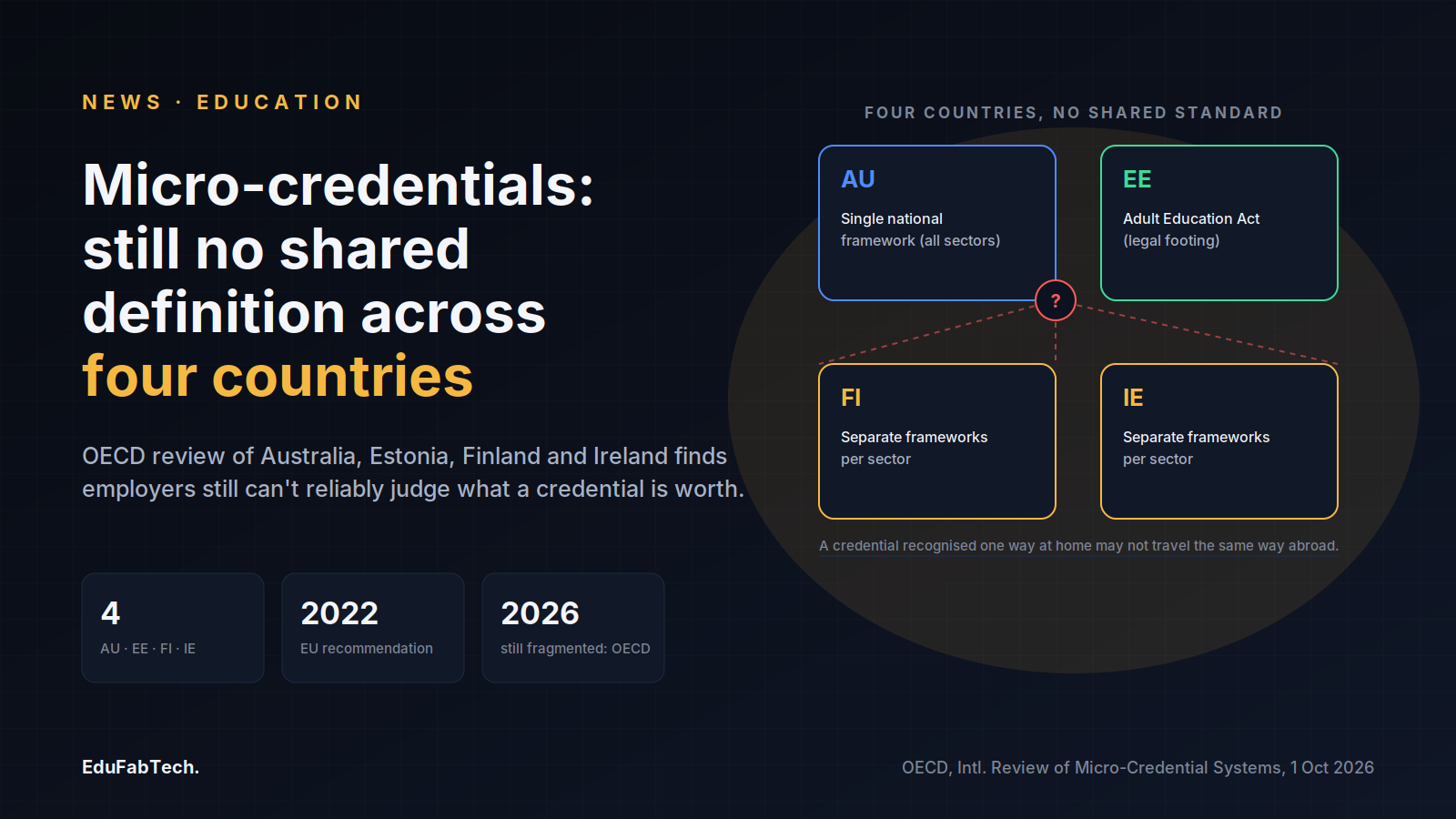
The OECD published a review on 1 October 2026 comparing how four of its member countries — Australia, Estonia, Finland and Ireland — regulate micro-credentials, the short, skills-focused courses that governments have promoted as a faster alternative to full degrees. The report, International Review of Micro-Credential Systems: From Fragmentation to Alignment, concludes that even within this small group of OECD countries, the systems built to define, quality-check and recognise these credentials remain incompatible with each other.
Micro-credentials have spread quickly because they let adults add a narrow, verified skill without re-enrolling in a full qualification. But the OECD review finds that this growth has mostly happened sector by sector and country by country, leaving "the co-existence of multiple frameworks and definitions (or a lack thereof), inadequate quality assurance systems, limited uptake of courses and weak links between provision and labour market needs," according to the report. The result, the OECD argues, is that learners struggle to know what a credential is actually worth and employers struggle to judge it at all.
The findings come from stakeholder interviews and consultations conducted directly with the four governments, which the OECD treats as a representative cross-section of how early movers are tackling the problem rather than as a survey of all OECD countries.
Four countries, four different starting points
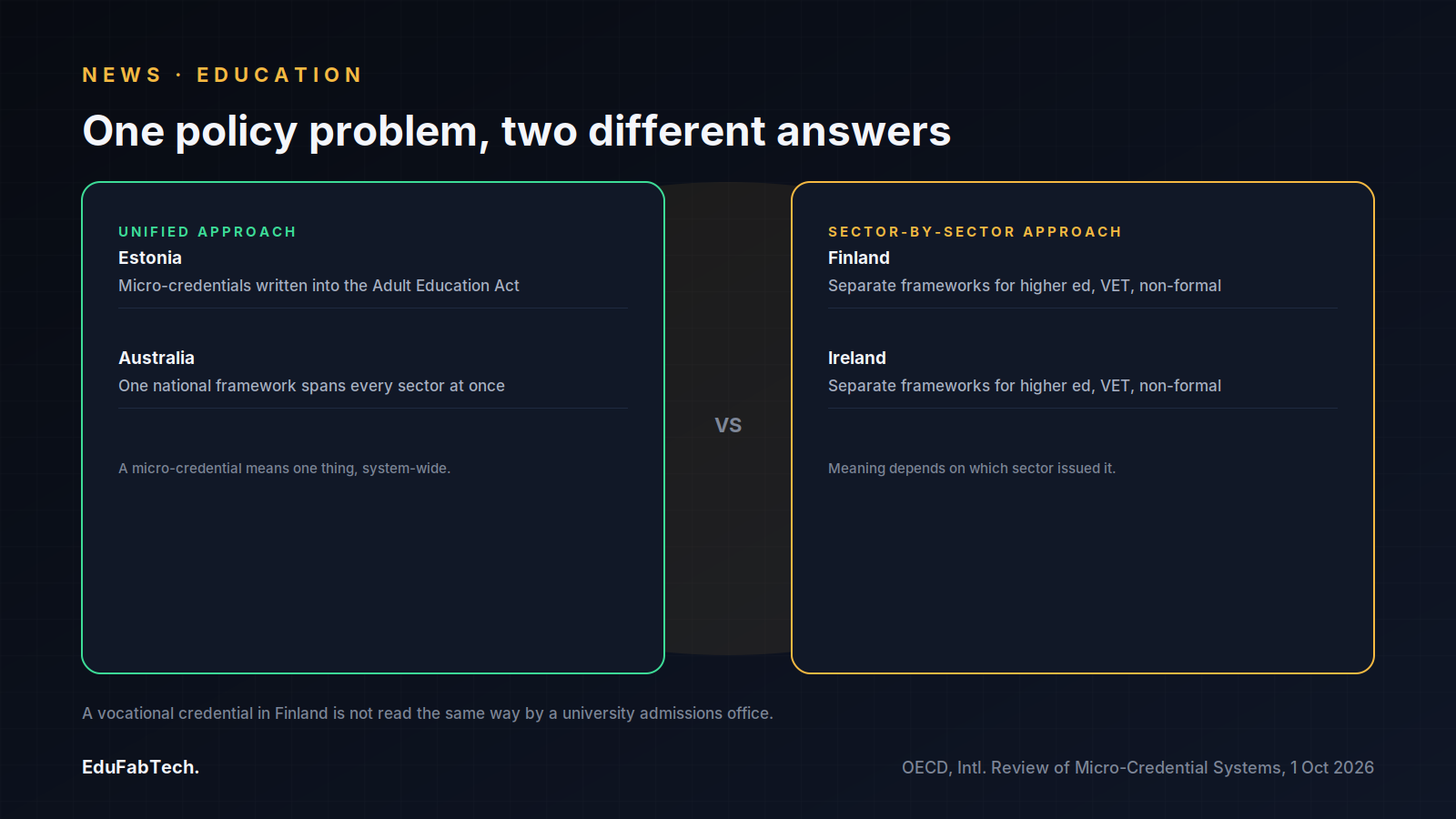
The clearest divide in the review is how each country has chosen to anchor micro-credentials in law or policy. Estonia has embedded them directly into its Adult Education Act, giving them the same legal footing as other recognised qualifications. Australia has gone further still, building a single national framework that applies across every education and training sector at once. Finland and Ireland have taken a narrower route, running separate, sector-specific frameworks for higher education, vocational training and non-formal learning rather than one unified structure.
That split matters for learners who move between sectors. A worker who completes a vocationally awarded micro-credential in Finland cannot assume it will be read the same way by a university admissions office, because the two sit inside different rulebooks. The OECD's point is not that one model is correct, but that the absence of a shared minimum — what a credential must specify about learning outcomes, credit value, assessment and provider eligibility — is what keeps the field fragmented even among committed early adopters.
Trust depends on who checks the provider
Quality assurance is handled unevenly even between the two countries the OECD treats as furthest along. Ireland and Estonia both apply their standard institution-level quality assurance process to universities and colleges that already have degree-awarding powers, which lets them fold micro-credentials into existing oversight. Estonia goes a step further by running a separate quality assurance track specifically for non-formal providers — technical schools, private trainers and public training centres — which the OECD review flags as important precisely because many adult learners seek training from these providers rather than from universities.
Micro-credentials that use results from skills assessment and anticipation exercises, and/or that are co-developed and endorsed by industry have a higher credibility and uptake in the labour market, the OECD review states.
That link to employer involvement is the report's core argument for why some credentials catch on and others do not: a short course designed with input from the industry it serves carries weight with hiring managers in a way that a course designed in isolation does not.
A regional attempt at a common standard, and its limits
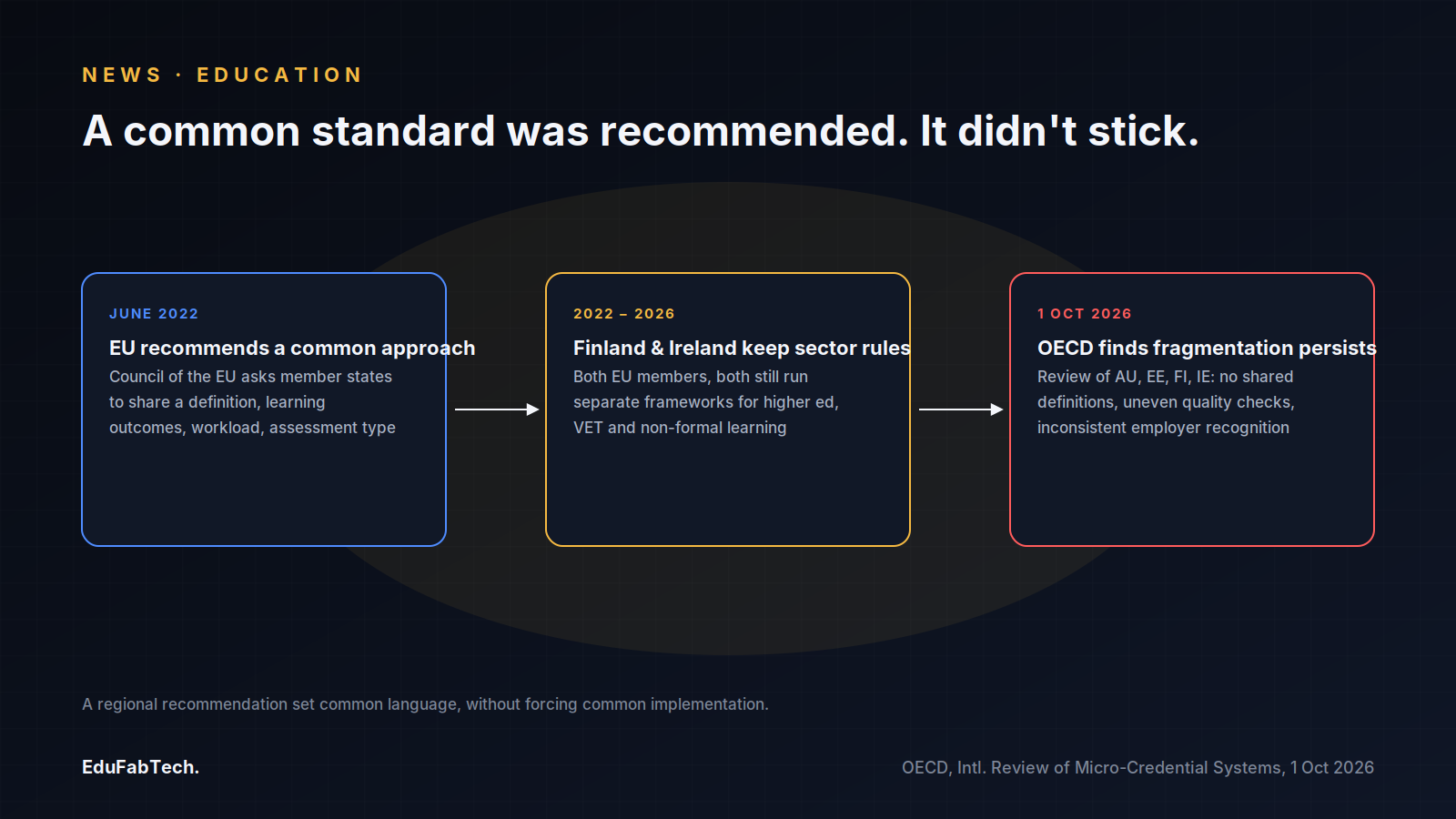
The fragmentation the OECD describes persists despite an earlier attempt to solve exactly this problem at a larger scale. In June 2022, the Council of the European Union recommended a common European approach to micro-credentials, asking member states to adopt a shared EU definition and standard elements — learning outcomes, workload and assessment type — so that a credential earned in one member state could be read consistently in another. Finland and Ireland are both EU members operating under that 2022 recommendation, yet the 2026 OECD review still finds them running separate frameworks by sector rather than one coherent national system. A regional recommendation, in other words, set common language without forcing common implementation.
Who is actually enrolling
The review's most direct warning for policymakers concerns who benefits. Early evidence reviewed by the OECD shows that participation in micro-credentials concentrates among people who are already highly skilled — the group best placed to identify, afford and complete a short course on their own initiative — rather than among workers most in need of reskilling. The report points to Ireland's Education and Training Boards as an example worth studying elsewhere, citing their outreach and financial-incentive work as a practical way to pull in learners who would not otherwise seek out a credential.
What it means for students and researchers
For students, the review is a reminder that a micro-credential's value is not fixed by the certificate itself but by whether the system that issued it defines, checks and publicises it in a way employers recognise — a Finnish vocational micro-credential and an Australian one are not guaranteed to be treated the same way by a hiring manager in a third country. For researchers studying skills policy, the comparison offers a rare like-for-like look at four governments solving the same problem on different legal foundations, which the OECD frames as a resource for countries now designing their own frameworks rather than a verdict on which model wins. The report does not estimate how many learners or employers are affected globally, since micro-credential provision outside its four case countries was not part of the review's scope.
A quick question for readers
Are group projects good for learning?
Loved by some, dreaded by many. What is your real experience?
Pick an answer, create a free account in a minute, and your vote counts. Already a member? Sign in
Source: OECD
Sources (2)
- OECD. International Review of Micro-Credential Systems: From Fragmentation to Alignment. OECD Publishing, 2026. oecd.org ↗ · checked 7 Oct 2026
- Council of the European Union. Council recommends a European approach to micro-credentials. Council of the EU, 2022. consilium.europa.eu ↗ · checked 7 Oct 2026