Nine-Paper PsychAD Collection Maps 6.3 Million Brain Cells Across Seven Disorders
A Mount Sinai-led consortium published a coordinated set of Nature-family papers on September 23, 2026, linking genetic risk to specific brain cell types across Alzheimer's, Parkinson's, schizophrenia and related conditions.
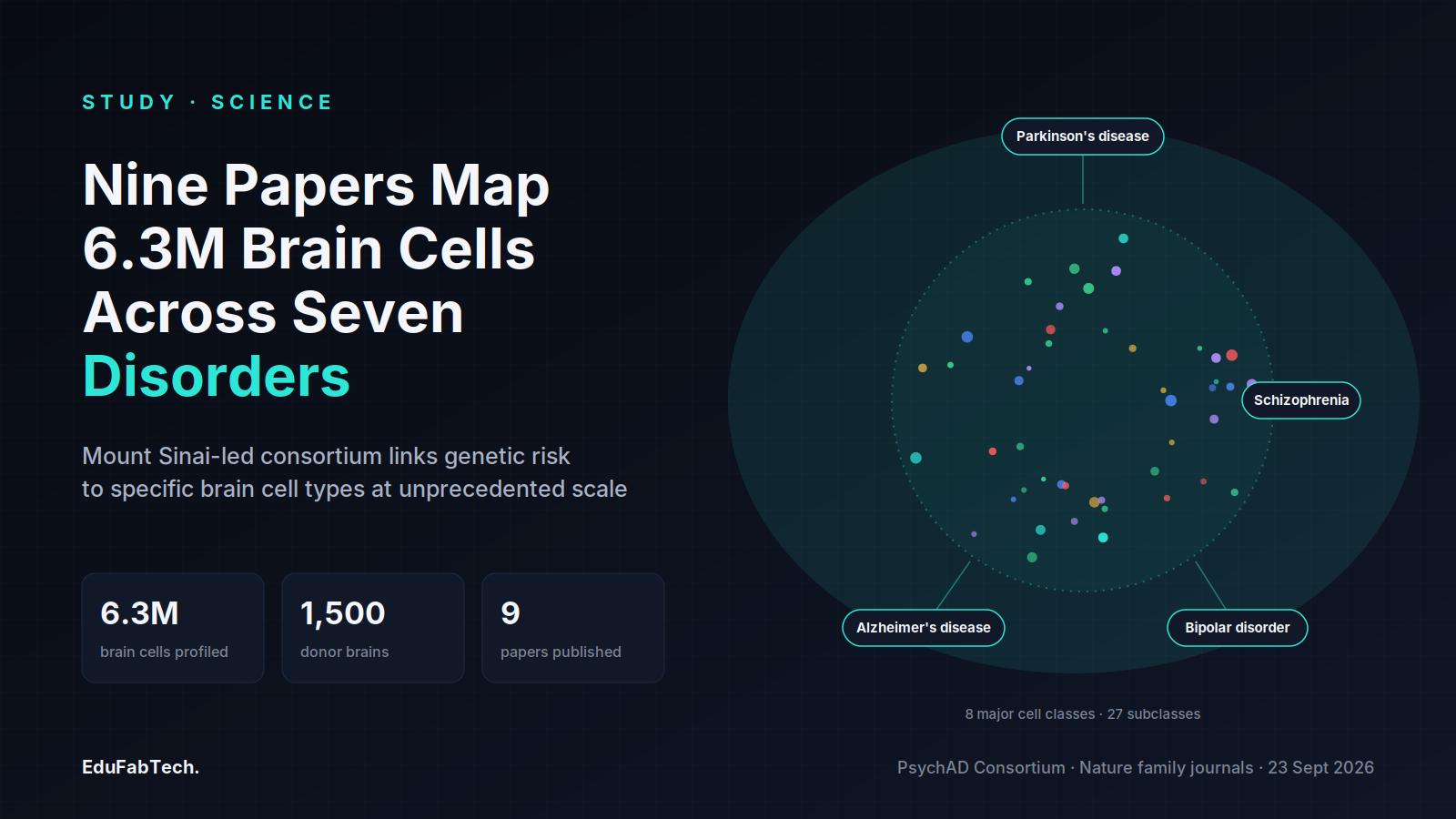
On September 23, 2026, a consortium led by researchers at the Icahn School of Medicine at Mount Sinai published a coordinated set of nine papers — three in Nature, three in Nature Communications, and one each in Nature Medicine, Nature Genetics and Scientific Data — built on a single shared resource: single-nucleus transcriptomes from more than 6.3 million brain cells drawn from nearly 1,500 donors. The project, called PsychAD, is funded primarily by the US National Institute on Aging, with contact principal investigator Panos Roussos.
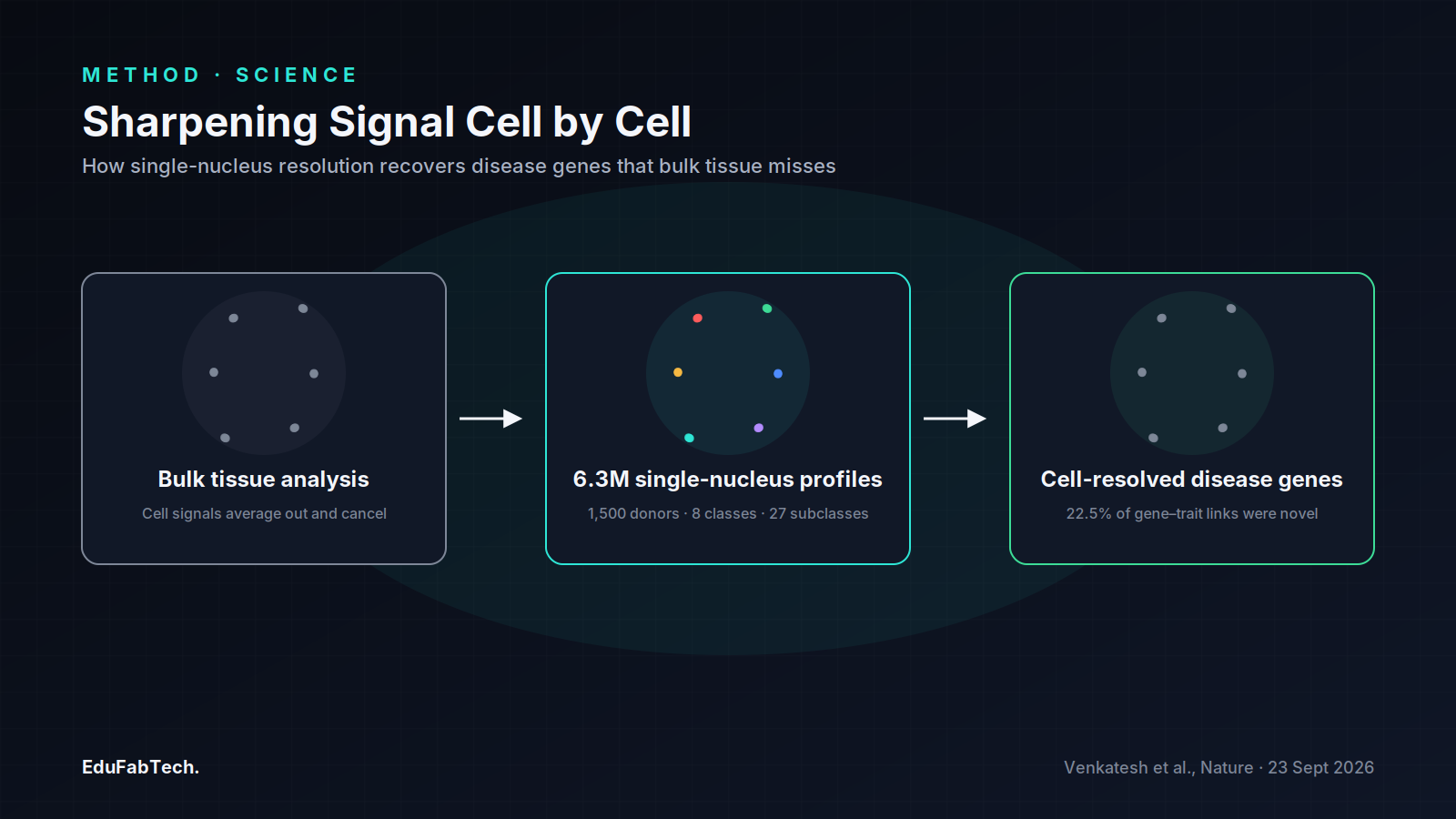
The aim was to move beyond studying one brain disorder at a time in bulk tissue, where signals from different cell types are averaged together and often cancel out. "No one has systematically examined how molecular mechanisms overlap across different brain disorders at this scale," Roussos said in the Mount Sinai announcement. The donor set includes people diagnosed with Alzheimer's disease, Parkinson's disease, Lewy body disease, vascular dementia, schizophrenia and bipolar disorder, alongside neurotypical controls.
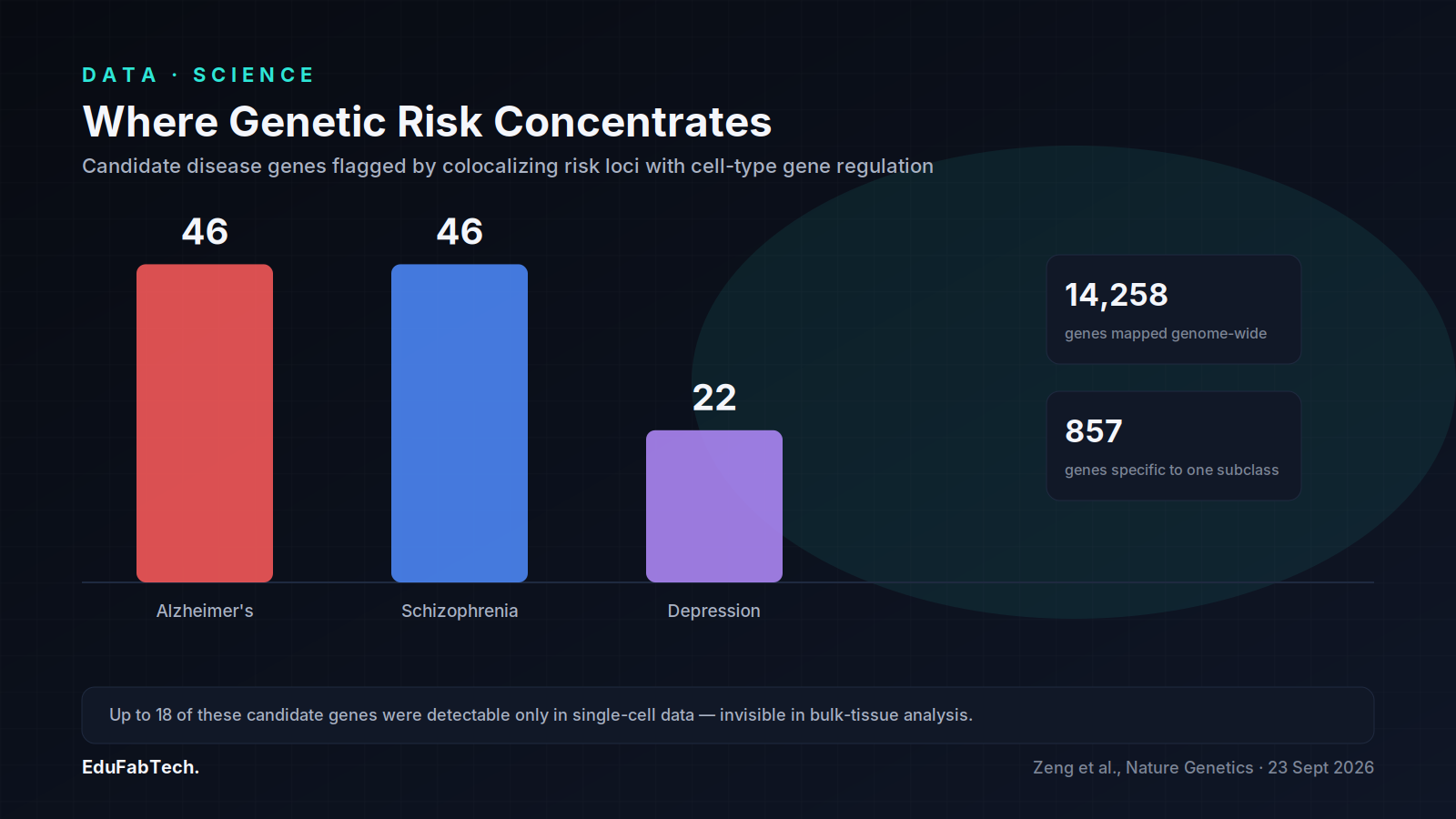
Two papers anchor the genetic side of the collection. In Nature Genetics, Zeng and colleagues profiled 5.6 million nuclei from 1,384 donors — 35.6% of non-European ancestry — sorting cells into 8 major classes and 27 subclasses. They mapped genetic regulation for 14,258 genes and found 981 genes with effects specific to a cell class and 857 specific to a finer subclass. Colocalization with disease risk loci flagged 46 candidate genes each for Alzheimer's disease and schizophrenia and 22 for major depressive disorder, of which up to 18 were detectable only in single-cell data and invisible in bulk tissue. Findings replicated in independent cohorts at rates of 66–95%.
Linking risk variants to specific cells across disorders
The companion Nature paper, led by Venkatesh and colleagues, used the same resource to build transcriptomic imputation models spanning 32 cell populations in the dorsolateral prefrontal cortex, covering 12,289 imputable genes in donors of European ancestry, 10,375 in African ancestry and 5,543 in admixed American ancestry. Applied across 12 neuropsychiatric and neurodegenerative disorders, the cell-resolved models recovered thousands of gene–trait associations that bulk-tissue analysis misses; 22.5% of the associations were novel. The team cross-validated results in the Million Veteran Program, a cohort of roughly 600,000 participants, and found that 76% of disorder pairs shared significantly overlapping gene–cell-type associations — evidence, the authors argue, for shared molecular pathways across conditions that are usually studied separately.
A third Nature paper, led by Lee and colleagues, used 1.3 million nuclei from 284 neurotypical donors to trace how the prefrontal cortex changes across the human lifespan. It reported non-linear, cell-type-specific trajectories — active remodeling in development, relative stability through midlife, and renewed transcriptional activity late in life — including a reprogramming of circadian clock genes in older adulthood. Kiran Girdhar, a co-author, said the team found that neuronal circadian rhythms largely disappear after age 60, even as new rhythmic activity emerges in microglia and oligodendrocytes.
What the consortium is not claiming
The published findings describe correlations between genetic variants, gene expression and disease status in specific cell populations — not proof that any single variant causes disease. The Nature Genetics paper notes that statistical power to detect regulatory effects depends heavily on how abundant a cell type is and how deeply it was sequenced, so rarer cell populations remain comparatively underpowered next to plentiful neuron types — excitatory neurons yielded 10,913 detectable regulatory genes against 414 for endothelial cells. The Nature transcriptome-wide study likewise flags that current single-nucleus protocols provide limited resolution on RNA isoforms and would benefit from more nuclei per donor and more donors overall.
An accompanying News & Views commentary in Nature, written independently of the consortium by Jennifer E. Below, describes the resource as potentially transformative for understanding brain aging and disease but stops short of independent validation, deferring the detailed evaluation to the primary papers themselves — a reminder that a resource of this scale needs years of follow-up use by outside labs before its practical value is settled.
Where this goes next
Mount Sinai says the consortium plans to expand the donor pool toward roughly 10,000 individuals and is already using the atlas to guide robotic drug-screening platforms aimed at cell types implicated in specific disorders. For now, the nine papers function as a shared reference dataset rather than a clinical result: no therapy, diagnostic test or biomarker has been validated from this release, and the authors' own caveats about statistical power and causation apply to every gene-level claim in the collection.
- Sanan Venkatesh, Roman Kosoy, Zhenyi Wu et al.. Single-nucleus transcriptome-wide association study of human brain disorders. Nature, 2026. doi:10.1038/s41586-026-10836-6
- Biao Zeng, Hui Yang, Prashant N. M. et al.. Single-nucleus atlas of cell-type specific genetic regulation in the human brain. Nature Genetics, 2026. doi:10.1038/s41588-026-02733-5
- Donghoon Lee et al.. Lifespan single-cell transcriptomic atlas of the human prefrontal cortex. Nature, 2026. doi:10.1038/s41586-026-10271-7
- Icahn School of Medicine at Mount Sinai. Nine Studies Led By Mount Sinai Investigators Featured in Coordinated Collection of Papers That Map the Molecular and Cellular Architecture of Brain Disorders. Mount Sinai Newsroom, 2026. link
- Jennifer E. Below. Vast cellular gene-expression atlas could transform how scientists understand brain ageing and disease. Nature (News & Views), 2026. doi:10.1038/d41586-026-02770-4