US House Passes Bill Forcing Large AI Data Centers to Pay Their Own Grid Costs
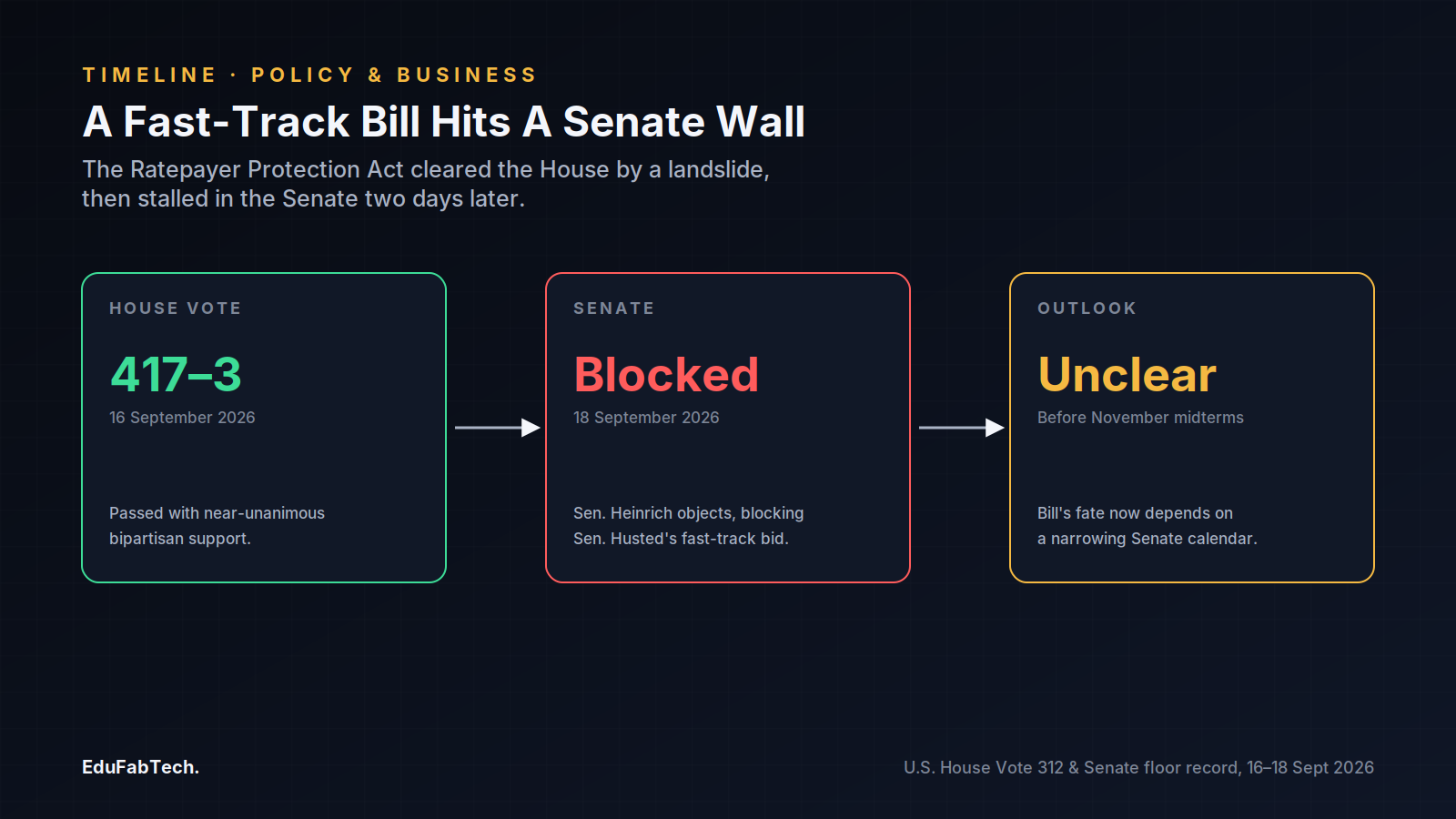
The Ratepayer Protection Act cleared the House 417–3 on September 16, 2026, but a parallel Senate push collapsed two days later, leaving the measure's fate before the midterms unclear.
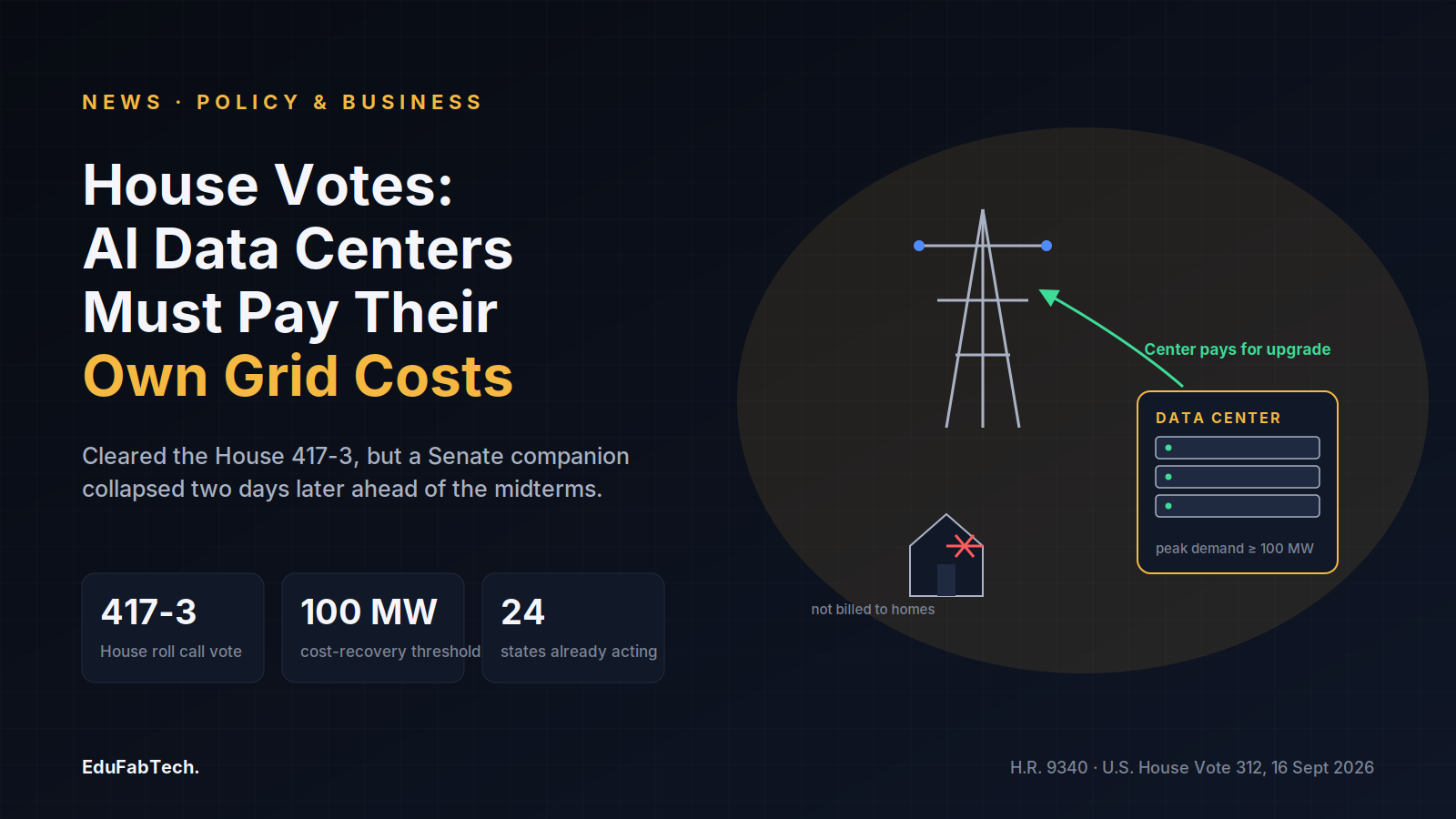
The US House of Representatives voted 417 to 3 on September 16, 2026, to pass the Ratepayer Protection Act, a bill that would push state utility regulators to make large data centers pay the full cost of the grid upgrades their power demand requires, rather than spreading those costs across residential electricity bills. The roll call, recorded as Vote 312 of the 119th Congress, shows the rare near-unanimity: 210 Republicans, 206 Democrats and the chamber's one independent voted yes, with only three Democrats — Summer Lee of Pennsylvania, Delia Ramirez of Illinois and Rashida Tlaib of Michigan — voting no, arguing the bill did not go far enough.
The bill, H.R. 9340, amends the Public Utility Regulatory Policies Act of 1978 (PURPA) to add a new federal standard that state public utility commissions must formally consider, though not necessarily adopt. Under that standard, any "large-load customer" — defined as a nonresidential facility, principally a data center, with peak demand of at least 100 megawatts at a single site — would pay the full incremental cost of the generation, transmission and distribution upgrades built to serve it. States that have already put comparable large-load tariffs in place, including Virginia, Ohio, Oregon and Oklahoma, would be exempt from having to revisit the question.
The bill also requires data center developers to post financial assurances covering the cost of infrastructure already built or committed if a project is later cancelled or relocated, so that utilities and their remaining customers are not left paying for capacity nobody uses. Because the bill invokes PURPA's Section 111(d) mechanism, state commissions must hold a proceeding on the question, but are not compelled to issue a particular rule — a structure that, by Utility Dive's reporting, mostly formalizes a shift many states were already making on their own; the outlet cites analysis from ClearView Energy Partners describing the bill as likely to "largely reinforce" existing state trends rather than force new ones.
What is driving the vote
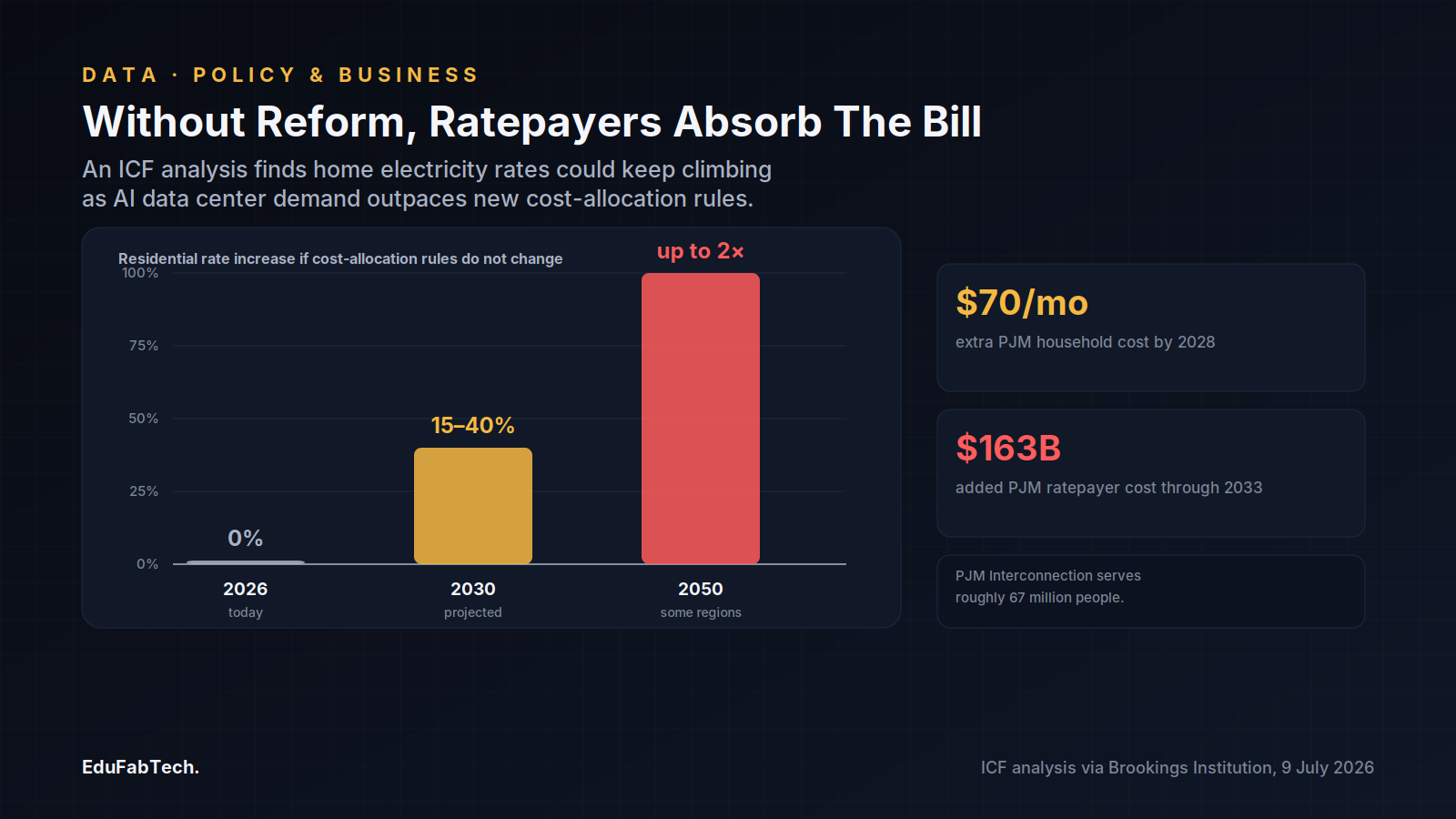
The push follows a year in which data center construction, driven overwhelmingly by AI training and inference capacity, has strained regional power grids and pushed up bills in the areas where that growth is concentrated. An ICF analysis cited in a July 9, 2026 Brookings Institution article by David Klaus and Mark MacCarthy projects that, absent new cost-allocation rules, residential electricity rates could rise between 15 and 40 percent by 2030, with the potential to double in some regions by 2050, as the cost of new generation and transmission capacity is spread across all ratepayers rather than billed to the facilities that require it.
Regional grid data adds specificity to that national projection. In the mid-Atlantic PJM Interconnection, which serves roughly 67 million people, the Natural Resources Defense Council estimates that an average household could pay around $70 more per month by 2028 because of data center-driven capacity costs, and that PJM consumers collectively could pay an additional $163 billion through 2033 if procurement and cost-allocation practices do not change.
The bill also arrives against the backdrop of a voluntary industry commitment that preceded it. On March 4, 2026, the White House announced a Ratepayer Protection Pledge under which seven major cloud and AI companies — Amazon, Google, Meta, Microsoft, OpenAI, Oracle and xAI — agreed to build or buy their own generation, cover their own infrastructure upgrade costs, and pay negotiated rates regardless of how much power they actually draw. By July 2026 the pledge covered roughly 80 percent of the US grid by Brookings' count, but the same article argues the commitment has no enforcement mechanism: turning it into an actual bill credit requires state legislatures, utility commissions and governors to write the tariff rules themselves. The Ratepayer Protection Act is, in effect, an attempt to give that voluntary pledge a statutory nudge.
A parallel effort stalled in the Senate
The House vote did not settle the matter. Two days later, on September 18, 2026, Senator Jon Husted sought unanimous consent to fast-track a companion measure through the Senate before the chamber's schedule narrows ahead of November's midterm elections. Senator Martin Heinrich objected, blocking the request and leaving the bill without an expedited path. Trade groups representing data center developers have separately argued that cost allocation is properly a state-level decision and should not be set by a federal statute, even one that leaves the final call to states.
What the bill would and would not change
Because PURPA's Section 111(d) mechanism is procedurally mandatory but substantively discretionary, the practical effect of the Ratepayer Protection Act, if it eventually becomes law, would depend heavily on what individual state commissions decide once they hold the required proceedings. Utility Dive's reporting notes that only a minority of US states — 13, by its count — currently lack any large-load tariff structure for data centers, meaning most of the country has already begun moving in the direction the bill describes, through state-level rulemaking rather than federal statute.
- What changes if the bill becomes law: states without a large-load tariff must hold a formal proceeding on whether to adopt a 100 MW cost-recovery standard.
- What does not change: states retain full discretion to decline the standard after considering it, and the bill sets no penalty for doing so.
- What is already happening independently: 24 states have adopted comparable data center cost-recovery rules on their own, according to the House Energy and Commerce Committee.
For engineers and researchers planning large training or inference deployments, the near-term signal is less about this specific bill than about the direction of travel: the era in which a new data center's electricity supply could be treated as a fixed, predictable line item is ending in the markets where AI infrastructure has concentrated. Whether that cost discipline arrives through an act of Congress, state utility dockets, or the voluntary pledges companies have already signed, the pattern across all three routes points the same way — toward large compute users bearing the marginal cost of the power they draw.
- Office of the Clerk, US House of Representatives. Roll Call Vote 312, H.R. 9340, 119th Congress, 2nd Session. US House of Representatives, 2026. link
- US Congress. H.R.9340 - Ratepayer Protection Act, 119th Congress. Congress.gov, Library of Congress, 2026. link
- Robert Walton. House passes ratepayer protection bill to limit data center cost shifts. Utility Dive, 2026. link
- David M. Klaus, Mark MacCarthy. The pledge to protect ratepayers from AI data center costs needs enforcement. Brookings Institution, 2026. link
- Natural Resources Defense Council. Rising Demand From Data Centers Driving Reliability, Cost Concerns. Natural Resources Defense Council, 2026. link