The Learning Styles Myth: What the Evidence Actually Shows
A widely taught idea about matching instruction to visual, auditory or kinesthetic learners has been tested directly and repeatedly fails — yet most teacher-training literature still endorses it.
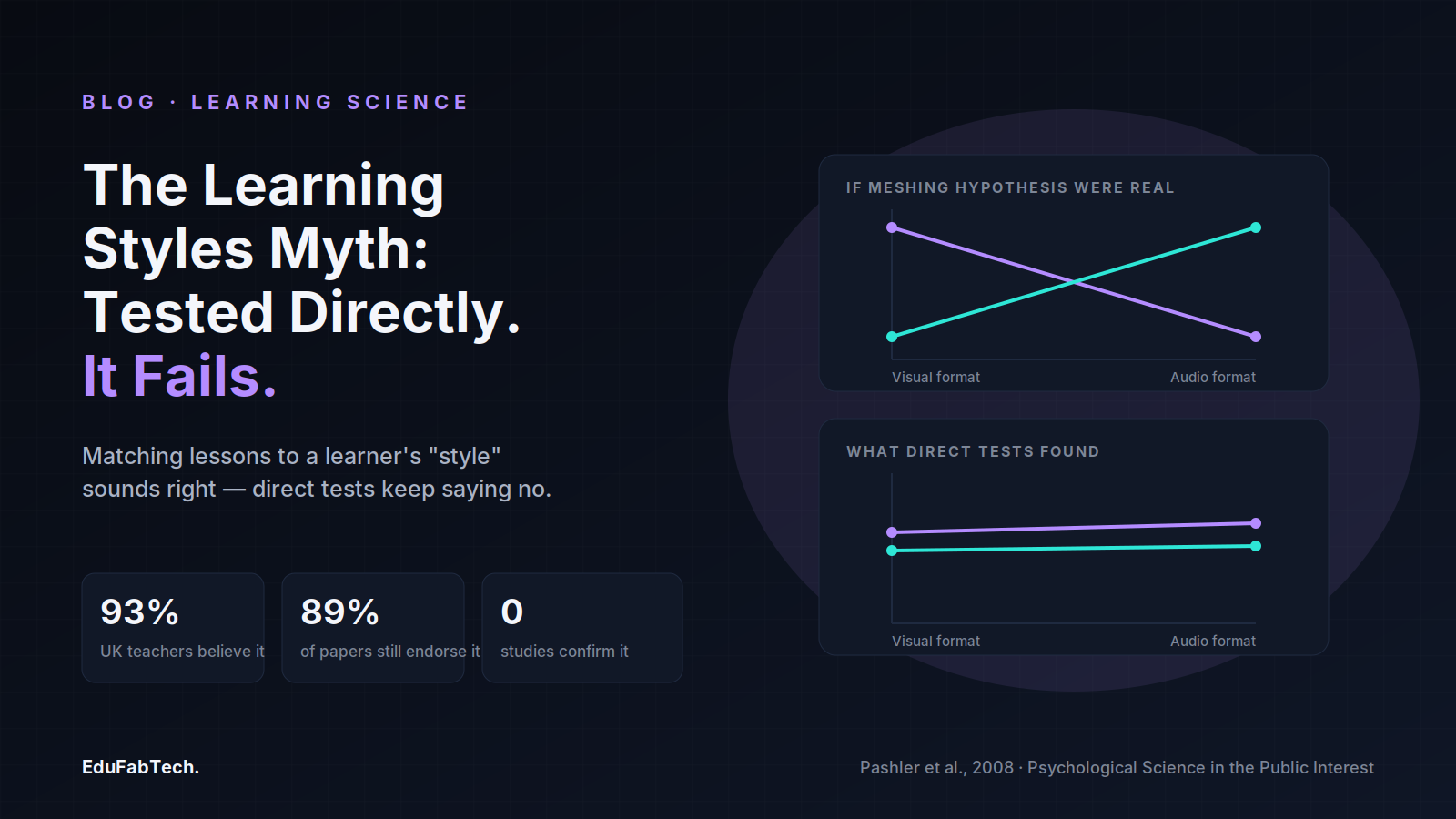
Ask a room of teachers whether students learn better when material is presented in their preferred "style" — visual, auditory, reading/writing or kinesthetic — and most will say yes. Ask a cognitive psychologist who has looked for evidence of this, and the answer is different. The claim has a specific, testable form, it has been tested directly several times, and the tests keep coming back negative. This is one of the clearer cases in education research where a widely held belief and a well-documented evidence base point in opposite directions, and it is worth separating what has actually been shown from what merely sounds plausible.
The idea usually travels under the name of the "meshing hypothesis": the claim that learning improves when the format of instruction is matched to an individual's preferred mode of taking in information — showing diagrams to a "visual learner," playing audio to an "auditory learner," and so on. It is distinct from the uncontroversial observation that people have different preferences, that some content is inherently better suited to one format than another, or that multimedia aids comprehension for everyone. The meshing hypothesis is a narrower and stronger claim: that the same content, taught in a format matched to a person's style, produces measurably better learning than the same content taught in a mismatched format.
A 2008 review in Psychological Science in the Public Interest by Harold Pashler, Mark McDaniel, Doug Rohrer and Robert Bjork set out exactly what evidence would be needed to support meshing: a study design that classifies learners by style, randomly assigns them to different instructional methods, and finds that each style group performs better under its matched method than under the others — a statistical interaction, not just a main effect of either style or method alone. Searching the literature for studies with this design, the authors found only a handful, and the ones that used rigorous methods did not find the predicted interaction. Their conclusion was blunt: there was "no adequate evidence base to justify incorporating learning-styles assessments into general educational practice," and the limited time and resources of educators would be better spent on approaches with a track record of improving learning.
What direct tests have found since
A review calling for better evidence is not the same as new evidence, so it matters that researchers have since run the kind of randomized, interaction-seeking studies Pashler and colleagues said were missing. In a study published in the Journal of Educational Psychology, Beth Rogowsky, Barbara Calhoun and Paula Tallal classified college-educated adults by auditory versus visual-word preference on a standardized inventory, then randomly assigned each person to receive the same nonfiction text either as an audiobook or as e-text, testing comprehension immediately and again two weeks later. If meshing were real, people with an auditory preference should have done better with audio and visual-preference people better with text. The study found no such interaction for either immediate or delayed comprehension — preference did not predict which format worked better for a given person.
A separate line of evidence comes from looking at whether students who say they have a given style actually study in ways that match it, and whether doing so helps them. Polly Husmann and Valerie Dean O'Loughlin surveyed 426 undergraduate anatomy students on their VARK-classified learning style (visual, auditory, reading/writing, kinesthetic) alongside their actual study strategies and course grades. The 2019 study in Anatomical Sciences Education found that most students' study strategies did not line up with their classified style in the first place, and — more directly relevant to the meshing claim — a student's VARK score was not correlated with their performance in the course, regardless of whether their study habits happened to match their style. Some individual study strategies, such as using a virtual microscope, were linked to better grades, but that held regardless of a student's stated learning style.
These are two studies, not a settled consensus built from dozens of replications, and they should be read as such. But they are notable precisely because they are the kind of study design the 2008 review said the field lacked, and both came back negative on meshing. No published study using the interaction design has yet returned a result supporting it.
Why the idea persisted in teacher training anyway
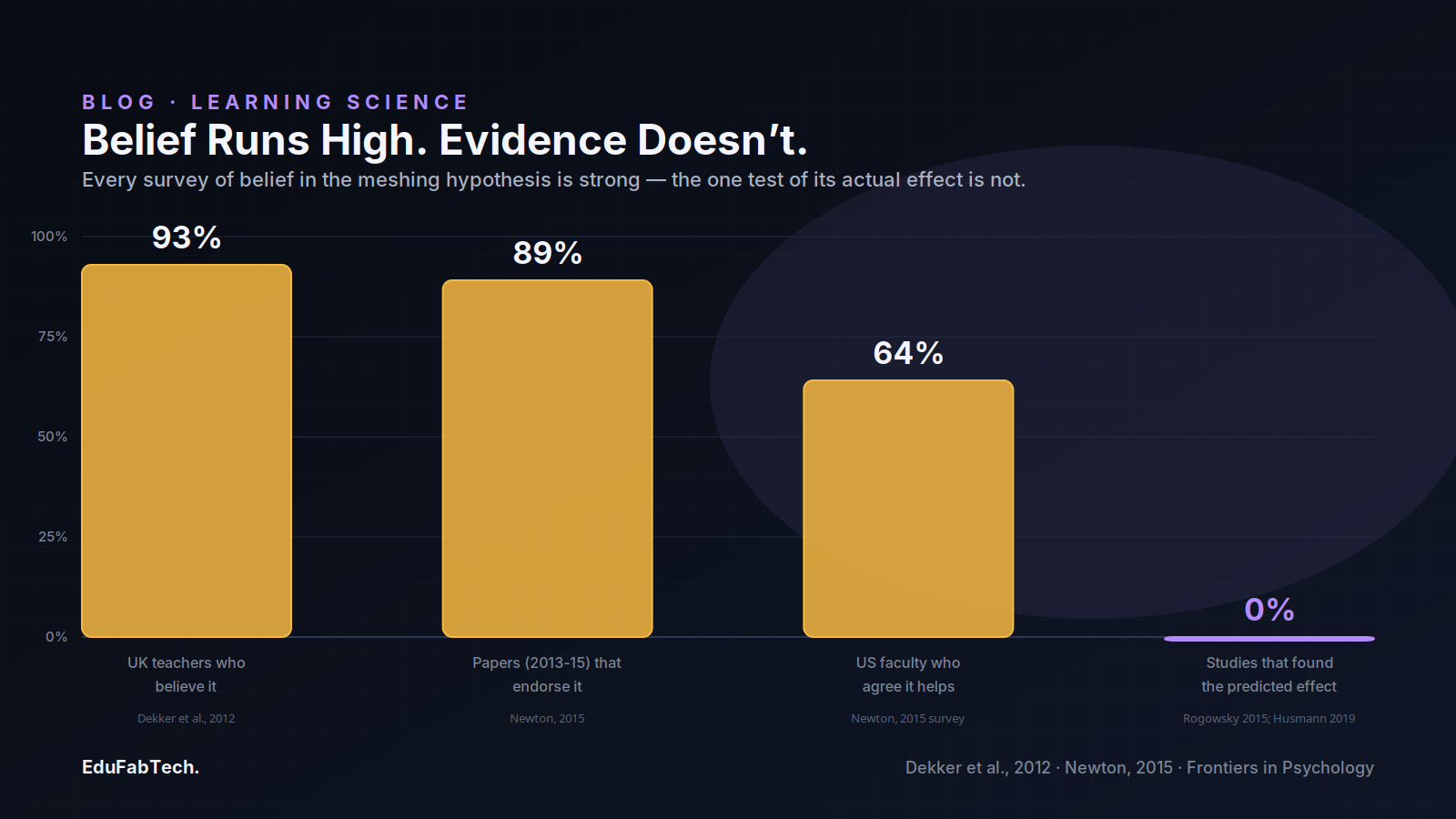
If the evidence is this consistent, the interesting question becomes why the idea remains so common in classrooms and in the research literature that teachers read. Philip Newton addressed this directly by searching PubMed and ERIC for papers published between 2013 and 2015 in a higher-education context that mentioned learning styles. Of 109 papers found, 89% endorsed learning styles in their conclusions, and 94% started from a positive assumption about the concept, according to the 2015 analysis published in Frontiers in Psychology. Newton also cites a survey finding that 64% of US higher-education faculty agreed that teaching to a student's learning style enhances learning. In other words, the claim has kept circulating inside the academic literature itself, not only in popular teaching advice — someone searching for evidence-based practice can easily land on a paper that treats meshing as established.
A separate survey, led by Sanne Dekker with Nikki Lee, Paul Howard-Jones and Jelle Jolles, tested 242 primary and secondary school teachers in the United Kingdom and the Netherlands on 32 statements about the brain and learning, 15 of which were established "neuromyths." Teachers endorsed an average of 49% of the neuromyths, but one item stood out: 93% of UK teachers agreed, in the 2012 Frontiers in Psychology study, that "individuals learn better when they receive information in their preferred learning style" — making it the single most widely believed myth the survey tested, well ahead of other misconceptions about the brain.
What is real, and what isn't
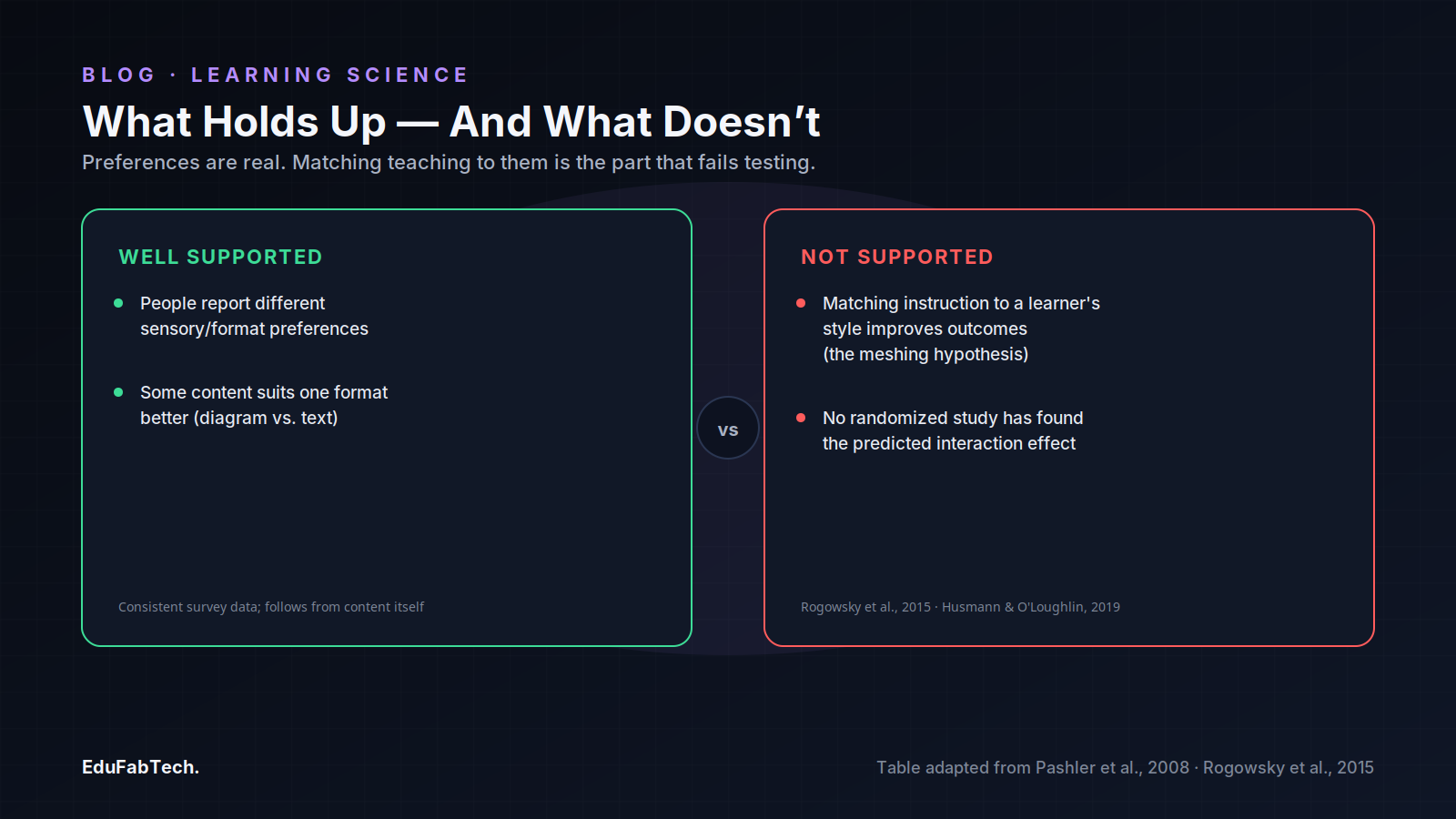
None of this research claims that people lack preferences, or that format never matters. People reliably report liking some formats more than others, and some content genuinely suits one format better — a diagram communicates spatial relationships that a paragraph of text cannot replicate, and the reverse holds for a narrative argument. The line separating a replicated, supportable finding from the learning styles myth is whether a format's benefit is general — holding across learners for well-designed material — or whether it depends on matching the material to a classification of the learner. Only the second claim is the one the direct tests above have failed to confirm.
| Claim | Status | Basis |
|---|---|---|
| People report different sensory/format preferences | Well supported | Survey and preference data are consistent and uncontroversial |
| Some content is better suited to one format (diagram vs. text) | Well supported | Follows from the content itself, not from classifying the learner |
| Matching instruction to a learner's style improves outcomes (meshing hypothesis) | Not supported by direct tests | Rogowsky et al. (2015); Husmann & O'Loughlin (2019); no interaction found |
What follows for teaching and study practice
For a teacher or course designer, the practical implication is not to abandon multimedia or variety — it is to stop sorting students into style categories and designing separate tracks around them. Time spent administering a VARK-style inventory and then producing parallel visual, auditory and kinesthetic versions of the same lesson is time not spent on practices with a documented evidence base, which was precisely the opportunity-cost argument Pashler and colleagues made in 2008. Retrieval practice, spaced review and well-structured worked examples have direct experimental support across varied learner populations; style-matching does not, despite being tested with the same randomized, interaction-based logic.
For students, the practical lesson is narrower but still useful: calling yourself a "visual learner" is not a reason to avoid a format that initially feels less comfortable, such as working through written derivations instead of watching a video. The Husmann and O'Loughlin data point in particular suggests that the study behaviors that actually track with better grades are not the ones that match a student's self-reported style — they are specific, content-appropriate strategies, evaluated on their own terms rather than filtered through a style label.
The broader pattern here is a useful one to recognize elsewhere in education research: an idea can be intuitively appealing, widely taught in teacher-training programmes, and still fail every direct empirical test designed to confirm it. The learning styles literature is unusual mainly in how clearly documented that gap is — a 2008 review specifying exactly what evidence would be needed, two subsequent studies supplying that exact test design, and a parallel literature documenting just how much the belief persisted in the papers and classrooms that should have moved on from it.
A quick question for readers
Which study method makes things stick for you until the exam?
Research says some methods work far better than others. Vote first, then see whether students agree with the evidence.
Pick an answer, create a free account in a minute, and your vote counts. Already a member? Sign in
Comments 0
CommentNo comments yet. Members start the conversation.
Source: Psychological Science in the Public Interest
Sources (5)
- Harold Pashler, Mark McDaniel, Doug Rohrer, Robert Bjork. Learning Styles: Concepts and Evidence. Psychological Science in the Public Interest, 2008. journals.sagepub.com ↗ · checked 12 Oct 2026
- Sanne Dekker, Nikki C. Lee, Paul Howard-Jones, Jelle Jolles. Neuromyths in Education: Prevalence and Predictors of Misconceptions Among Teachers. Frontiers in Psychology, 2012. frontiersin.org ↗ · checked 12 Oct 2026
- Philip M. Newton. The Learning Styles Myth Is Thriving in Higher Education. Frontiers in Psychology, 2015. frontiersin.org ↗ · checked 12 Oct 2026
- Beth A. Rogowsky, Barbara M. Calhoun, Paula Tallal. Matching Learning Style to Instructional Method: Effects on Comprehension. Journal of Educational Psychology, 2015. psycnet.apa.org ↗ · checked 12 Oct 2026
- Polly R. Husmann, Valerie Dean O'Loughlin. Another Nail in the Coffin for Learning Styles? Disparities Among Undergraduate Anatomy Students' Study Strategies, Class Performance, and Reported VARK Learning Styles. Anatomical Sciences Education, 2019. anatomypubs.onlinelibrary.wiley.com ↗ · checked 12 Oct 2026