The 2026 Nobel Prizes for Students: Six Prizes, Six Lessons, and the Degrees That Lead There
An alga that became a brain switch, a telescope made of Antarctic ice, a reaction that turns 0.00005% into 99.5%, a classics professor, a judge who made rape a crime of genocide, and two economists who rebuilt broken models.
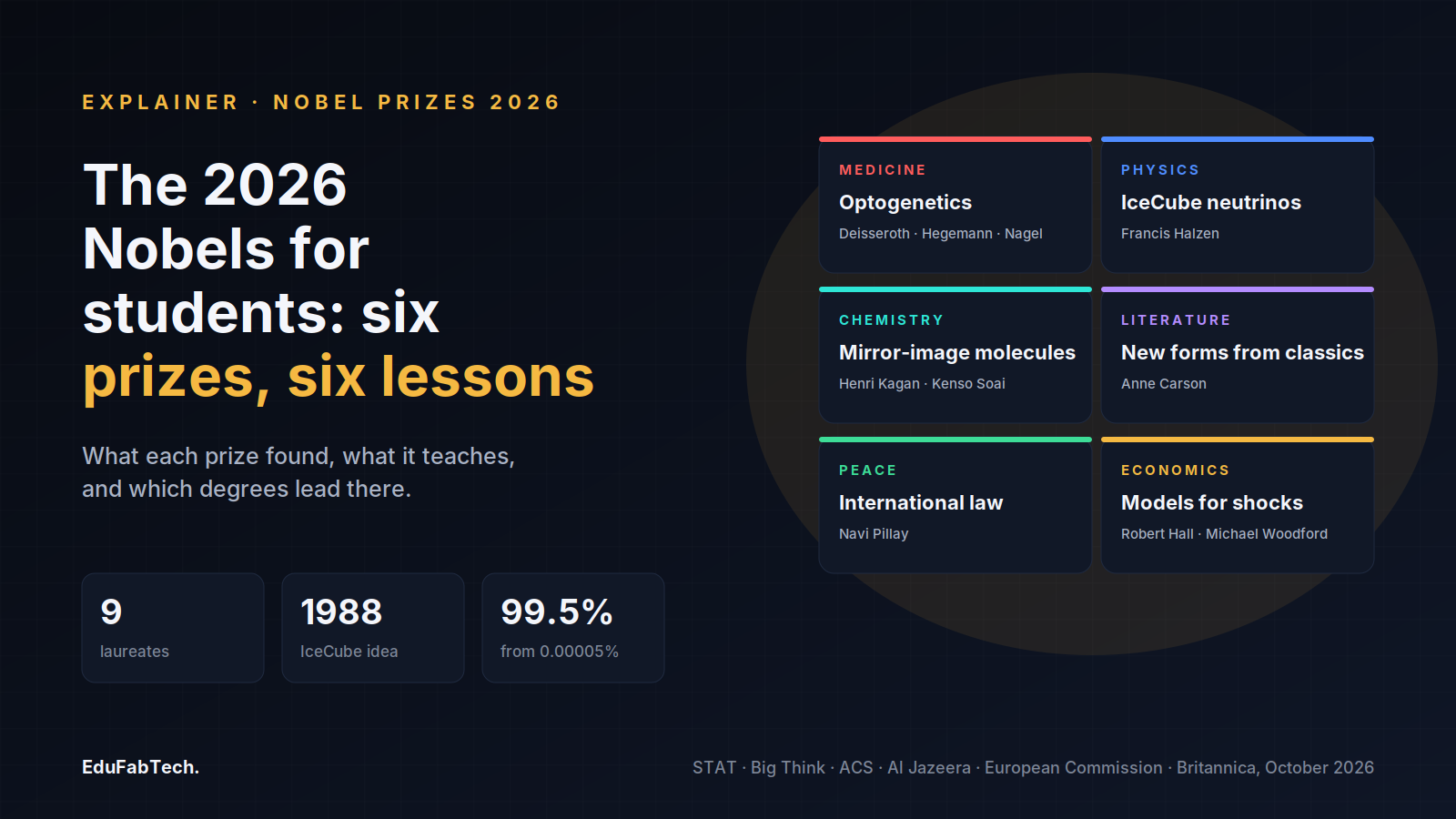
Between 5 and 12 October 2026, six Nobel announcements in Stockholm and Oslo named nine people. One started with a question about how a pond alga swims towards light; one with an idea its author called "cute" in 1988; one with a law practice opened by a woman of colour under apartheid. None of the nine set out to win a Nobel Prize, and most of the work being honoured was done decades ago, when they were roughly where today's students and young researchers are now. This article explains each prize in plain language, and then asks the question that matters for anyone still choosing a subject or a career: what does this prize teach you?
1. Medicine: a swimming alga became a switch for the brain
The Karolinska Institutet gave the Prize in Physiology or Medicine to Karl Deisseroth of Stanford University and the Howard Hughes Medical Institute, Peter Hegemann of Humboldt University in Berlin and Georg Nagel of the University of Würzburg "for their discoveries concerning light-gated ion channels and optogenetics", STAT reported on 5 October. The story begins in the early 1990s at the Max Planck Institute, where Hegemann asked how the single-celled green alga Chlamydomonas swims towards light. With Nagel he identified channelrhodopsin, a protein channel in the cell membrane that opens when light hits it, and found that it worked in any cell it was put into. Deisseroth put the channelrhodopsin gene into rat nerve cells, so that a flash of blue light could make a neuron fire inside a living brain. The landmark paper from his lab appeared in 2005. "We're not using light to collect information, we're using light to cause things to happen," Deisseroth said. The committee's chair, Per Svenningsson, said optogenetics "provides opportunities for mapping the brain in a way that we could once only dream of".
The lesson: nobody funding alga research in 1990 was funding neuroscience. Basic curiosity about an odd organism produced the tool that let scientists switch individual brain cells on and off. There is a second lesson in the same story. The first author of the 2005 paper, Ed Boyden, was a PhD student in Deisseroth's lab at the time, and commentators noted his absence from the prize. Science is a team activity; the Nobel can name at most three people. Students who want credit for their work should learn early how authorship, records and recognition are decided.
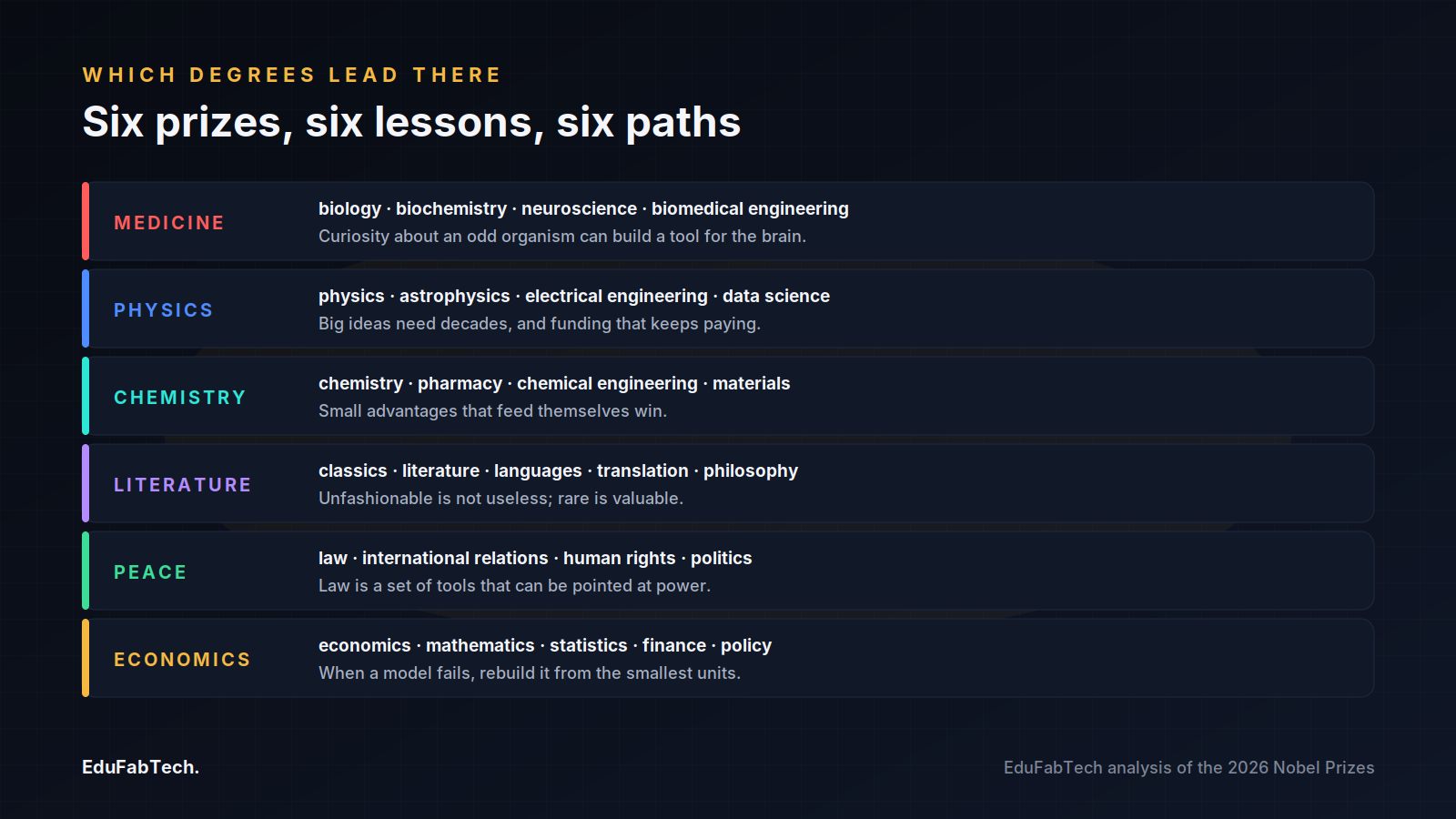
Who goes this way: biology, biochemistry, neuroscience, biomedical engineering, and increasingly physics and optics.
2. Physics: a "cute idea" became a telescope made of ice
Francis Halzen of the University of Wisconsin–Madison received the Physics Prize alone, for "decisive contributions to the IceCube Neutrino Observatory" and the discovery of high-energy neutrinos of astrophysical origin, according to the European Commission's announcement of 6 October. Neutrinos are particles so light and so unreactive that almost all of them pass through matter without a trace. To catch the rare ones that do interact, IceCube uses a cubic kilometre of Antarctic ice under the South Pole. As the astrophysicist Ethan Siegel describes it in Big Think, the detector has 86 strings of 60 light sensors each, about 5,160 in all, buried in the ice; it saw its first neutrinos in January 2006 and was completed in December 2010. Halzen proposed the idea in 1988 and called it "cute". It has since traced neutrinos to a blazar, a galaxy with a feeding black hole, about 3.7 billion light-years away. It is the first single-laureate physics prize since 1992.
The lesson: twenty-two years passed between the cute idea and the finished detector, and the prize came 38 years after the idea. Big science runs on patience and on funding that survives election cycles. Siegel notes that the US administration has proposed cutting IceCube's funding by more than half. A student choosing physics is choosing a field where the best ideas need decades and institutions that keep paying.
Who goes this way: physics, astrophysics, electrical engineering, data science; IceCube also needs people who can drill and operate equipment at the South Pole.
3. Chemistry: how a tiny advantage takes over
Henri Kagan of France and Kenso Soai of Japan won the Chemistry Prize "for the discovery of non-linear effects and autocatalysis in asymmetric organic synthesis", as the American Chemical Society reported on 7 October. The subject is chirality: many molecules come in two mirror-image forms, like a left and a right hand, and living things rarely treat them the same way. Making drugs, flavours and crop chemicals often means producing only one hand. In 1986 Kagan showed that a catalyst made from an impure mixture of mirror-image parts could produce a purer product than the mixture itself. In 1995 Soai reported a reaction in which the product speeds up its own formation, so a small excess of one hand grows with each cycle. In one version, a starting excess of 0.00005 per cent reached more than 99.5 per cent after three rounds. The idea that such a process could amplify a tiny imbalance had been proposed by the physicist Frederick Charles Frank in 1953, more than forty years before Soai showed it in a flask.
The lesson: 0.00005 per cent to 99.5 per cent in three rounds is the most striking number of the whole Nobel week, and it describes more than chemistry. Small advantages that feed themselves win. So do small habits. And a good theory can wait four decades for the experiment that proves it; Frank's 1953 idea is in the citation of a 2026 prize.
Who goes this way: chemistry, pharmacy, chemical engineering, materials science.
4. Literature: a classics professor who invented new forms
The Swedish Academy gave the Literature Prize on 8 October to Anne Carson, a 76-year-old Canadian poet, essayist and professor of classics born in Toronto, "for her bold and inventive oeuvre that, in playful dialogue with the classical tradition, has created new forms for contemporary literature", Al Jazeera reported. Carson has written more than 20 books, including The Beauty of the Husband, a book-length poem about a doomed marriage, and a modern-vernacular Trojan Women after Euripides. Her reaction to the news, to Icelandic radio: "Crazy. I think they're all crazy."
The lesson: ancient Greek is the subject every careers adviser warns against. Carson used it to make literature that did not exist before, by putting a 2,400-year-old tradition in conversation with the present. Old knowledge is not dead knowledge; it is raw material that few people have. Students drawn to a "useless" subject should know that depth in an unfashionable field is rare, and rare is valuable.
Who goes this way: classics, literature, languages, translation, philosophy, creative writing.
5. Peace: the judge who made rape a crime of genocide
The Norwegian Nobel Committee gave the Peace Prize on 9 October to Navanethem "Navi" Pillay, an 85-year-old South African jurist of Indian Tamil origin, "for her efforts to promote peace and international law", Al Jazeera reported. In 1967 she became the first woman to open a law practice in what was then the province of Natal, under apartheid, and she defended Nelson Mandela and other anti-apartheid activists. She became the first woman of colour on South Africa's High Court, then served on the International Criminal Tribunal for Rwanda, where the committee highlighted her work in establishing that rape and sexual violence can constitute crimes against humanity and genocide. She later served on the International Criminal Court and as UN High Commissioner for Human Rights. The committee's chair, Jørgen Watne Frydnes, said international law was "under tremendous pressure" and that judges "guard the thin red line between order and chaos".
The lesson: Pillay studied law in a country whose government had designed schooling to keep people like her out of the professions; the apartheid system's minister responsible for Black education said there was "no space for him in the European Community above certain forms of labour". She used the law that excluded her to change what the law could punish. A law degree is not only a route to a salary; it is a set of tools that can be pointed at power.
Who goes this way: law, international relations, human rights, political science.
6. Economics: when the models broke, they rebuilt them from the ground up
Robert Hall of Stanford University and Michael Woodford of Columbia University received the economics prize on 12 October for what Britannica summarises as the "microeconomic foundations of macroeconomic stabilisation". The older Keynesian models, built on statistical links between inflation, production and consumption, stopped working during the oil crises of the 1970s. Hall and Woodford built new models from the decisions of individual households and firms, and those models now guide how fiscal and monetary policy respond to shocks. They are "now used by central banks and governments around the world", the prize committee's chair, John Hassler, said, according to Al Jazeera; "we are better equipped to deal with shocks in the economy."
The lesson: when a theory fails in public, the response that wins is not to patch it but to rebuild it from the smallest units up. Every student who has lived through high inflation has watched these models at work, every time a central bank changes interest rates.
Who goes this way: economics, mathematics, statistics, finance, public policy.
What the six prizes have in common
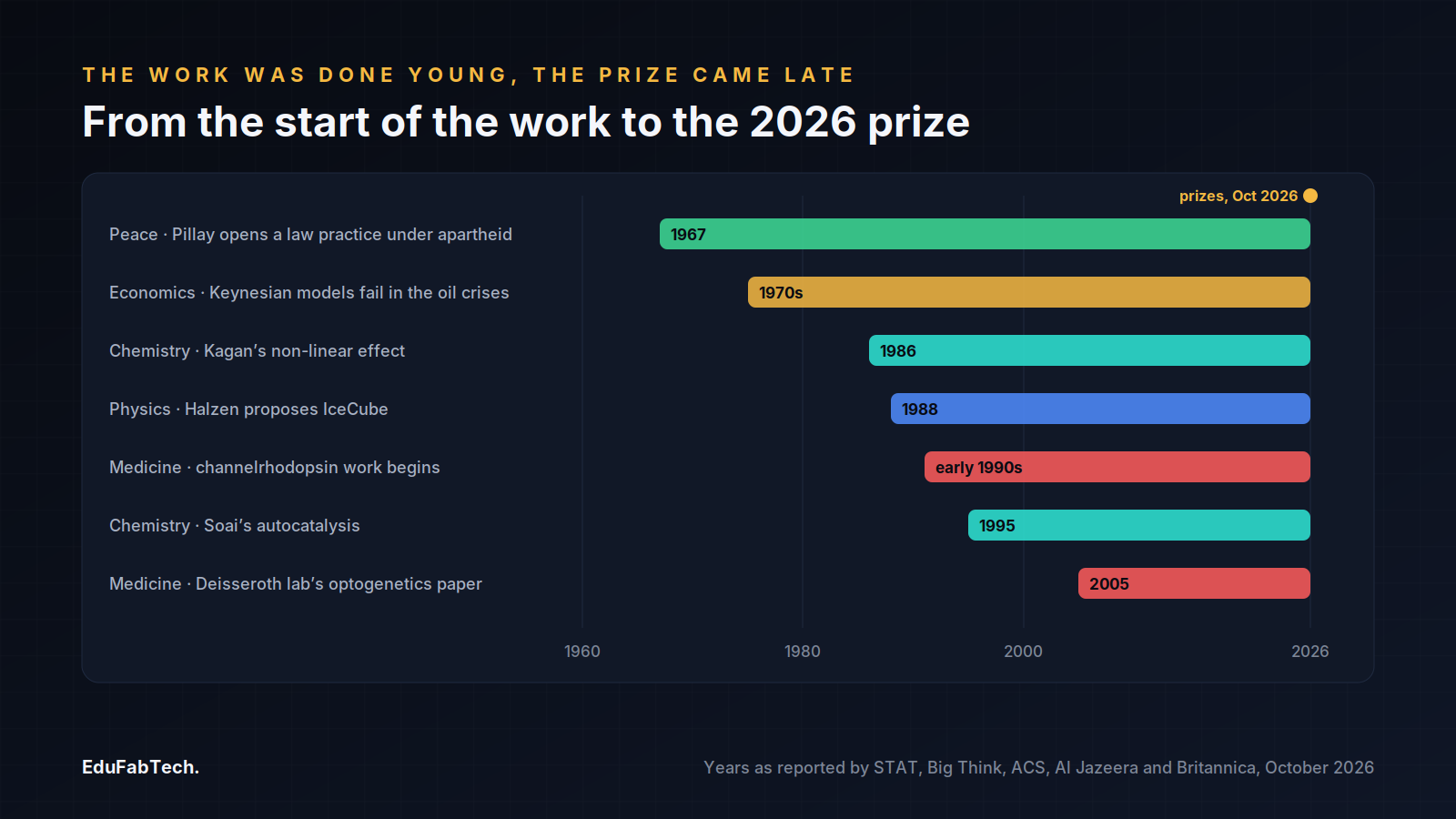
- The work was done young; the prize came late. Channelrhodopsin was found in the early 1990s, the optogenetics paper came in 2005, IceCube was proposed in 1988, Kagan's effect in 1986, Soai's reaction in 1995, Pillay's practice opened in 1967. Deisseroth, the youngest of the medicine laureates, is 55; Pillay is 85.
- Curiosity first, application later. An alga, a block of ice, a chemist's puzzle about mirror images and a dead language all became something nobody predicted.
- Teams and institutions matter. PhD students, thousands of IceCube collaborators and funding that lasts decades sit behind every name.
- Unfashionable is not useless. Classics, basic biology and neutrino physics were nobody's safe career choice.
- The prize is the same for all six. Each carries 12 million Swedish kronor, about 1.2 million US dollars, shared among the laureates in that category.
If you are 18 or 20 and choosing a subject, the 2026 laureates suggest a better question than "which field pays?": which question would you be willing to work on for twenty years before anyone noticed? Tell us yours in the forum, and vote in the polls on which of this year's six prizes will matter most to your generation.
A quick question for readers
How much do you sleep on a typical night during exam weeks?
Sleep is when memory consolidates. How much are students actually getting when it matters most?
Pick an answer, create a free account in a minute, and your vote counts. Already a member? Sign in
Comments 0
CommentNo comments yet. Members start the conversation.
Sources (5)
- Merelli, A.. 2026 Nobel Prize in Medicine awarded for brain research tool called optogenetics. STAT, 2026. statnews.com ↗ · checked 13 Oct 2026
- Siegel, E.. IceCube, high-energy neutrinos, and Francis Halzen win 2026's Physics Nobel. Big Think, 2026. bigthink.com ↗ · checked 13 Oct 2026
- ACS Publications. The 2026 Nobel Prize in Chemistry Goes to Henri B. Kagan and Kenso Soai. American Chemical Society, 2026. axial.acs.org ↗ · checked 13 Oct 2026
- Al Jazeera Staff. 2026 Nobel Peace Prize awarded to Navi Pillay. Al Jazeera, 2026. aljazeera.com ↗ · checked 13 Oct 2026
- 2026 Nobel Prize winners. Encyclopaedia Britannica, 2026. britannica.com ↗ · checked 13 Oct 2026