AI System Ataraxos Beats Stratego's Top Player 15-1-4, Trained for Under $8,000
A Nature paper published September 30, 2026 describes Ataraxos, the first AI to beat elite humans at Stratego, using a fraction of the training data and compute that DeepMind's DeepNash needed.
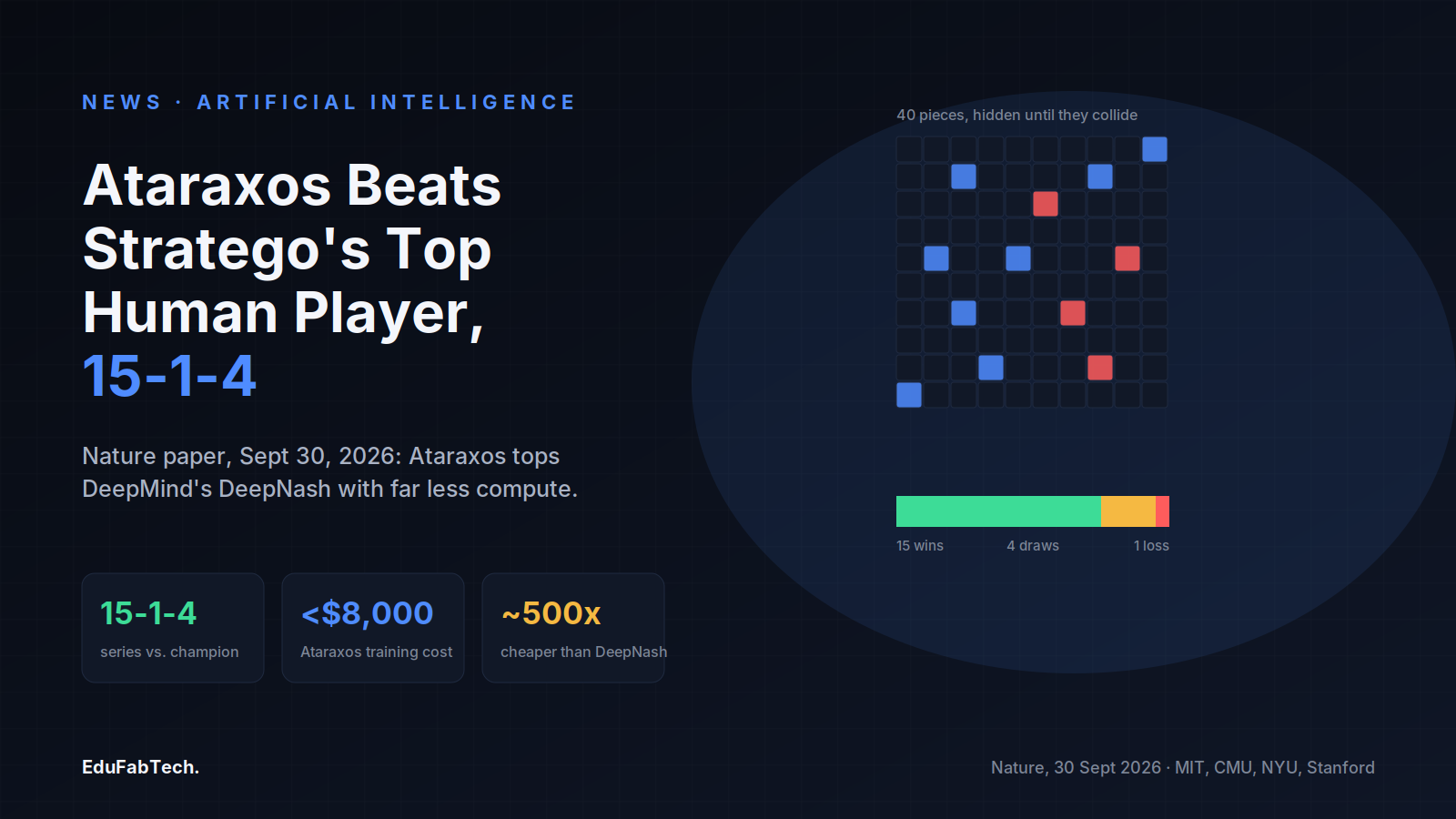
A team from the Massachusetts Institute of Technology, Carnegie Mellon University, New York University and Stanford University has built an AI system that beat the world's strongest Stratego player in an official 20-game series, winning 15, losing 1 and drawing 4, according to a paper published in Nature on September 30, 2026. The system, called Ataraxos, is described by its authors as the first to reach superhuman performance in the board game, which had resisted full mastery by AI longer than chess, poker or Go because of how much it hides from both players.
Stratego is played on a 10-by-10 board where each side secretly arranges 40 pieces of different ranks before the game starts. Identities stay hidden until two pieces collide, at which point the lower rank is removed. According to the MIT News account of the paper, the initial setup alone admits more than 10^66 possible configurations, and because neither player ever sees the other's full board, the game combines the deception of poker with the long-range planning of chess at a much larger scale.
The human opponent was Pim Niemeijer, a four-time world Stratego champion from the Netherlands, according to a report by The Decoder that interviewed people close to the project. Beyond the headline series, the same report states Ataraxos compiled a 39-2 record against championship-level human players overall. The researchers also noted an asymmetry in the match format: Niemeijer could study and adjust to the AI's play across the 20 games, while Ataraxos, once trained, could not adapt to him in the same way.
A fraction of the compute that DeepMind needed
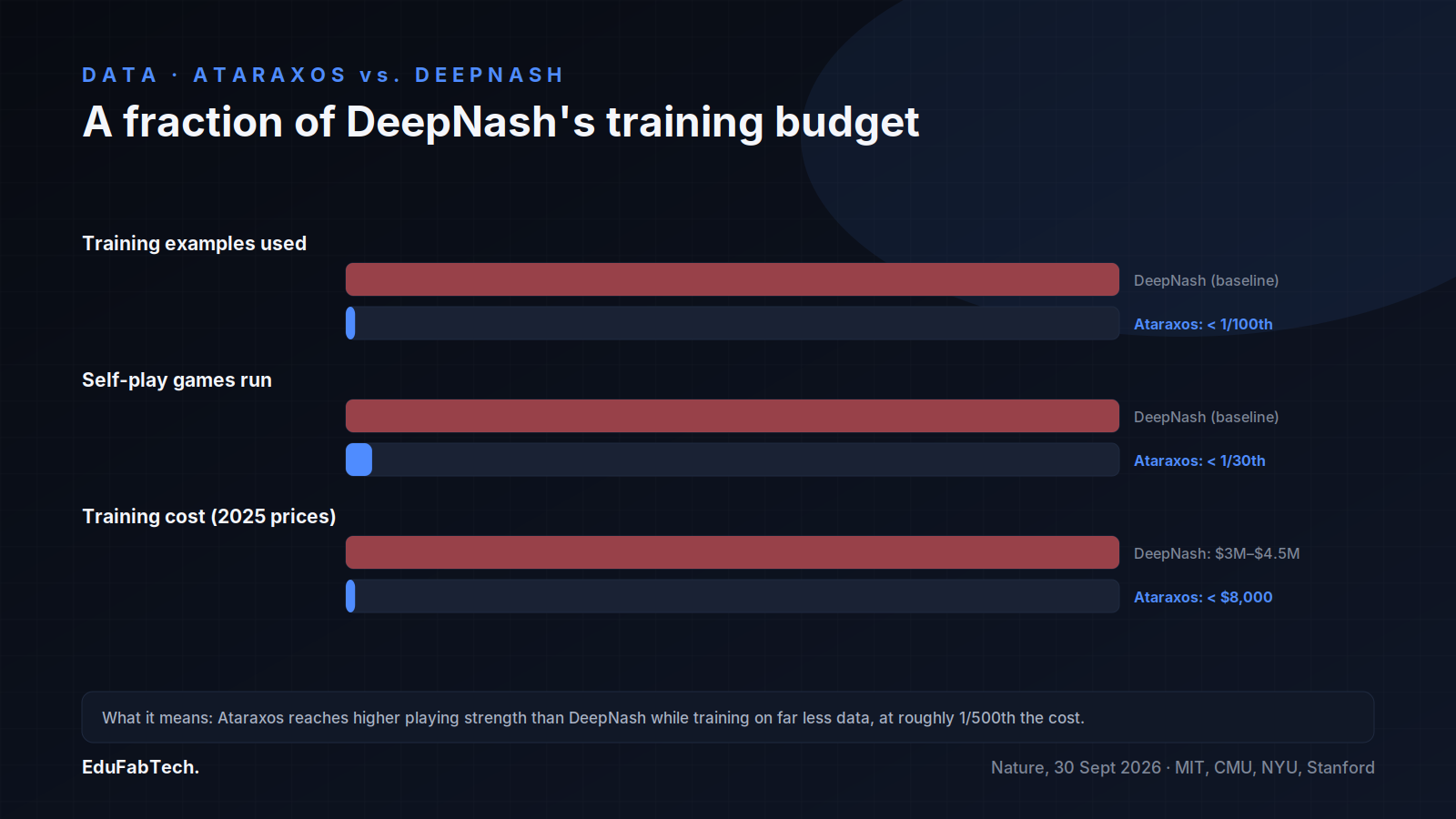
The previous benchmark in the game was DeepNash, a system from Google DeepMind described in a 2022 paper in Science that reached expert-level play through model-free, search-free reinforcement learning. Ataraxos surpasses it while using far less computation. Gabriele Farina, an MIT assistant professor and a senior author of the new paper, is quoted by TechXplore saying the system "reaches strictly higher playing strength than DeepNash while using less than one hundredth of the training examples and less than one thirtieth of the self-play games."
The Decoder's report puts a dollar figure on that gap: training Ataraxos cost under $8,000 at 2025 compute prices, using roughly a week on 16 Nvidia H100 GPUs plus four more days on four GPUs, against an estimated $3 million to $4.5 million at 2025 prices for DeepNash's training run. That is roughly a 500-fold difference in estimated cost between the two systems.
How the system plays
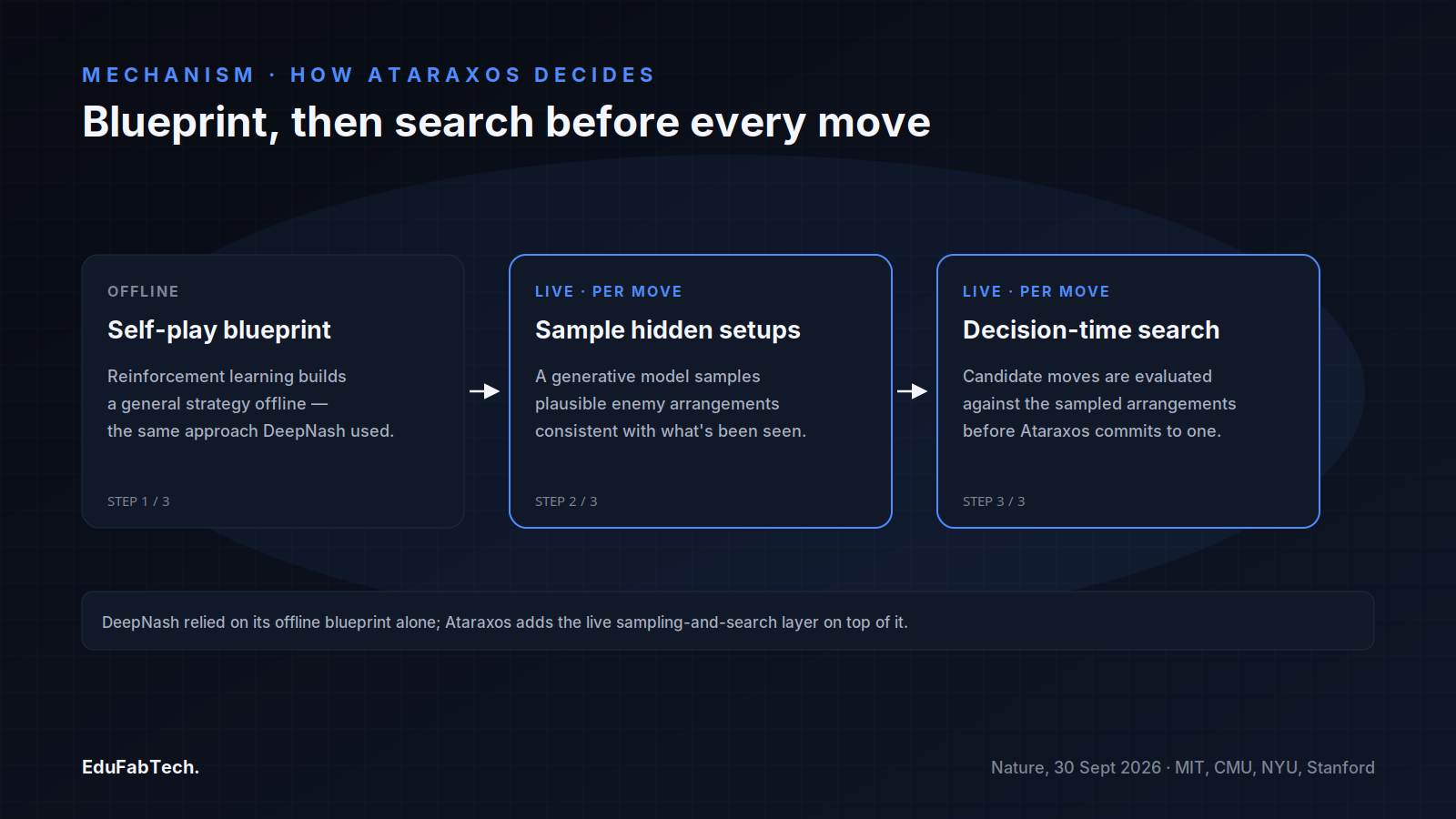
According to the TechXplore summary of the authors' description, Ataraxos combines two stages. First, self-play reinforcement learning builds a general "blueprint" strategy offline, in the same spirit as DeepNash's training. Second, during an actual game, the system runs decision-time planning: it uses a learned generative model to sample plausible arrangements of the opponent's hidden pieces consistent with everything observed so far, and evaluates candidate moves against those sampled possibilities before committing. DeepNash's original approach relied on the offline blueprint alone, without this live, move-by-move search layer.
Why imperfect-information games matter beyond the board
Stratego belongs to a class of problems researchers call games of imperfect information, where no player can see the full state of the world — a structure shared with negotiation, auctions, cybersecurity and military planning. The Nature paper frames its contribution as a general method for this class rather than a Stratego-specific trick, and the authors describe the search-plus-blueprint combination as applicable to other large hidden-information settings. For researchers working on multi-agent reinforcement learning, the practical signal is less the win over Niemeijer and more the efficiency curve: a result that recently needed millions of dollars and a DeepMind-scale compute budget was reproduced and improved on with four-figure costs and university-scale hardware.
For students and engineers studying game-theoretic AI, the paper's comparison table against DeepNash — on self-play games required, training examples used and final playing strength — gives a concrete efficiency benchmark that previously only existed as word-of-mouth estimates. The authors have not yet stated whether Ataraxos's code or trained models will be released; the Nature paper itself is the primary record of the method pending any further disclosure.
What is left unresolved
The format asymmetry the researchers themselves flagged — a human champion who can study and adapt against a fixed AI opponent across a short series, versus an AI that cannot adapt back within that series — means the 15-1-4 scoreline describes one match format rather than a settled verdict on human competitiveness in Stratego generally. Longer series, different opponents, or formats that let both sides adapt between games could move the result in either direction. The authors' own claim, as reported by MIT News, is narrower and more measurable: higher playing strength than DeepNash, reached with far less training data and self-play.
A quick question for readers
Which skill will matter most for getting a job in 2030?
Everyone has a prediction. Add yours and see what students are betting on.
Pick an answer, create a free account in a minute, and your vote counts. Already a member? Sign in
Comments 0
CommentNo comments yet. Members start the conversation.
Source: Nature
Sources (3)
- Samuel Sokota, Gabriele Farina, Zhiyuan Fan, Hengyuan Hu, Eugene Vinitsky, J. Zico Kolter et al.. Scalable decision-making for games of imperfect information. Nature, 2026. nature.com ↗ · checked 6 Oct 2026
- MIT News. This game-playing AI is the new champ at Stratego. MIT News, 2026. news.mit.edu ↗ · checked 6 Oct 2026
- Julien Perolat et al.. Mastering the game of Stratego with model-free multiagent reinforcement learning. Science, 2022. science.org ↗ · checked 6 Oct 2026