DRC's Bundibugyo Ebola Outbreak Passes 7,400 Cases and Is Now the Second Largest on Record
WHO and CDC data through mid-September 2026 show a Bundibugyo virus outbreak spreading faster than any prior Ebola epidemic, with no licensed vaccine or treatment yet proven against this species.
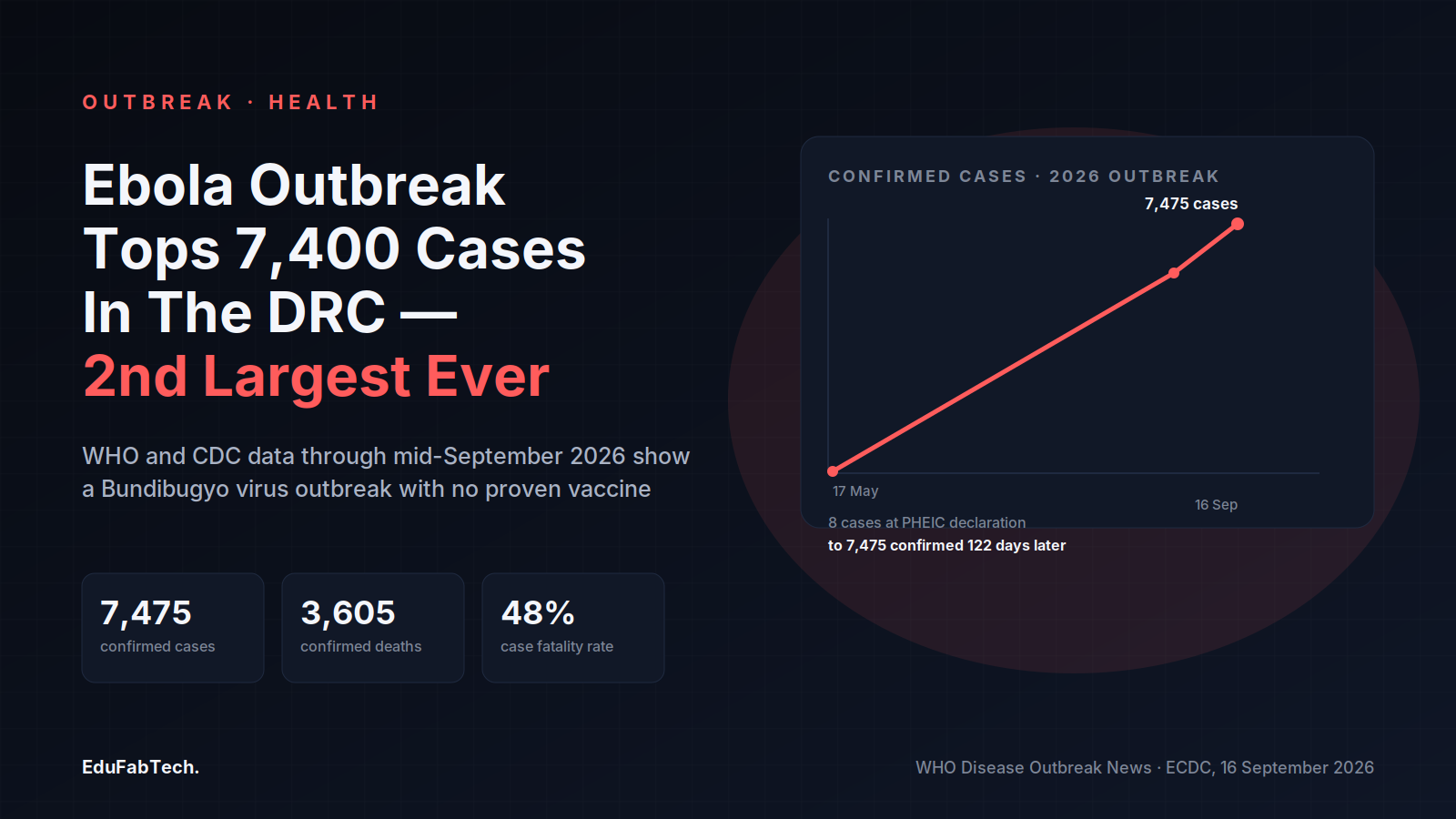
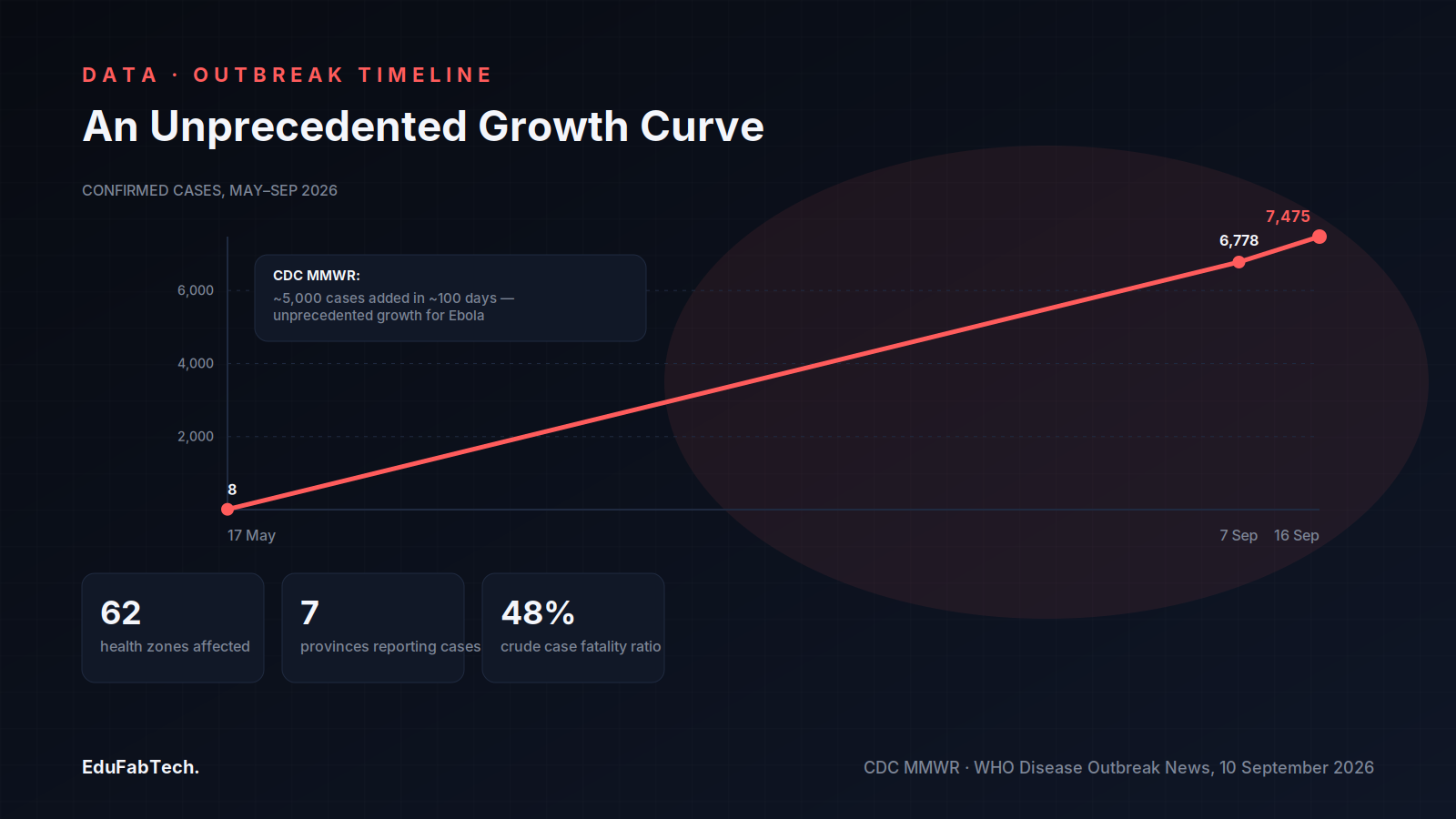
The Ebola outbreak caused by Bundibugyo virus in the Democratic Republic of the Congo has passed 7,400 confirmed cases. The World Health Organization's Disease Outbreak News bulletin, published 10 September 2026, put the toll at 6,778 confirmed cases and 3,269 deaths as of 7 September 2026. A more recent independent update from the European Centre for Disease Prevention and Control, citing WHO figures through 16 September 2026, puts the count higher still: 7,475 confirmed cases and 3,605 deaths, a crude case fatality ratio of roughly 48%.
A separate report from the US Centers for Disease Control and Prevention, published in the Morbidity and Mortality Weekly Report on 10 September 2026, states plainly that the outbreak "is now the second largest Ebola outbreak in history," behind only the 2014–2016 West Africa epidemic. The same report describes the growth as unprecedented for the disease: roughly 5,000 cases accumulated in about 100 days.
A fast-moving outbreak
The chain of transmission was first detected in Ituri Province in the spring of 2026 and confirmed as Bundibugyo virus disease by mid-May. WHO's Director-General declared a Public Health Emergency of International Concern on 17 May 2026, when the confirmed case count stood at eight, alongside 246 suspected cases and 80 suspected deaths in Ituri, plus two confirmed cases in Kampala, Uganda. Four months later, the outbreak has reached 62 of the country's health zones across seven provinces, according to the ECDC update, with Ituri and North Kivu accounting for the large majority of cases.
Uganda's cross-border chain, seeded by travellers from Ituri in May 2026, was declared over on 25 August 2026 after 42 consecutive days without a new confirmed case, per the ECDC summary. Three cases were exported further still: one patient was treated in France and two others were evacuated to Germany, all recorded as recovered in WHO's 10 September bulletin. The CDC's MMWR report adds a grim detail about the strain on the health system inside the DRC: as of its 21 August 2026 data cut, 59% of confirmed deaths occurred outside a treatment unit, meaning most people who died from the disease during that period never received facility-based care.
Why Bundibugyo virus is harder to contain
Ebola disease is caused by several distinct virus species, and licensed countermeasures exist for only one of them. The Ervebo vaccine and the monoclonal antibody treatments used against the 2014–2016 and 2018–2020 outbreaks target Zaire ebolavirus. Médecins Sans Frontières notes that no vaccine or treatment has been approved for Bundibugyo virus, which has caused only two prior recorded outbreaks — Uganda in 2007–2008 and the DRC in 2012 — with case fatality rates historically between 30% and 40%. The current outbreak's fatality ratio, near 48% in both the WHO and ECDC counts, is running higher than either of those precedents.
Testing treatments while the outbreak is still active
Because no therapy is approved for this virus species, WHO opened patient enrolment in the PARTNERS trial on 2 July 2026, a randomized platform study comparing the monoclonal antibody MBP134 against remdesivir, alone and in combination, with 28-day mortality as the primary endpoint.
"Research needs to happen alongside the response, not after it," said Professor Amanda Rojek, the trial's operations lead, in WHO's announcement.
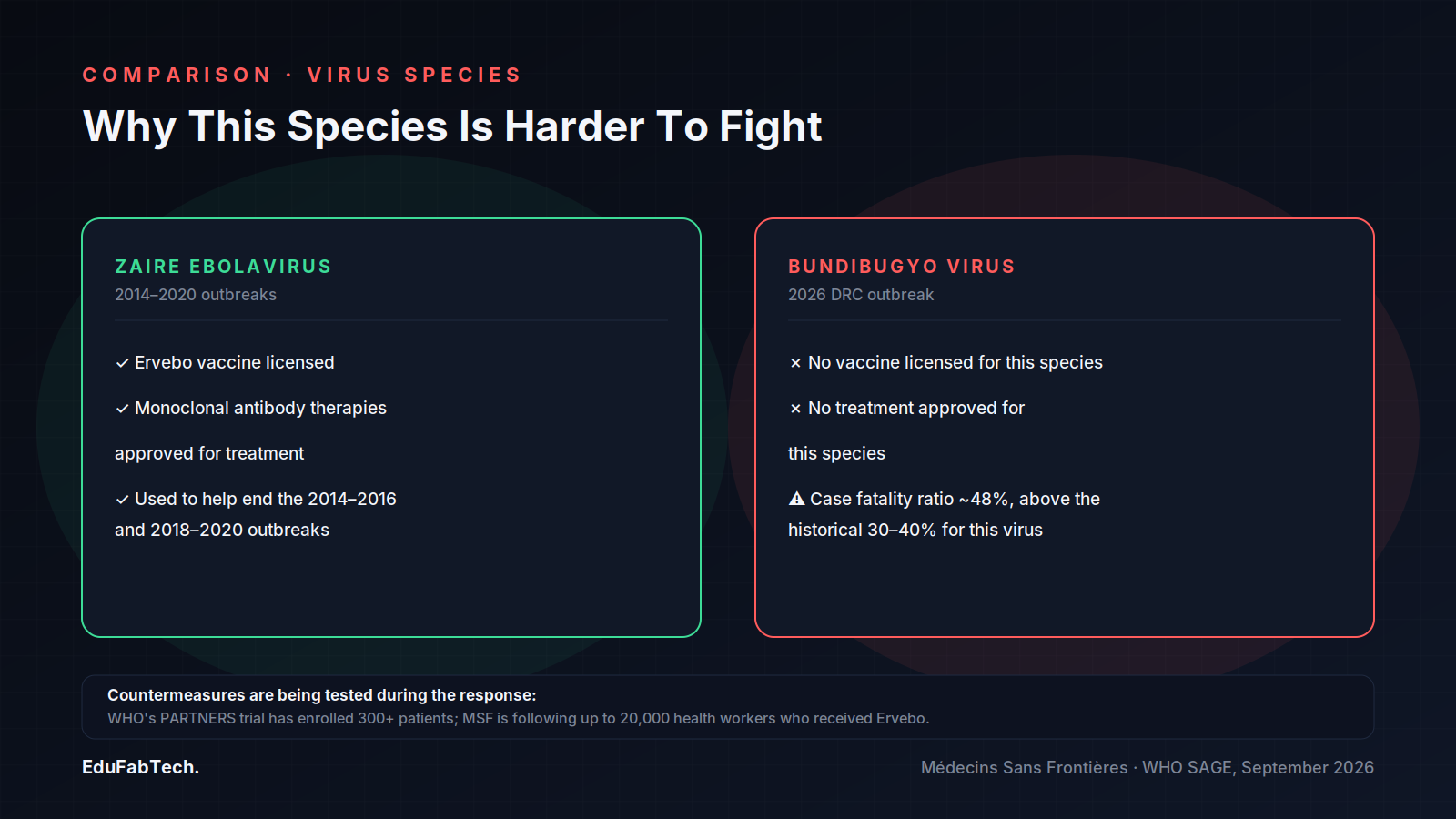
By the time of WHO's 10 September bulletin, PARTNERS had enrolled more than 300 confirmed patients across five treatment facilities in Ituri Province. On vaccination, Ervebo is being administered only under research protocols rather than as a routine public health tool: 2,007 people had received it across three provinces as of 6 September 2026, because WHO's Strategic Advisory Group of Experts on Immunization has determined the evidence for cross-protection against Bundibugyo virus remains insufficient to justify wider programmatic use. Médecins Sans Frontières has separately launched a study following up to 20,000 frontline health workers in Ituri and North Kivu over nine to twelve months to measure whether Ervebo offers any real-world protection against this species specifically.
What the trajectory means
Both the case count and the geographic footprint have grown steadily through each successive WHO update since May, and the CDC's own framing — an outbreak still in "uncontrolled expansion," with contact tracing, laboratory capacity and safe-burial teams below the targets the response has set for itself — suggests the peak has not yet been reached. Whether the PARTNERS trial yields a therapy in time to change outcomes for the current caseload, and whether SAGE eventually authorizes broader use of Ervebo pending stronger evidence, are the two questions likely to shape how this outbreak is remembered relative to the two much smaller Bundibugyo virus outbreaks that preceded it.
- World Health Organization. Disease Outbreak News: Ebola disease caused by Bundibugyo virus – Democratic Republic of the Congo. World Health Organization, 2026. link
- World Health Organization. Epidemic of Ebola disease caused by Bundibugyo virus in the Democratic Republic of the Congo and Uganda determined a public health emergency of international concern. World Health Organization, 2026. link
- Morgan CN, et al. (CDC Ebola Response Team). Notes from the Field: Characteristics and Monitoring of the 2026 Outbreak of Ebola Disease Caused by Bundibugyo Virus — Democratic Republic of the Congo, August 2026. MMWR / Centers for Disease Control and Prevention, 2026. link
- World Health Organization. Patient enrolment begins in a scientific trial to identify the first effective treatments for Bundibugyo virus disease. World Health Organization, 2026. link
- European Centre for Disease Prevention and Control. Ebola disease outbreak in the Democratic Republic of the Congo and Uganda. European Centre for Disease Prevention and Control, 2026. link
- Médecins Sans Frontières. Bundibugyo virus: Why this Ebola disease outbreak is different. Médecins Sans Frontières / Doctors Without Borders, 2026. link