Asian and African PhD Students Increasingly Pick China Over the US and UK, Nature Reports
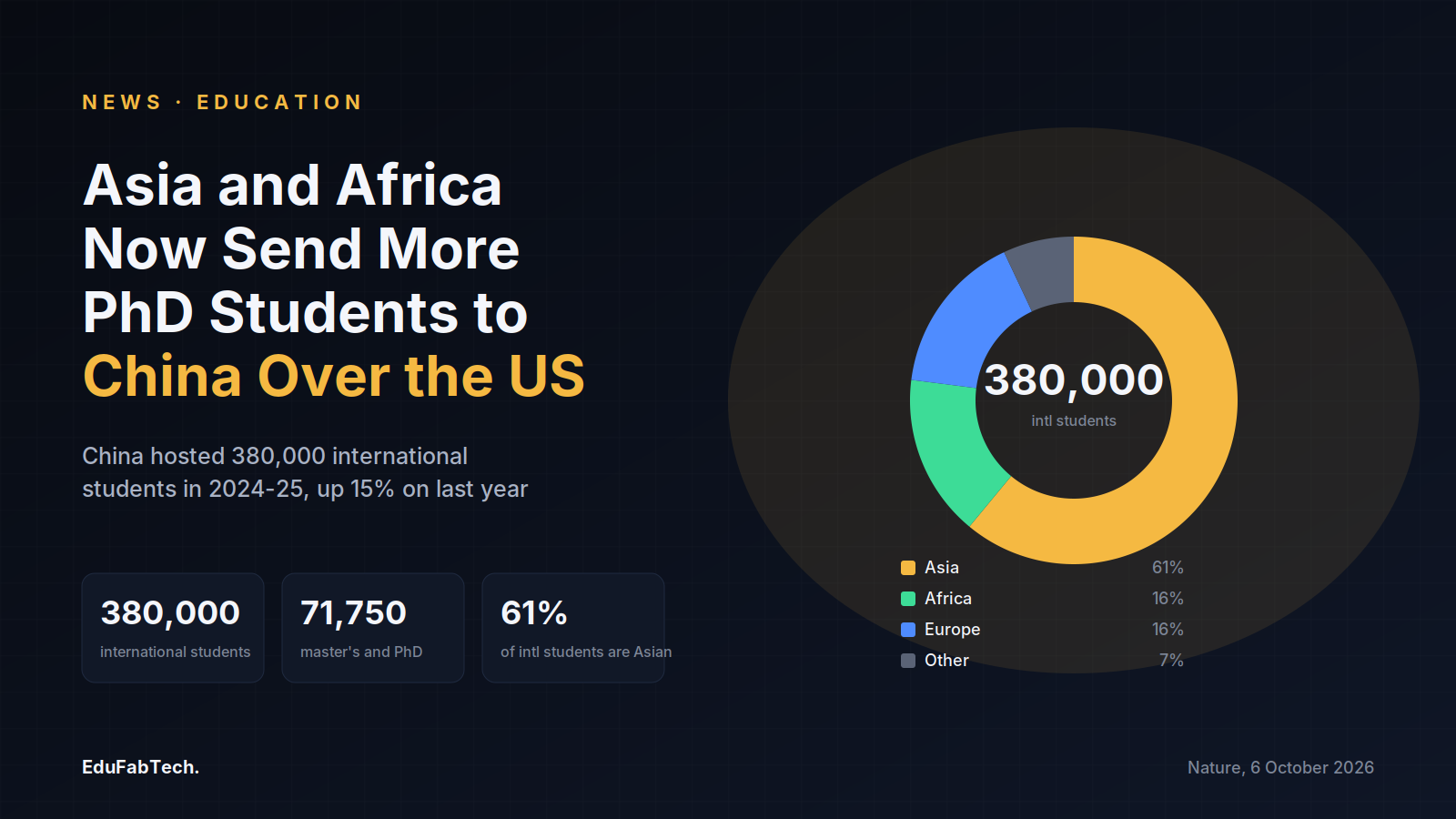
China hosted 380,000 international students in 2024-25, Ministry of Education data show, as a Nature feature published 6 October 2026 traces why doctoral candidates are choosing Chinese scholarships over Western universities.
On 6 October 2026, Nature published a feature tracing why growing numbers of doctoral students from Asia and Africa are choosing Chinese universities over long-standing destinations in the United States, the United Kingdom and Australia, built on interviews with students in Nanjing and Chengdu and on new enrolment data from China's Ministry of Education (Nature, 2026).
A larger, younger international student body
China hosted 380,000 international students in the 2024-25 academic year, up 15% on the previous year, according to Ministry of Education figures presented by senior official Xi Ru at the 2026 China Study Abroad Forum in Beijing on 13 April 2026, as reported by China Daily (2026). That is still below the roughly 500,000 foreign students China hosted before the pandemic, but within this year's cohort, 205,000 students were enrolled in degree programmes, and 35% of those, about 71,750 students, were in master's or doctoral programmes, the same report said.
Even at that scale, international students remain a small share of China's higher-education system: under 1% of its 48.5 million students, compared with roughly 6% in the United States and 24% in the United Kingdom, Nature (2026) reported.
The source countries are changing
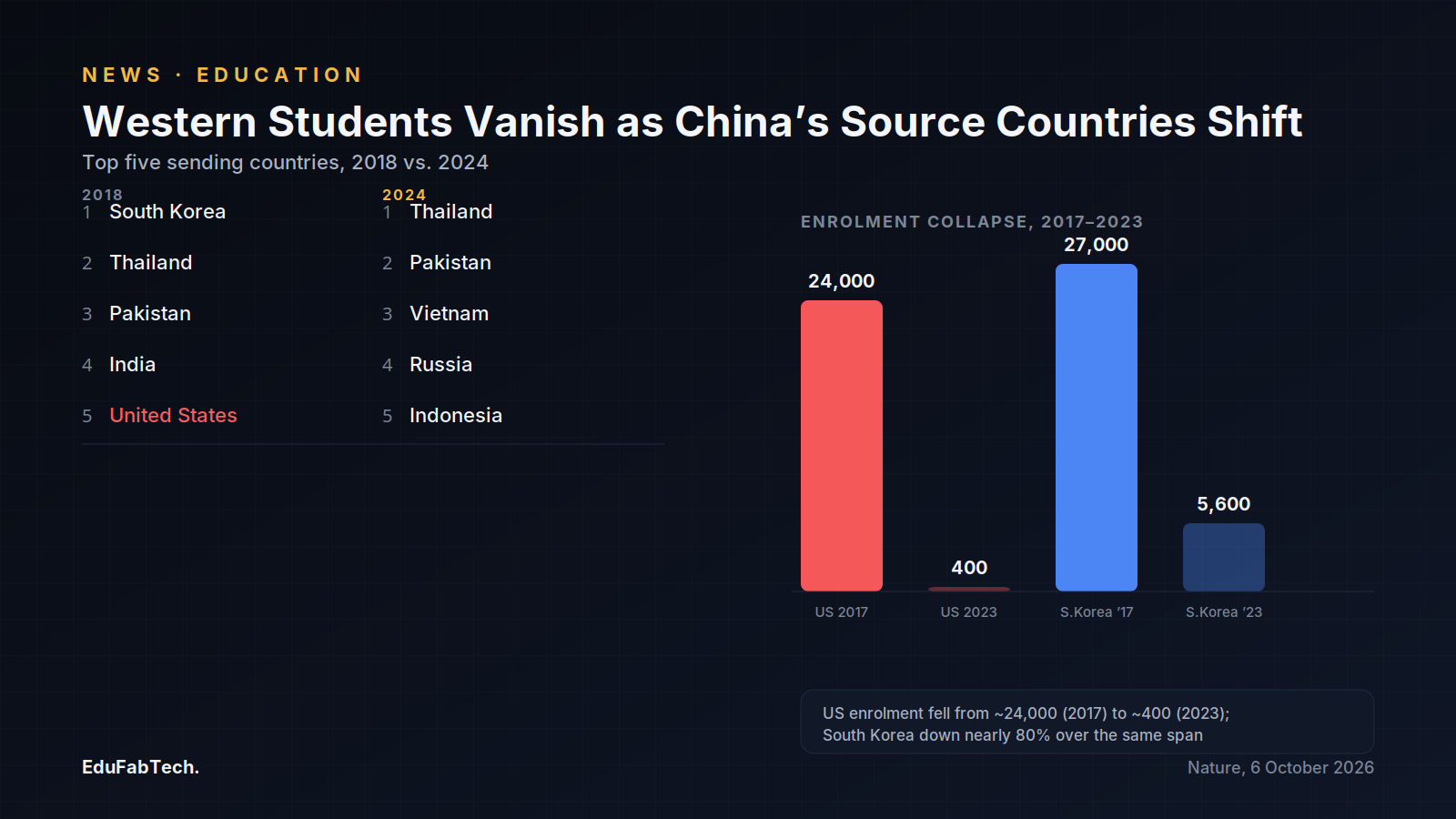
The mix of where students come from has shifted markedly. In 2018, the five largest source countries for international students in China were South Korea, Thailand, Pakistan, India and the United States; by 2024 the top five were Thailand, Pakistan, Vietnam, Russia and Indonesia, Nature (2026) found. Enrolment from South Korea fell by nearly 80% between 2017 and 2023, and the number of US students fell from about 24,000 in 2017 to roughly 400 in 2023, according to the same report.
| Rank | Top source countries, 2018 | Top source countries, 2024 |
|---|---|---|
| 1 | South Korea | Thailand |
| 2 | Thailand | Pakistan |
| 3 | Pakistan | Vietnam |
| 4 | India | Russia |
| 5 | United States | Indonesia |
Regionally, students from Asia made up 61% of the international total in 2024-25, those from Africa 16% and those from Europe 16%, Ministry of Education data reported by China Daily (2026) show. Engineering was the most popular field, chosen by 27.8% of degree-seeking students.
Funding, safety and a different kind of prestige
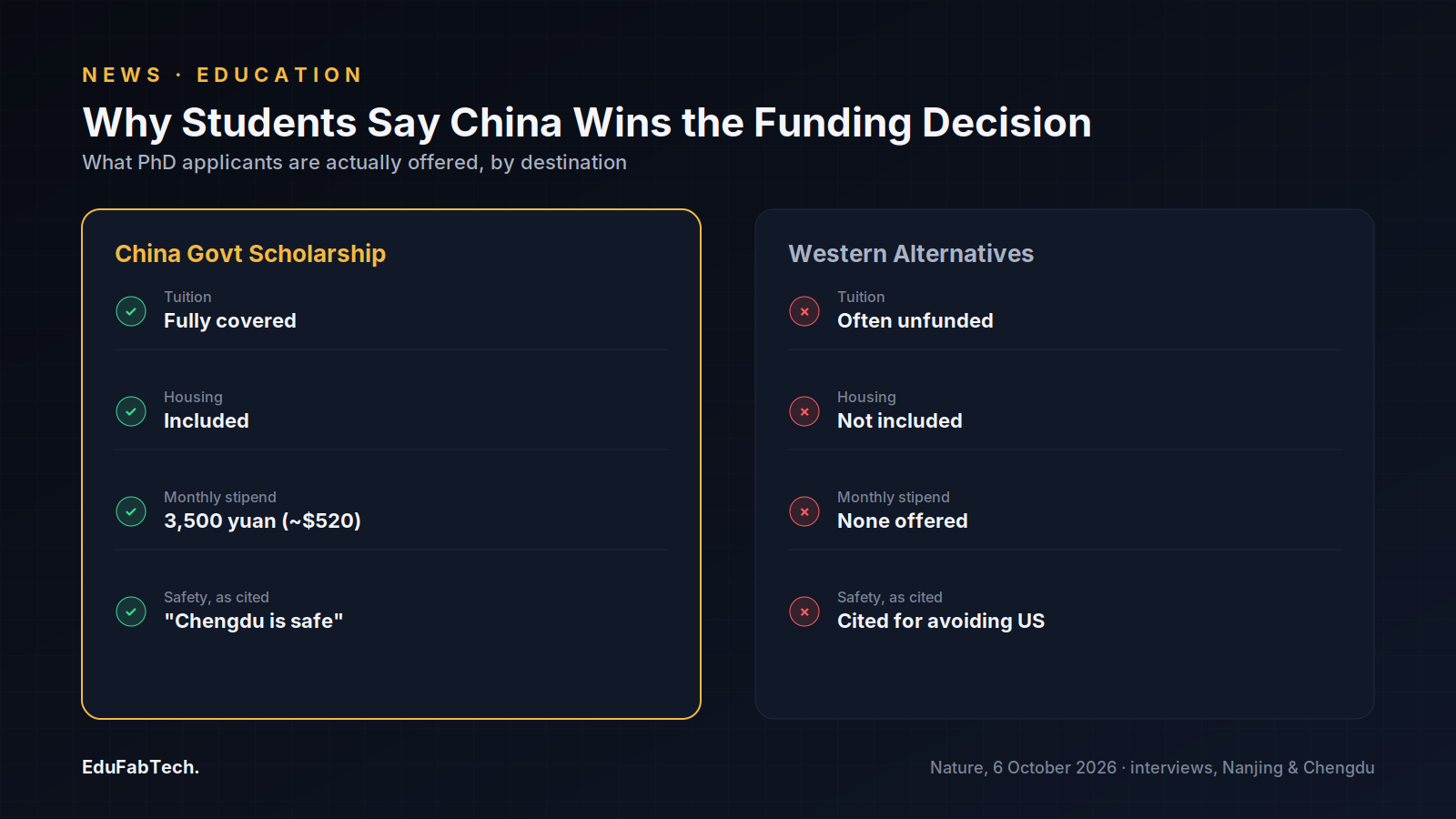
The students Nature (2026) interviewed point to money and safety as much as academics. Fatma Satyani, an Indonesian PhD student in big data and business intelligence at Nanjing University of Information Science and Technology, holds a Chinese Government Scholarship covering tuition and housing plus a stipend of 3,500 yuan, about $520, a month. Aminu Dalhatu Datti, a Nigerian doctoral student in meteorology at the same university, said he wanted "to come here and see the country" for himself.
Chairina Hanum Siregar, a third-year PhD student in management science and engineering at Sichuan University in Chengdu, told Nature she had applied to universities in the UK and Australia but was not offered funding, and did not apply to US institutions because of safety concerns. "As a woman, safety is very important, and I really like that the city of Chengdu is safe," she said.
A policy with a decade-long history
The growth traces back to a 2010 "Study in China" plan intended, in the government's own language, to "cultivate a batch of high-quality international students who understand China and are friendly to China," and to a 2016 decision to fold higher-education recruitment into the Belt and Road Initiative, which now spans more than 140 mostly low- and middle-income partner countries, Nature (2026) reported. Tu Mengwei, a sociologist at Swansea University, described the scholarship push to Nature as "part of a bigger scheme of expanding China's soft power and global influence."
What it means for students weighing their options
For prospective doctoral students, the trade-offs documented in the report are concrete rather than reputational. Chinese government scholarships typically guarantee tuition, insurance, housing and a stipend for the length of a PhD, at a time when the students interviewed cited unfunded offers from UK and Australian universities and safety concerns around the US as reasons to look elsewhere. Against that, Nature's reporting also recorded recurring complaints: the difficulty of learning Mandarin, limited employment options after graduation, a sense that Chinese degrees carry less weight internationally, and separation from Chinese classmates because international students are mostly taught in parallel, English-language programmes.
For researchers tracking global higher-education mobility, the shift also illustrates how quickly a pool of source countries can move: data from ICEF Monitor (2026) show Chinese student enrolment in Australia, Canada, the UK and the US down by about 13% from its 2019-20 peak, even as China's inbound numbers recover toward their own pre-pandemic level.
A quick question for readers
Have you thought about studying abroad?
The answers show what really stops students — cost, language or something else.
Pick an answer, create a free account in a minute, and your vote counts. Already a member? Sign in
Comments 0
CommentNo comments yet. Members start the conversation.
Source: Nature
Sources (3)
- Xiaoying You. Rising numbers of Asian and African PhD students choose to study in China. Nature, 2026. nature.com ↗ · checked 12 Oct 2026
- China Daily. China attracts 380,000 international students, marking growth in global education appeal. China Daily, 2026. chinadaily.com.cn ↗ · checked 12 Oct 2026
- ICEF Monitor. China in 2026: Slowing outbound student mobility, accelerating inbound momentum. ICEF Monitor, 2026. monitor.icef.com ↗ · checked 12 Oct 2026