First International Consensus Guideline for Personalized Phage Therapy Published in Nature Medicine
Twenty professional organizations and 18 experts set out more than 60 recommendations for selecting, producing and monitoring bacteriophage treatments against drug-resistant infections.
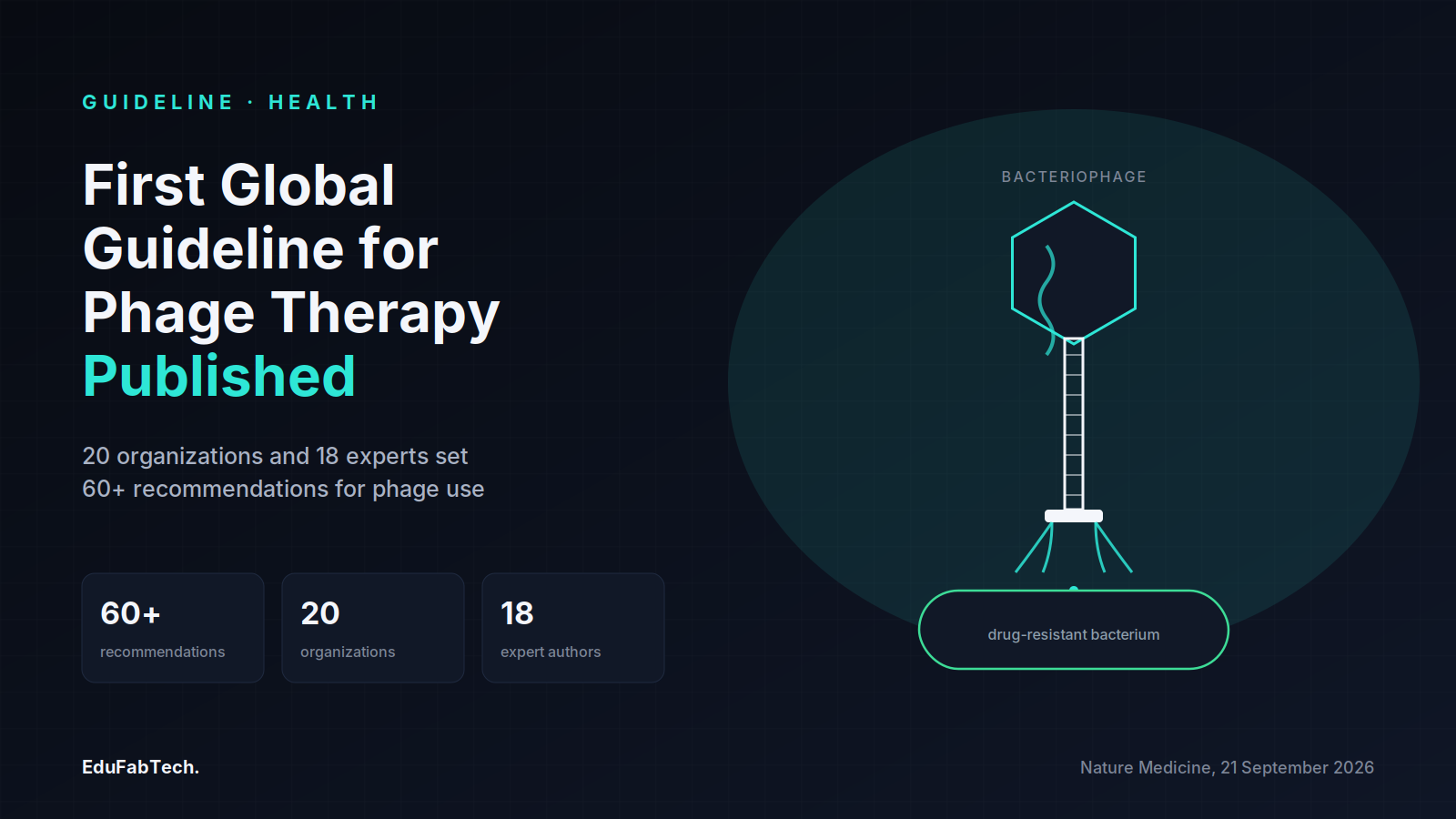
An international working group has published the first consensus guideline for personalized bacteriophage therapy, appearing in Nature Medicine on September 21, 2026. The guideline was coordinated by the German Society for Infectious Diseases (DGI) under the methodological framework of the Association of the Scientific Medical Societies in Germany, and it is the first attempt to set uniform, practice-oriented standards for a treatment that hospitals have so far delivered one patient at a time, outside routine regulatory pathways.
Bacteriophages are viruses that infect and kill specific bacteria. Interest in using them therapeutically has grown alongside the spread of antibiotic-resistant infections, but until now no professional body had issued coordinated recommendations covering how phages should be selected, tested, manufactured, administered and monitored. The new document, with corresponding authors Silvia Würstle, Simone Lieberknecht-Jouy and Maria Vehreschild of University Hospital Frankfurt and Annika Claßen of University Hospital Cologne, was built by 18 international experts, including representatives of regulatory agencies, drawing on input from 20 professional organizations and two patient advocacy groups.
The result is more than 60 recommendations spanning core principles, infrastructure, phage preparation and quality control, clinical administration, monitoring and documentation, and priorities for future research. According to the German Center for Infection Research, which supported the effort, the guideline took effect in January 2026 and remains valid through June 2030, with annual reviews scheduled in the interim to assess whether updates are needed.
What the guideline sets out
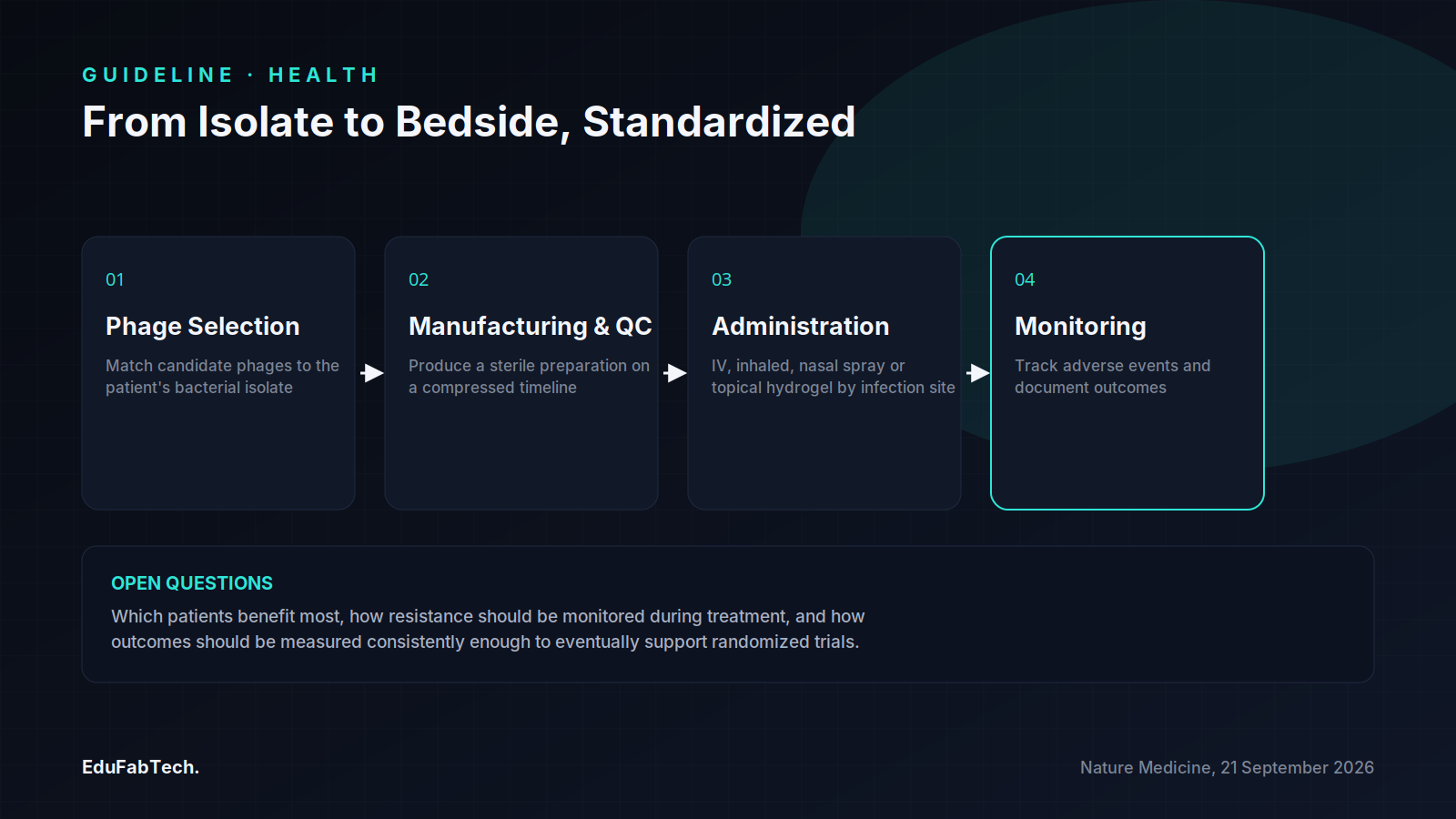
The recommendations are organized around the practical steps a hospital or laboratory needs to take before a patient ever receives a phage preparation. That includes criteria for identifying and characterizing candidate phages against a patient's specific bacterial isolate, infrastructure requirements for laboratories doing that matching work, manufacturing and quality-control standards for producing a sterile preparation on a compressed timeline, and protocols for administering phages intravenously, by inhalation, as a nasal spray, or in a topical hydrogel depending on the site of infection.
- Phage selection and susceptibility testing against the causative pathogen
- Laboratory infrastructure and manufacturing quality control
- Routes of administration matched to infection site
- Clinical monitoring, adverse-event reporting and documentation
- Open research questions the guideline group flags as unresolved
According to Medical Xpress, the framework is already being used clinically: University Hospital Frankfurt has treated ten patients since February 2026 under a phage therapy program aligned with the guideline, targeting pathogens including Pseudomonas aeruginosa and Staphylococcus aureus.
The evidence the guideline rests on
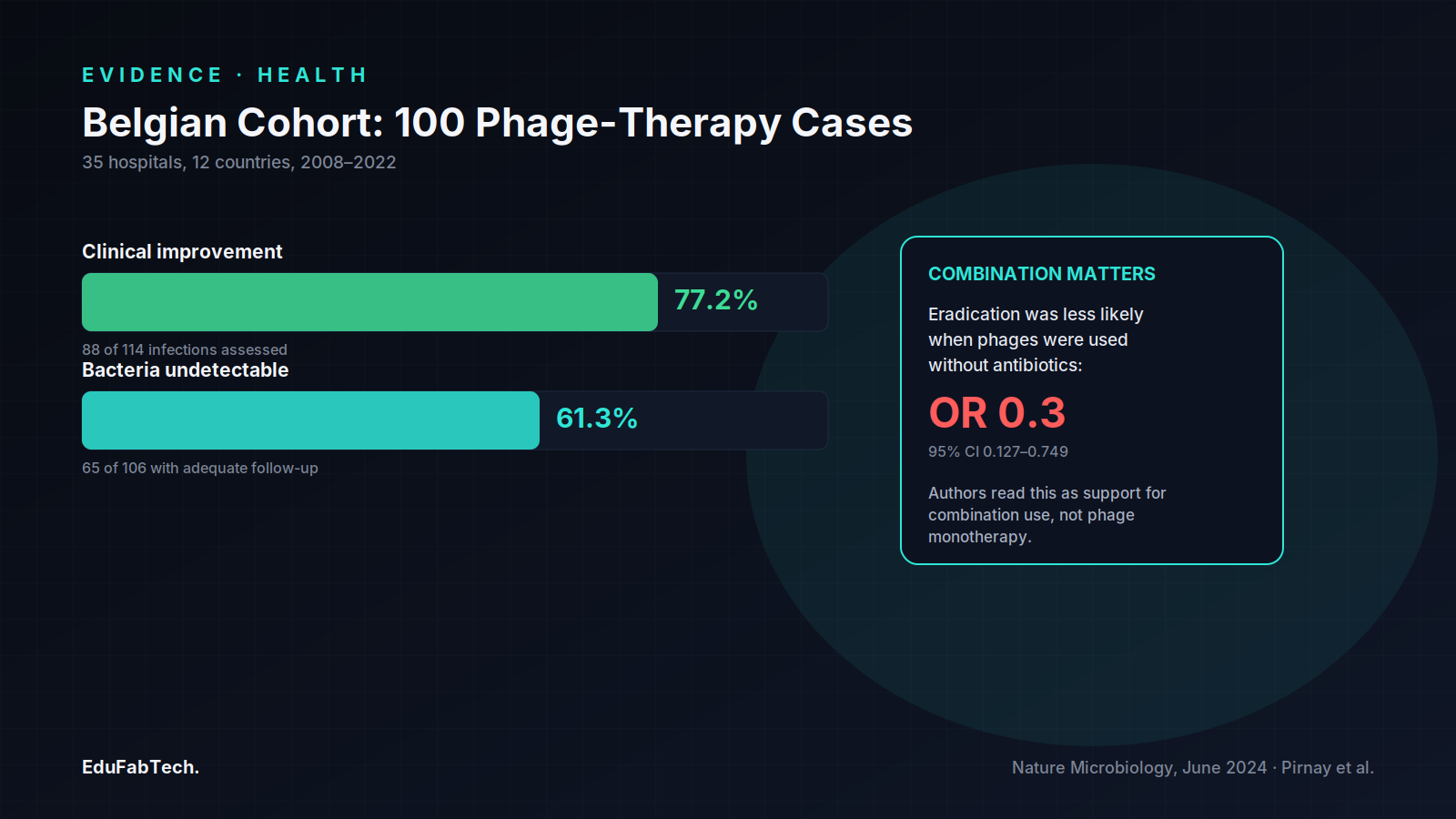
The strongest published outcome data behind personalized phage therapy so far comes from a Belgian consortium's retrospective review of its first 100 consecutive cases, treated across 35 hospitals in 29 cities and 12 countries between 2008 and 2022 and published in Nature Microbiology in June 2024. Clinical improvement was reported in 77.2% of infections (88 of 114 assessed) and the targeted bacteria became undetectable in 61.3% of infections with adequate follow-up (65 of 106). No serious phage-related adverse reactions were recorded. Notably, bacterial eradication was substantially less likely when phages were used without concomitant antibiotics (odds ratio 0.3, 95% confidence interval 0.127–0.749), a finding the study's authors, led by Jean-Paul Pirnay of Queen Astrid Military Hospital in Brussels, describe as supporting combination use rather than phage monotherapy.
That study is explicitly retrospective and observational, not a randomized trial, and its authors and the new guideline group both describe the evidence base as still forming rather than settled. The guideline itself devotes a section to open research questions, including which patients benefit most, how phage resistance should be monitored during treatment, and how outcomes should be measured consistently enough to eventually support randomized comparisons.
Why standardization matters now
The push for common standards comes as drug-resistant infections remain a substantial global health burden. Bacterial antimicrobial resistance was associated with an estimated 4.7 million deaths worldwide in 2021, according to a World Health Organization fact sheet last updated in July 2026, which also reports that roughly one in six laboratory-confirmed bacterial infections globally were resistant to antibiotics in 2023. Personalized phage therapy has generally been offered as a last-resort option when antibiotics fail, are unavailable, or are unsuitable for a given patient, typically under compassionate-use or named-patient regulatory routes rather than as an approved therapy.
The guideline authors frame standardized quality criteria as a precondition for phage therapy to move beyond scattered compassionate-use cases toward more systematic evaluation. Whether that translates into broader clinical access will depend on how national regulators, most of which have no dedicated framework for individualized biological therapeutics, choose to adopt or adapt the recommendations.
- Silvia Würstle et al.. A consensus-based guideline for personalized bacteriophage therapy. Nature Medicine, 2026. doi:10.1038/s41591-026-04654-6
- Jean-Paul Pirnay et al.. Personalized bacteriophage therapy outcomes for 100 consecutive cases: a multicentre, multinational, retrospective observational study. Nature Microbiology, 2024. doi:10.1038/s41564-024-01705-x
- World Health Organization. Antimicrobial resistance (fact sheet). World Health Organization, 2026. link
- German Center for Infection Research (DZIF). Common standards for the use of phages against hard-to-treat infections. EurekAlert!, 2026. link
- Medical Xpress. First global guideline sets standards for the use of phages in hard-to-treat infections. Medical Xpress, 2026. link