DHS Proposes Up to $100,000 in OPT Fees Paid by US Colleges, Far Above Other Countries' Charges
A proposed US rule would charge colleges $70,000 for a first work authorization and $30,000 for a renewal per international graduate, far more than the UK, Canada or Australia charge for comparable post-study work visas.
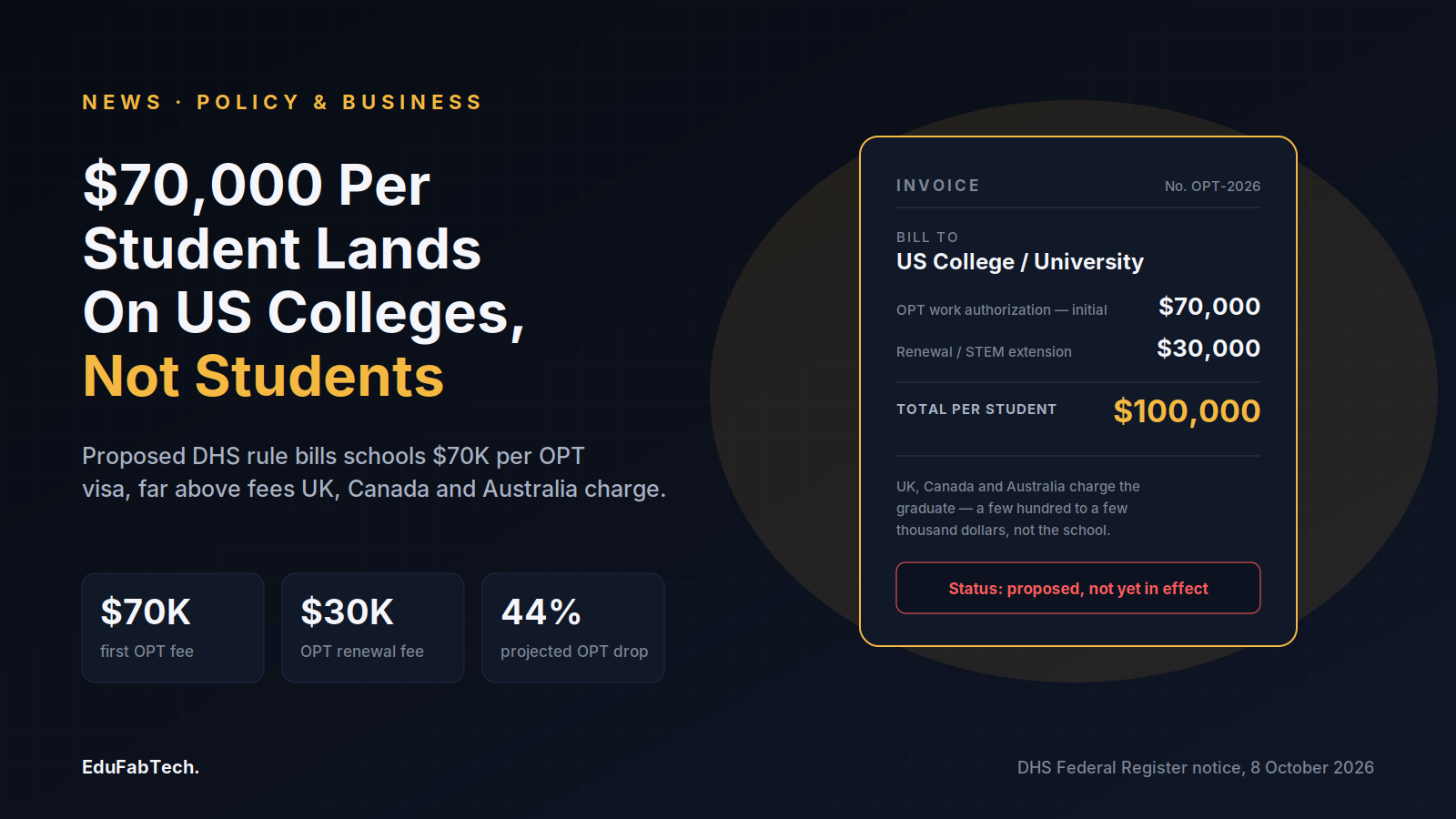
The US Department of Homeland Security published a proposed rule in the Federal Register on October 8, 2026 that would require colleges and universities to pay $70,000 for each international student's first authorization under Optional Practical Training (OPT), plus a further $30,000 for any subsequent or STEM-extension authorization for the same student. DHS announced the proposal on October 7, 2026, confirming that the fee falls on the school, which must pay before a designated school official recommends a student for work authorization or before the student applies to the US Citizenship and Immigration Services.
OPT lets international students on F-1 visas work in their field of study for up to one year after graduating, extendable to three years for those in science, technology, engineering and mathematics. DHS says the new charges are meant to combat fraud, citing cases in which schools, designated school officials, employers and F-1 students have exploited OPT rules through problematic worksites and so-called "pay-to-stay" visa arrangements, according to the agency's October 7, 2026 announcement. A DHS spokesperson said in that announcement: "Optional Practical Training was never meant to be a back door into the American workforce, a subsidy for cheap labor, or a prize for those who game the system."
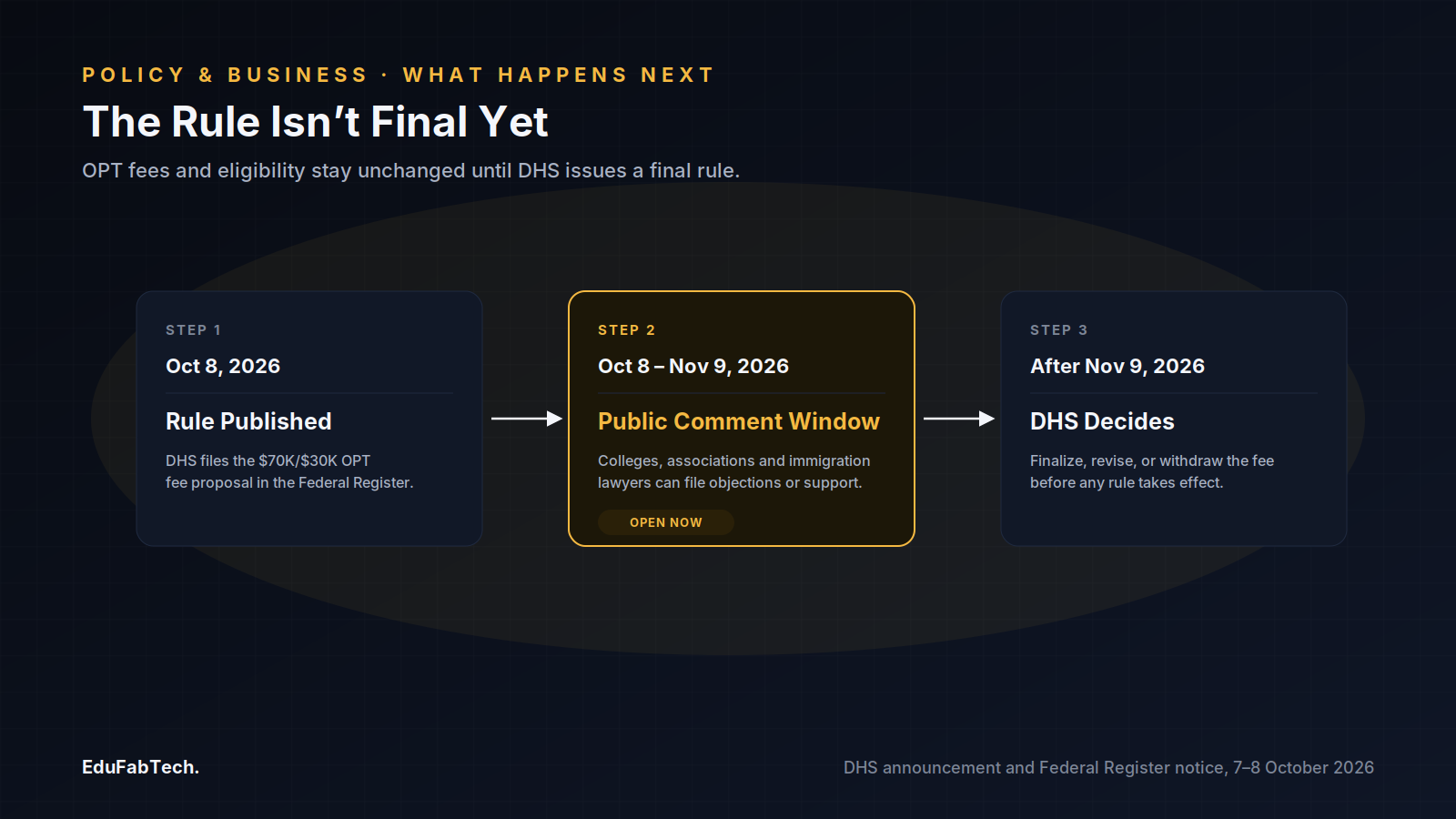
The rule is not yet in effect. Public comments are open from October 8 to November 9, 2026, after which DHS can finalize, revise or withdraw it.
Why the figure matters beyond one country
OPT is the largest single channel through which international graduates enter the US workforce. About 420,000 international students, roughly one-third of all international students in the country, participated in OPT during the 2025–26 academic year, according to a Nature news report (2026). The same report cites Michael Clemens, an economist at the Johns Hopkins School of Government and Policy, noting that OPT is particularly important for doctoral graduates in STEM fields, about 70% of whom used the programme in 2022.
Nature's reporting on the rule's own economic analysis found that DHS projects OPT participation could fall by as much as 44% if the fee takes effect, and that the fees could cost universities between $8.4 billion and $16.5 billion a year, costs that institutions would likely pass on through tuition or reduced international recruitment. Policy specialists quoted in that report said the change would weaken a pipeline that has long supplied science and engineering graduate programmes with talent.
How other countries price the same step
Several other major destinations for international students run comparable post-study work schemes, but at a different scale and with the cost falling on the graduate rather than the institution.
| Country | Route | Who pays | Cost | Typical duration |
|---|---|---|---|---|
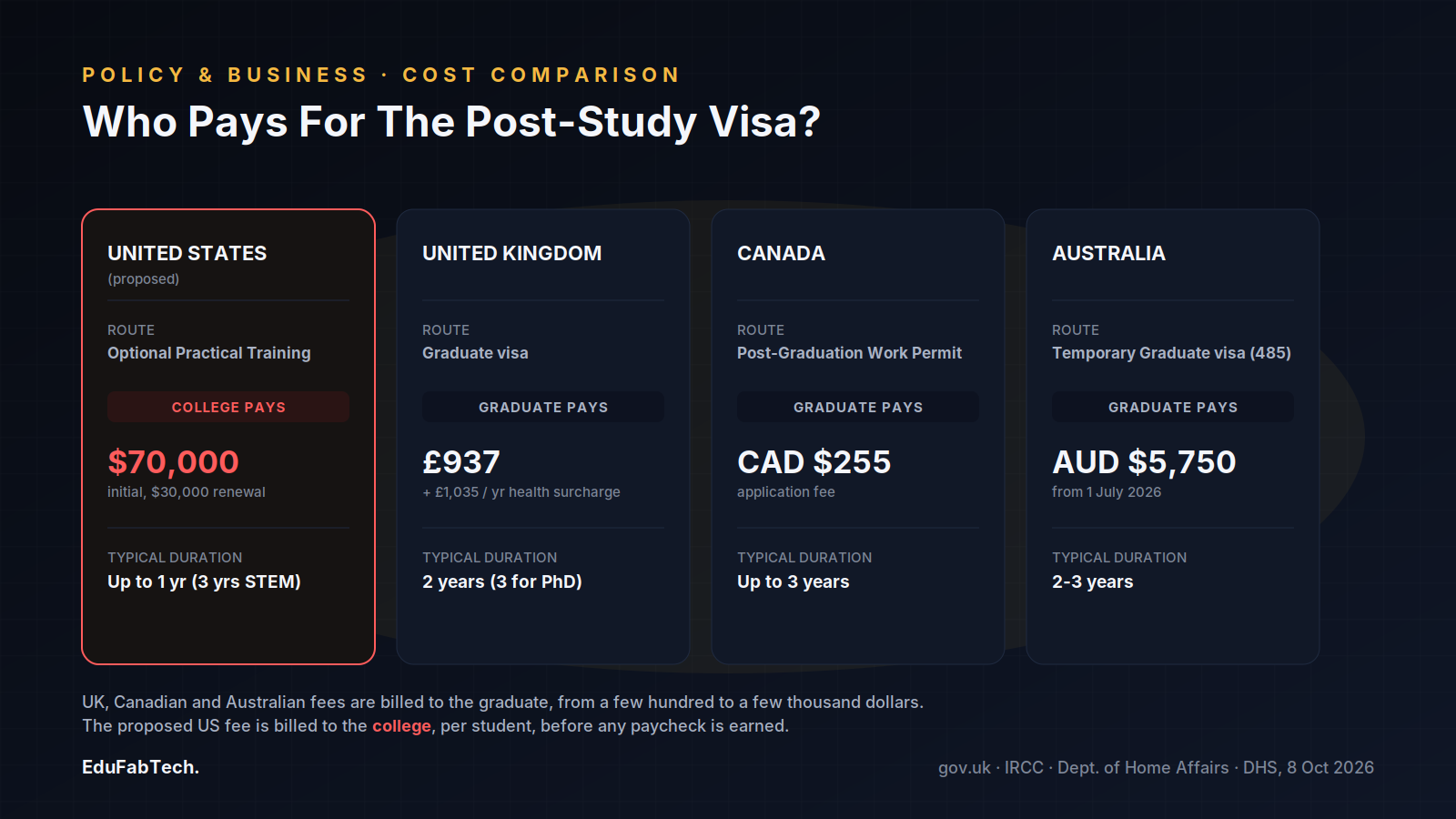
| United States (proposed) | Optional Practical Training | College or university | $70,000 initial, $30,000 per renewal | Up to 1 year, extendable to 3 for STEM |
| United Kingdom | Graduate visa | Graduate | £937 application fee plus £1,035 per year of Immigration Health Surcharge, per gov.uk | 2 years (3 for PhD graduates), per gov.uk |
| Canada | Post-Graduation Work Permit | Graduate | CAD $255 application fee, per Immigration, Refugees and Citizenship Canada | Up to 3 years, per IRCC |
| Australia | Temporary Graduate visa (subclass 485) | Graduate | AUD $5,750 for applications from 1 July 2026, per the Department of Home Affairs | 2 years for bachelor's and coursework master's graduates, 3 years for research master's and doctoral graduates |
The comparison shows two different cost structures rather than one scaled-up version of the other. The UK, Canadian and Australian fees are charged directly to the graduate and run from roughly a few hundred to a few thousand dollars. The proposed US fee is charged to the institution per student and runs into the tens of thousands of dollars before a graduate has earned a single paycheck.
What happens next
Because the rule is still a proposal, OPT eligibility, fees and application procedures remain unchanged for now, as DHS stated in its own announcement. Universities, higher-education associations and immigration lawyers are expected to file comments before the November 9, 2026 deadline, and DHS could adjust the fee amounts or the fraud-related justification before issuing a final rule. For prospective international students choosing where to study, and for the graduate schools and research labs that recruit them, the proposal adds a large and so far unresolved variable to a decision that other countries currently price far lower.
A quick question for readers
Do you work part-time while you study?
Many students work to pay the bills. See how common it is — and how many hours people really do.
Pick an answer, create a free account in a minute, and your vote counts. Already a member? Sign in
Comments 0
CommentNo comments yet. Members start the conversation.
Source: U.S. Department of Homeland Security
Sources (3)
- U.S. Department of Homeland Security. DHS Proposes Fees for Foreign Student Work Program to Protect American Jobs. U.S. Department of Homeland Security, 2026. dhs.gov ↗ · checked 11 Oct 2026
- U.S. Department of Homeland Security. Optional Practical Training Fees. Federal Register, 2026. govinfo.gov ↗ · checked 11 Oct 2026
- Suzi Wilson. US proposes $100,000 charge for international students to do post-graduate work. Nature, 2026. nature.com ↗ · checked 11 Oct 2026