DNA Typewriter Reconstructs a Mouse Embryo's Nearly Complete Cell Lineage Tree in Science Study
Published October 8, 2026, the University of Washington and Dartmouth-led study traced 1.3 million cells from a single fertilized egg through 13.5 days of mouse development.
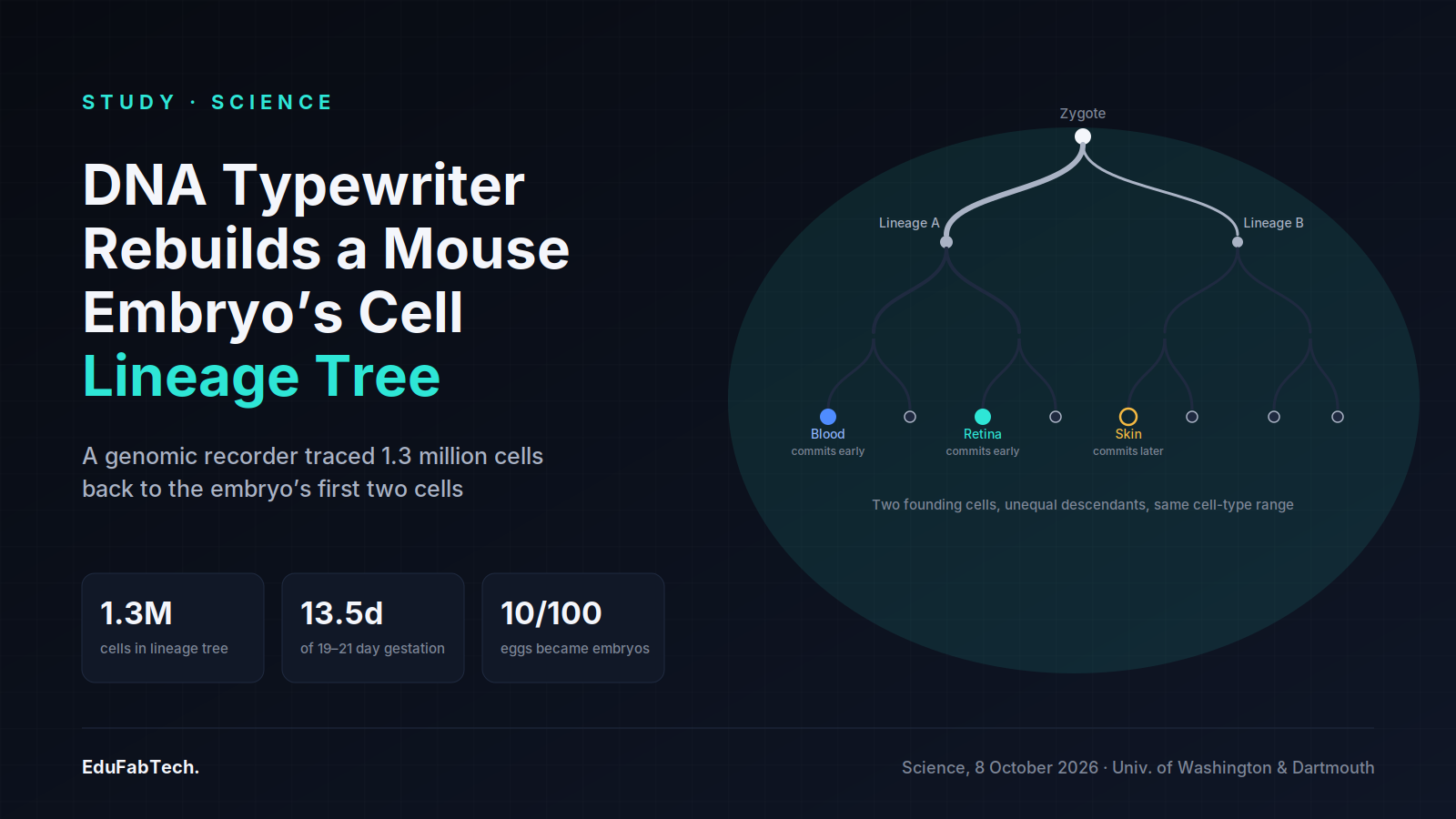
Researchers at the University of Washington School of Medicine and Dartmouth College reported in Science on October 8, 2026 that they had reconstructed the nearly complete cell lineage tree of a developing mouse, tracing roughly 1.3 million cells back to the two daughters of its first cell division. The team, led by co-senior authors Jay Shendure of the University of Washington and Chengxiang Qiu of Dartmouth, built the tree by inserting a genetic recording device called DNA Typewriter into a fertilized mouse egg before it began dividing.
A Recorder Built Into the Genome
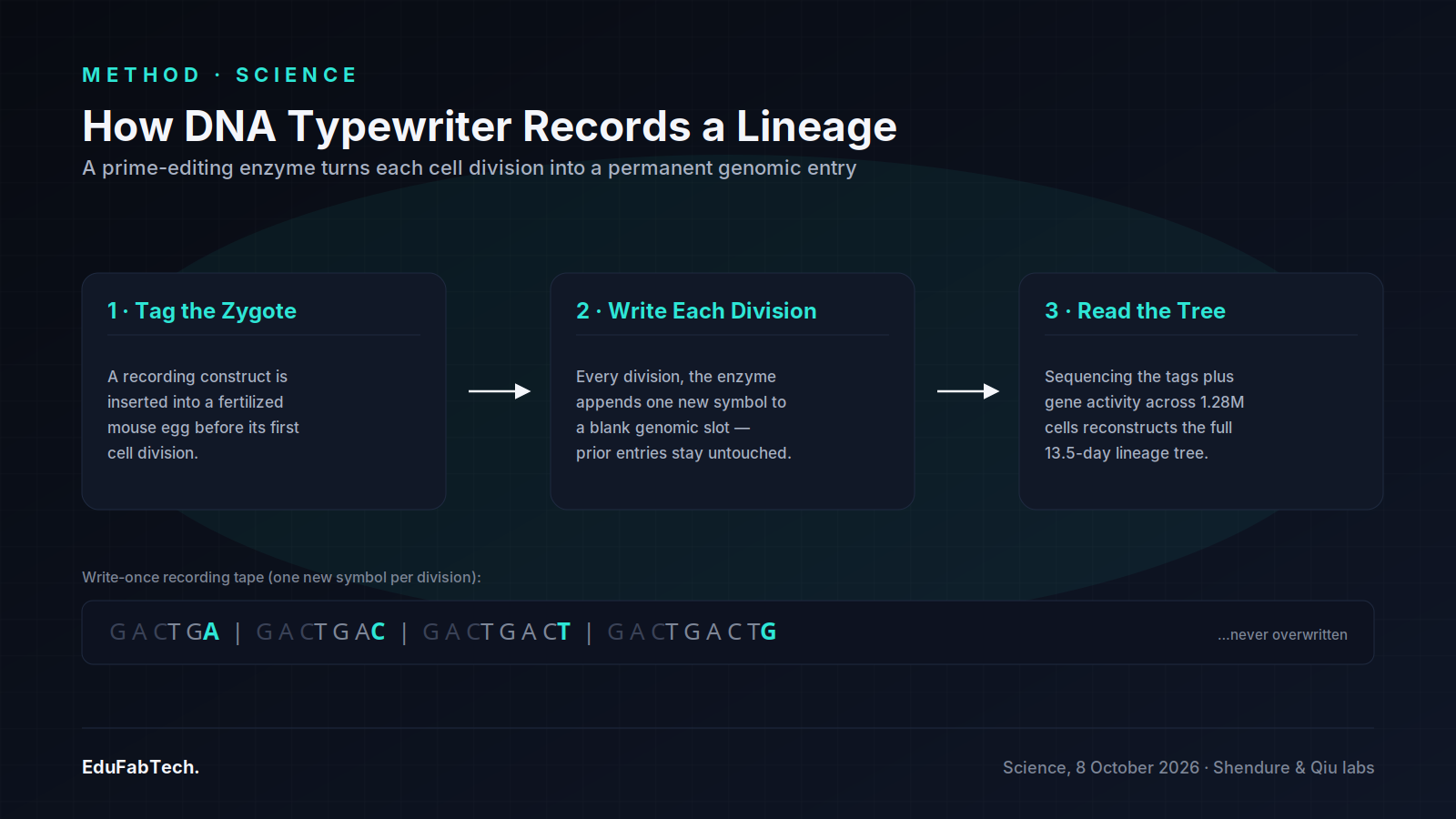
DNA Typewriter, originally developed by Shendure and Junhong Choi, now at Memorial Sloan Kettering Cancer Center, uses a cell's own DNA as a write-once tape. Each time a tagged cell divides, a prime-editing enzyme adds one new character to a designated genomic locus, always onto the next blank position rather than overwriting what came before, according to the University of Washington's account of the study. Because the symbols accumulate strictly in order, the resulting sequence in any cell's genome spells out that cell's entire division history, and comparing sequences across cells reveals how closely related they are.
Of 100 fertilized mouse eggs that received the recording construct, 10 developed into viable embryos, and the researchers focused their most detailed reconstruction on one of them, tracking cell divisions and gene expression over 13.5 days of a mouse gestation that normally runs 19 to 21 days, according to the University of Washington's account of the study.
From Two Cells to Organs
By sequencing the typewritten tags alongside each cell's gene activity, the team reconstructed a phylogenetic tree spanning roughly 1.28 million transcriptionally profiled cells, linking the embryo's organs and tissues back to its first cleavage. The analysis showed that the two daughter cells produced by that first division did not contribute equally: one lineage produced more descendants than the other, yet both founding lineages still generated the full range of cell types in roughly similar proportions, per the EurekAlert release describing the findings.
Cell Types Commit on Different Schedules
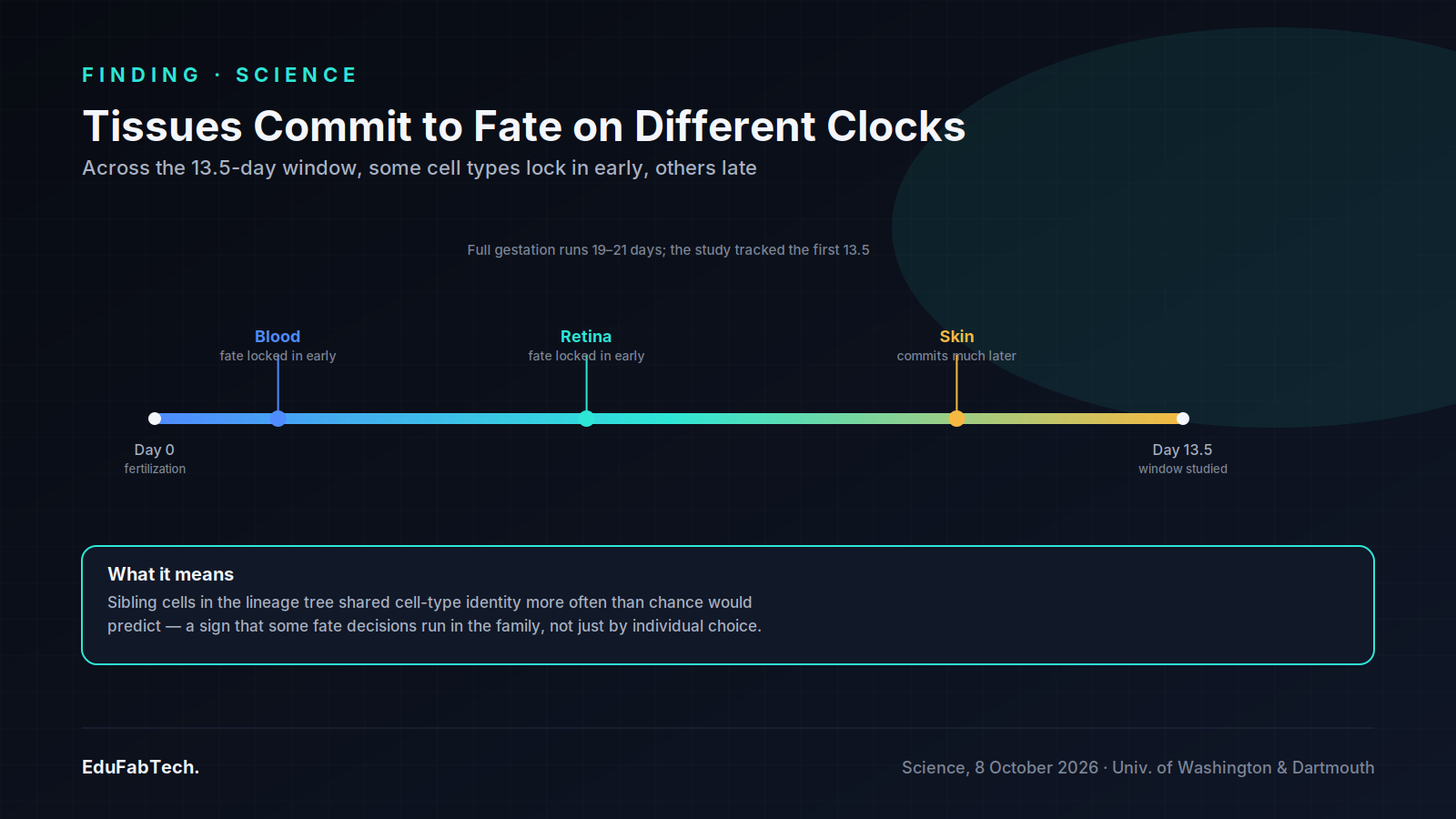
The reconstructed tree also let the researchers date when different tissues locked into their identity. Blood cells and the retina committed to their fates relatively early in the 13.5-day window the team examined, while the outer layer of skin did not commit until noticeably later, according to the University of Washington's account of the study. Sibling cells in the tree also shared cell-type identity more often than chance would predict, a pattern reported in the Science paper, suggesting that some developmental decisions are inherited along family lines rather than made independently by each cell.
What the Study Does and Doesn't Show
The reconstruction in Science rests on a single fully profiled embryo out of ten that survived to the relevant stage from 100 attempts, a detail the University of Washington's release reports alongside the headline result. The authors present this as a demonstration that whole-organism lineage recording through late organogenesis is feasible with current prime-editing tools, not as a settled description of mouse development in general; broader claims about typical patterns of lineage commitment would need the method applied across additional embryos.
Why Researchers Are Watching This Method
Lineage-tracing methods have historically relied on dyes, viral barcoding or genetic markers that capture only a handful of cell divisions or a limited window of development. A tool that can run continuously from the zygote through organ formation gives developmental biologists a way to ask when and why a given tissue's fate becomes fixed, which bears on questions ranging from birth defects to how abnormal cell growth drives cancer, according to the University of Washington's announcement of the work.
For labs working in developmental biology or cancer research, the paper is as much a methods contribution as a biological one: it specifies the recording and sequencing pipeline in enough detail that other groups working with mouse models could, in principle, apply DNA Typewriter to their own lineage questions, provided they can tolerate the same high embryo attrition the UW and Dartmouth team reported.
A quick question for readers
Which study habit do you think is most overrated?
Some popular habits have little evidence behind them. Which one do you think gets too much credit?
Pick an answer, create a free account in a minute, and your vote counts. Already a member? Sign in
Comments 0
CommentNo comments yet. Members start the conversation.
Source: Science (AAAS)
Sources (2)
- Qi Yu, Haedong Kim, Sophie Seidel, et al.. A DNA Typewriter records the cell lineage history of a mouse, from zygote to late organogenesis. Science, 2026. science.org ↗ · checked 9 Oct 2026
- University of Washington School of Medicine. DNA Typewriter records cells' history in early mouse embryo. EurekAlert!, 2026. eurekalert.org ↗ · checked 9 Oct 2026