GitHub Makes Local Sandboxing of Copilot Coding Agents Generally Available
From October 7, 2026, GitHub Copilot's coding agents can run inside an OS-level sandbox across CLI, app and VS Code, limiting file, network and credential access; individuals opt in, organizations can enforce it by policy.
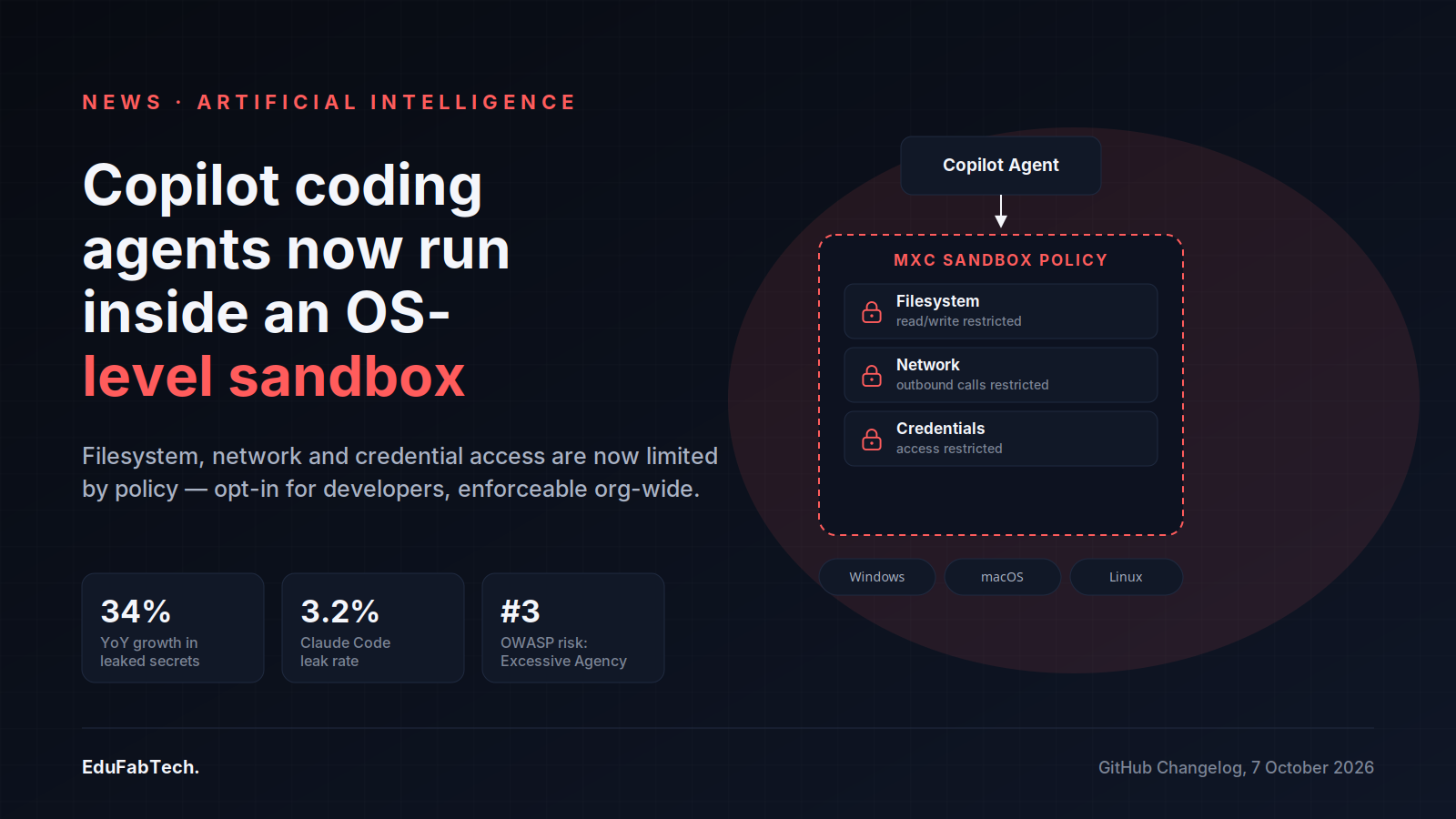
On October 7, 2026, GitHub made local sandboxing for GitHub Copilot's coding agents generally available, giving developers an operating-system-level boundary around what an AI agent is allowed to touch while it works. The control covers GitHub Copilot CLI, the standalone Copilot app, and VS Code sessions that use Agent Host, and it ships at no additional cost, according to GitHub's changelog entry announcing the release (GitHub, 2026). Before this, an agent's tool calls and shell commands generally ran with the same file, network and credential access as the developer who invoked them.
A sandbox for every agent session
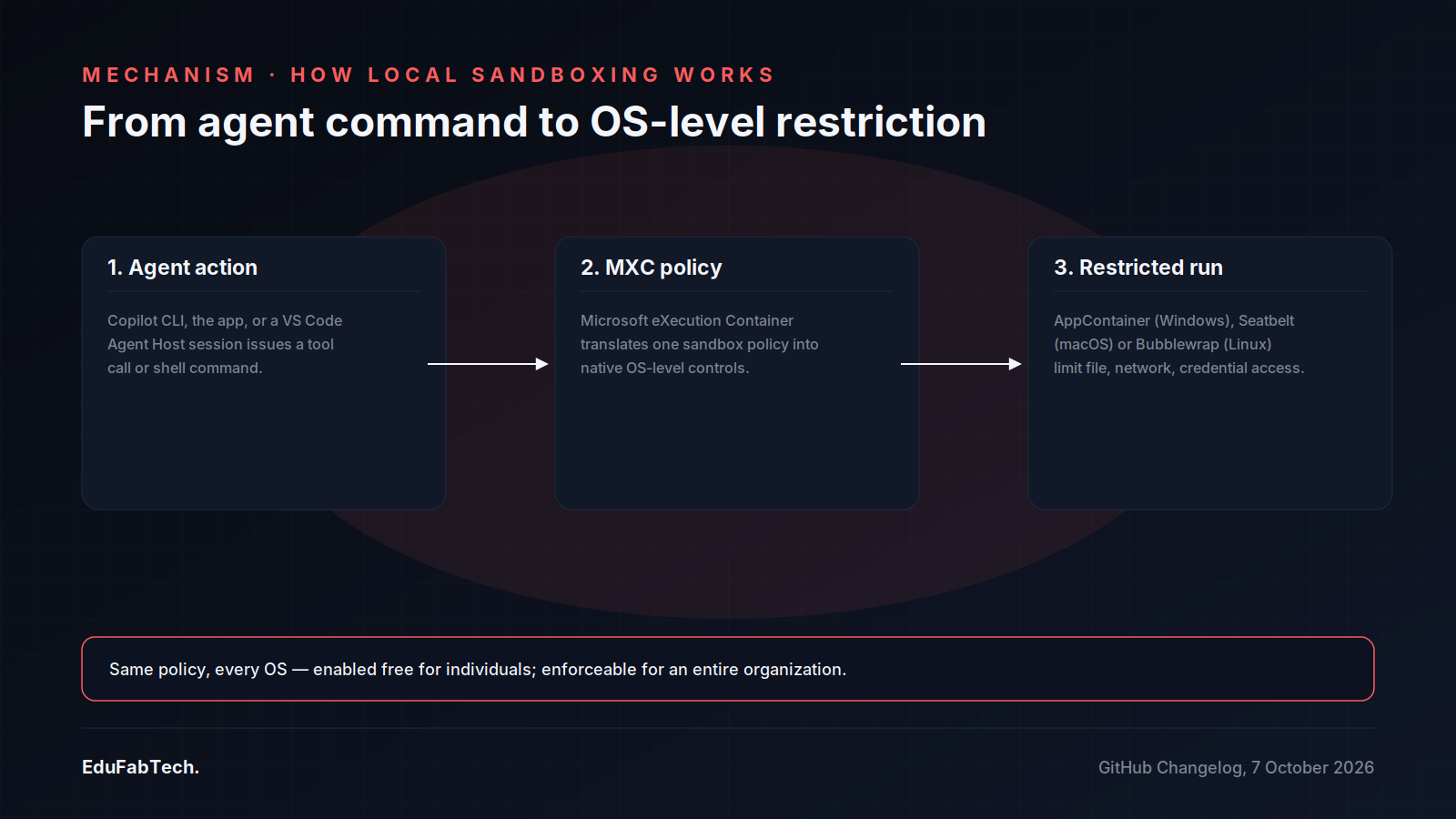
GitHub describes the feature plainly: "Tools and commands initiated by Copilot run with restricted access to the filesystem, network, credentials, and other system capabilities, based on policies defined by the developer or their organization," according to the same GitHub changelog post (GitHub, 2026). The enforcement layer is Microsoft eXecution Container (MXC), which GitHub says "translates a common sandbox policy into native operating-system controls across Windows, macOS, and Linux" — AppContainer-style process isolation on Windows, Seatbelt on macOS, and Bubblewrap on Linux, so the same policy behaves consistently regardless of which machine an agent is running on.
Individual developers can set their own filesystem, network and credential rules, but organizations get a stronger option: GitHub's changelog states that enterprise administrators can "use enterprise-managed settings to require sandboxing and enforce policies that developers cannot weaken." That turns sandboxing from an opt-in safeguard into a baseline an organization's Copilot users cannot disable, configured centrally through managed settings rather than left to each developer's judgment.
The risk this targets
The timing lines up with data on what unsandboxed coding assistance has already produced. GitGuardian's State of Secrets Sprawl 2026 report, published in March 2026, found that 28.65 million new hardcoded secrets were added to public GitHub commits in 2025, a 34% year-over-year increase and the largest single-year jump the firm has recorded. Secrets tied specifically to AI services rose 81% over the same period, which GitGuardian attributes in part to the proliferation of API keys and tokens that AI coding tools now read and write on a developer's behalf.
The same report measured a gap between AI-assisted and purely human commits: Claude Code-assisted commits showed a 3.2% secret-leak rate, versus a 1.5% baseline across all public GitHub commits (GitGuardian, 2026). GitGuardian is careful to note this is not simply a tool failure — a developer still accepts, edits or pushes whatever an assistant proposes — but the gap shows why limiting what an agent can read from disk or send over the network reduces the blast radius of a single bad suggestion, autocompletion of a stray credential, or a manipulated prompt.
That failure mode has a name in the security community that tracks these systems. The OWASP GenAI Security Project's 2026 Top 10 for LLM Applications ranks "Excessive Agency" third among the risks it tracks, describing it as the first edition to weigh community expert judgment "against a large body of real incident data" rather than expert opinion alone. Excessive agency covers exactly the scenario local sandboxing is built to contain: an agent with more filesystem, network or credential reach than the task in front of it actually requires.
What the sandbox doesn't cover
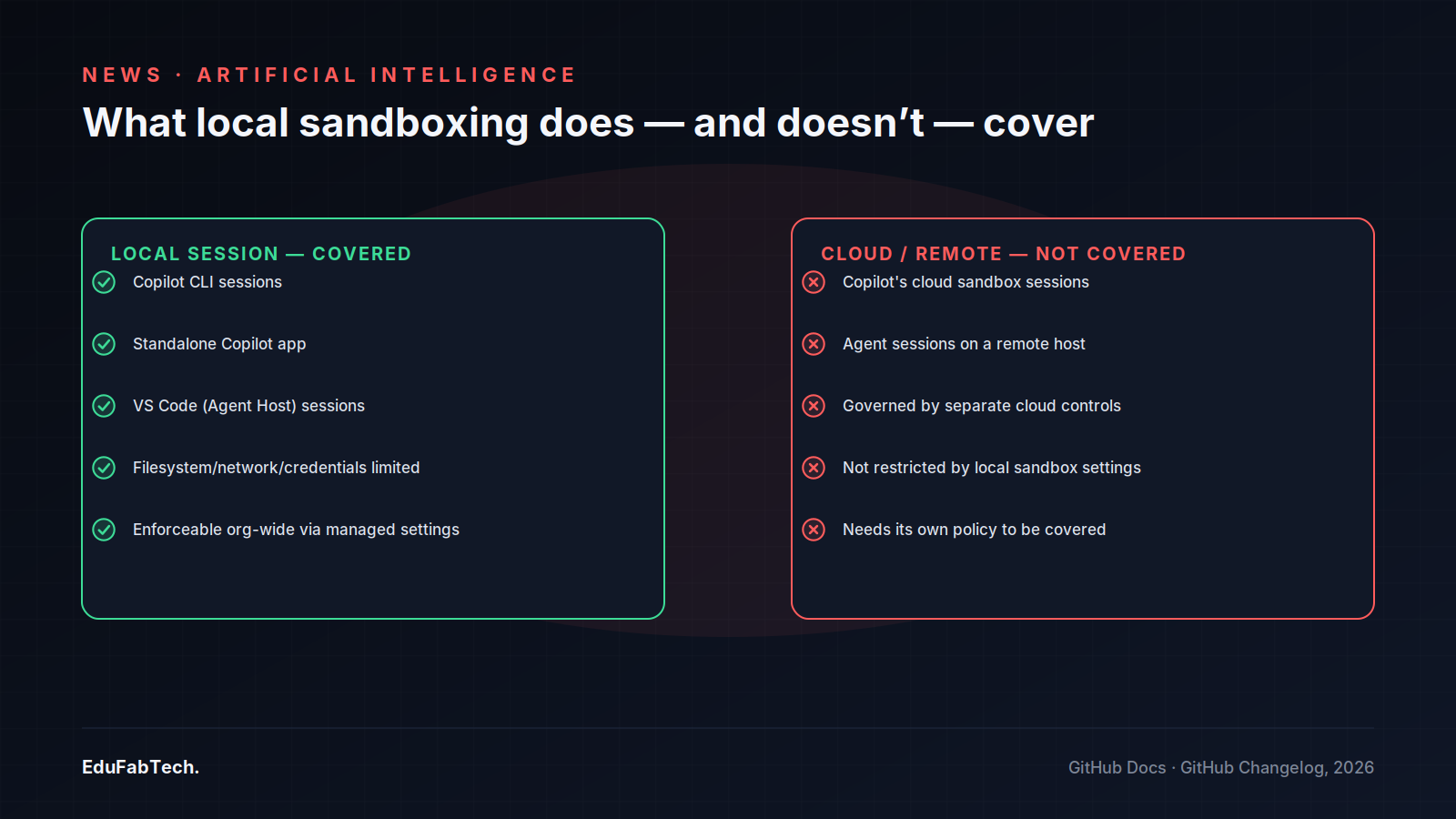
The protection has a defined edge. GitHub's own documentation notes that local sandbox settings apply to sessions running on a developer's own machine; they do not extend to Copilot's cloud sandbox sessions or to agent sessions running on a remote host, which are governed by separate controls. A developer who runs an agent locally with sandboxing enabled, then hands the same task to a cloud-hosted agent session, is not automatically covered by the same restrictions.
What it means for developers and researchers
For students, researchers and engineers who increasingly delegate shell commands, file edits and dependency installs to an AI coding agent, the practical change is that a misbehaving or manipulated agent now has a narrower default blast radius — provided sandboxing is actually turned on and the policy is tight enough to matter. Teams running Copilot in a lab or research-software setting can use enterprise-managed settings to make that non-optional, which is relevant anywhere students or collaborators bring their own API keys, cloud credentials or shared datasets into a repository an agent can touch.
The broader lesson sits in the gap between the two reports cited above: GitHub's control reduces what an agent can reach, but GitGuardian's data describes a leak rate that is still driven by what a human developer approves. Sandboxing lowers the cost of a single bad agent action; it does not substitute for reviewing what an agent proposes before it is committed, pushed or run with elevated access.
A quick question for readers
Which skill will matter most for getting a job in 2030?
Everyone has a prediction. Add yours and see what students are betting on.
Pick an answer, create a free account in a minute, and your vote counts. Already a member? Sign in
Comments 0
CommentNo comments yet. Members start the conversation.
Source: GitHub
Sources (3)
- GitHub. Local sandboxing for GitHub Copilot now generally available. GitHub Changelog, 2026. github.blog ↗ · checked 13 Oct 2026
- GitGuardian. The State of Secrets Sprawl 2026: AI-Service Leaks Surge 81% and 29M Secrets Hit Public GitHub. GitGuardian, 2026. blog.gitguardian.com ↗ · checked 13 Oct 2026
- OWASP GenAI Security Project. OWASP GenAI Security Project Unveils 2026 Top 10 for LLM Applications, New Agent Control Standard and Sponsors as Community Tops 30,000 Members. OWASP, 2026. genai.owasp.org ↗ · checked 13 Oct 2026