Gene Therapy Cuts Bleeding Episodes in Adolescents With Hemophilia B, Small Phase 1 Trial Finds
A single infusion of an AAV-delivered factor IX gene brought bleeding rates down in 11 adolescents in China, extending results already seen in adults to a younger, still-growing patient group.
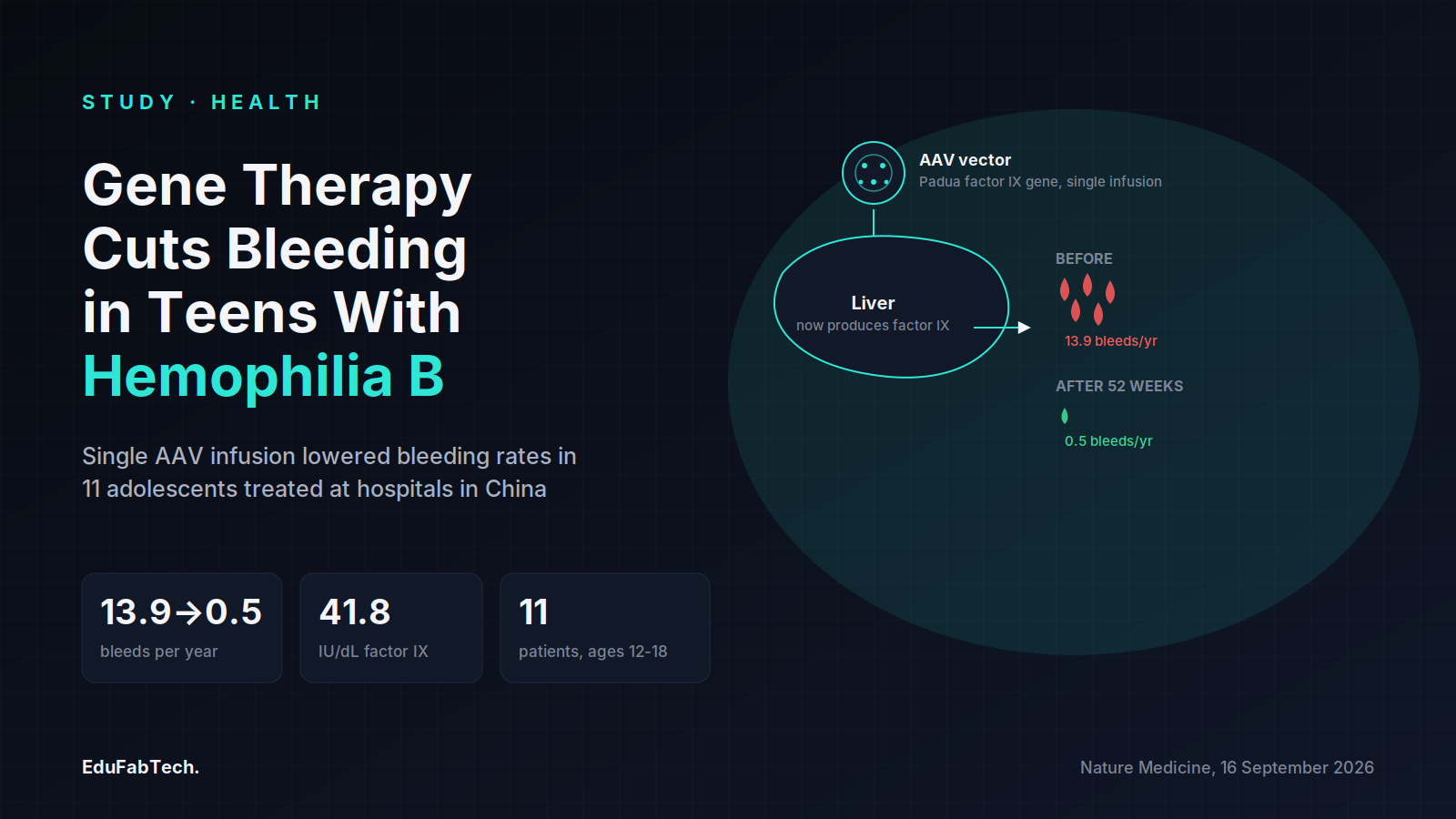
A single infusion of gene therapy reduced bleeding episodes in adolescents with hemophilia B, according to a phase 1 trial published in Nature Medicine on September 16, 2026. The trial, run at hematology centers in China and led by researchers including Feng Xue, Aiming Zhang and Mankai Ju, treated 11 patients aged 12 to 18 with an adeno-associated virus (AAV) vector carrying the Padua variant of the factor IX gene, then tracked them for 52 weeks.
Hemophilia B is caused by a deficiency of clotting factor IX, which leaves patients prone to spontaneous and injury-related bleeding, often into joints. Standard care means regular intravenous infusions of factor IX concentrate, sometimes several times a week for life. Gene therapy aims to replace that routine with a single dose that gets the liver to produce the missing clotting factor on its own.
What the trial found
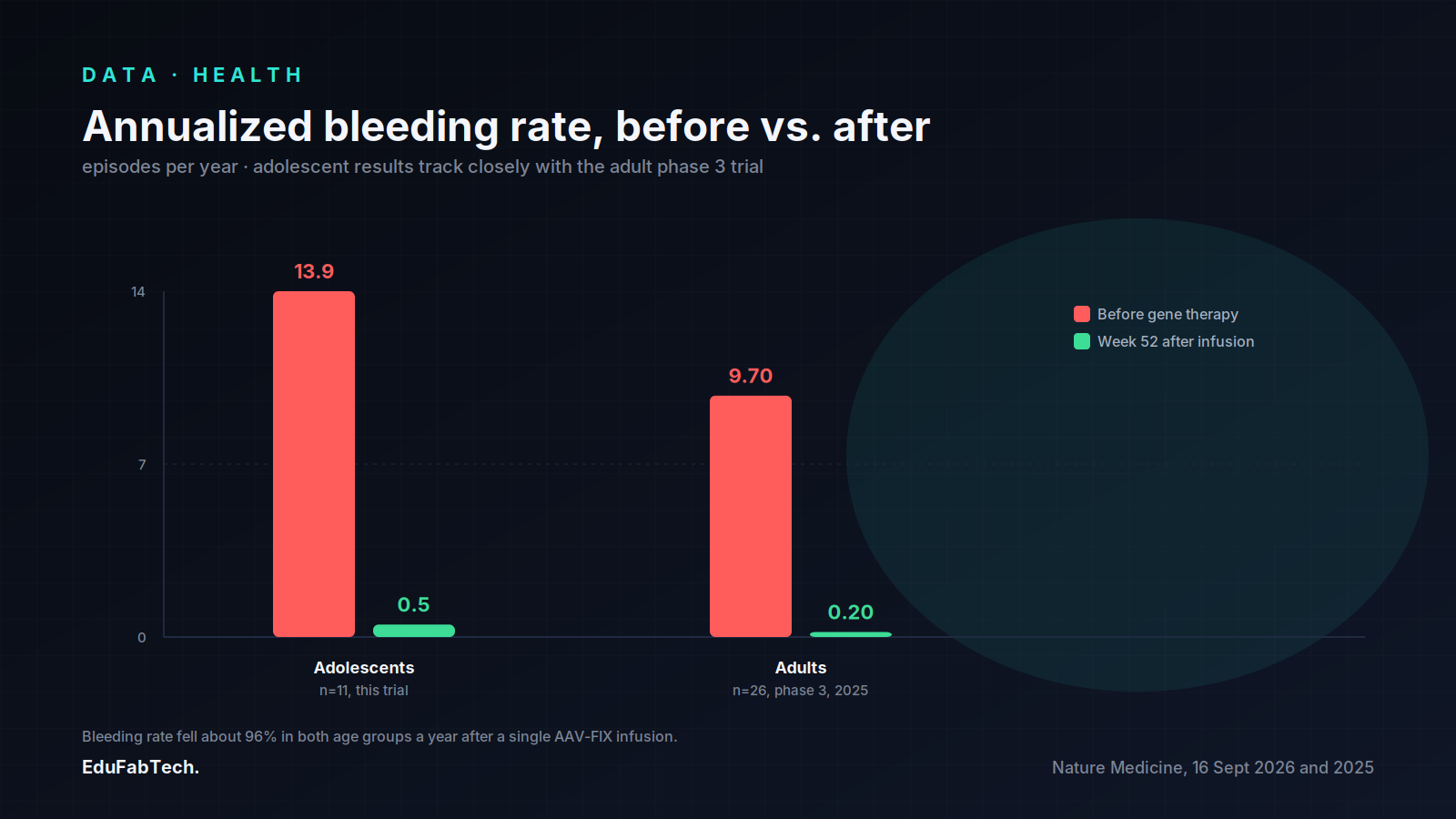
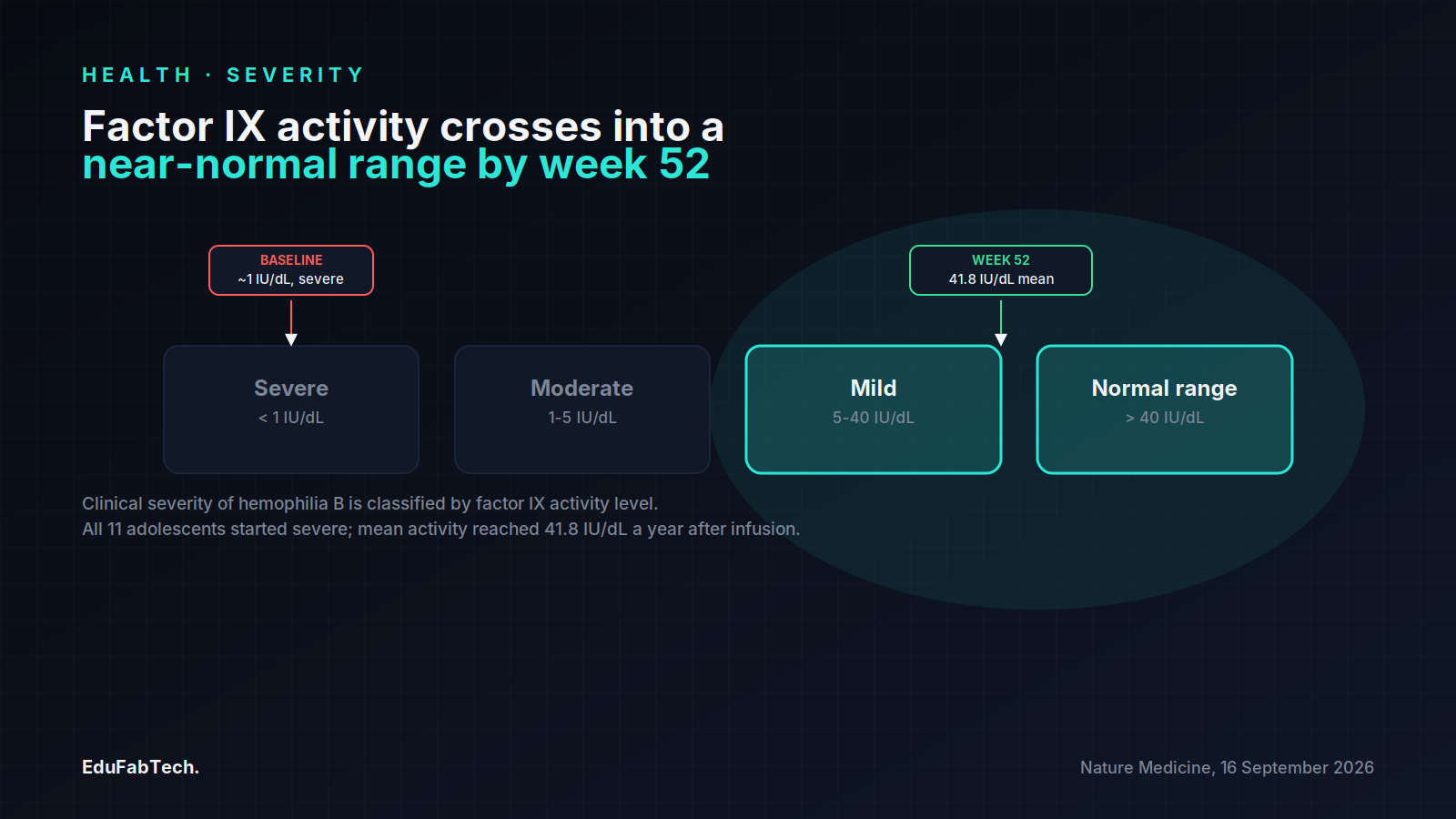
Before treatment, the 11 participants had a mean annualized bleeding rate of 13.9 episodes per year. A year after the infusion, that figure had fallen to 0.5, the authors report. Mean factor IX coagulant activity reached 41.8 IU/dL (standard deviation 30.1) at week 52 — well above the roughly 1 IU/dL baseline typical of severe hemophilia B and into a range associated with mild disease or better.
On safety, the trial recorded no dose-limiting toxicity. The most common adverse events were transient rises in white blood cell and neutrophil counts and a corticosteroid-associated rash, changes usually managed during the immune-suppressing regimen used alongside AAV gene therapy to protect the transduced liver cells. One serious adverse event and two grade 3 adverse events were also reported, though the paper does not describe either as treatment-limiting.
How it lines up against results in adults
The same gene therapy, known as BBM-H901 and developed by China-based Belief BioMed, has already been tested in adults. A combined report of a phase 1 pilot, a phase 1/2 dose-escalation study and a phase 3 trial — also published in Nature Medicine, in 2025 — followed 42 adult men who received the identical dose of 5 × 10¹² vector genomes per kilogram. In the phase 3 cohort, annualized bleeding fell from 9.70 to 0.20 events per year, a 97.9% drop in joint bleeds, and 80.8% of participants had zero bleeding events across 52 weeks. Mean factor IX activity at week 52 reached 41.9 IU/dL, and 92.3% of adult participants sustained levels above 5 IU/dL, the threshold generally used to distinguish severe from moderate disease.
The adolescent results track closely with those adult figures on both the bleeding-rate reduction and the factor IX levels achieved, though the adolescent cohort of 11 is smaller than the adult phase 3 group of 26, and the trial is single-arm, meaning there is no untreated comparison group tracked over the same period. Regulators in Macao, China, have already approved BBM-H901 for adults under the name dalnacogene ponparvovec, developed jointly with Takeda China, giving the therapy a regulatory track record the adolescent program can build on.
Why the adolescent question matters
Extending gene therapy to adolescents raises separate concerns from treating adults. A still-growing liver and years of ahead-of-time hormonal and developmental change could, in principle, affect how long a single AAV dose keeps expressing the transgene, and adolescents also spend more remaining years of life potentially exposed to the antibodies that AAV vectors generate — antibodies that currently rule out a second dose of the same vector serotype if factor levels fade.
Hemophilia B is markedly less common than hemophilia A. The US Centers for Disease Control and Prevention estimates, based on data from federally funded treatment centers covering 2012 to 2018, that about 33,000 males in the United States live with hemophilia overall, and that hemophilia A is three to four times more common than hemophilia B. Globally, a 2026 analysis in PLOS Global Public Health, built on World Federation of Hemophilia Annual Global Survey data from 119 countries between 2014 and 2023, found combined hemophilia prevalence rising from 2.75 to 3.75 per 100,000 people over that decade — a trend the authors attribute mainly to improved diagnosis, broader registry coverage and better survival, rather than a true rise in incidence. Because hemophilia B is rarer, trial cohorts for it are inherently small, which is part of why this adolescent study — registered as NCT05709288 on ClinicalTrials.gov — enrolled only 11 patients.
What the trial does not yet show
The authors describe this as a phase 1 trial establishing safety and initial efficacy signals, not a confirmatory study. With 11 participants, a single-arm design, one geographic setting and one year of follow-up, the results cannot yet establish how durable factor IX expression will be over a full adolescent lifespan, nor whether outcomes will hold across broader, more diverse patient populations. The authors themselves flag that extended follow-up is needed to evaluate long-term durability, a caveat that applied equally to the adult data before phase 3 confirmation and will likely apply to the adolescent program for some years yet.
- Xue F, Zhang A, Ju M, et al.. Factor IX Padua AAV gene therapy in adolescents with hemophilia B: a phase 1 trial. Nature Medicine, 2026. doi:10.1038/s41591-026-04636-8
- Author collective (Belief BioMed trial investigators). Factor IX-Padua AAV gene therapy in hemophilia B: phases 1/2 and 3 trials. Nature Medicine, 2025. doi:10.1038/s41591-025-04012-y
- Centers for Disease Control and Prevention. About Hemophilia. CDC, 2025. link
- Mothashin et al.. Regional variations and trends in hemophilia prevalence: A global analysis with future projection. PLOS Global Public Health, 2026. doi:10.1371/journal.pgph.0006098
- U.S. National Library of Medicine. Gene Therapy for Hemophilia B Patients Aged 12-18 Years Old (NCT05709288). ClinicalTrials.gov, 2026. link