Single-Infusion In Vivo CAR T-Cell Therapy Eases Four Neurologic Autoimmune Diseases in Small NEJM Trial
A 16-patient study published in the New England Journal of Medicine on September 3, 2026, shows a lentiviral vector can generate CD19-targeted CAR T cells inside the body, easing MS, MOGAD, myasthenia gravis and inflammatory myopathy without chemotherapy.
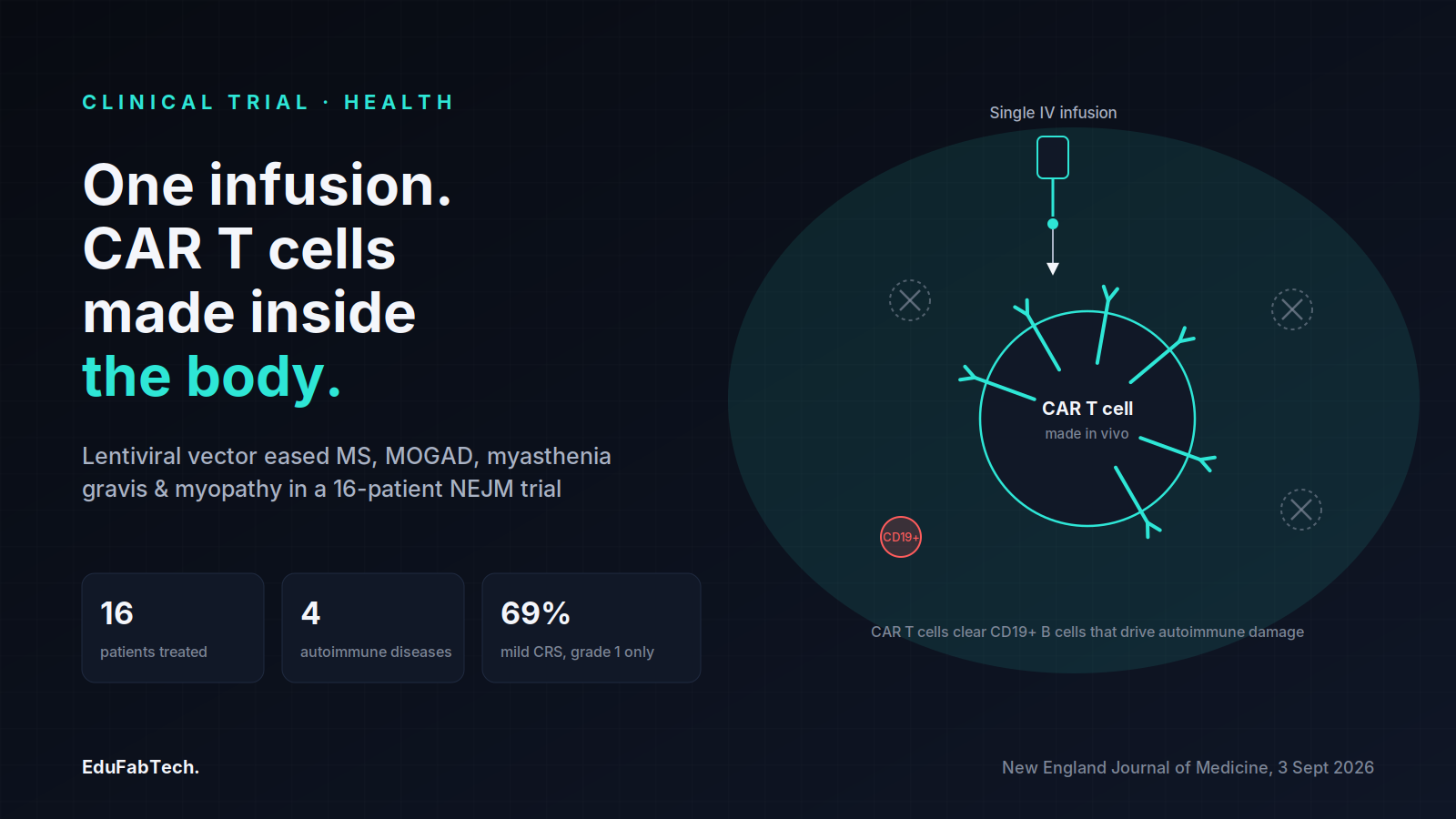
A single intravenous infusion that reprograms a patient's own T cells while they are still inside the body eased symptoms across four different neurologic autoimmune diseases in a small trial published in the New England Journal of Medicine on September 3, 2026. The study, led by researchers at Tongji Hospital, Huazhong University of Science and Technology in Wuhan, China, enrolled 16 patients and is among the first published human data testing in vivo CAR T-cell generation — engineering the cells inside the patient rather than manufacturing them in a lab, as current approved CAR T products for blood cancers require — against autoimmune disease of the nervous system and muscle.
An infusion instead of a manufactured cell product
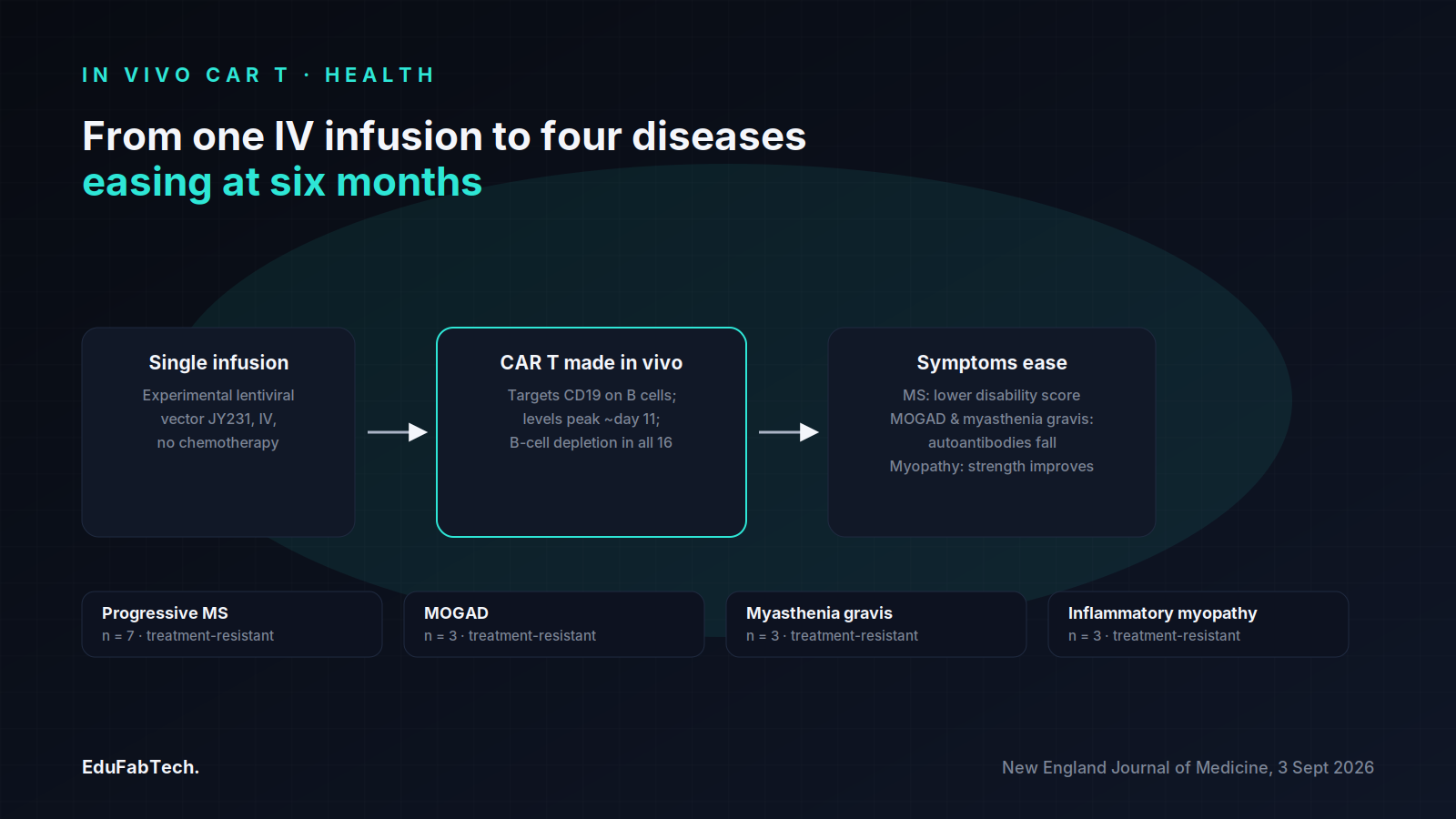
Conventional CAR T-cell therapy involves extracting a patient's T cells, re-engineering them outside the body to recognize a target protein, expanding them in culture, and reinfusing them after a course of lymphodepleting chemotherapy to make room for the new cells. That process can take weeks and carries its own toxicity. The therapy tested in this trial, an experimental lentiviral vector called JY231, is instead given as a single intravenous infusion and reprograms T cells directly inside the body to produce chimeric antigen receptors targeting CD19, a protein on the surface of B cells. Because B cells drive much of the autoantibody production and tissue damage in these diseases, depleting them was the therapeutic goal. No lymphodepleting chemotherapy was used.
Results across four disease groups
The trial enrolled patients with four distinct, treatment-resistant conditions: seven with progressive multiple sclerosis, three with myelin oligodendrocyte glycoprotein antibody-associated disease (MOGAD), three with generalized myasthenia gravis, and three with idiopathic inflammatory myopathies. According to reporting on the trial by Medscape Medical News, all 16 patients generated detectable CAR T cells in vivo, with levels peaking around 11 days after infusion, and all showed B-cell depletion. At six months of follow-up, the seven progressive MS patients had reduced disability scores on the Expanded Disability Status Scale and no new gadolinium-enhancing brain lesions on MRI at either the three- or six-month scans. Patients with MOGAD and generalized myasthenia gravis showed measurable declines in their disease-specific autoantibodies, and the three patients with inflammatory myopathy showed improved muscle strength.
Safety profile
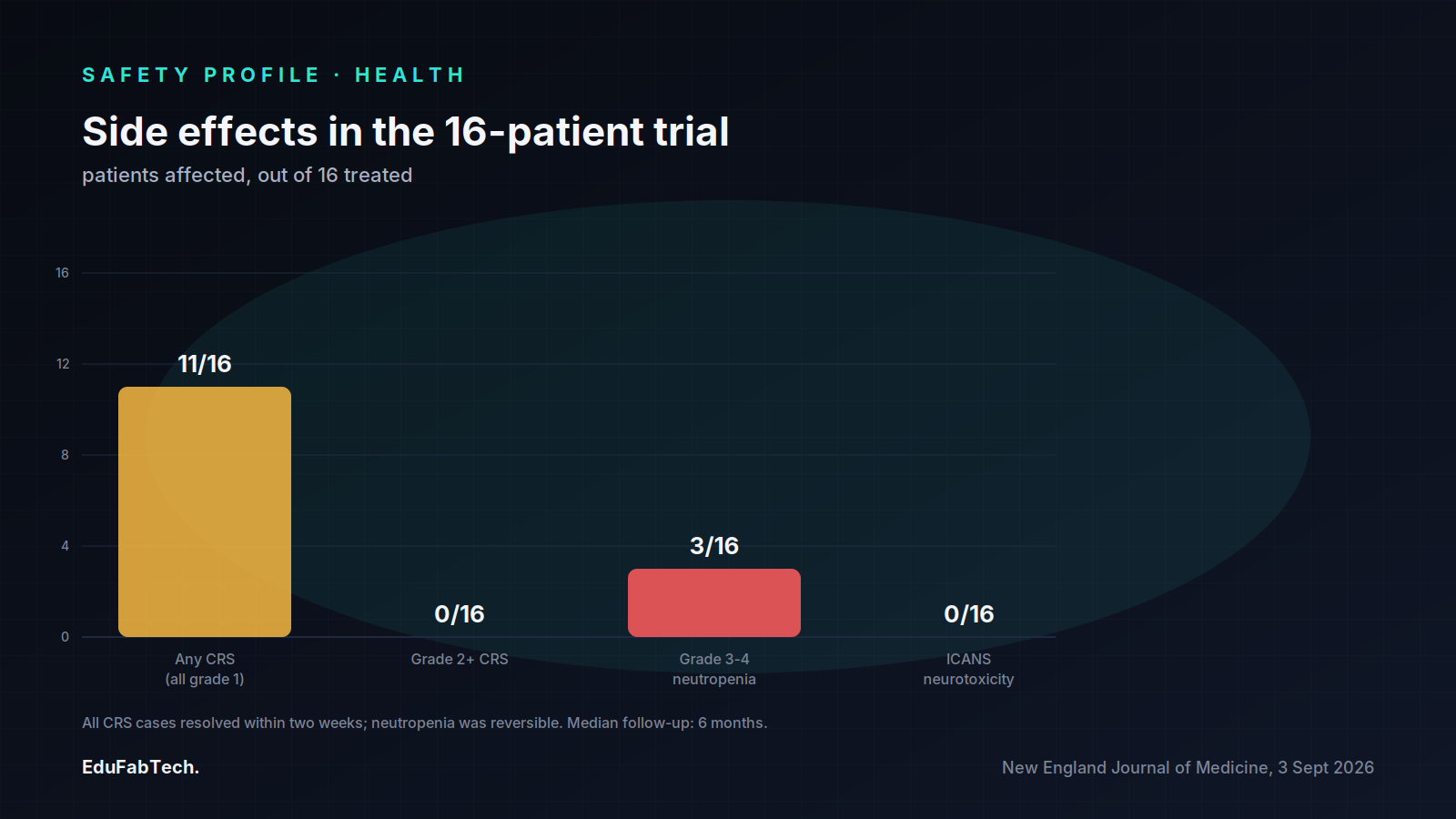
Cytokine release syndrome, a common and sometimes serious side effect of CAR T-cell therapies, occurred in 11 of the 16 patients (69%), but all cases were mild (grade 1) and resolved within two weeks; no grade 2 or higher cases were reported. Three patients developed grade 3–4 neutropenia, a drop in a type of white blood cell, which was reversible. No cases of the neurotoxicity syndromes sometimes seen with CAR T-cell products, such as immune effector cell-associated neurotoxicity syndrome, were reported. Nature's news coverage of the study describes the side-effect profile as manageable, in line with the trial authors' own characterization.
What the trial does not show
The study was an open-label, single-arm trial with no control group and a median follow-up of six months — design features the authors themselves flag as limiting how much can be concluded from the results. There was no placebo or active comparator, the patient groups were small enough that individual responses can swing group-level results, and the durability of B-cell depletion and clinical benefit beyond six months is unknown. An independent critique published by Clinical Trial Vanguard argues that testing in vivo CAR T-cell therapy in central nervous system autoimmune disease will run into a different obstacle than the biology itself: most trial sites are not set up to reliably distinguish disease flares, treatment-related inflammation and cytokine release syndrome from each other on routine imaging, and the diseases involved are rare enough that recruiting larger, controlled trials will be slow.
Why it matters beyond this trial
In vivo CAR T-cell generation has been explored mainly in cancer and, more recently, in a handful of small case series for lupus and other autoimmune diseases. If the approach holds up in larger trials, removing the need for cell manufacturing and pre-conditioning chemotherapy would substantially lower the logistical and physical burden of CAR T-cell therapy, potentially making it feasible for diseases and health systems where manufactured cell therapy is currently out of reach. But the trial reported here treated 16 people for six months without a comparison group, and the authors describe the findings as a proof of concept rather than evidence of a durable treatment. Larger, randomized, longer-follow-up trials are needed before conclusions can be drawn about how well, and for how long, the therapy works.
- Yu-Hang Cheng et al.. Lentiviral In Vivo CD19 CAR T-Cell Therapy in Neurologic Autoimmune Disorders. New England Journal of Medicine, 2026. doi:10.1056/NEJMc2603114
- Rachel Fieldhouse. Immune therapy engineered inside the body eases multiple sclerosis. Nature, 2026. link
- Medscape Medical News. 'Good First Try': In Vivo CAR T for Neurologic Autoimmune Disease. Medscape, 2026. link
- Clinical Trial Vanguard. In Vivo CAR-T for CNS Autoimmune Disease Looks Promising. The Trial Design Problem Is Hiding in Plain Sight.. Clinical Trial Vanguard, 2026. link