Reanalysis of Eight Mammography Trials Puts Breast Cancer Overdiagnosis Below 5%, Not 30-50%
A JNCI meta-analysis argues that decades of high overdiagnosis estimates in breast cancer screening trials reflected immature data and uneven follow-up, not a real biological effect.
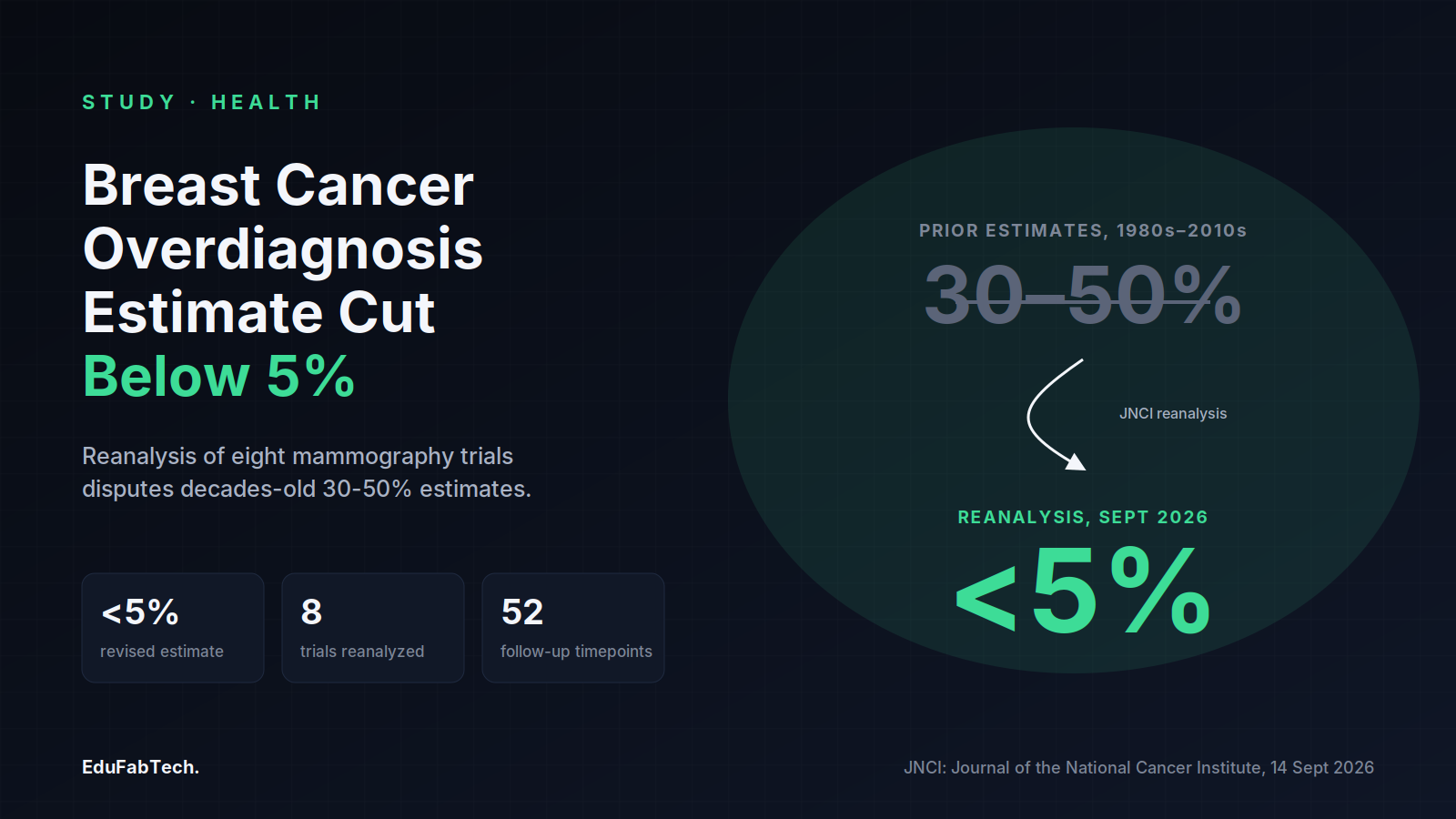
A meta-analysis published on 14 September 2026 in JNCI: Journal of the National Cancer Institute reports that overdiagnosis in mammography screening trials is consistent with a rate below 5%, not the 30-50% figures that have circulated in the screening literature for decades. The paper, "Breast cancer overdiagnosis in mammography trials—separating signal from noise," was written by Sisse Helle Njor and Casper Urth Pedersen (Lillebælt Hospital-University Hospital of Southern Denmark, and Aarhus University), Elsebeth Lynge (University of Copenhagen), Robert A. Smith (American Cancer Society) and Matejka Rebolj (Queen Mary University of London).
Overdiagnosis, in this context, means a screen-detected cancer that would never have caused symptoms or death within a person's lifetime, so treating it provides no benefit and only exposes the patient to surgery, radiotherapy or drug side effects. Estimating how often this happens has been one of the most contested numbers in cancer screening, because it depends on projecting what would have happened to a tumor if it had never been found — something no test can observe directly.
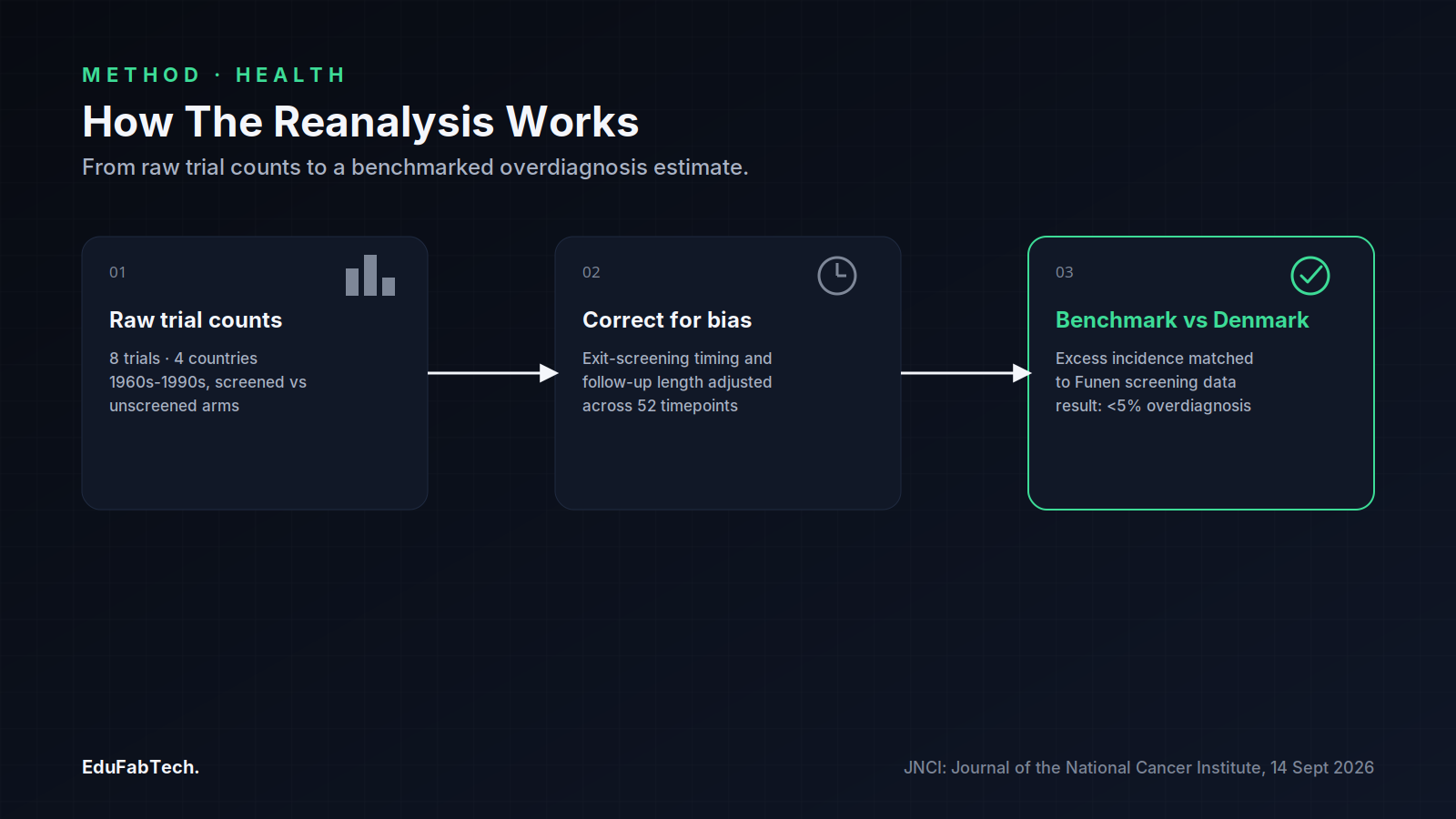
The eight trials reanalyzed were the New York Health Insurance Plan study, the Swedish Two-County trial, the Malmö, Stockholm and Gothenburg trials, the Edinburgh trial, the Canadian National Breast Screening Study and the UK Age trial — together the evidence base that most national screening guidelines have relied on since the 1980s and 1990s. Instead of comparing raw cancer counts between screened and unscreened arms, the authors checked the trials' excess-incidence patterns at 52 separate follow-up timepoints against what would be expected in a real population screening program, using data from the organized mammography rollout in Funen, Denmark, as the reference.
Where the high estimates came from
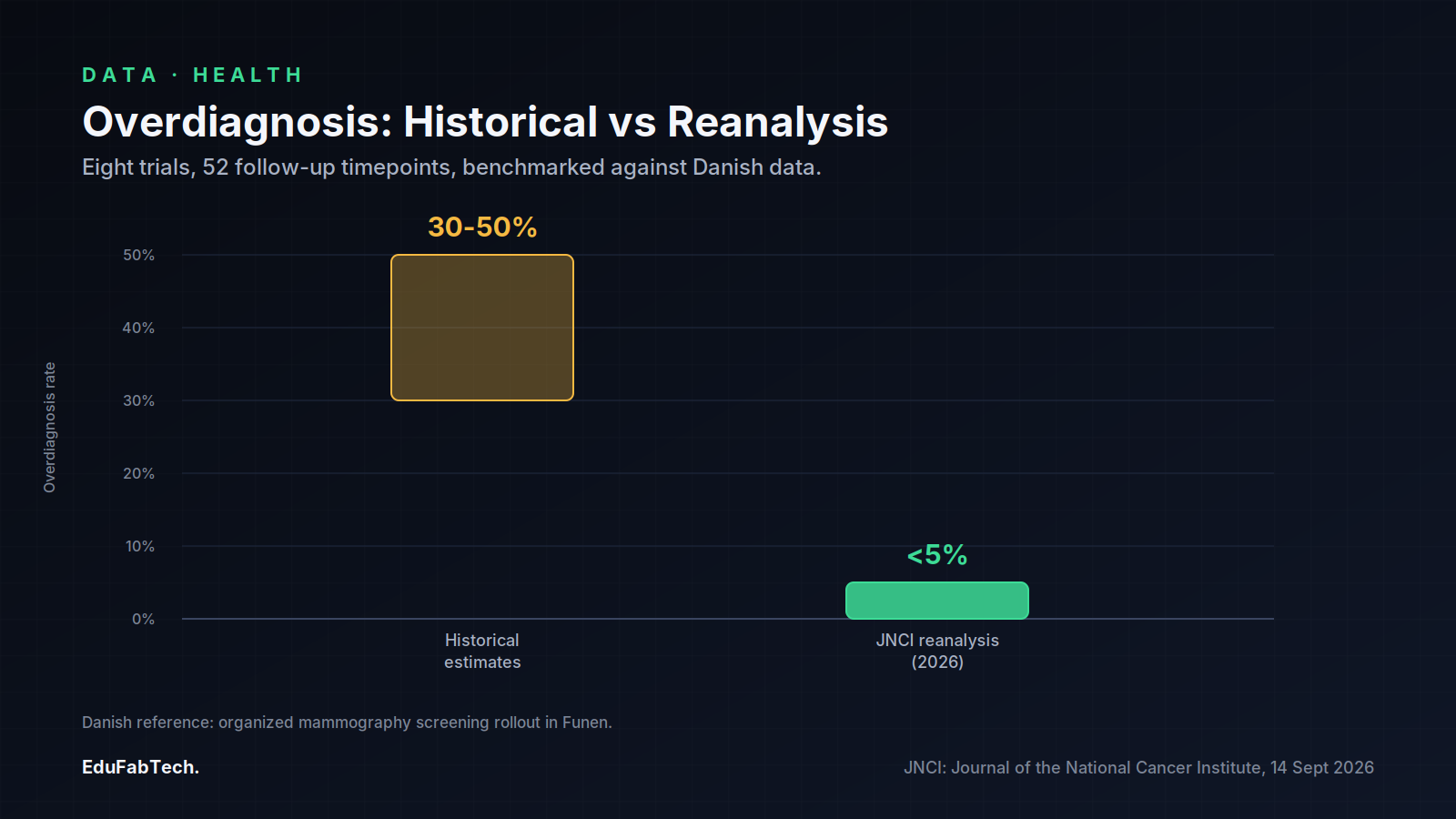
The authors attribute the historically high overdiagnosis estimates to three recurring analytical problems. Trial control groups were often screened after the randomized phase ended, which inflates the count of cancers attributed to the screened arm's follow-up window if the comparison period is cut off too early. Screening rounds and calendar-time exposure also differed between arms in several trials. And many published estimates were calculated before enough follow-up time had accumulated for the early bump in diagnoses — the well-documented effect of catching cancers sooner rather than never — to be balanced out by the corresponding drop in later, interval or advanced-stage cancers.
"When interpreted in their full temporal context, randomized trial data are consistent with overdiagnosis of less than five percent, rather than with estimates nearing 50%," said Matejka Rebolj, senior epidemiologist at Queen Mary University of London's Wolfson Institute of Population Health. Elsebeth Lynge added that the initial rise in diagnoses after screening starts reflects cancers being found earlier, not necessarily cancers that would never have surfaced on their own — the distinction the reanalysis tries to isolate statistically.
What the reanalysis does and doesn't settle
The paper is explicitly a reanalysis of existing trial data rather than a new prospective study, and the authors frame their approach — benchmarking excess incidence against a single regional reference population in Denmark — as one way of resolving conflicting historical estimates, not a final measurement. Independent commentary on the paper, reported by ScienceDaily and SciTechDaily, has focused on whether a single reference population, however well documented, can stand in for the diverse settings — different eras, different imaging technology, different underlying incidence — represented across eight trials run in four countries between the 1960s and 1990s.
The study also separates invasive breast cancer from ductal carcinoma in situ (DCIS), a non-invasive lesion that accounts for a disproportionate share of disputed overdiagnosis cases, since DCIS is far less likely than invasive cancer to progress to a life-threatening tumor if left alone. The authors report that once exit screening in control groups and follow-up duration are corrected for, the excess-incidence pattern across both categories tracks closely with the low overdiagnosis rate seen in the Danish reference data, rather than the divergent, much higher figures produced by some of the original trial publications.
Why the number matters
Overdiagnosis estimates feed directly into how screening programs communicate risk to participants and how guideline bodies weigh the harms and benefits of routine mammography. A rate near 50% has been used to argue that a large share of women treated after screening are harmed rather than helped; a rate under 5% implies the opposite balance. "The benefits of detecting breast cancer early and preventing premature death will outweigh the small risk of unnecessary treatment," Njor said, summarizing the paper's conclusion, though the authors stop short of calling the overdiagnosis question closed, given that their method rests on one country's screening data as the yardstick for trials run in very different times and places.
The work was supported by the Novo Nordisk Foundation and Cancer Research UK. Because the underlying trials are decades old and cannot be rerun, the debate over overdiagnosis is likely to continue as a matter of statistical reinterpretation rather than new experimental evidence — this paper is one attempt among several competing analytical frameworks to settle what the existing numbers actually show.
- Sisse Helle Njor, Casper Urth Pedersen, Elsebeth Lynge, Robert A. Smith, Matejka Rebolj. Breast cancer overdiagnosis in mammography trials—separating signal from noise: a meta-analysis. JNCI: Journal of the National Cancer Institute, 2026. doi:10.1093/jnci/djag302
- University of Southern Denmark (distributed via EurekAlert). New analysis points to low overdiagnosis in breast cancer screening. EurekAlert!, 2026. link
- ScienceDaily. A major risk of breast cancer screening may have been overestimated for decades. ScienceDaily, 2026. link
- SciTechDaily. Scientists Reassess a Major Risk of Breast Cancer Screening. SciTechDaily, 2026. link