Netherlands Moves to Ban Phones All Day in Schools, Joining a Growing European List
From January 2027 Dutch schools must keep phones out of sight all day, not just in class, as the cabinet cites early results from a 2024 lesson-time rule and joins France, Italy, Hungary and others.
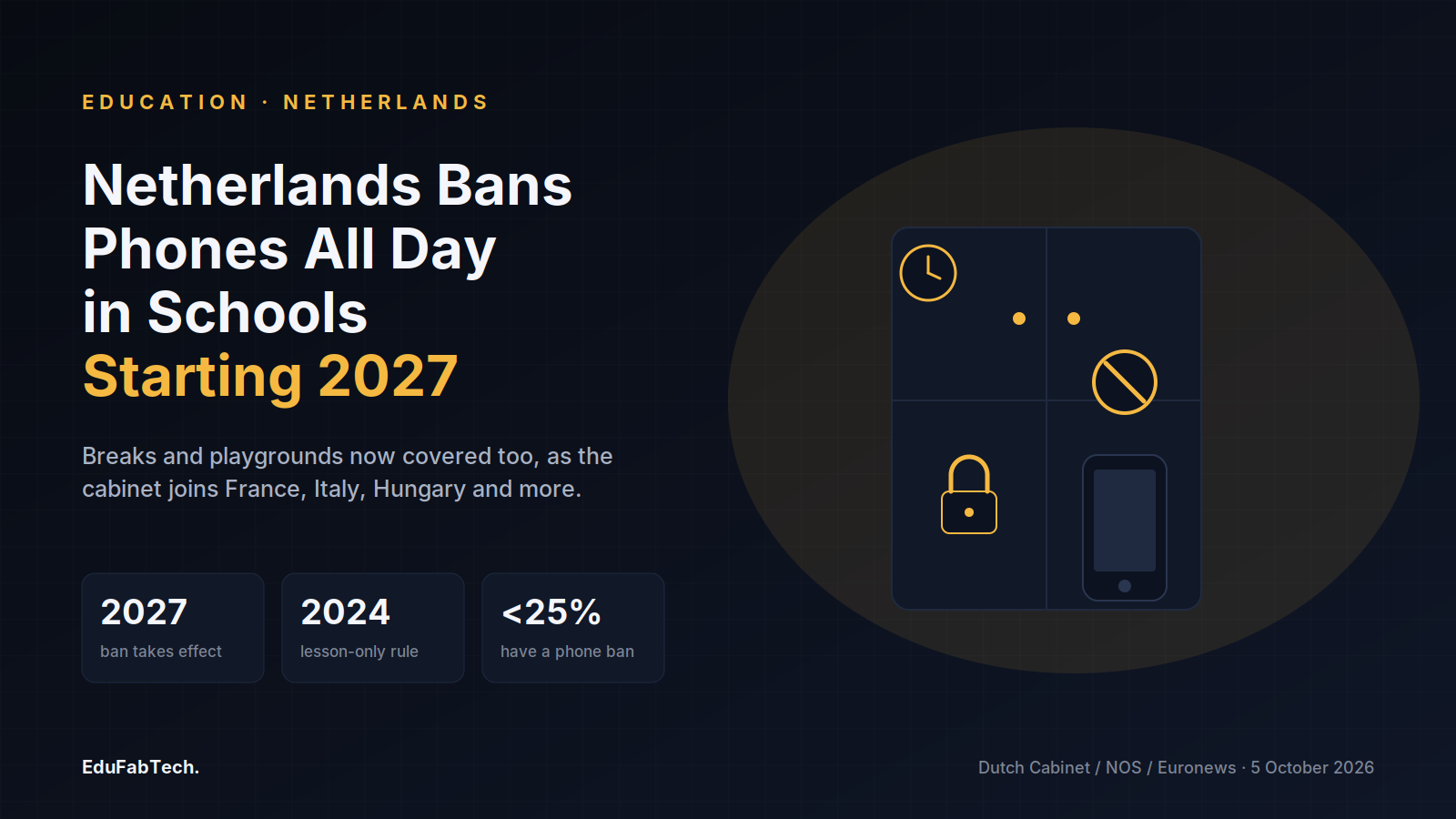
The Dutch cabinet announced on 5 October 2026 that mobile phones must be kept out of sight for the entire school day, including breaks and time on the playground, in primary and secondary schools from 1 January 2027. The policy, called "Thuis of in de Kluis" ("Home or in the Locker"), was presented by State Secretary for Digital Affairs Willemijn Aerdts as part of a wider strategy letter on children's online safety, covering social media age limits and child-rights assessments of platforms including YouTube, Roblox, Instagram, Snapchat, TikTok and ChatGPT, according to the government's announcement.
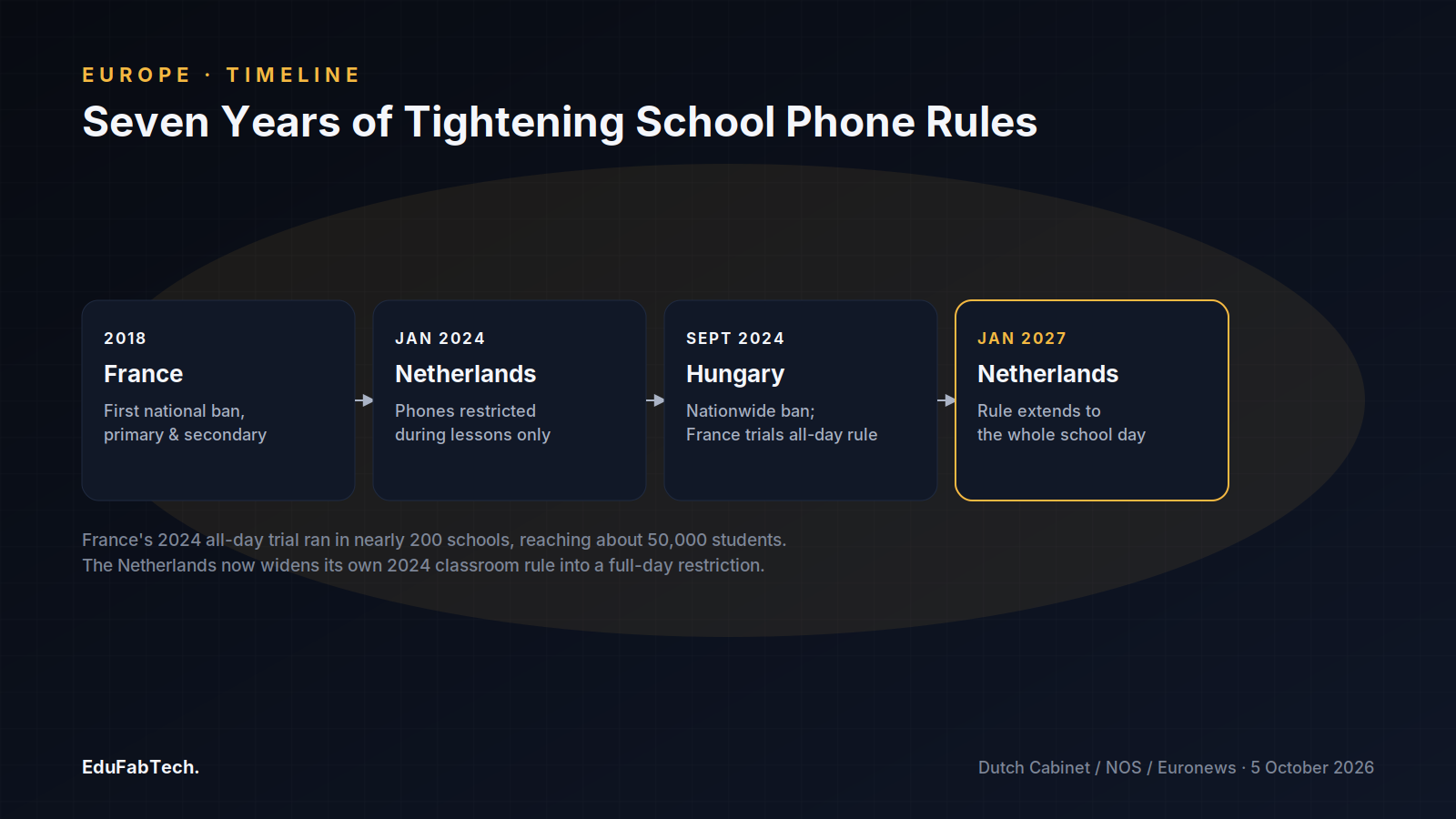
The move extends a narrower rule already in force. Since January 2024, Dutch national agreements have restricted non-educational phone, smartwatch and tablet use during lessons only, with exceptions for students who need a device for a disability or special educational need, as the government notes in its announcement. The cabinet says the "first results are positive" and is now widening the restriction to cover the whole school day, not just classroom time, a change reported by Dutch broadcaster NOS. Aerdts framed the measure around child safety rather than only classroom focus, stating that online, on social media or in video games, children quickly lose oversight and face "unacceptable risks," according to the same government release.
Part of a wider European pattern
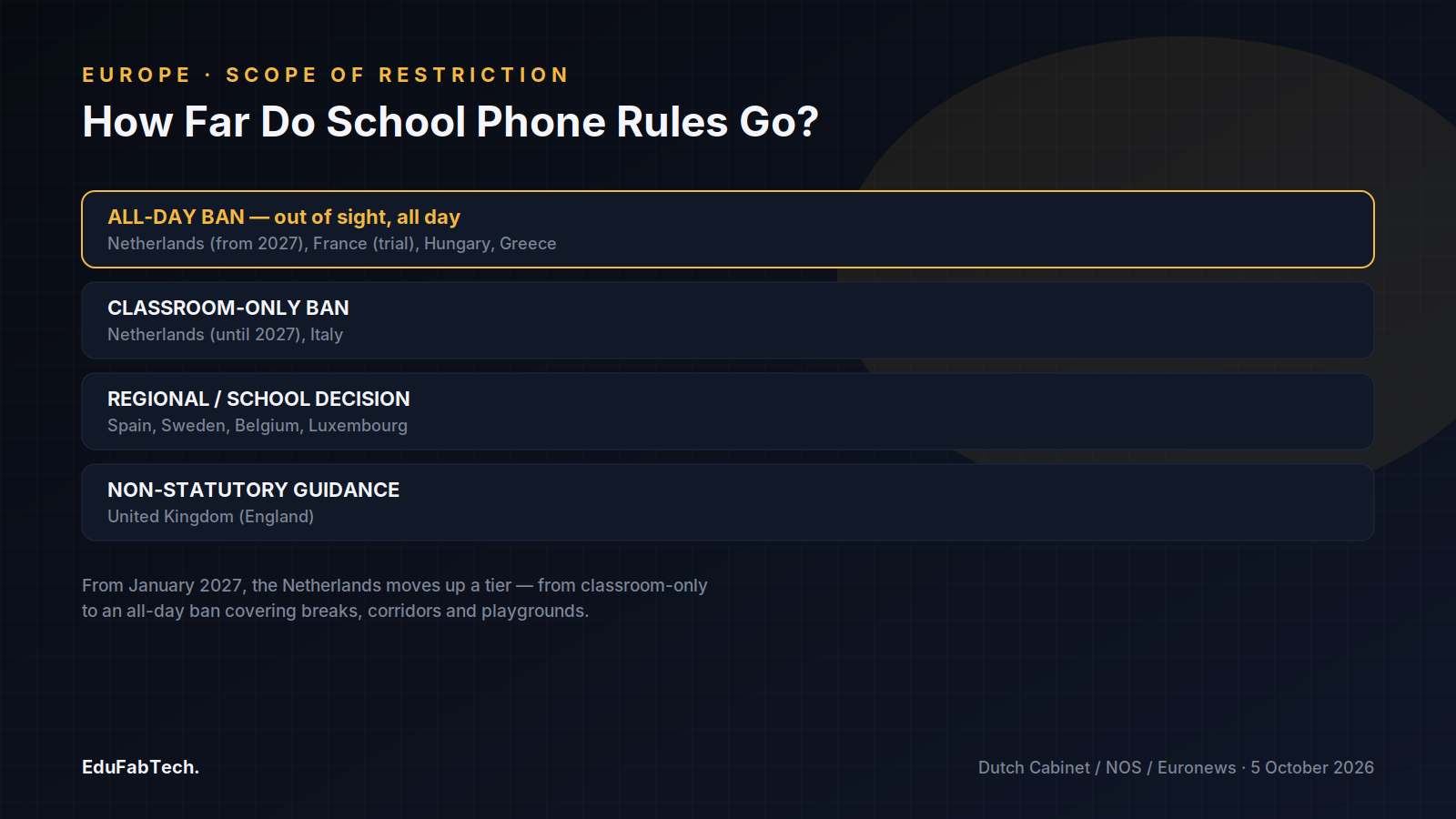
The Netherlands joins a list of European countries that have moved toward restricting phones in schools over the past several years, though the scope and strictness vary widely by country. France has prohibited phones in primary and secondary schools since 2018, and tested an extended "digital break" covering the whole school day in nearly 200 schools in 2024, affecting roughly 50,000 students, according to reporting by Euronews. Italy has banned phones in classrooms from pre-school through secondary level by ministerial decree, with exceptions for students needing devices for educational support. Hungary introduced a nationwide ban in September 2024 that drew protests from teacher unions, and Greece requires students to keep phones in their bags for the whole school day, the same Euronews survey found.
Other countries have taken a lighter or more decentralized approach. Spain has left the decision to roughly seven of its regional governments rather than legislating nationally. Sweden restricts classroom use unless a phone serves a learning purpose, leaving the details to individual schools. Belgium's Wallonia-Brussels Federation banned recreational use starting in the 2025/2026 school year, and Luxembourg phased in restrictions by school level starting at Easter 2025. The United Kingdom has issued non-statutory guidance for schools in England rather than a government-wide ban, per the same Euronews reporting.
What the evidence says
International guidance has leaned toward restriction, though not always toward an outright ban. UNESCO's 2023 Global Education Monitoring Report, drawing on an analysis of more than 200 education systems, found that the mere proximity of a mobile device distracted students and had a negative impact on learning in 14 countries it reviewed, and recommended that technology be used in class "only when it can support learning outcomes," a standard that explicitly includes smartphones, according to the report. At the time of that report, UNESCO noted that fewer than one in four of the education systems it covered had banned smartphones in schools, so the current wave of national and regional restrictions — the Netherlands among the latest — moves closer to, but still well short of, a global norm.
What it means for students, teachers and researchers
For students and teachers, the practical change in the Netherlands is a matter of scope rather than a new principle: phones that were already unavailable during lessons will also be unavailable during breaks, before and after school hours on the premises, and in corridors and playgrounds. The Dutch government has not published compliance or outcome data from the 2024 lesson-time rule beyond describing the results as "positive," so researchers evaluating the policy's effect on attention, wellbeing or academic performance will need to wait for a formal evaluation rather than rely on the cabinet's own characterization.
For comparative education researchers, the patchwork of national rules — full-day bans in some countries, classroom-only restrictions in others, and no government-wide policy at all in some — creates a natural setting for before-and-after and cross-country comparisons, provided each country's implementation date, scope and enforcement mechanism are tracked separately rather than treated as a single "phone ban" category. The Netherlands' shift from a lesson-only to an all-day rule, effective 1 January 2027, is a useful marker for that kind of tracking, since it changes only the scope of an existing policy rather than introducing a wholly new one.
A quick question for readers
Is using AI to help write an assignment cheating?
Universities are still writing their rules. Where do students draw the line?
Pick an answer, create a free account in a minute, and your vote counts. Already a member? Sign in
Comments 0
CommentNo comments yet. Members start the conversation.
Source: Government of the Netherlands (Rijksoverheid)
Sources (2)
- Rijksoverheid (Ministry of the Interior and Kingdom Relations). Kabinet presenteert strategie om kinderen online te beschermen. Government of the Netherlands, 2026. rijksoverheid.nl ↗ · checked 5 Oct 2026
- NOS. Kabinet scherpt advies schermgebruik aan: mobieltjes hele schooldag in de kluis. NOS, 2026. nos.nl ↗ · checked 5 Oct 2026