NSF Funding Falls 23% in FY2026 After White House Held Back $1 Billion
The US National Science Foundation ended fiscal year 2026 having made its fewest new awards in decades, after the White House set aside agency funds for a separate initiative; China's basic-research funder raised its budget the same year.
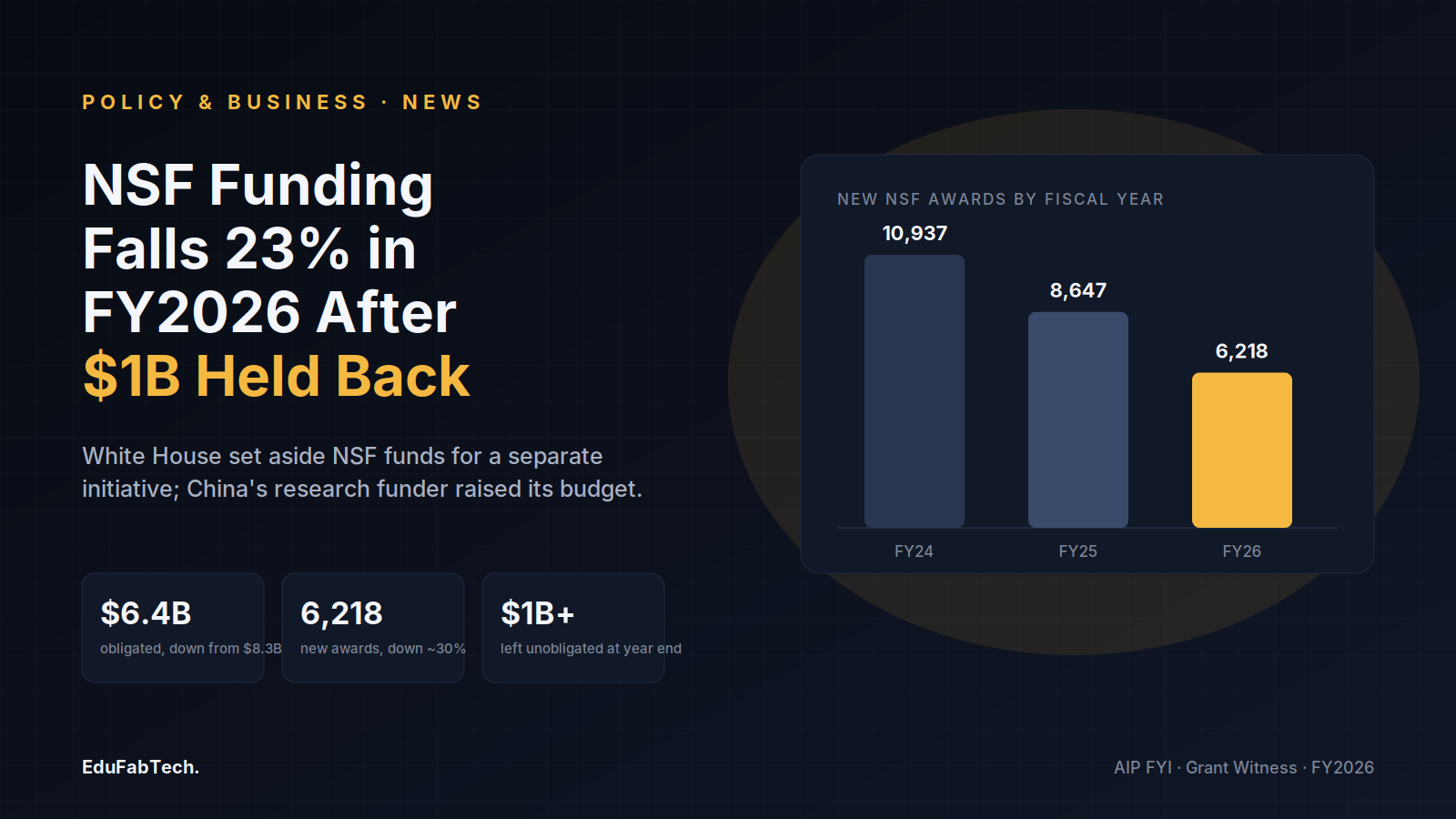
The US National Science Foundation closed fiscal year 2026, which ended September 30, having obligated $6.4 billion in research funds across 6,218 awards — down from $8.3 billion and 8,647 awards in fiscal year 2025, and from 10,937 awards in fiscal year 2024, according to agency data analyzed by the independent tracking project Grant Witness and reported by AIP FYI, the science-policy newsletter of the American Institute of Physics. The drop amounts to roughly 23% less money and close to 30% fewer new grants than the year before, leaving the agency with more than $1 billion unobligated at year's end.
The agency's own explanation, relayed to reporters, points to a redirection of funds rather than a budget cut. NSF spokesperson Mike England said the agency had "carried over funds to invest in agency priorities that are aligned with broader administration initiatives." Nature reported that NSF staff described roughly $1 billion of the agency's budget as having been placed in a separate account to fund the White House Office of Science and Technology Policy's "Grand Research Challenges" initiative, a program OSTP has not yet detailed publicly in full.
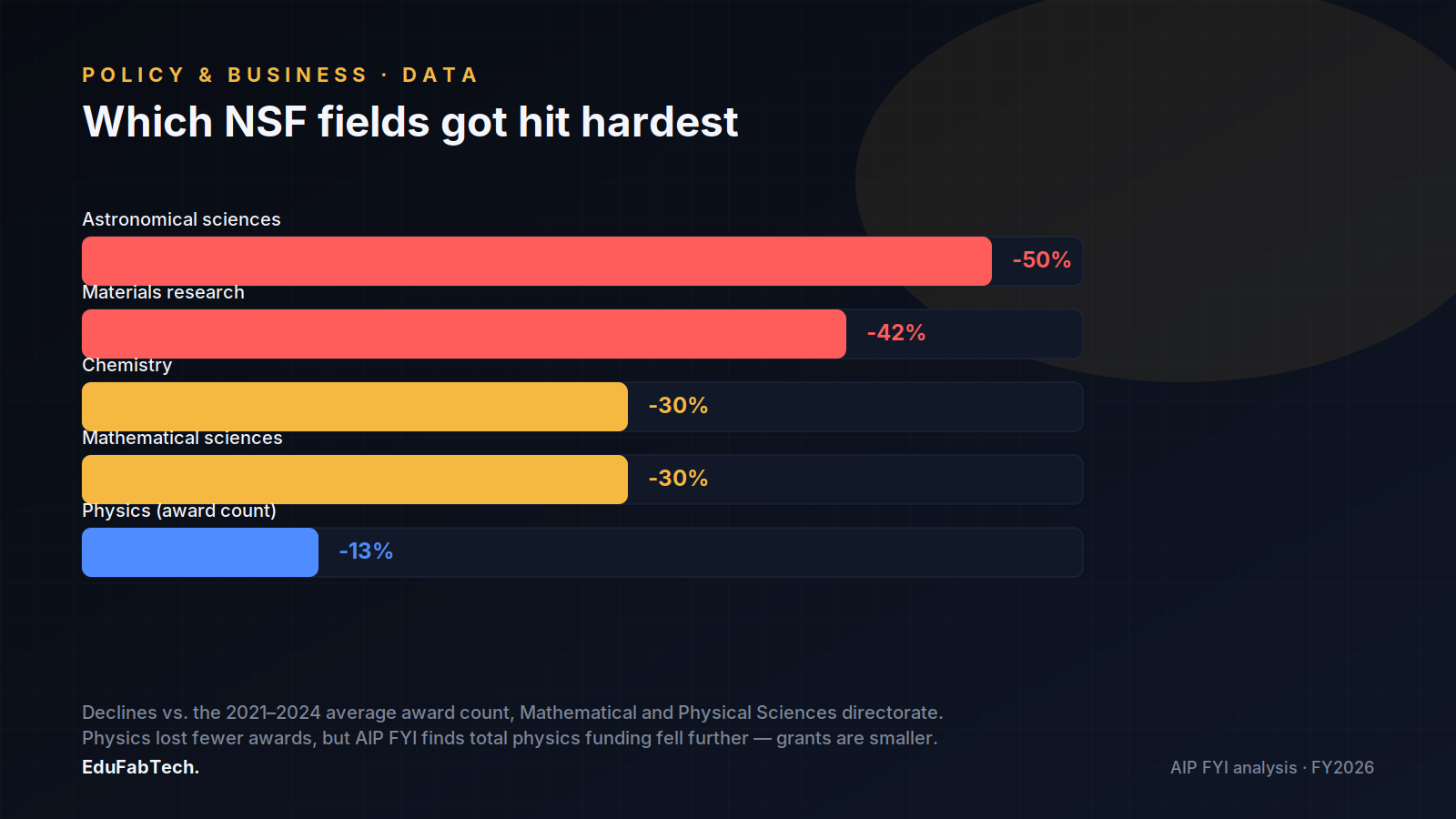
For researchers applying to NSF this year, the slowdown has not fallen evenly. AIP FYI's analysis of the agency's Mathematical and Physical Sciences directorate found astronomical-sciences awards down 50% and materials-research awards down more than 40% against the 2021–2024 average, with chemistry and mathematical sciences both down roughly 30%. Physics award counts fell about 13% — comparatively smaller than the other fields — but the total money attached to them fell further, meaning individual physics grants are smaller than before. The American Astronomical Society's president, Marcel Agüeros, was quoted saying "I don't think there's any reason here for physicists to take a victory lap" — a reminder that a stable award count does not mean stable funding.
The diversion of funds has also drawn scrutiny in the US Congress. In an August 10, 2026 letter, House Science Committee ranking member Zoe Lofgren and Representative George Whitesides told OSTP Director Michael Kratsios that the agency appeared to have moved about $300 million out of NSF's mathematics and physical-sciences directorates into the Grand Research Challenges program without congressional appropriation, and asked for a full accounting by August 14. The letter noted that NSF was already running 30–40% behind its usual pace of distributing funds at that point in the fiscal year.
Not every major funder slowed down
The pullback was not universal even within the US federal research system. According to the same AIP FYI report, the National Institutes of Health managed to obligate its full extramural research budget of roughly $34 billion in fiscal year 2026, despite also starting the year slowly — underscoring that NSF's shortfall reflects a specific allocation decision rather than a government-wide retreat from research spending.
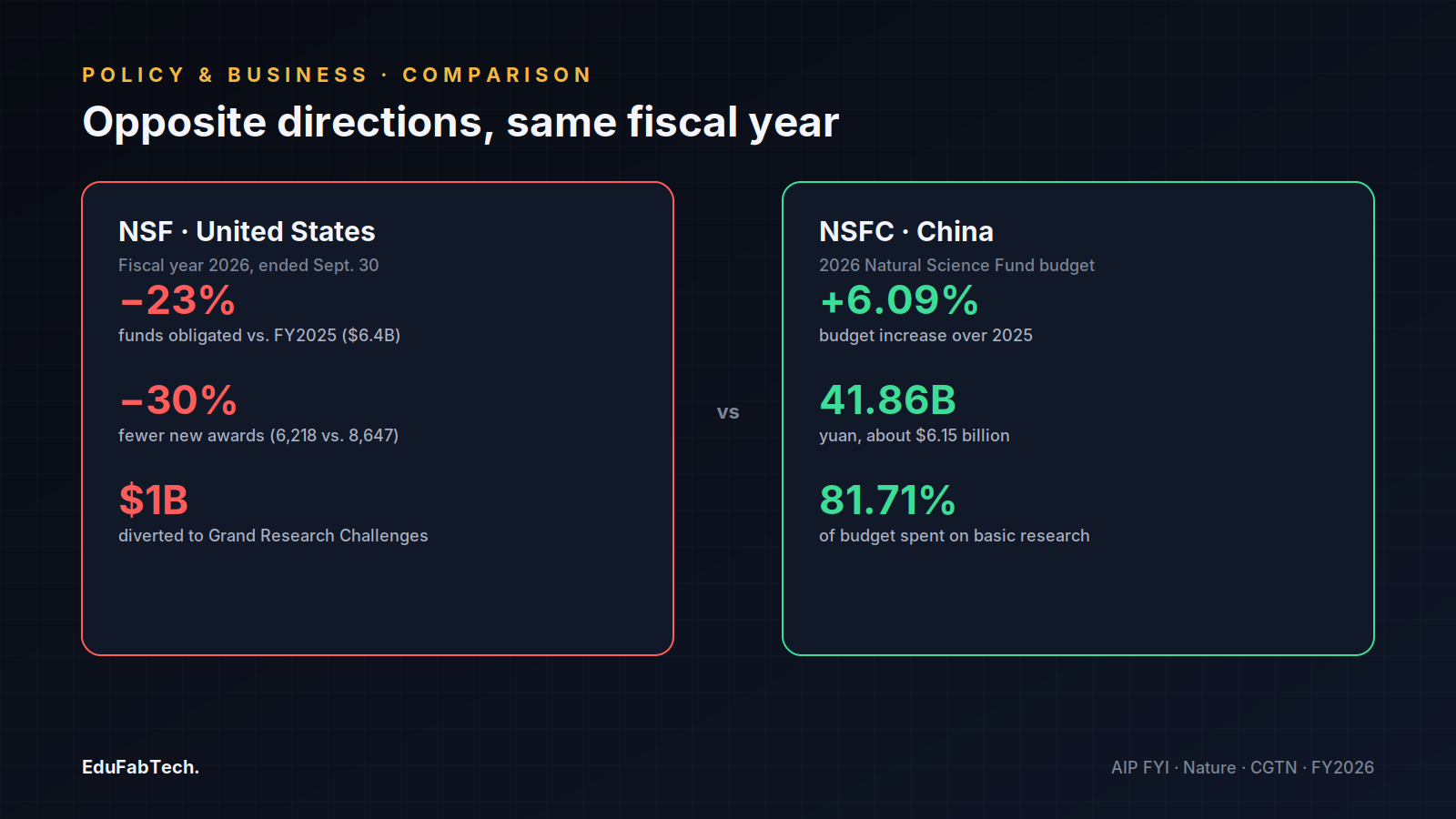
The contrast looks sharper outside the United States. China's National Natural Science Foundation, the country's main funder of basic research, set its 2026 Natural Science Fund budget at 41.86 billion yuan (about $6.15 billion), an increase of 2.4 billion yuan, or 6.09%, over 2025, according to budget figures reported by CGTN. Basic research made up 81.71% of NSFC's general public budget spending for the year. The two funders are not directly comparable in scale or structure — NSFC funds basic natural-science research specifically, while NSF's remit is broader — but the direction of travel in the same fiscal year was opposite: one agency's new-grant output fell by close to a third, the other's core research budget grew.
What it means for researchers applying now
For graduate students, postdoctoral researchers and principal investigators who depend on NSF funding, fewer awards per cycle means lower odds of success for a given proposal, independent of its quality — a dynamic that compounds in fields like astronomy and materials science where the decline is sharpest. Early-career researchers are typically the most exposed, since they have fewer alternative funding sources and often cannot absorb a funding gap in their training timeline the way an established lab with multiple grants can.
NSF has signaled that the slowdown may continue rather than reverse quickly. AIP FYI's reporting on the agency's fiscal year 2027 solicitations found that some Mathematical and Physical Sciences programs are planning for further reductions of 30% or more next year, with physics facing a comparatively smaller 10% decrease. The Office of Management and Budget's August apportionment documents, cited in the same reporting, estimated that around $1.7 billion in unspent NSF funds would carry over into fiscal year 2027 — money that, if released, could restore some grantmaking capacity, but whose disposition remains tied to how the Grand Research Challenges initiative is ultimately structured and funded.
NSF declined to comment when asked by AIP FYI about the directorate-level breakdown of the cuts. OSTP has not published a public account of the Grand Research Challenges program's budget or selection criteria as of this writing, and Director Kratsios told the House Science Committee in July that he would "refer" funding questions back to NSF, according to the August 10 letter from Lofgren and Whitesides.
A quick question for readers
How much do you spend on books and course materials per term?
Amounts in US dollars. The results help show how much course materials really cost students.
Pick an answer, create a free account in a minute, and your vote counts. Already a member? Sign in
Comments 0
CommentNo comments yet. Members start the conversation.
Source: Nature
Sources (3)
- Nature news team. Exclusive: NSF set to issue lowest number of new grants in four decades. Nature, 2026. nature.com ↗ · checked 10 Oct 2026
- AIP FYI staff. Astronomy, Materials Science Awards Plummet at NSF. American Institute of Physics (FYI), 2026. aip.org ↗ · checked 10 Oct 2026
- CGTN. China boosts 2026 science funding, focusing on basic research. CGTN, citing National Natural Science Foundation of China budget data, 2026. news.cgtn.com ↗ · checked 10 Oct 2026