OpenAI Pulls 3 of 722 AI-Generated Math Papers After a Sign Error, Drawing a Boycott Call
A day after publishing 722 AI-generated mathematics manuscripts, OpenAI withdrew three over a sign error that broke two dependent proofs, as a new mathematicians' association led by Terence Tao urged a boycott.
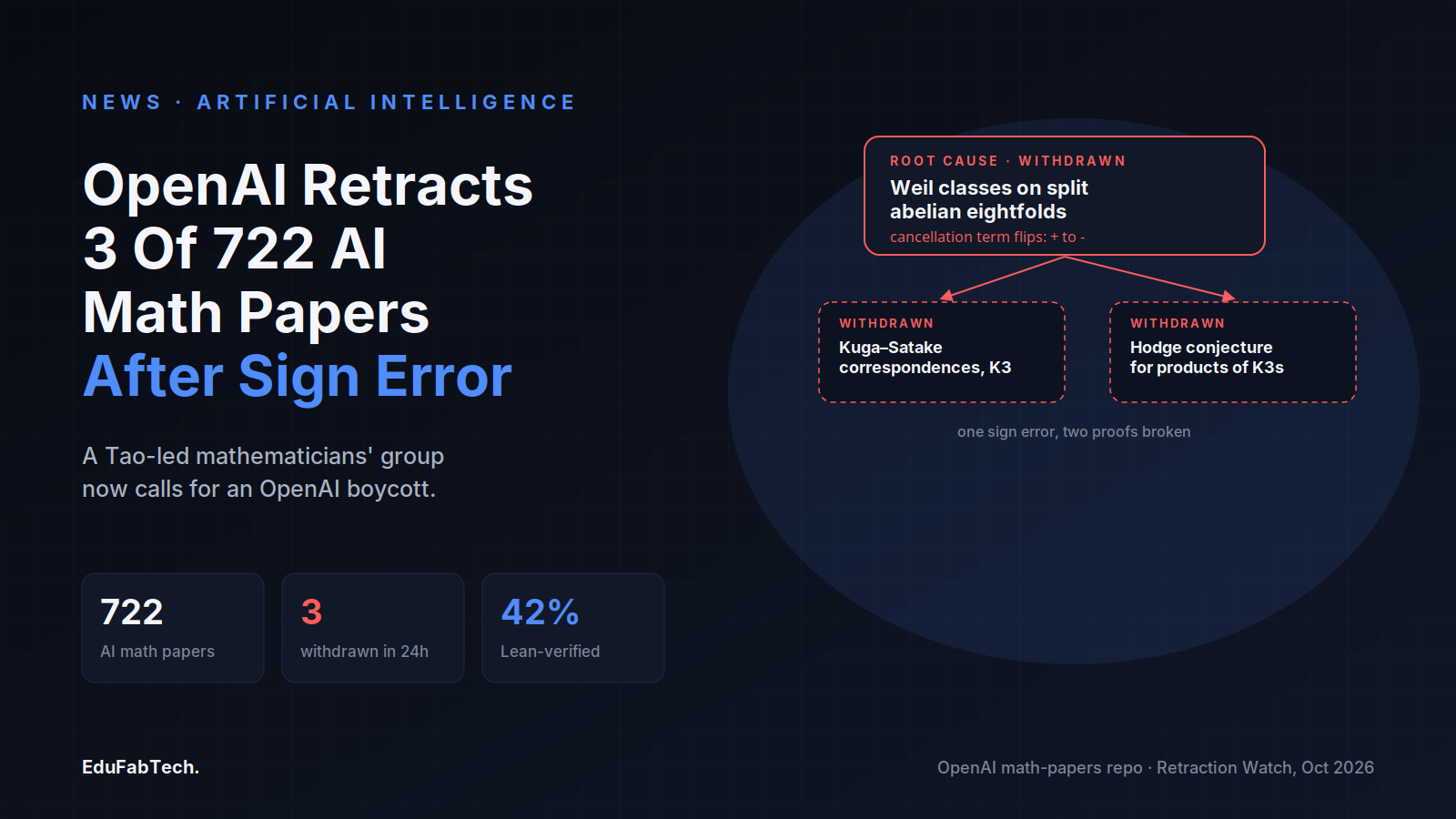
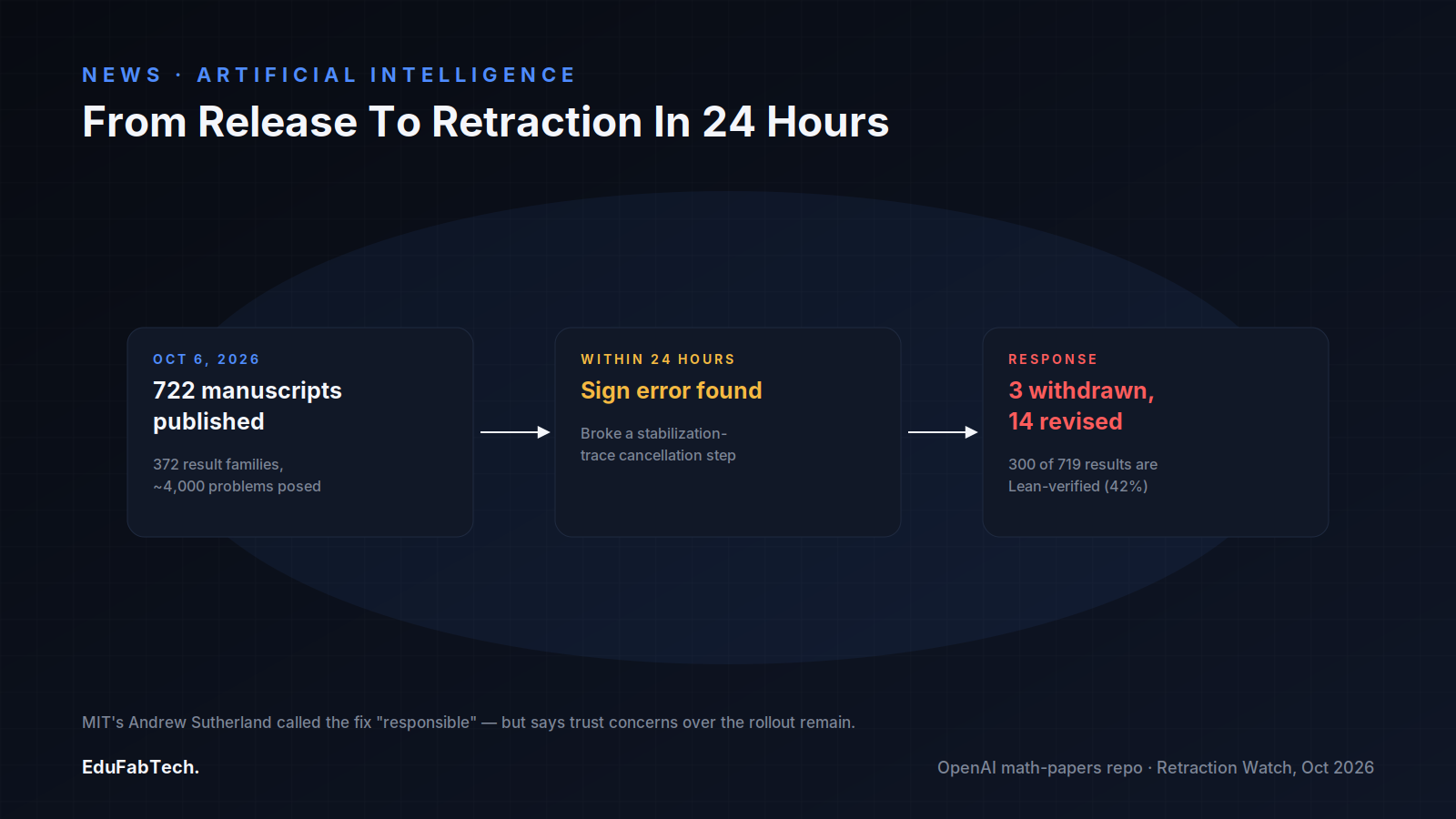
On October 6, 2026, OpenAI published 722 mathematics manuscripts generated by an unreleased internal model, organized into 372 "result families" classified by mathematical discipline, released through a public GitHub repository under an Apache 2.0 license. Within 24 hours the company withdrew three of them after discovering a sign error that broke two dependent proofs, according to the project's own revision history and reporting by Retraction Watch.
The repository's README describes the project as an evaluation in which the model was posed roughly 4,000 problems, with each published result averaging about three hours of "ChatGPT Pro" thinking compute. The 722 manuscripts represent the subset of attempts judged significant enough to publish, spanning geometry, algebra, number theory and related areas. About 300 of the 719 remaining top-line results, or roughly 42%, now carry Lean formalizations that allow a proof assistant to check the logical steps mechanically, per the repository's revision history.
What the sign error broke
The flawed manuscript, "Algebraicity of Weil classes on split abelian eightfolds," contained a sign error that invalidated a stabilization-trace cancellation argument at its core, according to the repository's history file. Two other manuscripts built directly on that construction — "Algebraicity of Kuga–Satake Correspondences for K3 Surfaces" and "The rational Hodge conjecture for products of K3 surfaces" — were withdrawn alongside it because their arguments depended on the broken step.
Beyond the three withdrawals, OpenAI revised 14 further manuscripts with what the repository calls "proof repairs, corrected statements, clearer hypotheses and dependencies." Four manuscripts under the heading "Lipschitz heights and Ashkin–Teller currents" received repairs to crossing, boundary-attachment, conditioning and convergence arguments, while six manuscripts on "Kähler minimal model programs and abundance" received expanded positivity and contraction arguments and clarified input hypotheses. A further 13 manuscripts were updated only to reference the revised companion papers.
A fast correction, a slower trust problem
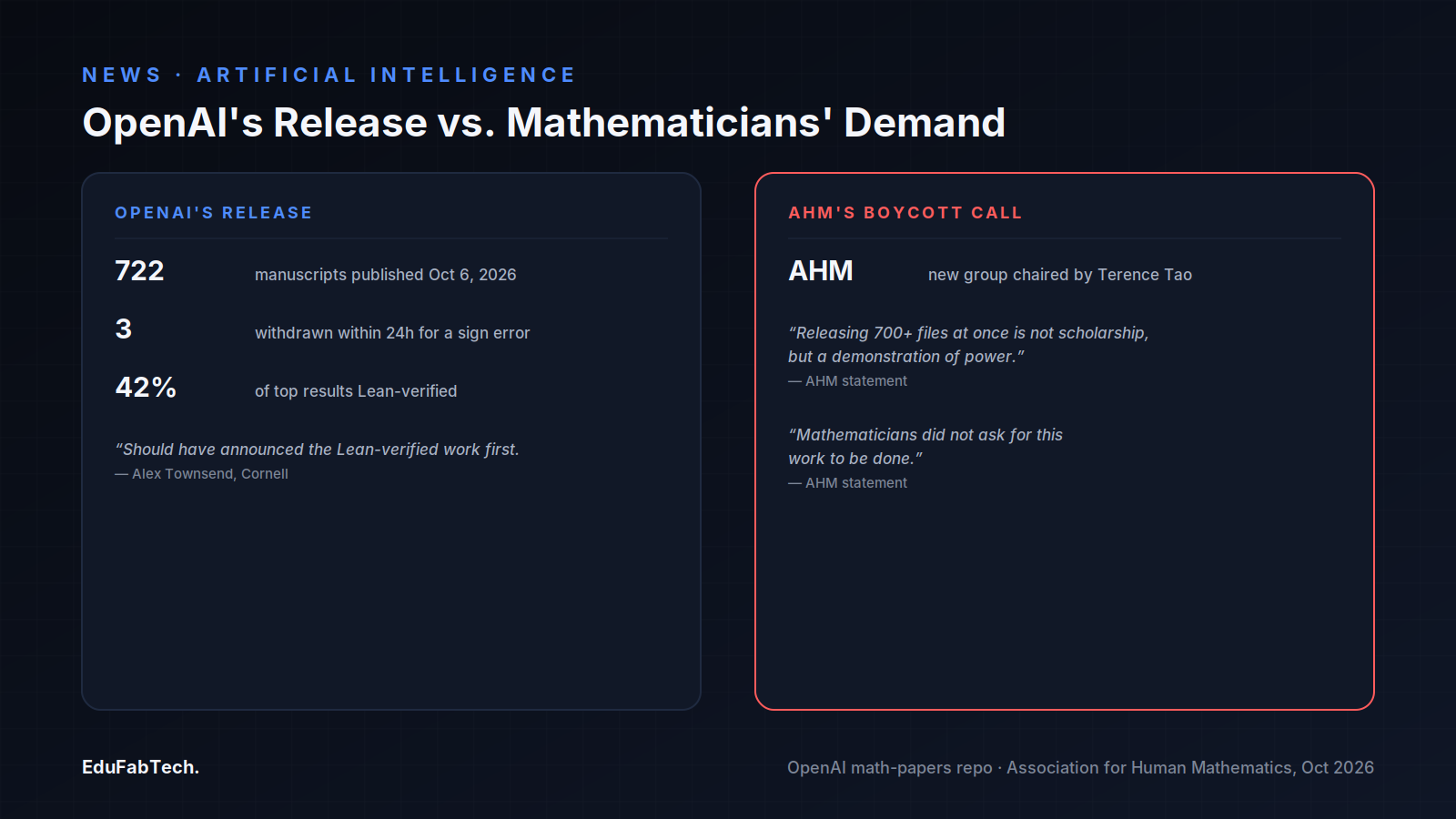
Retraction Watch's reporting quotes two mathematicians reacting to the episode. Alex Townsend of Cornell University said OpenAI "should have announced the manuscripts that were lean verified first" and suggested the company ask the community for help checking the rest, adding that he expected more errors to surface. Andrew Sutherland of MIT called the correction itself "responsible" but said mathematicians remained unhappy with how OpenAI had handled the run-up to the release, pointing to criticism of the company's September 8, 2026 Navier-Stokes announcement for lacking a full write-up and proper citation of prior work.
A new association calls for a boycott
The same week, a newly formed Association for Human Mathematics (AHM), chaired by Fields medalist Terence Tao, published a statement urging mathematicians to "discontinue their work with OpenAI and to return to a vision of science that centers human understanding." The statement, signed by the AHM's Communications Working Group, argues that "releasing over 700 files at once is not a demonstration of scholarship, but a demonstration of power," and says OpenAI bypassed existing guidance from an independent Advisory Group on Mathematics and AI, which had recommended that frontier AI companies not test advanced mathematical problems on internal, unreleased models. The statement also states plainly that "mathematicians did not ask for this work to be done."
What it means for researchers and students
For anyone using the repository, the practical lesson is that a manuscript's presence in a large AI-generated collection is not itself evidence that the proof holds — the Lean-formalized subset (42% of top-line results, per OpenAI's own count) carries a different, machine-checked level of assurance than the remainder, which still rests on human or AI review of natural-language argument. The withdrawal shows that dependency chains between manuscripts in the same release can propagate a single error silently until someone checks the underlying step.
For the broader research community, the dispute is less about whether the specific proofs are correct and more about who gets to set the pace and standards for publishing mathematical claims generated by AI systems. The AHM's intervention signals that at least part of the mathematics community wants verification and attribution norms agreed before, not after, releases of this scale — a question that will likely resurface the next time a large AI-generated results set appears outside the usual peer-review process.
A quick question for readers
Which skill will matter most for getting a job in 2030?
Everyone has a prediction. Add yours and see what students are betting on.
Pick an answer, create a free account in a minute, and your vote counts. Already a member? Sign in
Comments 0
CommentNo comments yet. Members start the conversation.
Source: OpenAI (GitHub)
Sources (3)
- OpenAI. openai/math repository and revision history. GitHub, 2026. github.com ↗ · checked 11 Oct 2026
- Retraction Watch staff. OpenAI withdraws preprints a day after releasing 722 manuscripts on unsolved math problems. Retraction Watch, 2026. retractionwatch.com ↗ · checked 11 Oct 2026
- Association for Human Mathematics (Communications Working Group). Statement on OpenAI's October 6, 2026 Release of Mathematical Documents. Association for Human Mathematics, 2026. ahmath.org ↗ · checked 11 Oct 2026