A Blood-Based Score Combining Ten microRNAs and CA19-9 Flags Early Pancreatic Cancer in a 1,785-Person Study
Published in Nature Medicine on September 16, 2026, the PANXEON assay caught 86.8% of stage I-II pancreatic tumors, though the authors say it still needs large prospective trials before clinical use.
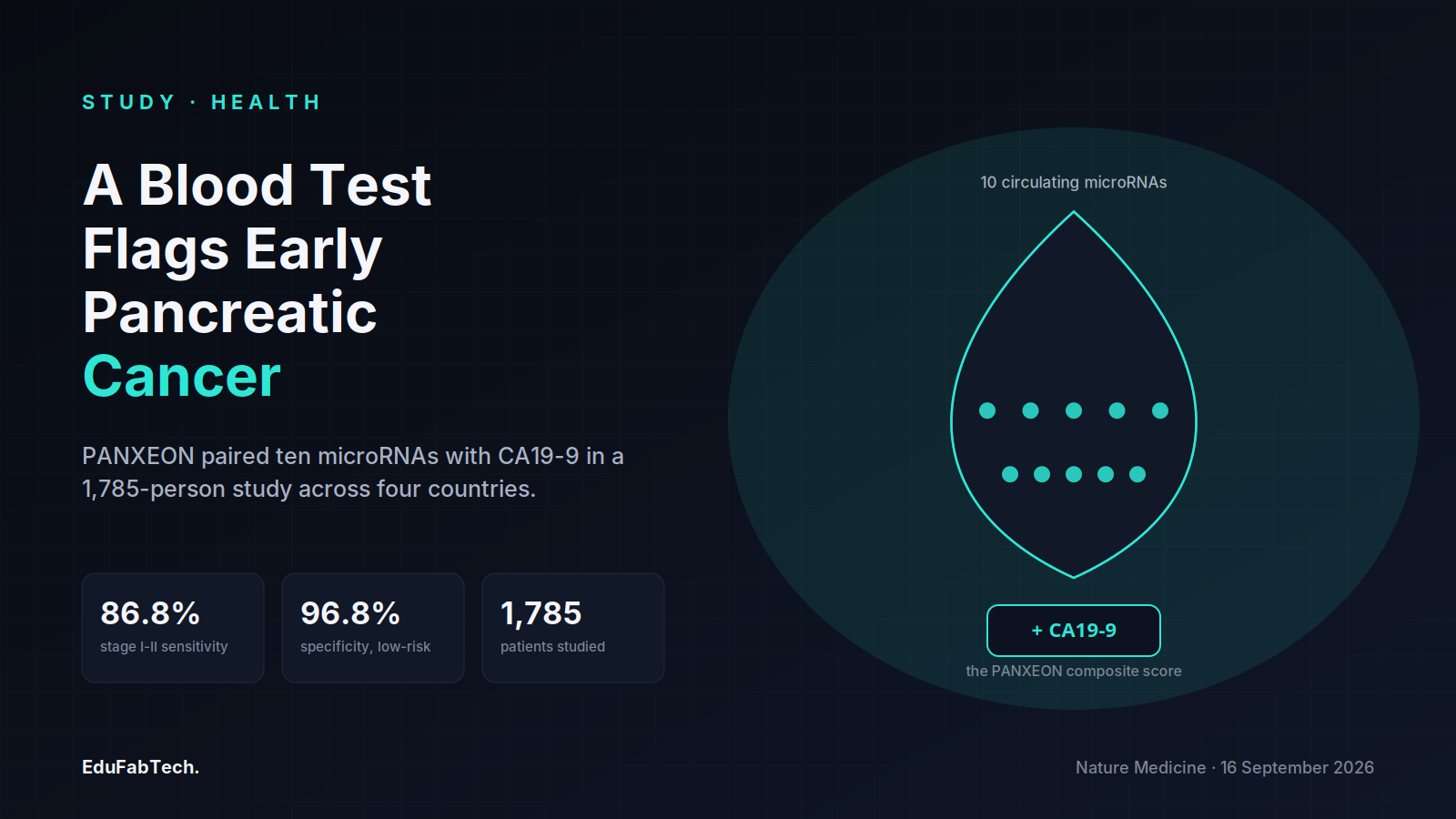
Researchers led by City of Hope's Ajay Goel, with co-first authors Caiming Xu and Alessandro Mannucci, published a prospective, multicenter study on September 16, 2026, in Nature Medicine describing a blood test that combines a ten-microRNA signature with the established protein marker CA19-9 to flag pancreatic ductal adenocarcinoma (PDAC) at an earlier, more treatable stage. The assay, named PANXEON, was evaluated in 1,785 individuals recruited across four countries, with training, validation and independent testing cohorts kept separate throughout the analysis.
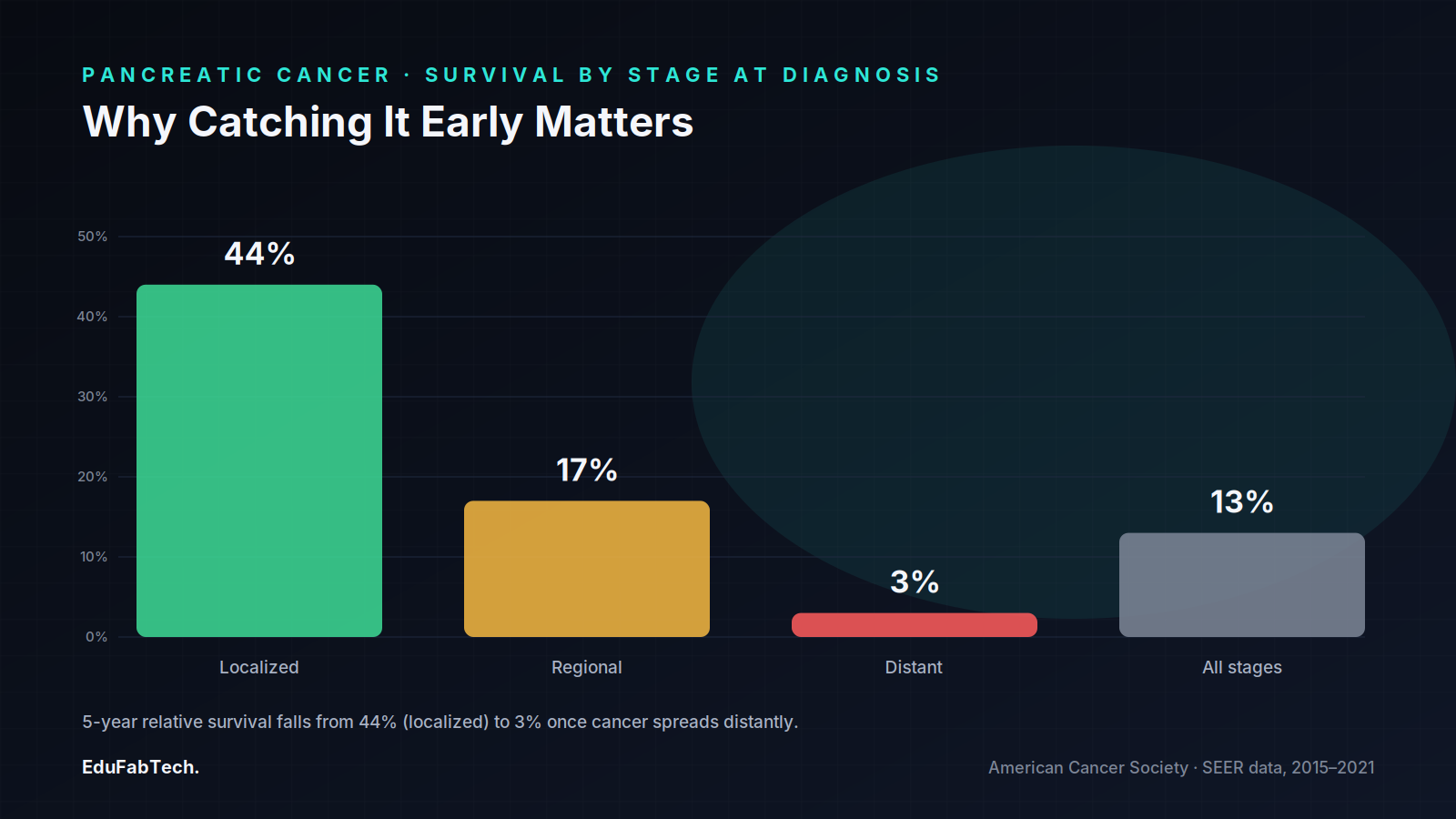
Pancreatic cancer is usually diagnosed after it has already spread, which is the main reason it remains one of the deadliest common cancers. According to the American Cancer Society's SEER-based survival tables, covering people diagnosed between 2015 and 2021, five-year relative survival is 44% when the tumor is still localized to the pancreas but falls to 17% once it has reached nearby tissue and to 3% after distant spread. Across all stages combined, five-year survival sits at 13%. Because early-stage disease produces few symptoms, most cases are caught only after that window has closed.
What the test measures
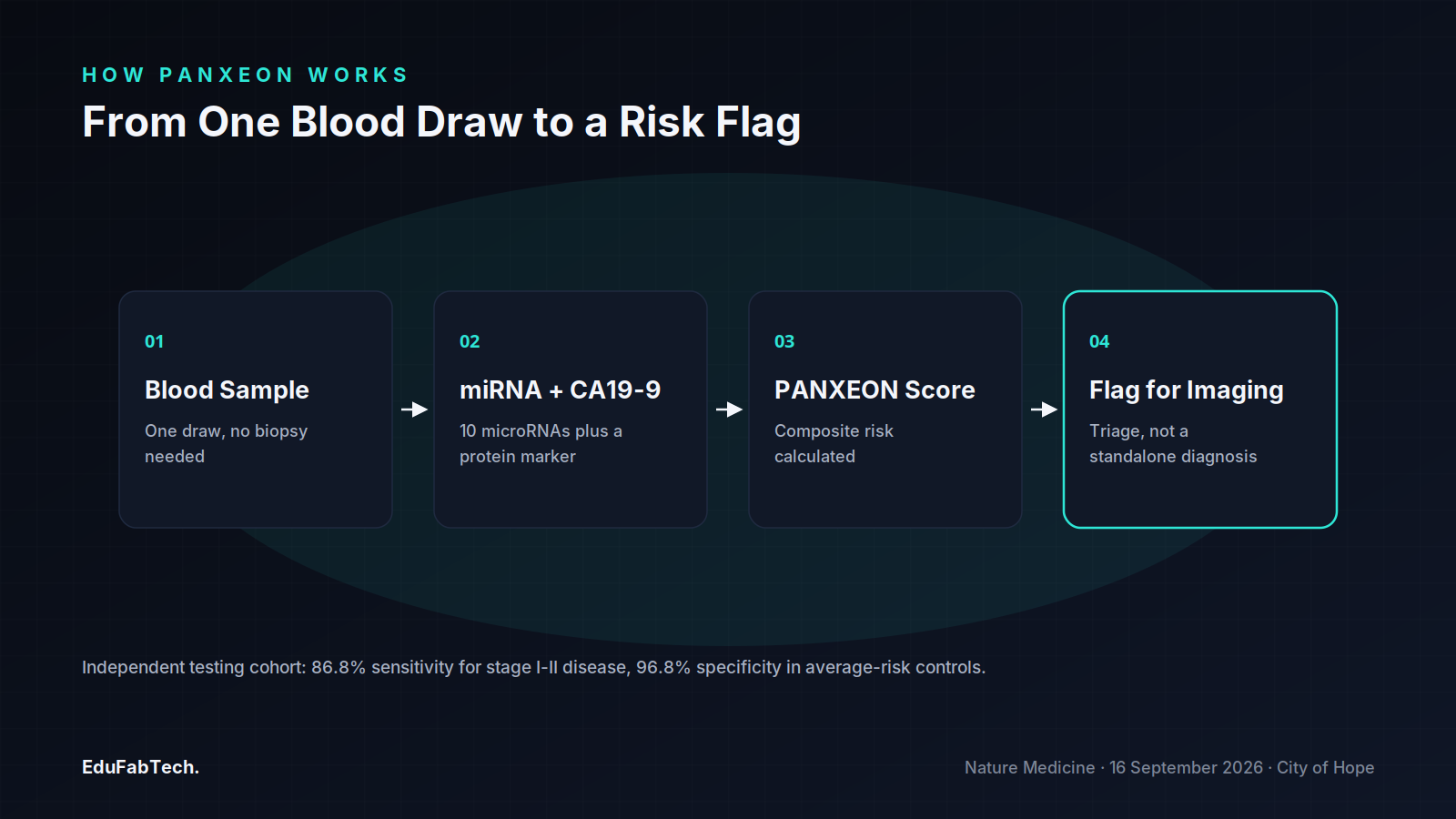
PANXEON draws on a single blood sample and reads three signals: a panel of ten circulating and exosomal microRNAs, plus levels of carbohydrate antigen 19-9 (CA19-9), a protein already used clinically to monitor pancreatic cancer but historically considered too unreliable on its own for screening. The study team first identified the microRNA signature in a training cohort, then locked it before testing it on samples the model had not seen.
In the independent testing cohort, the microRNA signature alone reached an area under the receiver operating characteristic curve (AUROC) of 88.6% for distinguishing PDAC or high-grade dysplasia from controls, with a sensitivity of 83.8% for early-stage (stage I-II) cancer. Adding CA19-9 to form the composite PANXEON score raised sensitivity for stage I-II disease to 86.8%, with a specificity of 96.8% in average-risk controls — equivalent to a 3.2% false-positive rate in that group. Among people already flagged as high-risk (for example, due to pancreatic cysts or inherited risk factors), the false-positive rate was higher, at 15.6%.
Catching disease before it becomes cancer
Beyond invasive PDAC, the researchers also tested PANXEON against high-grade dysplasia, a precancerous lesion sometimes described as "stage 0" pancreatic cancer, in patients under surveillance for pancreatic cysts. The assay identified 64.3% of these lesions, a lower detection rate than for invasive cancer but one the authors present as clinically meaningful, since catching dysplasia before it progresses could allow surgical removal ahead of a cancer diagnosis. The test also showed limited cross-reactivity with other gastrointestinal cancers, according to the additional comparison cohorts included in the study.
"Pancreatic cancer remains so deadly largely because we find it after the window for cure has begun to close," said senior author Ajay Goel, chair of the Department of Molecular Diagnostics and Experimental Therapeutics at City of Hope, in the institution's announcement of the findings.
What the authors say it is not
The authors are explicit that PANXEON is not proposed as a stand-alone screening test for the general population. They frame it instead as a noninvasive triage tool intended to identify people who warrant further diagnostic workup, such as imaging, rather than a replacement for it. The paper states the assay "warrants further large-scale prospective studies," language the authors use to signal that these results, while derived from a sizable multicenter cohort, are not sufficient on their own to justify clinical deployment. A separate registered study is now recruiting to follow the assay's performance for disease monitoring over time.
One detail worth noting for anyone evaluating the result: Goel is listed as a paid consultant to Biocartis, a diagnostics company that holds an option to acquire rights to PANXEON. That commercial relationship does not by itself undermine the reported statistics, which were generated against held-out testing cohorts, but it is the kind of conflict-of-interest disclosure that independent replication in future trials will need to account for.
Where this fits among pancreatic cancer detection efforts
PANXEON joins a small number of blood-based approaches under development for pancreatic cancer, most of which have struggled to combine high sensitivity for early-stage disease with an acceptably low false-positive rate in average-risk populations. The 96.8% specificity reported here for low-risk controls is the figure most relevant to any future general-population use, since a high false-positive rate in that setting would trigger unnecessary follow-up imaging and biopsies at scale. The 15.6% false-positive rate in high-risk groups reflects a different, already-monitored population, where clinicians may tolerate more false alarms in exchange for higher sensitivity.
The study's funding, disclosed in the paper, came from the U.S. National Institutes of Health's National Cancer Institute and the Italian Association for Cancer Research. The next step described by the authors is validation in additional large, prospective cohorts, ideally including people identified through routine risk assessment rather than those already referred to specialist centers, before any regulatory or clinical screening application is considered.
- Caiming Xu, Alessandro Mannucci, Ajay Goel, et al.. Liquid biopsy for early detection of pancreatic ductal adenocarcinoma. Nature Medicine, 2026. doi:10.1038/s41591-026-04625-x
- City of Hope. New Study: Blood Test Shows Promise for Detecting Pancreatic Cancer at Its Earliest Stages. City of Hope, 2026. link
- American Cancer Society. Survival Rates for Pancreatic Cancer. American Cancer Society, 2026. link
- CLP Magazine. PANXEON Liquid Biopsy Shows 87% Accuracy for Early Pancreatic Cancer Detection in Study. Clinical Laboratory Products, 2026. link