Phase 1 Trial Finds a Cancer-Style T-Cell Engager Can Push Refractory Lupus Into Remission
In a 12-patient dose-escalation study published in Nature Medicine, most participants with treatment-resistant lupus reached low disease activity or remission within a year, but the researchers call the result preliminary.
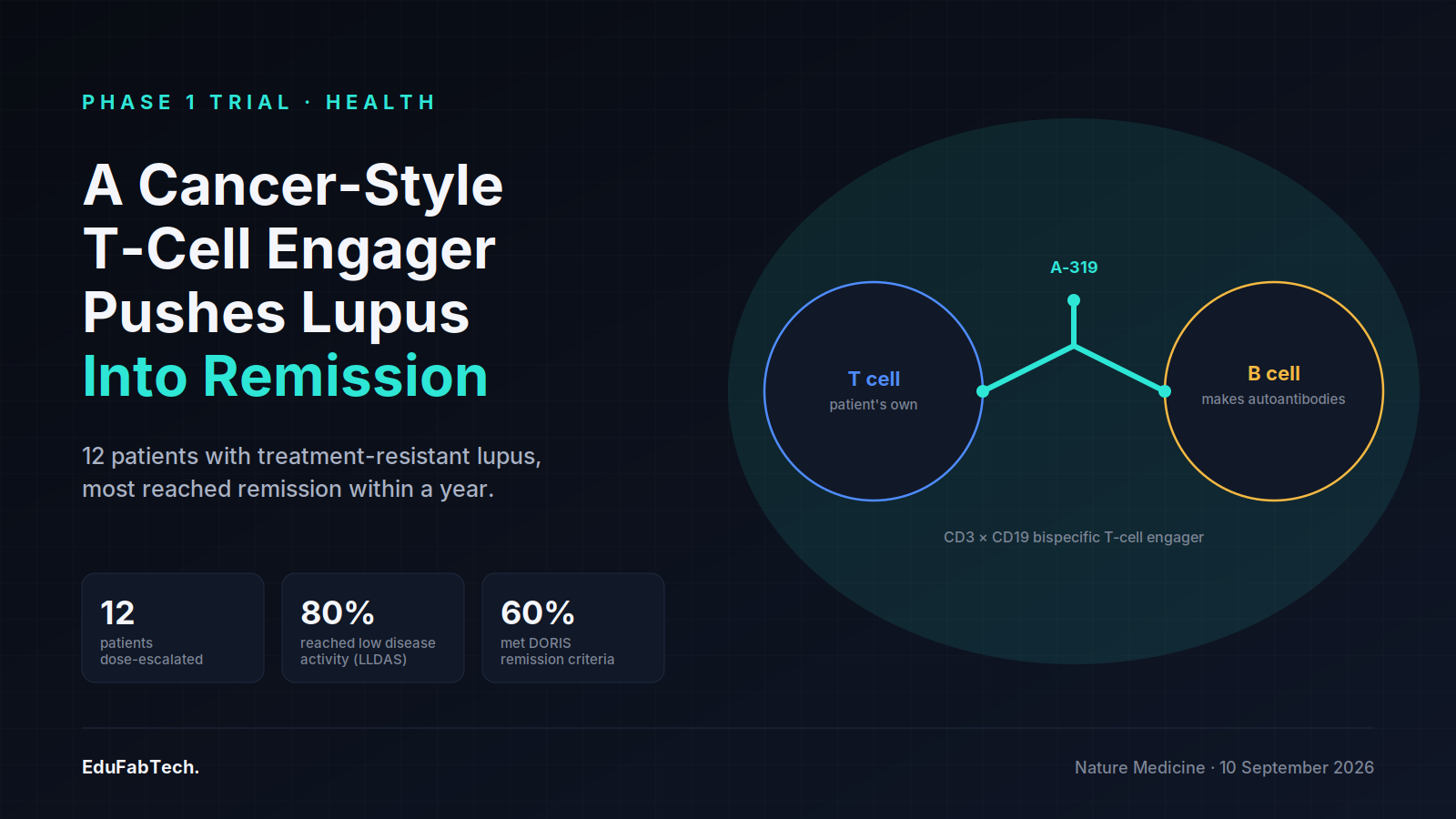
A phase 1 trial of a bispecific antibody borrowed from cancer therapy has pushed most of its 12 participants with treatment-resistant lupus into remission or low disease activity within a year, according to a paper published online in Nature Medicine on September 10, 2026. The trial was run out of Union Hospital at Tongji Medical College, Huazhong University of Science and Technology, in Wuhan, China, with co-authors at Stanford University, the University of Pennsylvania and Yale University, and co-sponsored by the biotech company ITabMed.
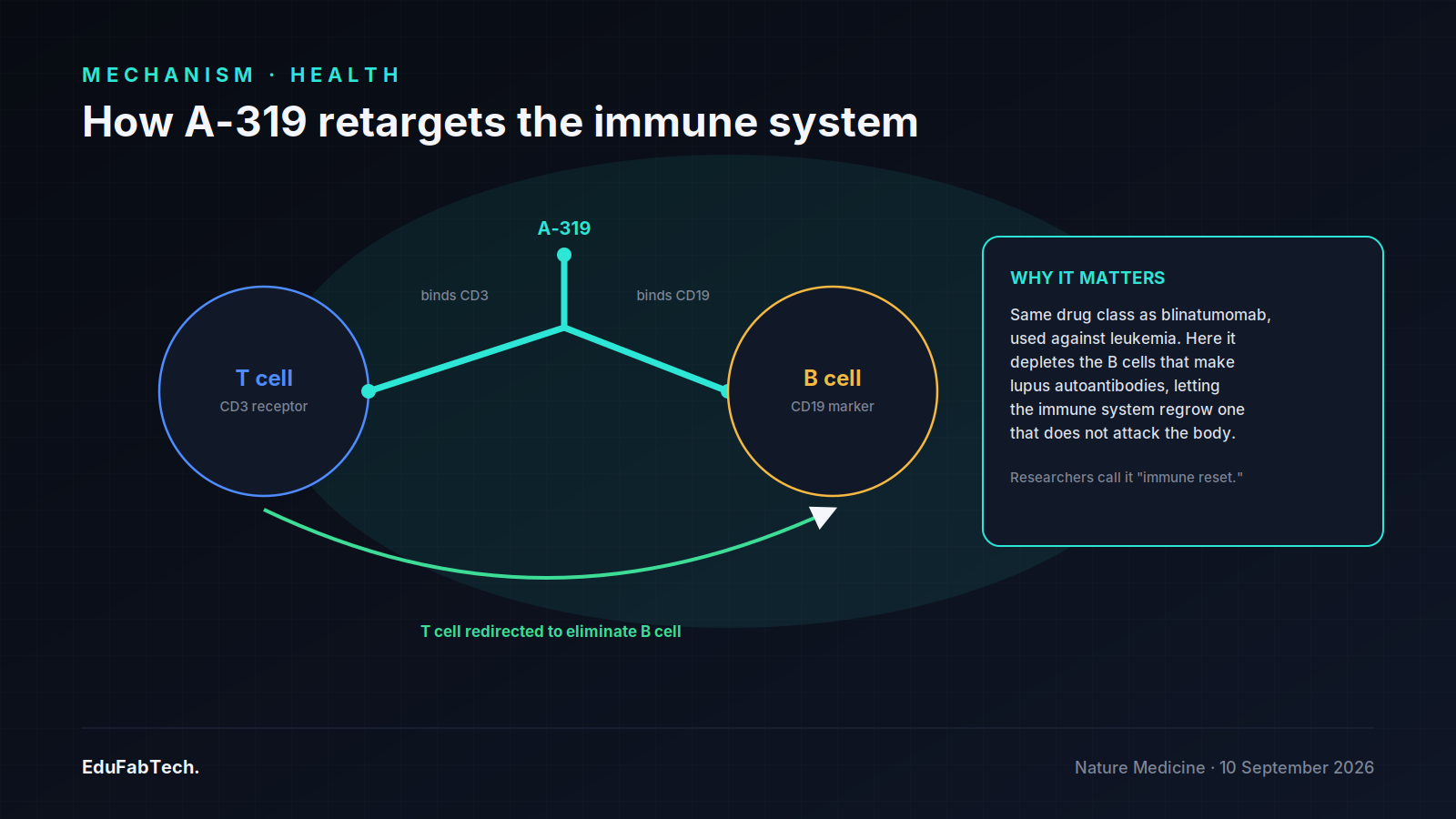
The drug, called A-319, is a CD3×CD19 bispecific T-cell engager: a lab-made antibody with one arm that grabs a patient's own T cells and another that grabs CD19, a marker found on B cells. The same design class underlies cancer drugs such as blinatumomab, which redirects T cells to kill leukemia cells. In lupus, the target isn't a tumor but the B cells that manufacture the autoantibodies driving the disease. The idea, sometimes called "immune reset," is to wipe out the pathogenic B-cell population and let the immune system regenerate one that doesn't attack the body's own tissue.
Systemic lupus erythematosus affects roughly 43.7 people per 100,000 worldwide, according to a 2023 modelling study in the Annals of the Rheumatic Diseases, and a meaningful share of patients don't respond adequately to standard immunosuppressants. For those with refractory disease, the treatment options that remain are limited and often come with their own toxicity.
How the trial was built
This was a first-in-disease, open-label, dose-escalation study, registered as NCT06400537, with a principal investigator based in Wuhan. Twelve patients with active, treatment-refractory lupus were split into three cohorts of escalating dose. All began with a week of low priming infusions (0.05 micrograms per kilogram) to blunt the initial immune reaction, then moved to three weeks of higher dosing: 0.3 micrograms per kilogram in the first cohort of six patients, 0.6 in a cohort of three, and 1.2 in a final cohort of three. The primary endpoint, as in any first-in-human study, was safety and tolerability rather than efficacy.
B-cell depletion tracked the dose. In the lowest-dose cohort it was incomplete, with roughly 10% of B cells still circulating at week four. The two higher-dose cohorts achieved complete depletion, down to undetectable levels. Notably, the researchers reported clinical improvement even in patients whose B-cell depletion was incomplete, which is part of what they describe as preliminary evidence for a broader immune-resetting effect rather than depletion alone.
What improved, and by how much
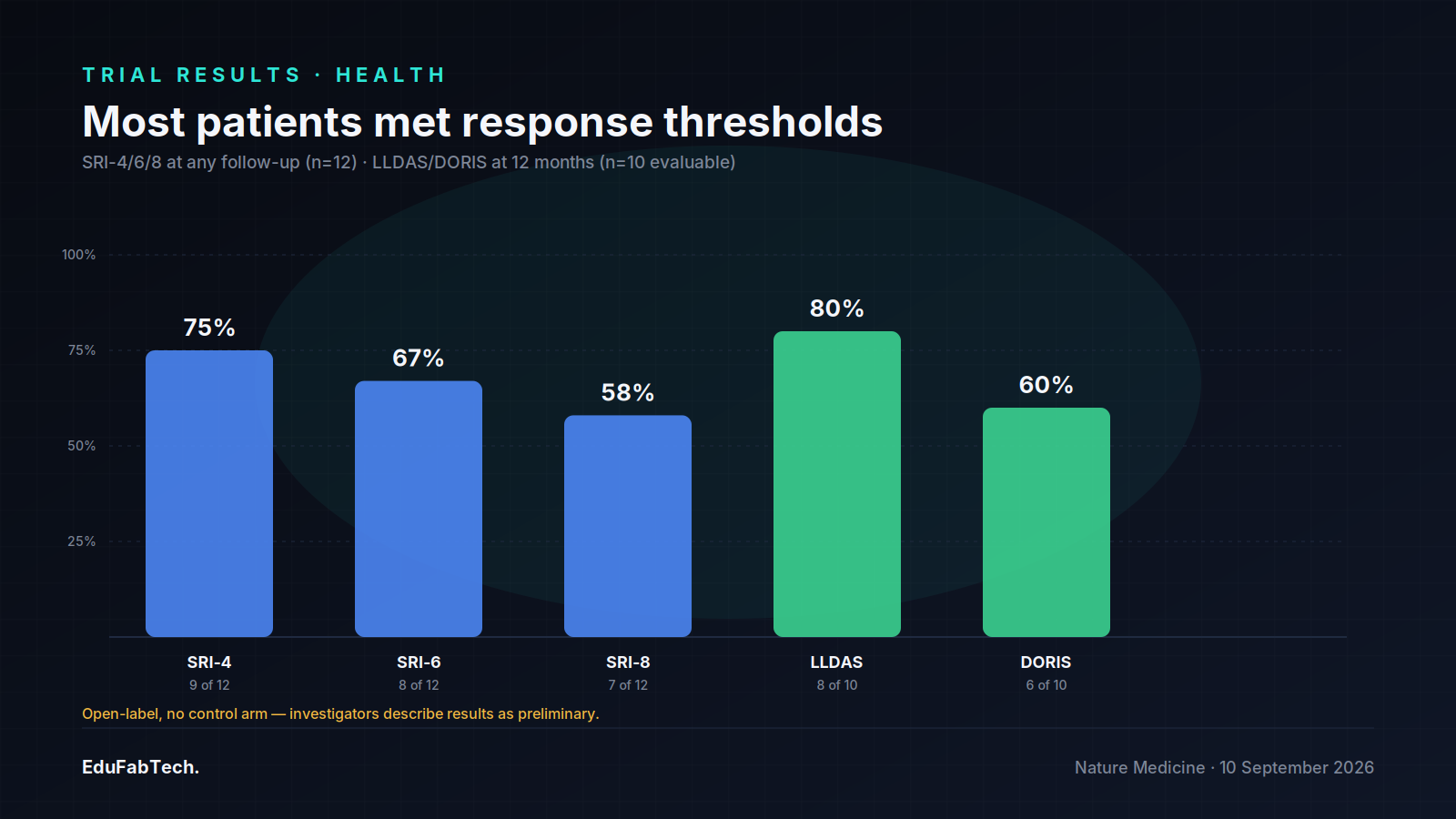
Using the SLE Responder Index, nine of the 12 patients met the SRI-4 threshold, eight met the stricter SRI-6, and seven met SRI-8. Two patients withdrew before the 12-month mark — one for a renal complication, one for disease rebound — leaving ten evaluable at that point. Of those ten, eight (80%) had reached Lupus Low Disease Activity State and six (60%) met the Definition of Remission in SLE, two treat-to-target benchmarks used across lupus trials. Among patients who entered the study with significant proteinuria (0.5 grams per 24 hours or higher), four of seven had fallen below that threshold by month six. Every patient reduced their glucocorticoid dose over the course of follow-up, and eight brought it down to 7.5 milligrams a day or less, a level considered low-risk for long-term steroid toxicity.
Safety, so far
One patient had a grade 2 cytokine release syndrome event, which resolved within 12 hours; most other cases of cytokine release syndrome in the trial were grade 1. The paper reports no grade 3 or higher cytokine release syndrome, no neurotoxicity, no treatment-related deaths, and no other treatment-related serious adverse events across the cohort. That is a materially lighter toxicity profile than reported for CD19 chimeric antigen receptor (CAR) T-cell therapy in lupus, an adjacent approach being tested in separate trials, though A-319 has not been tested head-to-head against CAR-T and the comparison is indirect.
Why this isn't a verdict yet
Twelve patients, no control arm, no blinding, and a single-country trial population are real limits, and the investigators frame their own findings as preliminary — the phrase used in their earlier conference report was "preliminary evidence of autoimmune reset." A bispecific antibody has one practical advantage over CAR-T: it's an off-the-shelf infusion rather than a cell product manufactured individually for each patient, which would make it far easier to scale if later, larger trials confirm the effect. Whether the remissions seen here hold up, and whether they persist once treatment stops, will depend on the randomized, controlled trials that would normally follow a study of this size.
- Xu J, Mei C, Guan X, et al.. A bispecific CD3×CD19 antibody for systemic lupus erythematosus: a phase 1 trial. Nature Medicine, 2026. doi:10.1038/s41591-026-04572-7
- National Library of Medicine (U.S.). Clinical Study of A-319 in the Treatment of Active/Refractory Systemic Lupus Erythematosus (NCT06400537). ClinicalTrials.gov, 2026. link
- Tian J, Zhang D, Yao X, Huang Y, Lu Q. Global epidemiology of systemic lupus erythematosus: a comprehensive systematic analysis and modelling study. Annals of the Rheumatic Diseases, 2023. doi:10.1136/ard-2022-223035
- Wang X, Zhang Y, Wang H, et al.. Allogeneic CD19-targeting T cells for treatment-refractory systemic lupus erythematosus: a phase 1 trial. Nature Medicine, 2025. doi:10.1038/s41591-025-03899-x