UK Biobank Study of 95,559 Wrist Trackers Links REM and Deep Sleep Stages to Risk of 83 Diseases
A PLOS Medicine phenome-wide analysis published September 17, 2026, ties accelerometer-measured sleep stages to later diagnoses, while its authors caution the design cannot show cause and effect.
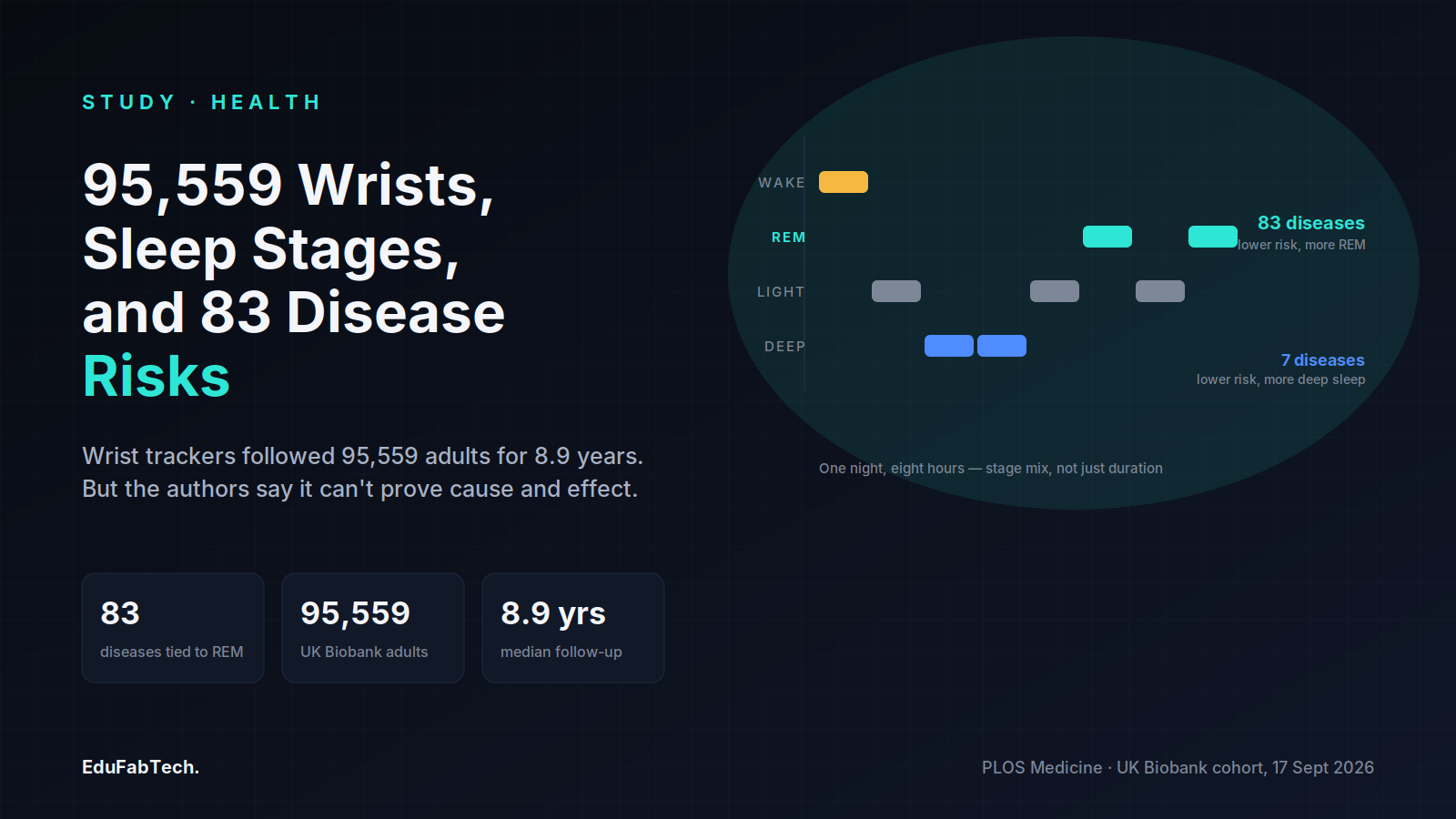
A cohort study published in PLOS Medicine on September 17, 2026, reports that people who spend more time in REM and deep sleep, as measured objectively by wrist accelerometers, go on to develop dozens of diseases at lower rates than people who spend less time in those stages. The analysis, led by researchers from the School of Public Health at Peking University and Capital Medical University in Beijing, followed 95,559 UK Biobank participants for a median of 8.9 years and tested associations against 1,049 disease phenotypes built from 10,515 ICD-10 diagnostic codes.
The study addresses a long-standing gap in sleep epidemiology: most large cohort studies rely on self-reported sleep duration, which is a poor proxy for what actually happens during sleep. Here, participants wore an Axivity AX3 accelerometer on the wrist for seven consecutive days, and the raw movement data was passed through a deep-learning algorithm called SleepNet to classify each night into REM, light (N1/N2), and deep (N3) sleep, alongside total duration, wakefulness after sleep onset, and night-to-night irregularity.
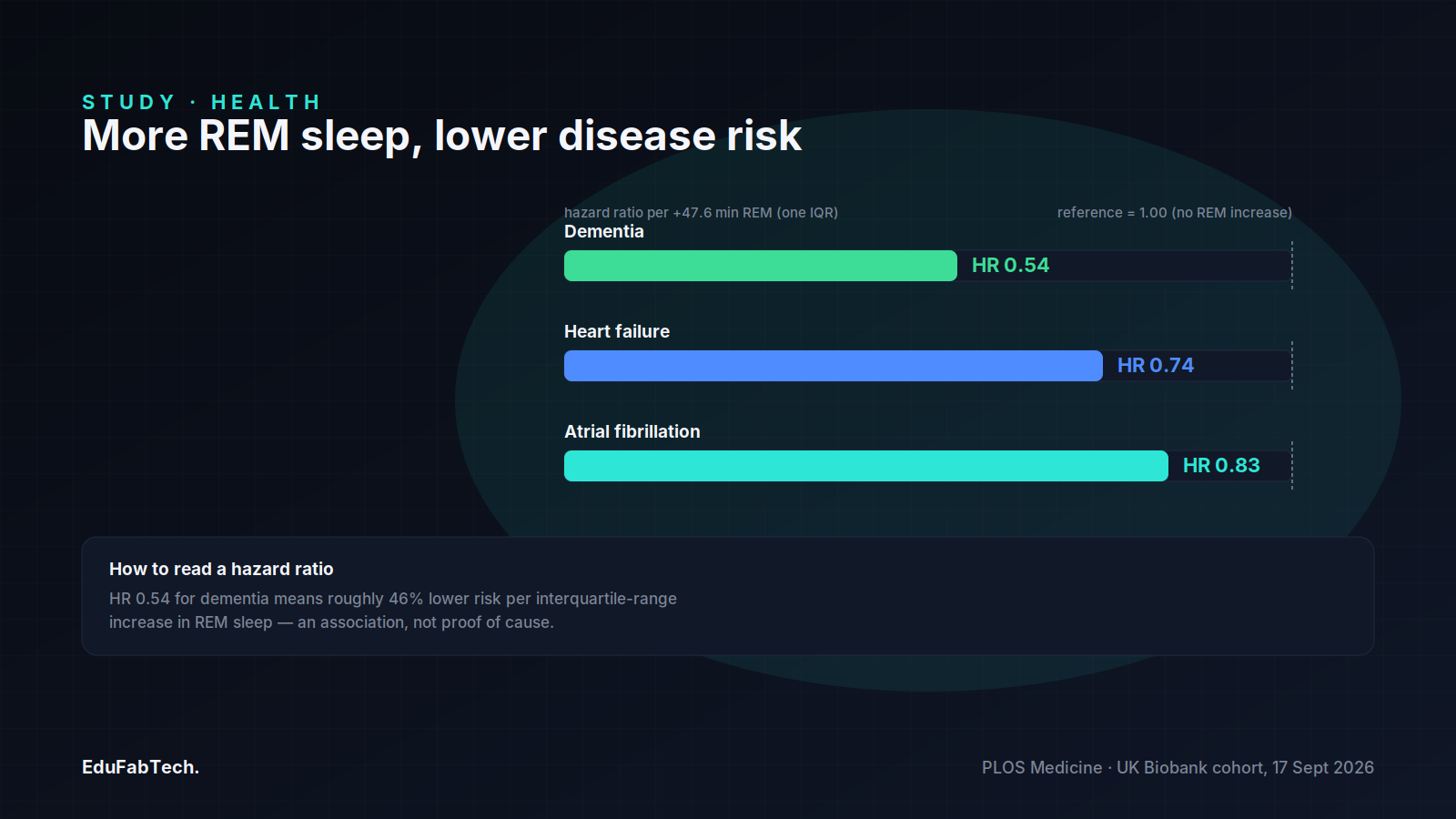
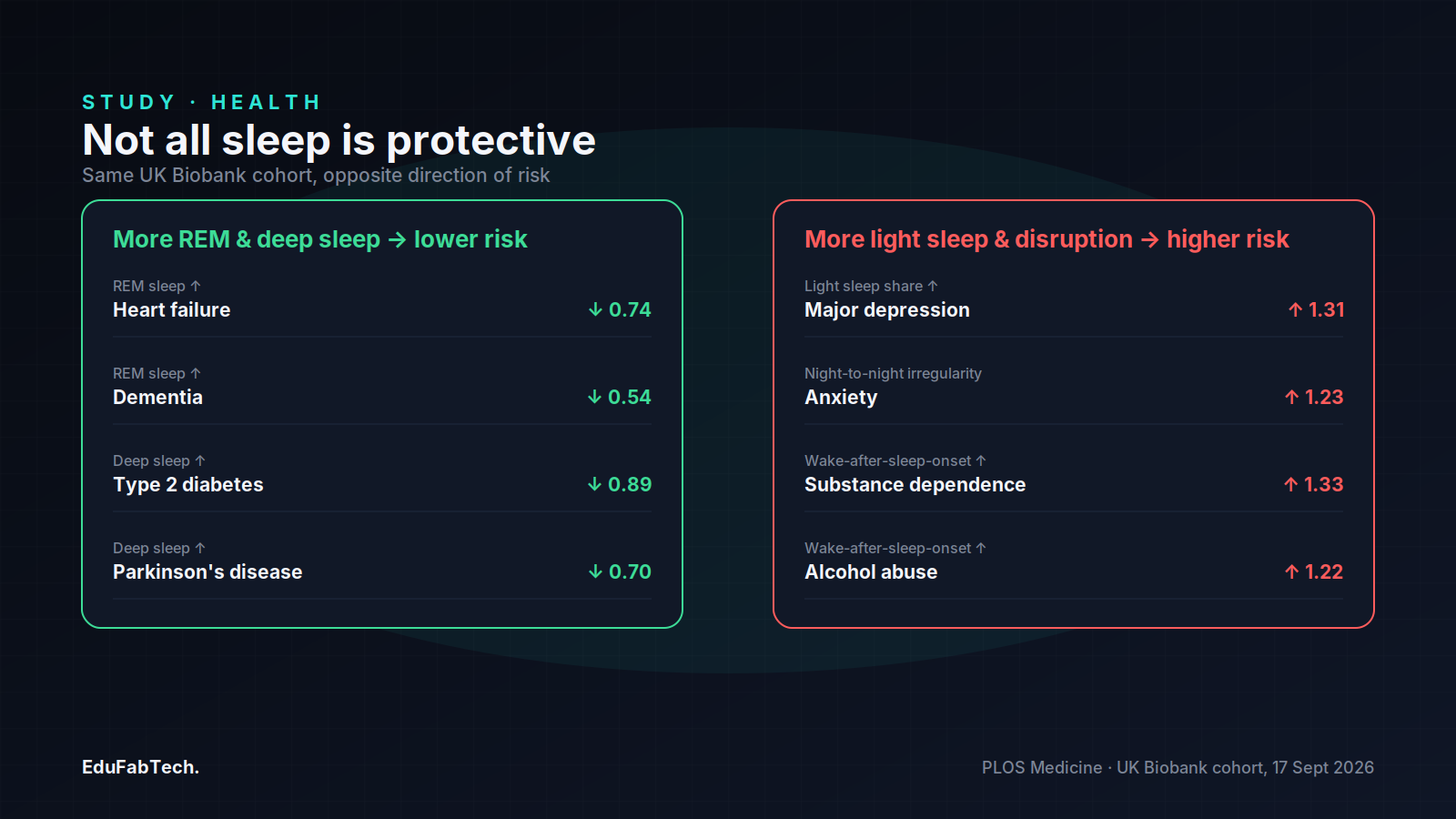
Greater REM sleep showed the broadest protective pattern, linked to lower risk across 83 disease phenotypes. Each interquartile-range increase in REM duration (about 47.6 minutes) was associated with a hazard ratio of 0.74 (95% CI 0.68–0.80) for heart failure, 0.83 (95% CI 0.79–0.86) for atrial fibrillation, and 0.54 (95% CI 0.47–0.62) for dementia. Deep sleep showed a narrower but still notable pattern, tied to lower risk of 7 conditions, including type 2 diabetes (HR 0.89, 95% CI 0.85–0.93), major depressive disorder (HR 0.86, 95% CI 0.82–0.91), and Parkinson's disease (HR 0.70, 95% CI 0.62–0.80).
Where the pattern reverses
Light sleep behaved differently: a greater share of light sleep relative to other stages was associated with a higher, not lower, risk of major depressive disorder (HR 1.31, 95% CI 1.25–1.36). Night-to-night sleep irregularity was linked to elevated risk of anxiety (HR 1.23, 95% CI 1.16–1.31) and major depressive disorder (HR 1.26, 95% CI 1.18–1.34), and more time spent awake after initially falling asleep was associated with higher risk of substance dependence (HR 1.33, 95% CI 1.16–1.52) and alcohol abuse (HR 1.22, 95% CI 1.13–1.32).
On total sleep duration, the relationship was non-linear across 86 phenotypes, with 6 to 8 hours a night associated with the lowest overall disease risk. Sleeping less than 5 hours stood out sharply: compared with the reference group, short sleepers showed 37 significant adverse associations out of 41 phenotypes tested for that comparison, spanning cardiovascular, metabolic, and psychiatric conditions.
What the authors say the data cannot show
The paper is explicit about its limits. The authors write that the observational design "does not support causal conclusions" and list several sources of possible distortion: participants' baseline characteristics were recorded, on average, 5.7 years before the sleep measurement; sleep was assessed only once, over seven days, which may not capture long-term patterns; outcome data came only from inpatient hospital diagnoses, missing conditions managed entirely in outpatient settings; and accelerometer-derived sleep staging shows systematic differences from polysomnography, the clinical gold standard. The UK Biobank cohort itself skews toward healthier, White European, higher-socioeconomic-status volunteers, which limits how far the findings generalize.
Perhaps most telling, the researchers ran a sensitivity analysis excluding the first two years of follow-up, a standard check for reverse causation — the possibility that early, undiagnosed disease was already disrupting sleep before diagnosis, rather than poor sleep causing the disease. That two-year washout retained only about 60% of the original associations, which the authors treat as evidence that a meaningful share of the raw findings likely reflect reverse causation rather than sleep driving disease risk.
Why it matters despite the caveats
Even with those constraints, the scale of the phenome-wide screen is unusual: after Bonferroni correction for multiple testing, the authors report 156 associations they consider statistically robust across the full set of sleep metrics and diseases tested. The study's practical takeaway, as the authors put it, is that "maintaining a sleep duration of 6–8 hours can effectively reduce the risk of multiple diseases, providing new insights for health promotion and preventive practice" — a conclusion about duration that rests on more consistent evidence than the stage-specific associations, given the latter's sensitivity to the washout check.
The findings add to a growing body of work using consumer-grade wearables to move sleep research beyond self-report, but they also illustrate why single-cohort, observational associations — however large the sample — need replication in populations with different demographics and, ideally, corroboration from interventional or genetically informed designs before REM or deep sleep duration is treated as a modifiable target for disease prevention.
- Jingsong Luo, Ruiyi Liu, Jie Yin, Wangnan Cao, Shengzhi Sun, Rui Chen. Accelerometer-derived real-world sleep stages and risk of incident diseases: A UK Biobank cohort study and phenome-wide association analysis. PLOS Medicine, 2026. doi:10.1371/journal.pmed.1005213
- Jingsong Luo, Ruiyi Liu, Jie Yin, Wangnan Cao, Shengzhi Sun, Rui Chen. Accelerometer-derived real-world sleep stages and risk of incident diseases (full text). PMC, National Library of Medicine, 2026. doi:10.1371/journal.pmed.1005213
- ScienceDaily. More REM sleep linked to lower risk of 83 diseases. ScienceDaily, 2026. link