Randomized Trial Finds Teclistamab Outperforms Standard Early Treatment in High-Risk Smoldering Myeloma
A 59-patient phase 2 trial published in Nature Medicine on September 11, 2026 found that treating high-risk smoldering multiple myeloma early with teclistamab produced deeper, more durable responses than the current standard regimen.
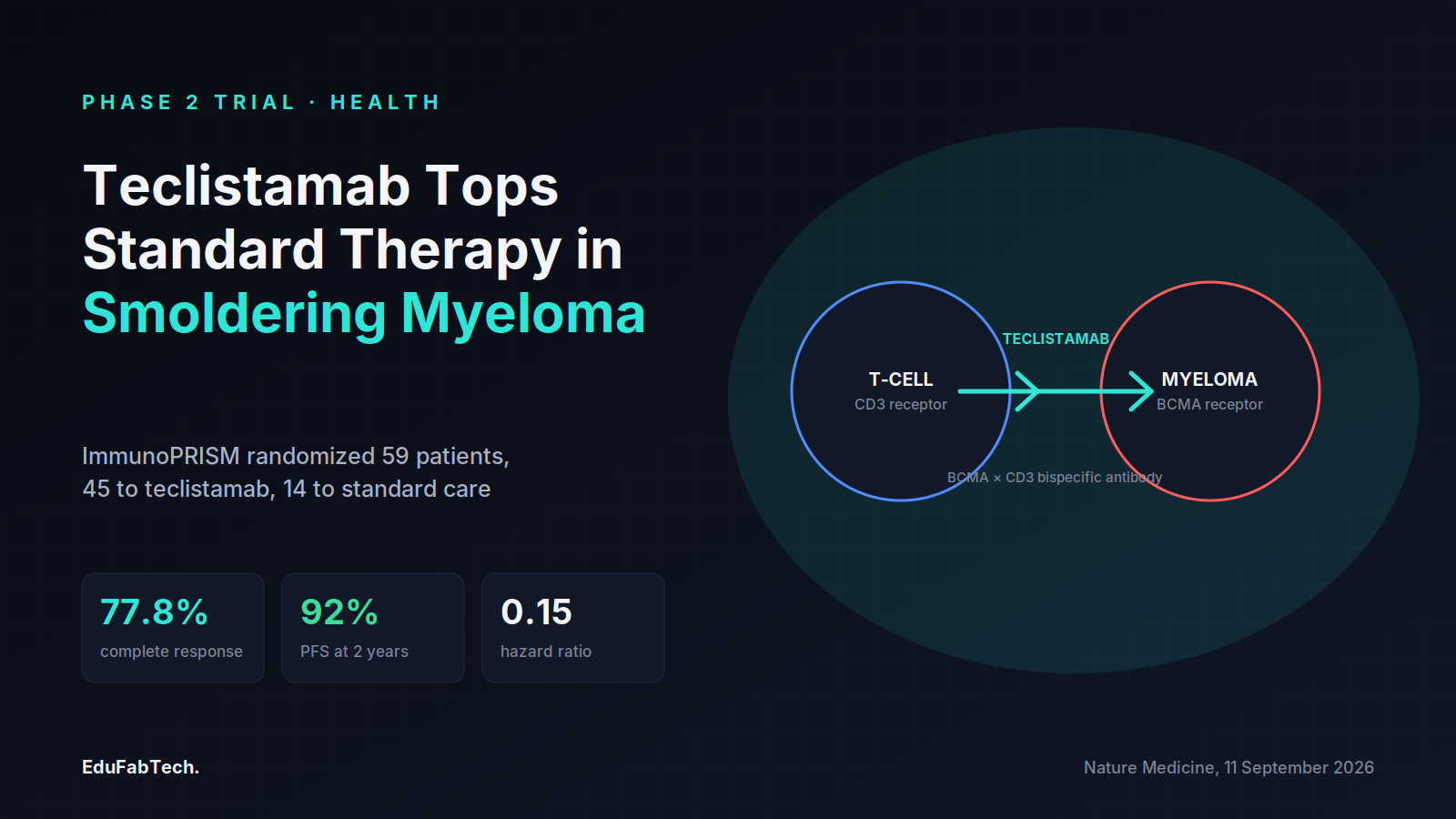
A phase 2 randomized trial published in Nature Medicine on September 11, 2026 reports that treating high-risk smoldering multiple myeloma early with the bispecific antibody teclistamab produced a complete response in 77.8% of treated patients, compared with 0% of patients given the current early-intervention standard, lenalidomide plus dexamethasone. The trial, called ImmunoPRISM, was run by investigators at Dana-Farber Cancer Institute together with sites including the Colorado Blood Cancer Institute and Oregon Health & Science University's Knight Cancer Institute, and is registered with the U.S. National Library of Medicine as NCT05469893.
A precursor state, not yet active cancer
Smoldering multiple myeloma is an asymptomatic condition in which abnormal plasma cells are detectable in blood and bone marrow but have not yet caused the organ damage that defines active multiple myeloma. Patients classified as high-risk face a substantial chance of progressing to symptomatic disease within a few years, and the standard approach for this group has for some time been either careful monitoring or a course of lenalidomide plus dexamethasone intended to delay progression without committing patients to full myeloma-intensity treatment.
ImmunoPRISM tested a different premise: that intervening early with a T-cell-engaging immunotherapy, rather than an immunomodulatory drug combination, could produce deeper and more durable remissions in a population whose disease burden is still comparatively low.
Trial design
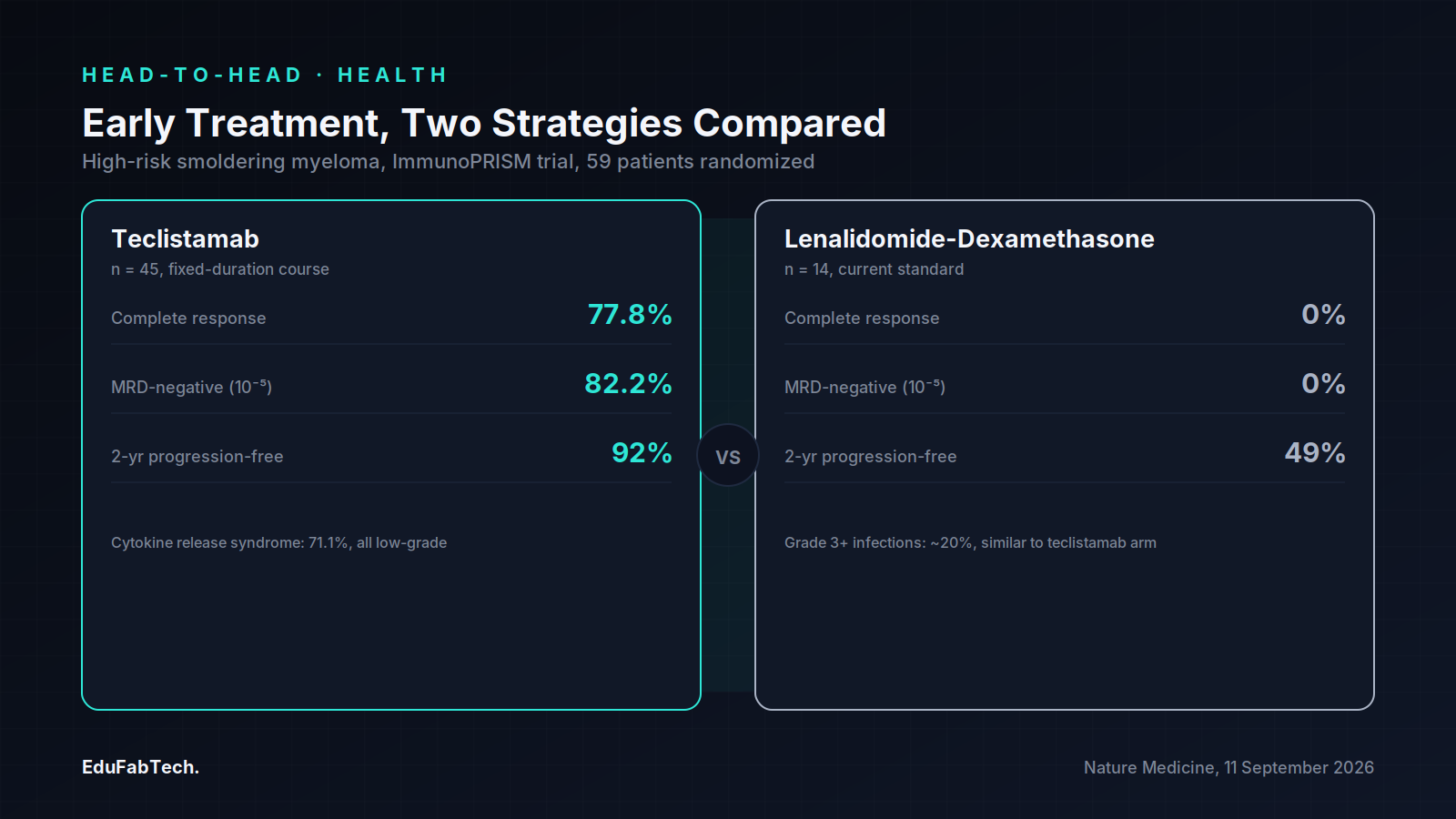
The trial treated 59 patients with high-risk smoldering multiple myeloma, randomizing 45 to a fixed-duration course of teclistamab and 14 to lenalidomide-dexamethasone, according to the Nature Medicine report. Teclistamab is a BCMA-by-CD3 bispecific antibody already used to treat relapsed or refractory multiple myeloma after several prior lines of therapy, following accelerated approval by the U.S. Food and Drug Administration in October 2022. In ImmunoPRISM it was given for a defined period rather than indefinitely, testing whether a fixed course of T-cell engagement is enough to drive deep remission in earlier-stage disease.
The trial's primary endpoints were complete response rate and minimal residual disease (MRD) negativity, both markers of how thoroughly a treatment clears detectable disease rather than simply controlling it over time.
Results
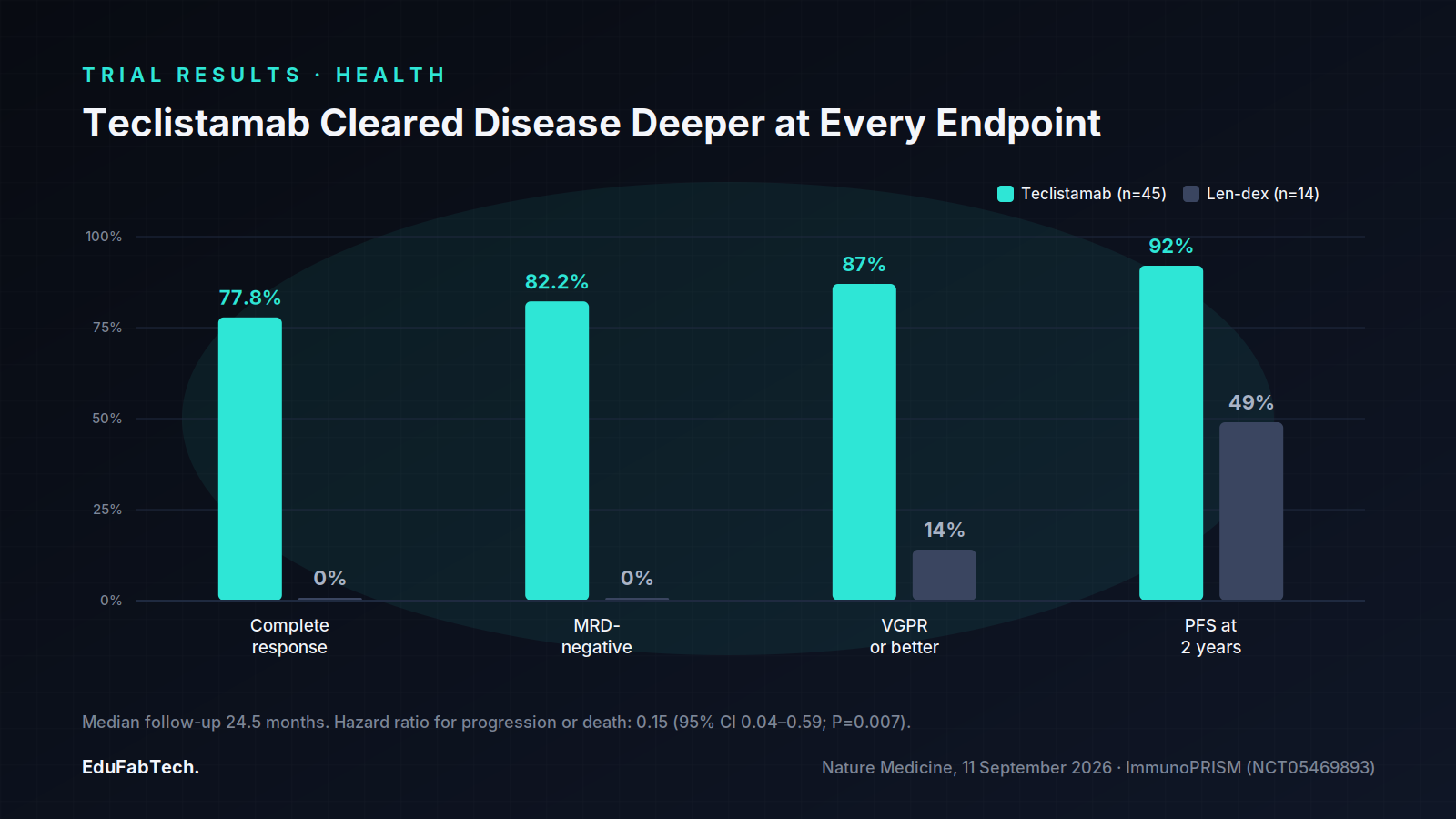
At a median follow-up of 24.5 months, the two arms diverged sharply, according to the trial results reported in Nature Medicine (2026):
| Outcome | Teclistamab (n=45) | Lenalidomide-dexamethasone (n=14) |
|---|---|---|
| Complete response or better | 77.8% | 0% |
| MRD-negative at 10⁻⁵ | 82.2% | 0% |
| Very good partial response or better | 87% | 14% |
| 2-year progression-free survival | 92% | 49% |
The hazard ratio for progression or death with teclistamab versus lenalidomide-dexamethasone was 0.15 (95% confidence interval 0.04–0.59; P=0.007), as reported in the Nature Medicine paper. No deaths were recorded in either arm during the follow-up period covered by the analysis.
Safety profile
Cytokine release syndrome, a known effect of T-cell-engaging antibodies, occurred in 71.1% of patients on teclistamab, but the Nature Medicine authors report all cases were low-grade, with no grade 3 or higher events and no cases of immune effector cell-associated neurotoxicity syndrome. Grade 3 or higher infections occurred at similar rates in both arms, around 20%, which the investigators note in the same paper is lower than infection rates reported in earlier teclistamab trials conducted in more heavily pretreated, relapsed disease.
What the trial does not yet show
The study authors are explicit that ImmunoPRISM does not establish whether early treatment prevents progression to active myeloma over the long term or extends overall survival: follow-up so far is not long enough to assess either, and the small size of the cohort, 59 treated patients split unevenly across two arms, limits what can be concluded about specific patient subgroups, a caveat stated directly in the Nature Medicine paper (2026). Complete response and MRD negativity are widely used as early readouts in myeloma trials because they correlate with better long-term outcomes in other settings, but here they remain surrogate measures rather than proof that disease has been eradicated or that progression has been permanently delayed.
Independent coverage of the results, first presented at the European Hematology Association Congress and summarized by Targeted Oncology in 2026, framed the findings as evidence that early immunologic intervention may be an effective strategy for myeloma interception, while noting that treating an asymptomatic population carries a different risk-benefit calculation than treating active disease: some patients who would never have progressed will still be exposed to a therapy and its side effects.
ImmunoPRISM is described by its investigators as a randomized phase 2 trial, not a confirmatory phase 3 study. Larger and longer trials would be needed before early bispecific-antibody treatment could be considered a change to standard practice for high-risk smoldering multiple myeloma.
- Omar Nadeem, David M. Cordas dos Santos, Irene Ghobrial, et al.. Teclistamab versus lenalidomide-dexamethasone in high-risk smoldering multiple myeloma: a randomized phase 2 trial. Nature Medicine, 2026. doi:10.1038/s41591-026-04642-w
- Dana-Farber Cancer Institute. ImmunoPRISM Trial Shows Teclistamab Improves Depth of Response and Progression-Free Survival in High-Risk Smoldering Multiple Myeloma. Dana-Farber Cancer Institute Newsroom, 2026. link
- National Library of Medicine. Immuno-PRISM (PRecision Intervention Smoldering Myeloma), Study Record NCT05469893. ClinicalTrials.gov, 2026. link
- Targeted Oncology editorial staff. Teclistamab Shows 100% Response Rate in High-Risk Smoldering Myeloma. Targeted Oncology, 2026. link
- International Myeloma Foundation. FDA Approves Tecvayli (teclistamab-cqyv) for the Treatment of Relapsed or Refractory Multiple Myeloma Patients. International Myeloma Foundation, 2022. link