UK Suspends a University's Visa Licence as Australia Plans to Cut Student Share Below 25%
Tighter Home Office compliance rules led to a university's student sponsor licence being suspended on 30 September 2026, while Australia's opposition unveiled a migration plan on 6 October 2026 to cut international enrolments below 25% of the sector.
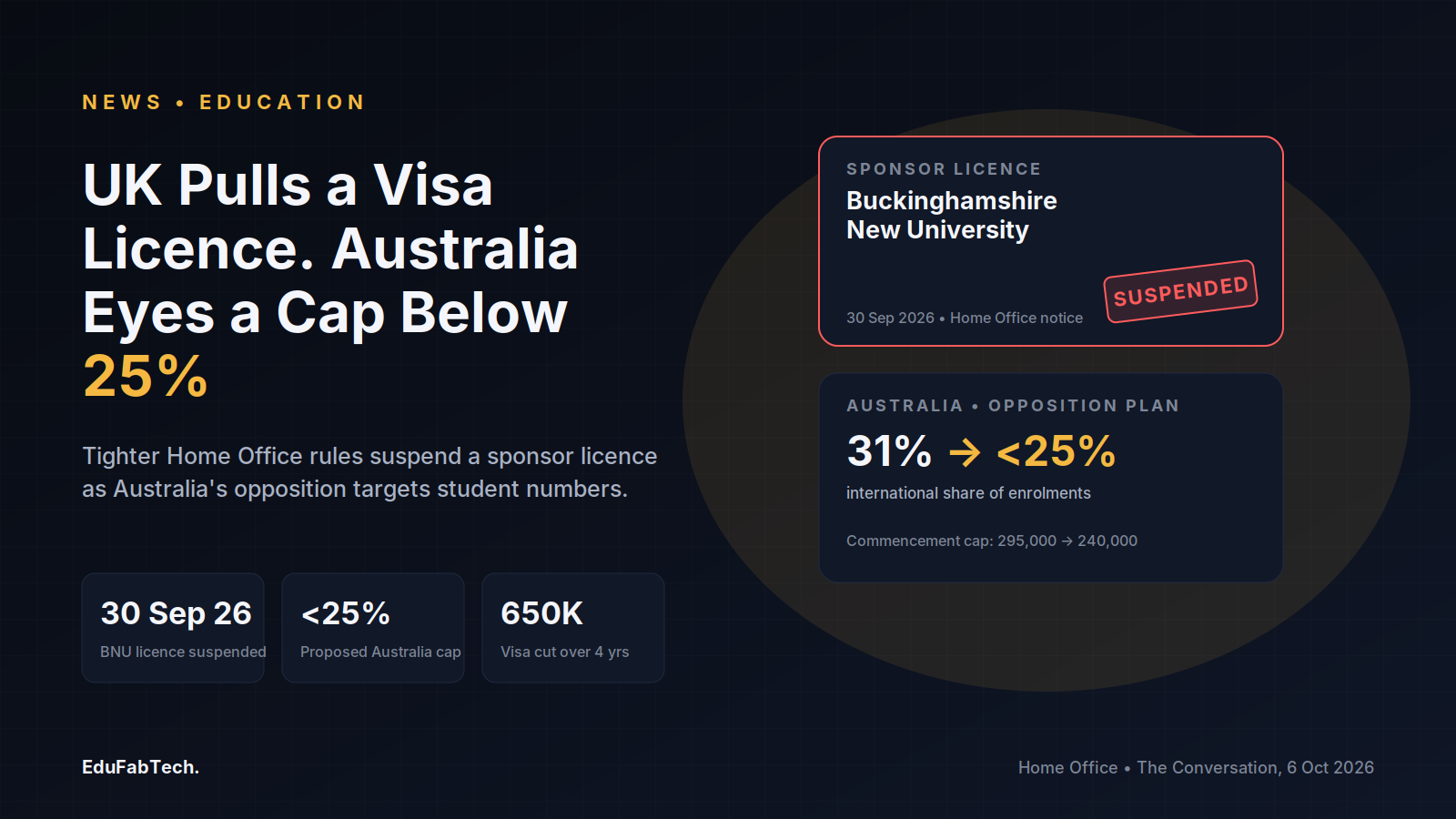
On 30 September 2026, the UK Home Office suspended the student sponsor licence of Buckinghamshire New University, the first time in roughly a decade that a full university has lost the right to sponsor international students, according to the Home Office's published notice. A week later, on 6 October 2026, Australia's opposition Coalition went further in the other direction, unveiling a migration plan that would cut the international share of university enrolments to below 25%, scrap post-study work visas outright, and shrink the country's temporary-visa population by about 650,000 people over four years, as reported by The Conversation.
Neither country is acting alone, and neither change is final: the UK's rule change is already in force, while Australia's is a proposal from a party currently in opposition. But together they mark a shift in how two of the largest destinations for international students are trying to control who gets in and how long they can stay after graduating.
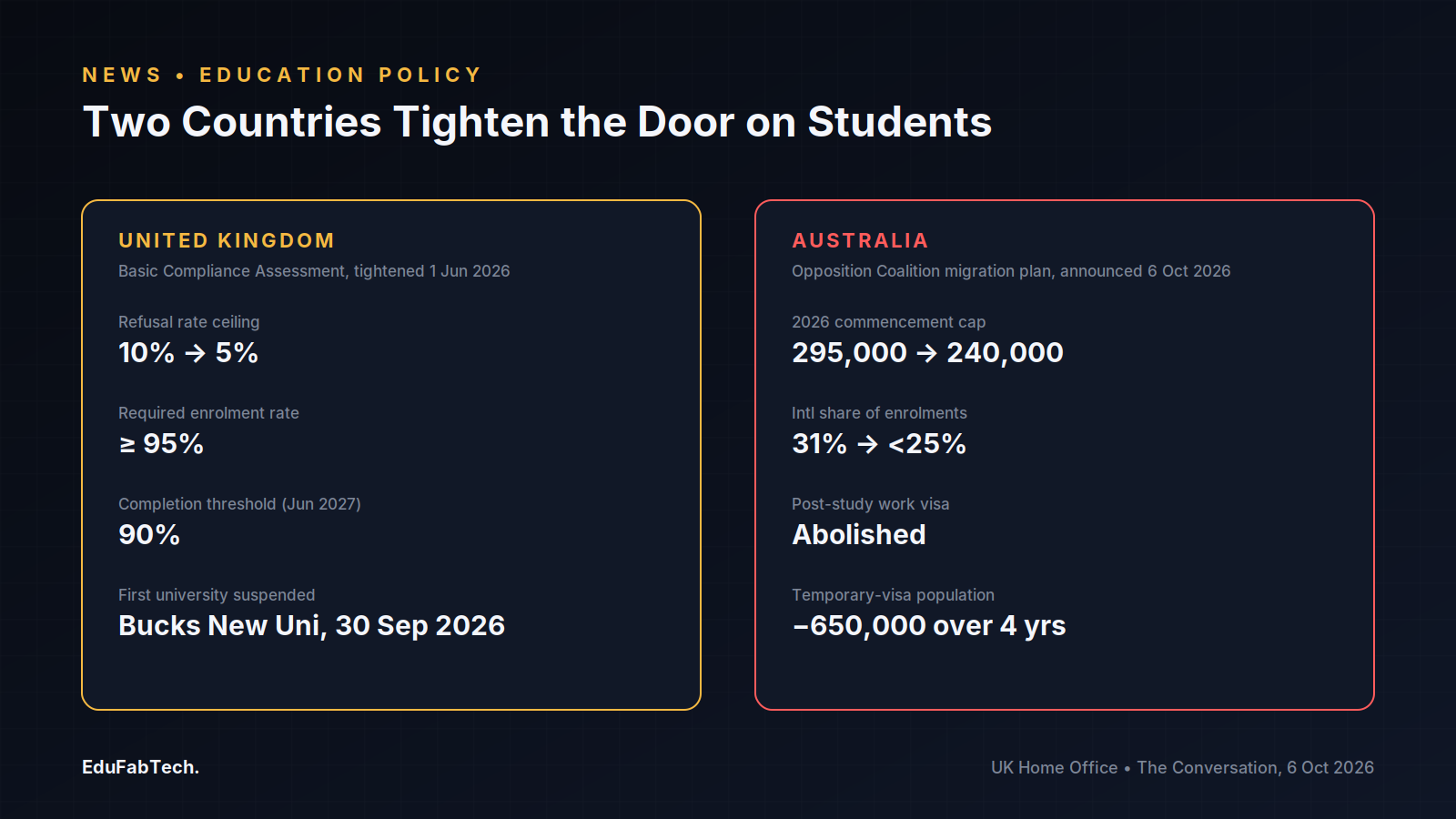
In the UK, the Home Office tightened its Basic Compliance Assessment (BCA) from 1 June 2026. Sponsors must now keep their visa refusal rate below 5%, up from the previous 10% ceiling, hold an enrolment rate of at least 95%, and will face a course-completion threshold rising to 90% from June 2027, under guidance tracked by the UK Council for International Student Affairs (UKCISA). Sponsors are now sorted into a red-amber-green rating, with the lowest-scoring metric, not an average, deciding the outcome.
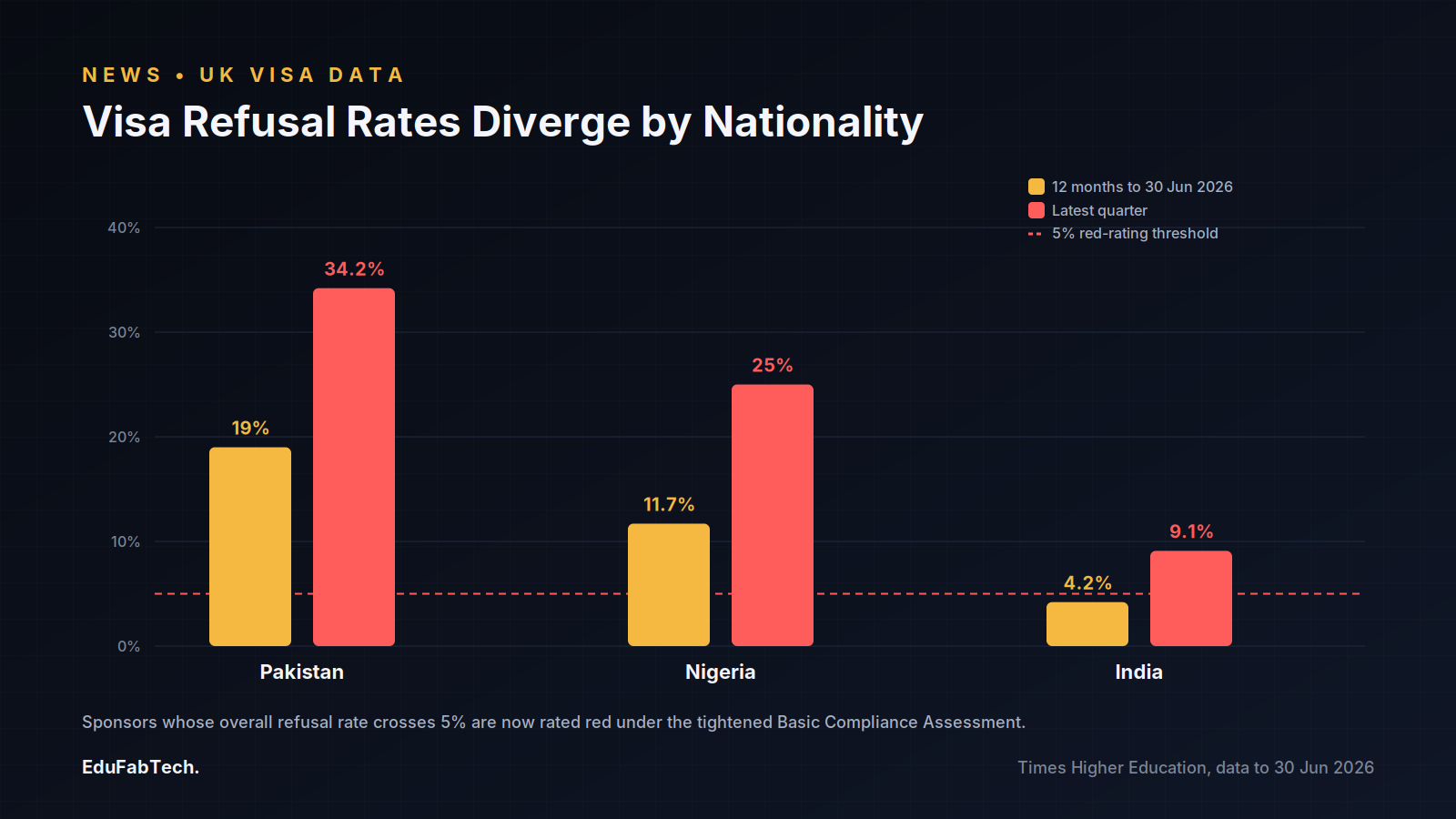
The refusal rates behind that squeeze vary sharply by nationality. In the 12 months to 30 June 2026, the refusal rate for applicants from Pakistan rose to 19%, and to 34.2% in the most recent quarter; for Nigeria it rose to 11.7%, and 25% in the latest quarter; for India it nearly doubled to 4.2%, reaching 9.1% in the latest quarter, according to data compiled by Times Higher Education. Any sponsor whose overall refusal rate crosses 5% is now rated red and at risk of enforcement action.
Buckinghamshire New University's suspension followed that pattern. The Home Office's notice cites "concerns about the university's compliance with its sponsor duties," gives the institution 20 working days to respond, and leaves its licence open to full revocation if it cannot show the licence should be reinstated. The university has already confirmed it will not run a January 2027 intake; current sponsored students can continue studying while the suspension is in place, per the Home Office notice. Times Higher Education reports that sector estimates of how many other universities are now at risk of a red rating range from "a small group" to institutions across multiple university types, including some members of the research-intensive Russell Group.
Australia's opposition goes further on numbers
Australia's governing Labor party has already raised its 2026 international student planning level to 295,000 new commencements, but the opposition Coalition's plan, announced by leader Angus Taylor in Sydney alongside deputy leader Jane Hume, Nationals leader Matt Canavan and shadow minister Jonathon Duniam, would cut that figure to 240,000 and push the international share of university enrolments down from 31% in 2024 to below 25%, according to The Conversation's analysis of the announcement.
The plan would abolish the Temporary Graduate visa, which currently lets most higher-education graduates stay and work in Australia for 18 months or more, and replace it with a narrower "post-study transitional visa" limited to PhD graduates, health and education graduates, and students from regional universities. Secondary applicants, meaning the family members international students can currently bring with them, would also be restricted. The Coalition frames this as part of holding net overseas migration at 100,000 a year in 2028-29 and 2029-30, rising only gradually after that, per The Conversation.
"A temporary visa should mean temporary. Australia is a home, not a hotel," the Coalition said in presenting the plan, as quoted by Times Higher Education. Universities Australia, the peak body for the country's universities, said the plan risked "doing lasting damage to one of Australia's great success stories," with chief executive Luke Sheehy warning that cutting international student numbers "too hard comes with real consequences for Australia." International education contributed A$14.4 billion to Australia's publicly funded universities last year, with individual institutions' exposure ranging from A$20 million at the University of New England to A$1.75 billion at Monash University, according to Times Higher Education.
What it means for students and researchers
For prospective students, the practical effect differs by country and, within the UK, by nationality. Applicants from countries with refusal rates above a sponsor's threshold are more likely to find their chosen university unwilling to issue a Confirmation of Acceptance for Studies (CAS), since one more refusal could tip that sponsor into the red band. UK institutions are already withdrawing offers to reduce their exposure, and a Coalition-led Australia cutting post-study work rights to a handful of exempted fields both point toward graduates in research-adjacent disciplines becoming the main route left for staying on after a degree.
For researchers and universities that depend on international postgraduates to staff laboratories and sustain research income, the Australian proposal is not current law and depends on the Coalition winning power; the UK's tightened BCA, by contrast, is already shaping admissions decisions this intake cycle. Both cases illustrate a broader pattern across major study destinations: enforcement and eligibility rules are increasingly being set at the level of individual nationalities and fields of study, rather than applied uniformly to all international applicants.
A quick question for readers
Which study method makes things stick for you until the exam?
Research says some methods work far better than others. Vote first, then see whether students agree with the evidence.
Pick an answer, create a free account in a minute, and your vote counts. Already a member? Sign in
Comments 0
CommentNo comments yet. Members start the conversation.
Source: GOV.UK (UK Home Office)
Sources (3)
- UK Home Office. Buckinghamshire New University: student sponsor licence suspension. GOV.UK, 2026. gov.uk ↗ · checked 13 Oct 2026
- Times Higher Education. More UK universities 'at risk' over soaring visa refusal rates. Times Higher Education, 2026. timeshighereducation.com ↗ · checked 13 Oct 2026
- The Conversation. Taylor would hold net overseas migration at annual 100,000 for two years in plan hitting students, refugees. The Conversation, 2026. theconversation.com ↗ · checked 13 Oct 2026