Oncolytic Virus Added to Chemotherapy Shows a Survival Signal in Pancreatic Cancer, With Mixed Results on Significance
Nature Medicine published the phase 2b VIRAGE trial on September 30, 2026: VCN-01 plus chemotherapy lengthened survival in metastatic pancreatic cancer, reaching significance in one of two prespecified primary analyses but not the other.
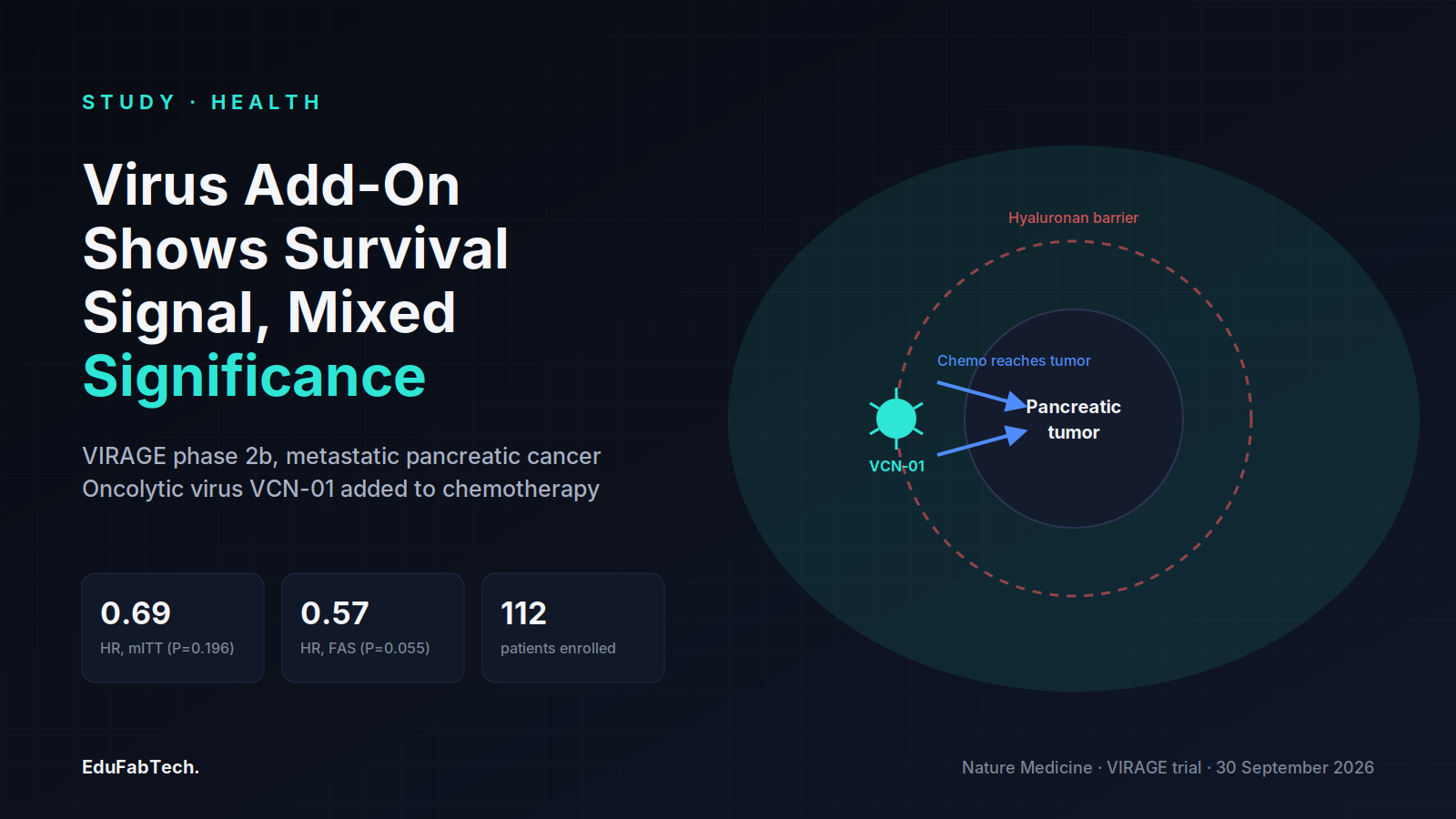
A randomized phase 2b trial testing an engineered oncolytic virus alongside standard chemotherapy for metastatic pancreatic cancer reported longer survival and longer-lasting responses than chemotherapy alone, according to results published in Nature Medicine on September 30, 2026. The trial specified two overlapping primary analysis populations for its main survival comparison: one narrowly missed conventional statistical significance and the other narrowly met it. Investigators are treating the combined result as a basis for a larger confirmatory study rather than a settled outcome.
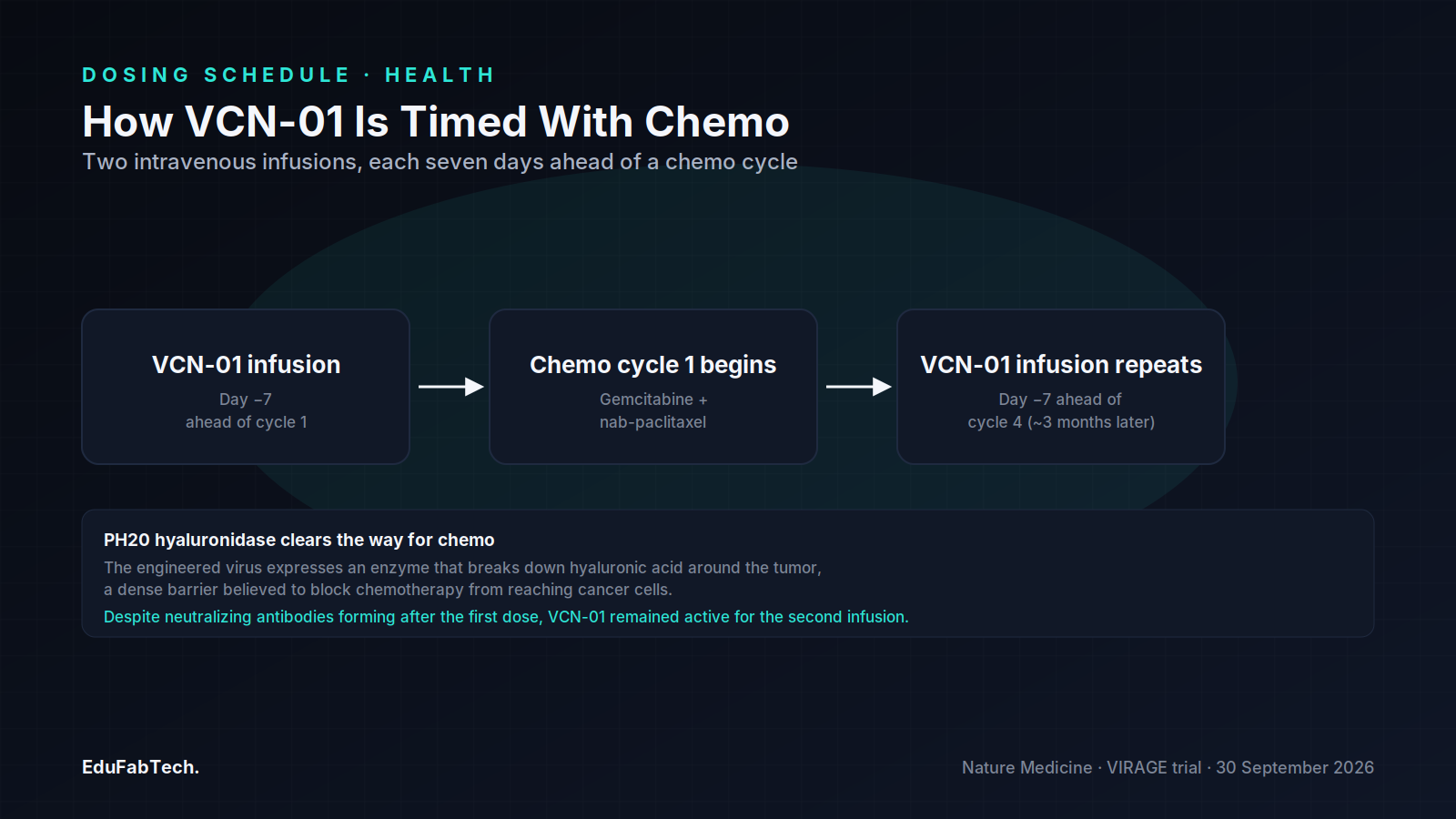
The trial, called VIRAGE, enrolled 112 people with newly diagnosed metastatic pancreatic ductal adenocarcinoma at 14 sites, five in the United States and nine in Spain, according to the sponsor's announcement from Theriva Biologics, the company developing the therapy. Participants were randomly assigned to receive gemcitabine and nab-paclitaxel, a standard first-line chemotherapy combination, either alone or together with two intravenous infusions of VCN-01, an adenovirus engineered to express the enzyme PH20 hyaluronidase. The virus doses were given seven days before the first and fourth chemotherapy cycles, roughly three months apart. PH20 breaks down hyaluronic acid in the dense tissue surrounding pancreatic tumors, a barrier widely believed to block chemotherapy from reaching cancer cells.
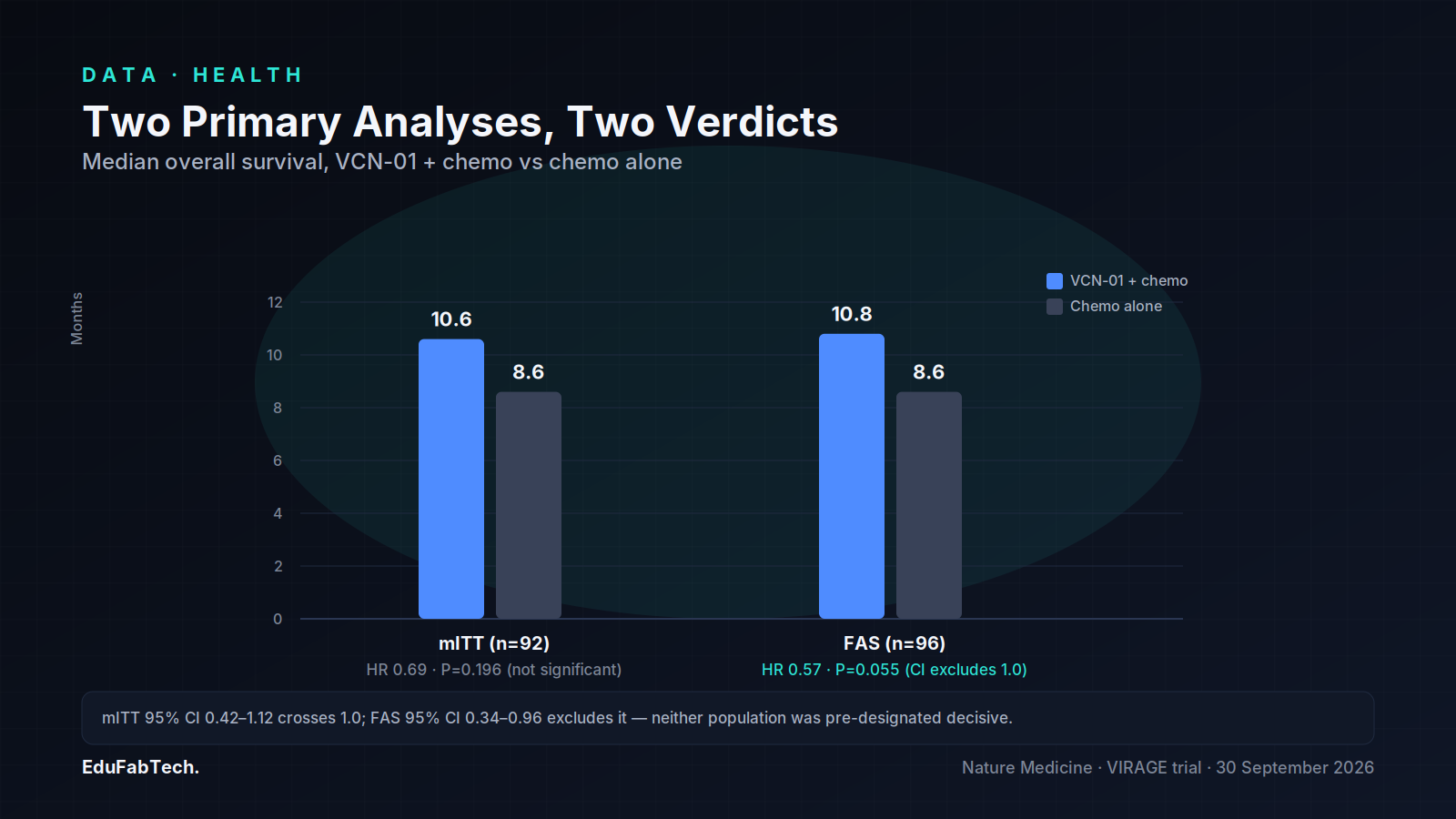
Two primary analyses, two different verdicts
In the modified intent-to-treat population (92 of the enrolled patients), median overall survival was 10.6 months with VCN-01 plus chemotherapy versus 8.6 months with chemotherapy alone, a hazard ratio of 0.69 (95% confidence interval 0.42–1.12, P = 0.196), according to results reported by OncLive and Oncology Nursing News from the published paper. That confidence interval crosses 1.0, and the p-value sits well above the conventional 0.05 threshold, so this comparison is not statistically significant on its own.
In the trial's other prespecified primary population, the full analysis set (96 of the enrolled patients), the same comparison came out stronger: 10.8 months versus 8.6 months, a hazard ratio of 0.57 (95% CI 0.34–0.96, P = 0.055). That confidence interval excludes 1.0, which is why several outlets covering the publication have described this analysis as meeting the trial's primary endpoint, even though the p-value itself sits just above 0.05. Neither the published paper nor the sponsor's announcement singles out one of the two populations as the decisive reading, and that split between two primary analyses of the same trial is itself a reason investigators are describing the result as encouraging rather than conclusive.
A stronger signal in patients who received both doses
A prespecified subgroup of patients who completed both VCN-01 infusions and at least four chemotherapy cycles fared better: median overall survival was 14.8 months versus 11.6 months in the matched chemotherapy-only group, a hazard ratio of 0.44 (95% CI 0.21–0.92, P = 0.046). Progression-free survival in this subgroup was 11.2 months versus 7.4 months (HR 0.48, 95% CI 0.25–0.91, P = 0.017). Because this is a subgroup rather than either of the trial's full primary populations, it is best read as a hypothesis-generating signal — it excludes patients who could not tolerate or complete both doses, which can bias results toward healthier, more treatment-responsive participants.
Response duration and tumor shrinkage
Duration of response, measured in patients whose tumors shrank, was 11.2 months with VCN-01 added versus 5.4 months with chemotherapy alone (HR 0.22, 95% CI 0.08–0.62, P = 0.0035). Survival at 15 months was 35.5% in the VCN-01 group versus 12.8% in the chemotherapy-only group, and at 18 months it was 31.1% versus 8.5%. The objective response rate was 39.6% with VCN-01 added versus 31.3% without, a difference the paper reports did not reach significance (P = 0.314).
Safety
Grade 3 or higher treatment-related adverse events included elevated liver transaminases in 15.1% of VCN-01-treated patients, flu-like symptoms in 13.2%, and drug-induced liver injury in 3.8%, per the same reporting. Two treatment-emergent deaths occurred during the trial but were judged unrelated to either study drug. Pharmacokinetic data showed the virus remained active for the second infusion despite patients developing neutralizing antibodies after the first dose.
Why the margin matters
Metastatic pancreatic cancer remains one of the hardest cancers to treat: the five-year relative survival rate for cancer that has spread to distant sites is 3%, based on diagnosis data from 2015–2021 compiled by the American Cancer Society and updated in January 2026, against 13% across all stages combined. Median survival on standard first-line chemotherapy alone has changed little in recent years, which is why a shift from roughly 8.6 months to the 10.6–10.8 month range seen across the trial's two primary analyses — significant in one population, not the other — is being treated by investigators as worth pursuing in a larger trial.
What independent observers are watching
Commentary from Clinical Trial Vanguard cautions that phase 2 survival signals in pancreatic cancer have a history of not translating cleanly into phase 3 confirmation, partly because small randomized trials are prone to chance imbalances between arms that disappear at larger scale. The commentary flags that the trial did not stratify randomization by tumor hyaluronan burden, the biological feature VCN-01 is designed to act on, raising the possibility that the survival difference partly reflects an uneven distribution of that trait between arms rather than a treatment effect alone.
Theriva Biologics has started a second trial, VIRAGE2, testing more frequent VCN-01 dosing — three or more infusions roughly two months apart rather than two infusions three months apart. The company's general director, Manel Cascalló, said the team is "excited about the potential for VCN-01 in different cancer therapy combinations." The first patient was dosed in August 2026, but the sponsor has described the trial as a proof-of-concept study not powered to assess efficacy, meaning its results will inform dosing strategy rather than confirm a survival benefit.
A quick question for readers
Which study habit do you think is most overrated?
Some popular habits have little evidence behind them. Which one do you think gets too much credit?
Pick an answer, create a free account in a minute, and your vote counts. Already a member? Sign in
- Hernández-Yagüe T. et al.. Intravenous hyaluronidase-expressing oncolytic adenovirus with chemotherapy in metastatic pancreatic cancer: a randomized phase 2b trial. Nature Medicine, 2026. doi:10.1038/s41591-026-04705-y
- Theriva Biologics. Theriva Biologics Announces Publication of the Results from the VIRAGE Phase 2b Clinical Trial of VCN-01 in Metastatic Pancreatic Cancer Published in Nature Medicine. GlobeNewswire, 2026. link
- OncLive. VCN-01 Plus Chemo Improves Survival in Newly Diagnosed Metastatic Pancreatic Cancer. OncLive (MJH Life Sciences), 2026. link
- Oncology Nursing News. VCN-01 Plus SOC Improves Survival, Is Safe in Metastatic PDAC. Oncology Nursing News (MJH Life Sciences), 2026. link
- American Cancer Society. Survival Rates for Pancreatic Cancer. American Cancer Society, 2026. link
- Moe Alsumidaie. The VIRAGE Trial Cracked the Pancreatic Cancer Wall. Now the Hard Question Is Whether the Field Can Read the Blueprint.. The Clinical Trial Vanguard, 2026. link