Is AI Eating First Jobs? What the October 2026 Data Says to Graduates, Read Closely
A Stanford team finds a 19% hiring gap for 22- to 25-year-olds in AI-exposed jobs; graduate unemployment sits at 7.3%, inside its usual range; Census Bureau papers find a worse first job. How all three can be true, and what students should do.
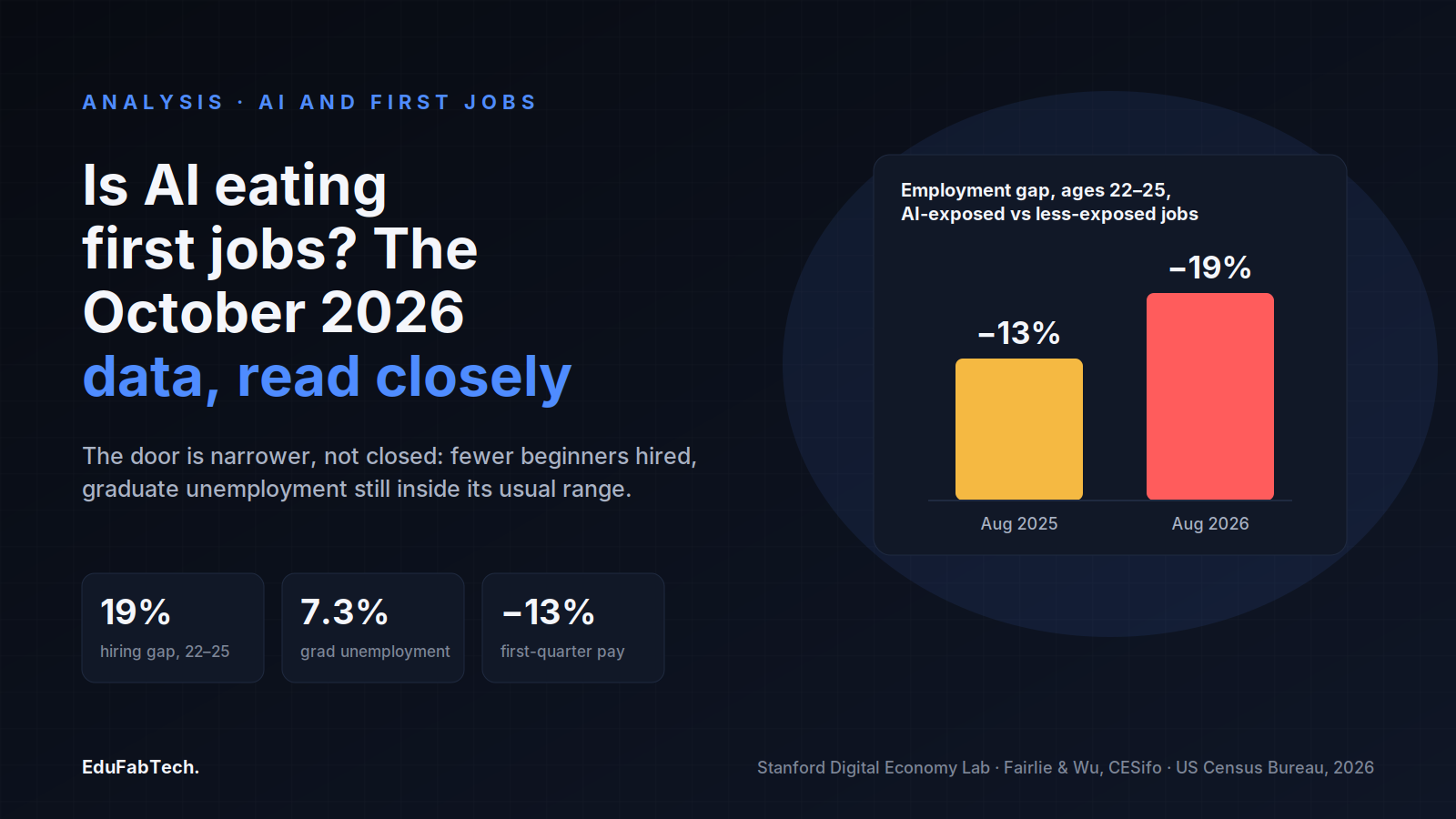
Within six weeks this autumn, three sets of researchers looked at the same question and seemed to reach opposite answers. In August 2026 a Stanford team reported that employment of 22- to 25-year-olds in the occupations most exposed to AI had fallen 19 per cent behind their less-exposed peers, and that the gap was widening. In September, two economists using official survey data reported that unemployment among recent US graduates in summer 2026 was 7.3 per cent, "not unusually high relative to earlier summers". The same month, two US Census Bureau papers found that graduates from the most AI-exposed majors were less likely to have a job a quarter after graduating, and earned 13 per cent less when they did. Is AI eating first jobs or not? The answer is in the details of what each study measured, and those details tell a student exactly where to be careful.
The alarm: fewer young people hired into AI-exposed jobs
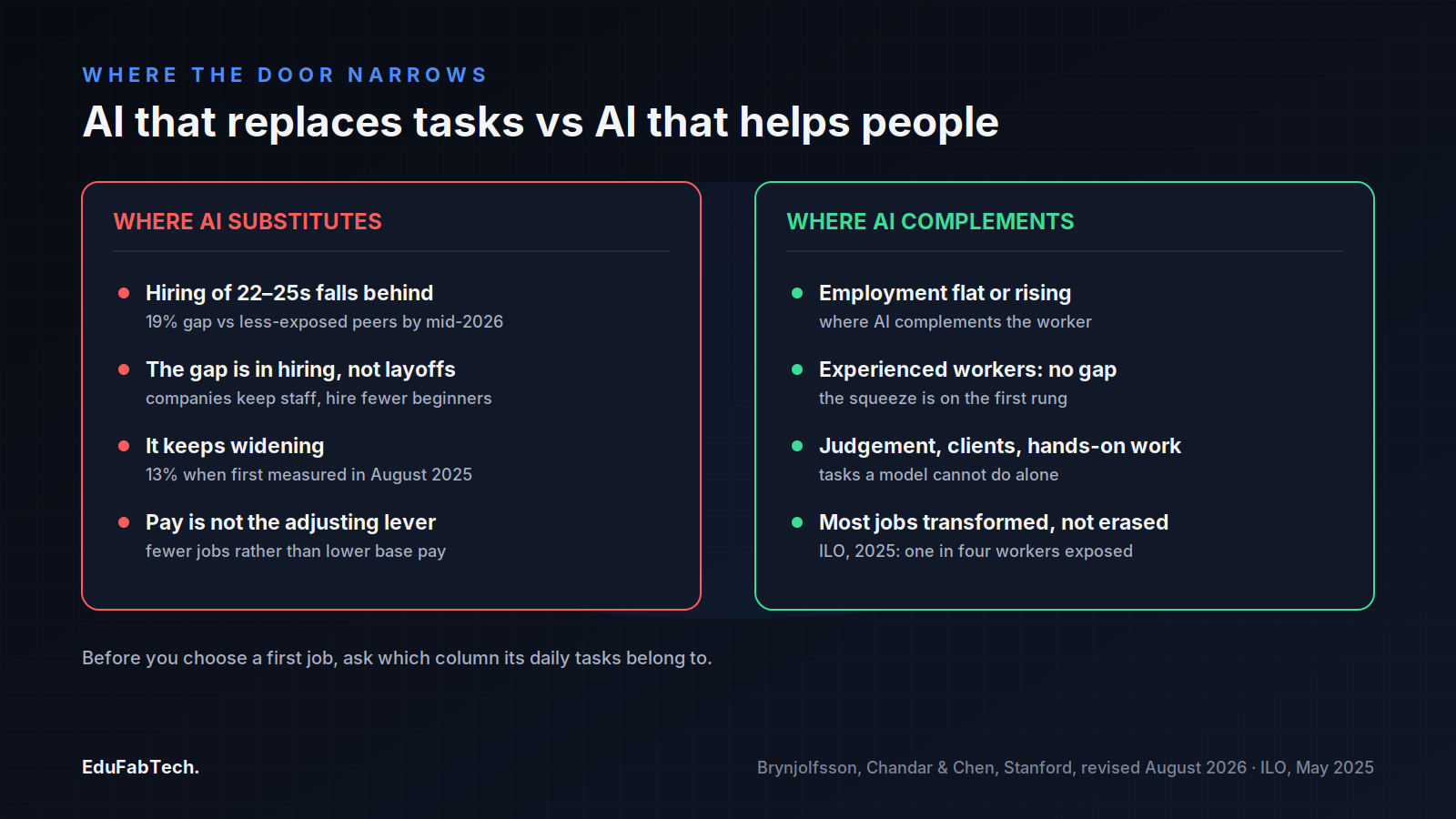
The most cited evidence comes from Erik Brynjolfsson, Bharat Chandar and Ruyu Chen at the Stanford Digital Economy Lab. Their working paper, "Canaries in the Coal Mine?", revised on 12 August 2026, uses payroll records from ADP covering millions of US workers through June 2026. Its six findings are worth reading as a set. There is no sign of job losses across the whole economy. But employment for workers aged 22 to 25 in AI-exposed occupations is 19 per cent below where it would have been had it kept pace with less-exposed peers, and the gap has grown steadily since the authors first documented it in August 2025, when it stood at 13 per cent. Experienced workers in the same occupations show no comparable gap. The gap comes mainly from less hiring of young people, not from layoffs. It is concentrated in jobs where AI substitutes for human tasks; where AI complements workers, employment is flat or rising. And the adjustment is happening through jobs rather than pay.
Read together, those findings describe a door that is narrowing, not a wave of firings. Companies are keeping the people they have and hiring fewer beginners into tasks a model can now do.
The calm: graduate unemployment is within its normal range
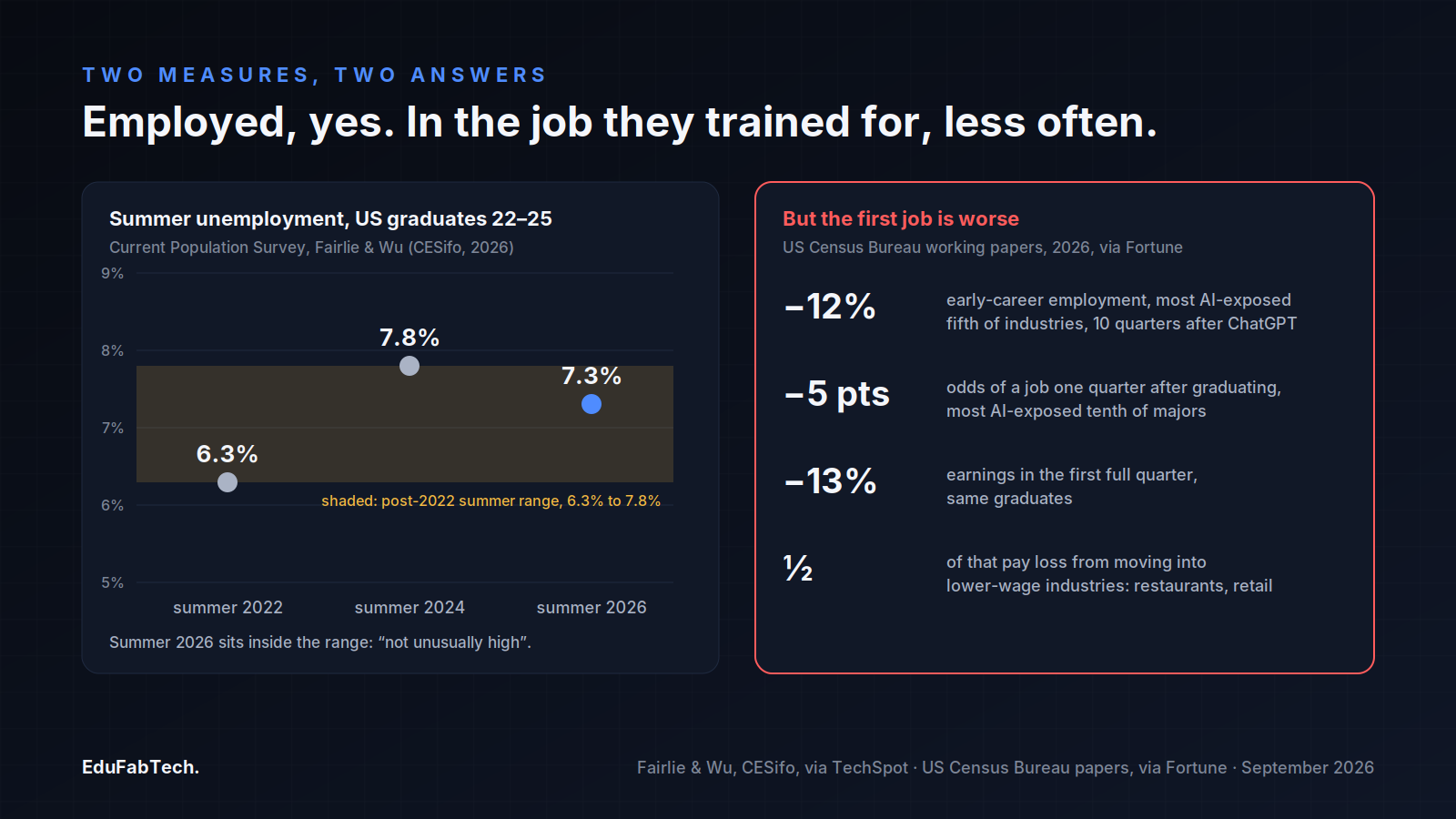
The counter-evidence uses a different measure. Robert Fairlie and Jane Wu, in a working paper published by the CESifo research network and reported by TechSpot on 26 September, used the US Census Bureau's Current Population Survey to track bachelor's degree holders aged 22 to 25 who were not in further study. Their unemployment rate in summer 2026 was 7.3 per cent. Summer graduate unemployment since 2022 has ranged from 6.3 to 7.8 per cent, so 2026 sits inside the range. Comparison groups, same-age workers without degrees and graduates aged 30 to 49, showed no statistically significant difference in trends, and the most AI-exposed occupations, such as customer service and programming, showed no statistically significant AI-linked rise in unemployment. The authors were careful about what this means: "These findings do not rule out larger effects in the future," they wrote, as TechRadar reported, noting that median monthly AI spending per employee has doubled since the end of 2025. They also flagged two traps in reading graduate numbers. Graduate unemployment rises every summer as a new class enters the market and falls again in autumn, so a single month can mislead. And AI-exposed jobs tend to be desk jobs that are easy to do remotely, so earlier studies may have mixed up the effect of AI with the effect of remote work on who gets hired.
A former commissioner of the US Bureau of Labor Statistics, Erika McEntarfer, made a related point to EdSource on 5 October: the rise in new-graduate unemployment began before ChatGPT's release in 2022, and there is little evidence so far that AI has wiped out white-collar jobs.
The middle: the job you get, not whether you get one
The Census Bureau papers explain how both of those findings can be true at once. As Fortune reported on 17 September, one paper, co-authored by Lee Tucker, found that in the most AI-exposed fifth of industries, early-career employment fell 12 per cent over the ten quarters after ChatGPT's release. A second paper followed graduates from the most AI-exposed tenth of college majors: their odds of holding a job one quarter after graduation fell by 5 percentage points, and their earnings in that first full quarter fell 13 per cent. About half of the earnings loss came from lower pay inside the same industries; the other half came from graduates moving into lower-wage industries, mainly restaurants and retail. Hiring volumes had largely recovered by early 2025, Tucker's team found, but from a smaller base, and the gaps for the most exposed majors were still substantial.
That is the reconciliation. An unemployment rate counts whether you have a job. It does not count whether the job is the one you trained for. A graduate in computer science who takes a shift at a coffee chain is employed. The Stanford data sees the missing entry-level programming hire; the unemployment rate sees a worker with a job; the Census data sees both, and the pay cut between them.
Outside the United States
Almost all of the hard data is American, because the US has the payroll and survey records fine-grained enough to test the question. The global picture is broader and less precise. The International Labour Organization's 2025 update on generative AI and jobs estimates that about one in four workers worldwide is in an occupation with some degree of exposure, and concludes that because human input remains necessary, most jobs will be transformed rather than eliminated. The early signs elsewhere follow the US pattern of hiring rather than firing: on 7 October Bloomberg reported that AI adoption is slowing entry-level hiring at the technology hubs Wall Street banks run in India.
What universities are doing, and what students think of it
Universities are responding by handing students the tools. The California State University system pays 13 million dollars a year for ChatGPT Edu for all 470,000 of its students, EdSource reported, and has awarded more than 3 million dollars in grants for faculty to experiment with AI in teaching. Students are not all convinced it will help. "Entry-level jobs are work that people don't want to do," one San Jose State student said; another, studying advertising, thought AI could replace some entry-level work in his field "because I think a lot of companies try to cut costs". A prenursing student said the hands-on parts of her intended career seemed fairly resistant. Some faculty asked what the skills were supposed to be. Access to the tool is not the same as a plan for the first job.
Six things the evidence says to do
- Ask whether AI substitutes or complements in your target job. The Stanford data shows the hiring gap in substitution-heavy work and flat or rising employment where AI complements people. A job description full of tasks a model can draft alone is a warning sign; one built around judgement, clients, hands-on work or responsibility is not.
- Treat experience as the scarce asset. Experienced workers in exposed occupations show no gap. The thing being squeezed is the first rung, so anything that gets you experience before graduation, internships, part-time roles in your field, research assistantships, apprenticeships, moves you up past it.
- Do not switch majors on a headline. Graduate unemployment in summer 2026 was inside its post-2022 range. The risk is concentrated in specific occupations and in the first job, not in having a degree.
- Plan the first job, not just the degree. Half of the earnings loss in the Census data came from graduates sliding into other industries. Decide before you graduate what your second-best job inside your field would be, so the fallback is not the nearest counter.
- Learn the tools, but do not expect them to set you apart. When a university system gives the same model to 470,000 students, using it well is the minimum, not the edge.
- Watch the data, not the forecasts. The Stanford team publishes its indicators so they can be followed over time, and the CESifo authors call their own result "a useful first test". The honest state of knowledge in October 2026 is that the door is narrower in some places, and nobody yet knows how far it will close.
For the many readers choosing a subject now, the 2026 Nobel laureates offer the long view: the work that mattered took decades. The labour data offers the short one: get the first rung early. Tell us in the forum what the job market looks like in your field and your country, and answer this week's question in the polls: is AI changing what you plan to study?
A quick question for readers
Which skill will matter most for getting a job in 2030?
Everyone has a prediction. Add yours and see what students are betting on.
Pick an answer, create a free account in a minute, and your vote counts. Already a member? Sign in
Comments 0
CommentNo comments yet. Members start the conversation.
Sources (5)
- Brynjolfsson, E.; Chandar, B.; Chen, R.. Canaries in the Coal Mine? Six Facts about the Recent Employment Effects of Artificial Intelligence. Stanford Digital Economy Lab, 2026. digitaleconomy.stanford.edu ↗ · checked 13 Oct 2026
- The AI job apocalypse hasn't hit recent college grads, at least not yet. TechSpot, 2026. techspot.com ↗ · checked 13 Oct 2026
- College grads shut out of AI-exposed majors since 2022 are ending up in retail and food service. Fortune, 2026. fortune.com ↗ · checked 13 Oct 2026
- Melhado, W.; Sanchez, M.. Cal State goes all in on AI, but some job-seeking students remain skeptical. EdSource, 2026. edsource.org ↗ · checked 13 Oct 2026
- International Labour Organization. Generative AI and jobs: 2025 update. ILO, 2025. ilo.org ↗ · checked 13 Oct 2026