Studying in Albuquerque: universities, housing and student life
A practical guide to the University of New Mexico, Southwestern Indian Polytechnic Institute, finding a room, free buses, markets and the real costs of being a student in New Mexico's largest city.
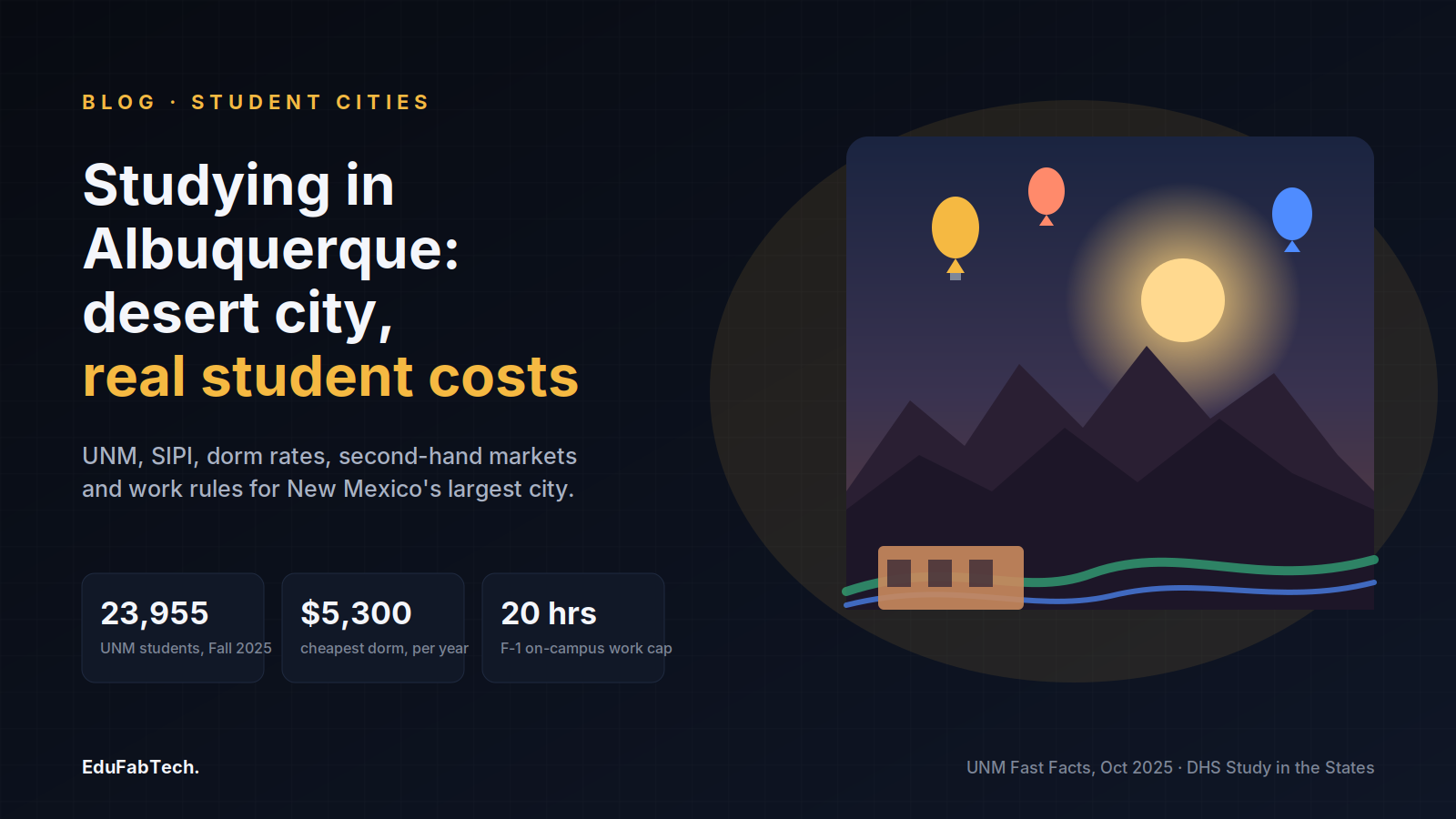
Albuquerque sits in the high desert of central New Mexico, strung along the Rio Grande where the river's cottonwood bosque cuts a green line through dry mesa. The Sandia Mountains close off the eastern edge of the city and turn watermelon-pink at sunset — sandía is Spanish for watermelon. The old alignment of Route 66 still runs through town as Central Avenue, and most of what a student needs is arranged along it. The air is thin and bright, the sun is relentless for most of the year, and a short, dramatic monsoon brings afternoon thunderstorms in July and August. For a few mornings every October the sky above the city fills with hot-air balloons during the Balloon Fiesta.
It is a spread-out, car-shaped city of low adobe-coloured buildings rather than a dense campus town, and that geography shapes student life more than anything else here. Two very different institutions anchor it: a large public research university and a federal tribal college. This guide walks through both, then through the practical business of living here — housing, second-hand furnishing, part-time work, study spaces, transport and cost — with figures tied to the pages that publish them.
Throughout, EduFabTech's own local listings for the city sit at /in/united-states/albuquerque, and the sections below link to the parts of it that match each topic.
Two very different campuses
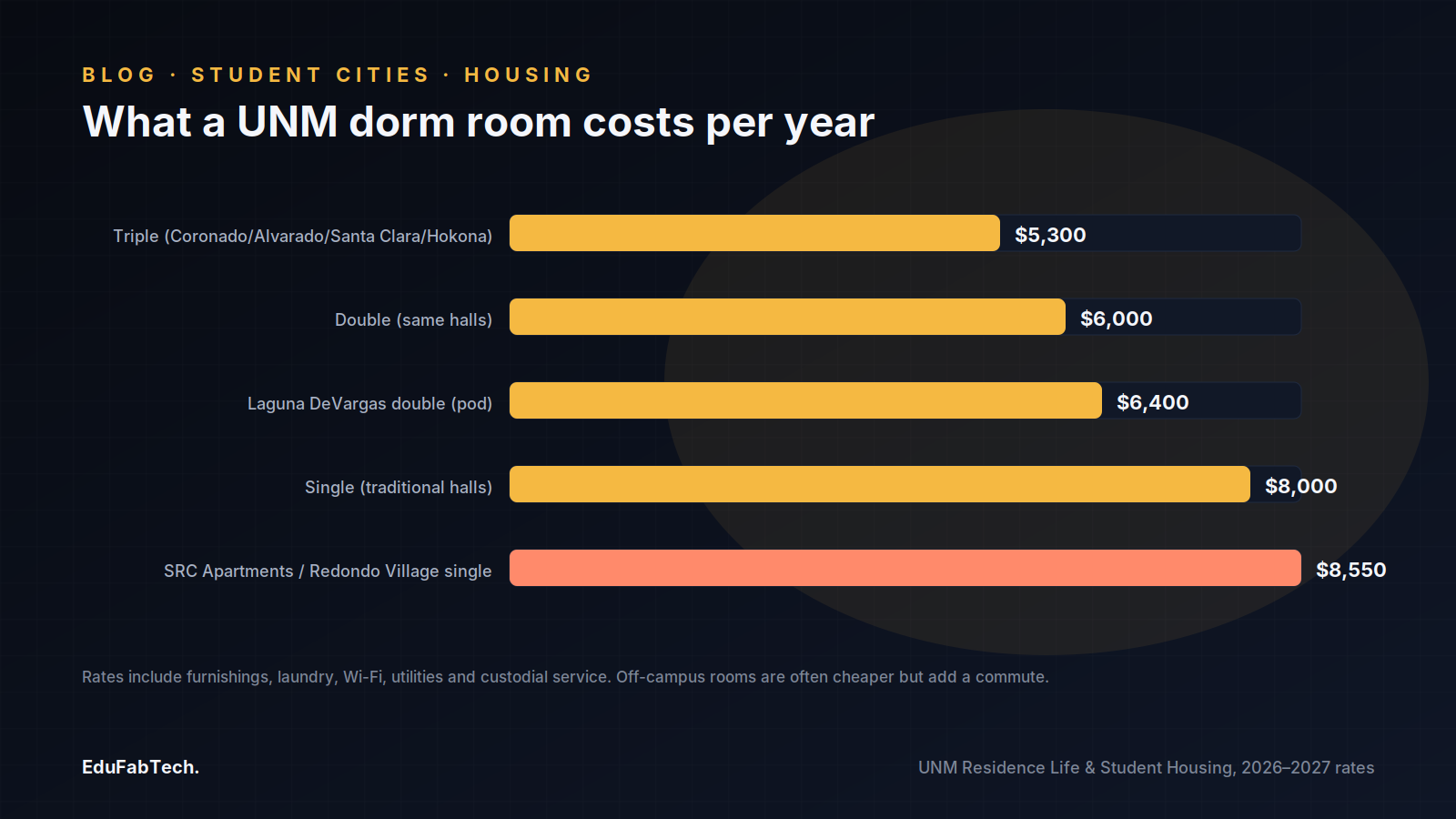
The University of New Mexico is the city's centre of gravity and the state's flagship. According to UNM Fast Facts (updated October 2025), the university was founded in 1889, occupies nearly 800 acres near old Route 66, and enrolled 23,955 students in Fall 2025 — 18,029 undergraduates and 4,305 graduate students. The same page lists more than 215 degree and certificate programmes, including 94 bachelor's, 71 master's and 37 doctoral degrees. The main campus is known for its Pueblo Revival architecture — rounded, earth-coloured, flat-roofed buildings designed in large part by the architect John Gaw Meem — and for The Pit, the sunken basketball arena dug into the ground south of campus. Studying at UNM means a full research university: a medical school, a law school, a school of engineering, and a strong tradition in Southwest and Latin American studies, anthropology and the arts. The campus wraps around Smith Plaza and the duck pond; most undergraduate life happens within a walkable core, even though the wider city is anything but walkable.
The Southwestern Indian Polytechnic Institute is a different kind of place. It is a federal tribal college on Coors Boulevard NW, in the North Valley just outside the village of Los Ranchos de Albuquerque. The Bureau of Indian Affairs records that SIPI was established in 1971 at the request of the 19 Pueblo tribes of New Mexico and other federally recognised tribes, is operated by the Bureau of Indian Education within the U.S. Department of the Interior, and awards the Associate of Applied Science, Associate of Arts and Associate of Science, alongside career-technical and transfer programmes with an emphasis on science, mathematics and technology. The same source notes that SIPI received initial accreditation from the Higher Learning Commission in 2014. It serves American Indian and Alaska Native students from across the country, and many go on to transfer into bachelor's programmes, including at UNM. If your listings search is campus-specific, EduFabTech separates them at /near/university-of-new-mexico and /near/southwestern-indian-polytechnic-institute.
One more institution is worth knowing even though it is not a university: Central New Mexico Community College (CNM), whose main campus is just south of UNM, is a common and far cheaper route into a degree, and its students share many of the same off-campus neighbourhoods.
Where students settle, and what a room costs
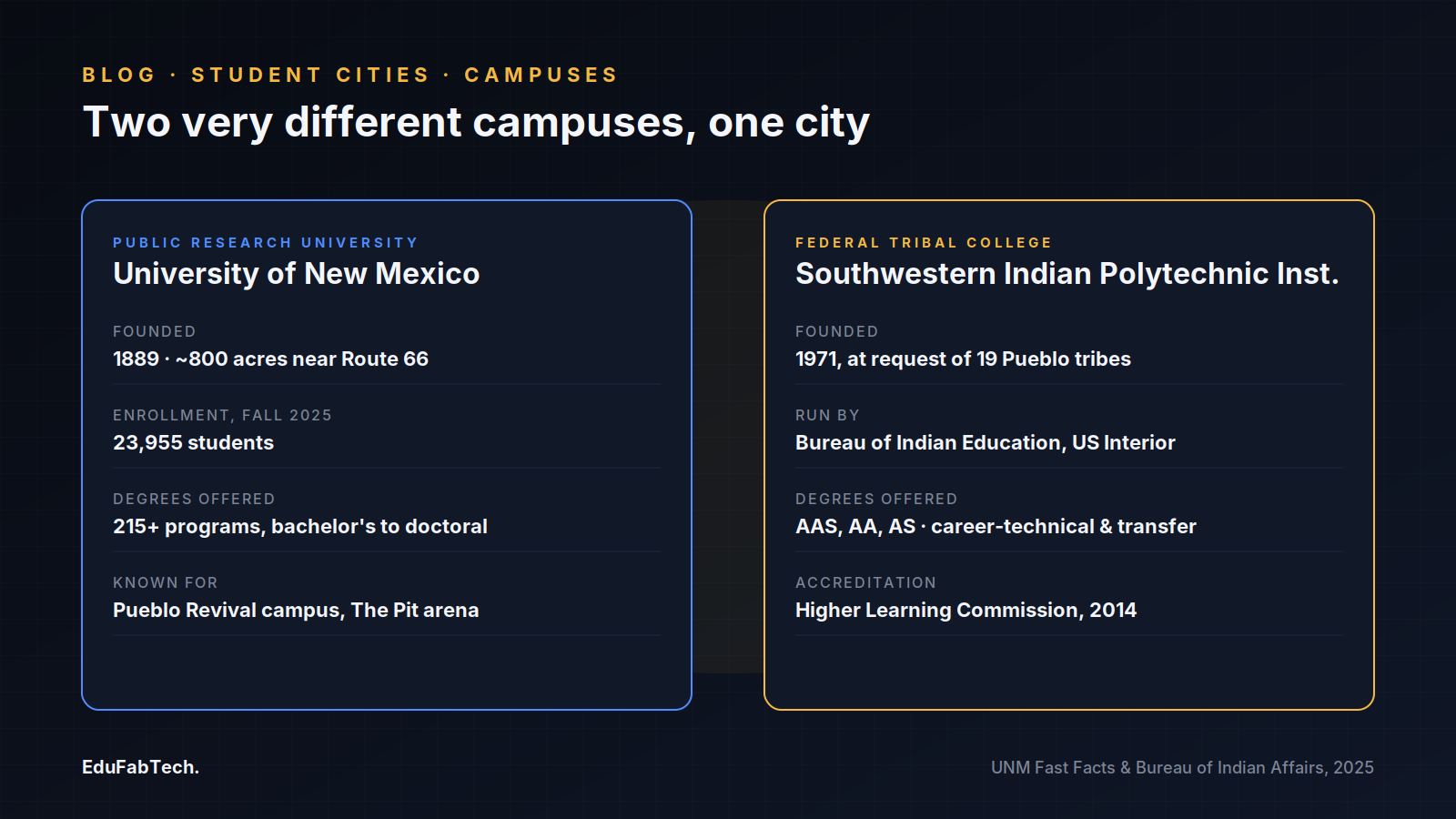
Most first-year UNM students start in the residence halls clustered on the north and east sides of campus. The University of New Mexico's Residence Life & Student Housing rate page for 2026–2027 lists the traditional halls — Coronado, Alvarado, Santa Clara and Hokona — at $5,300 per academic year for a triple room, $6,000 for a double and $8,000 for a single. The Laguna DeVargas "pods" run $6,400 for a double, and the apartment-style options at the SRC Apartments and Redondo Village reach $8,550 a year for a single bedroom. The same page states that these rates include furnishings, laundry, Wi-Fi, all utilities and custodial service for shared areas, billed in two instalments across the year. For a first year, with everything bundled and nothing to furnish, that is often the simplest option.
After the first year, most students move off campus, and this is where Albuquerque's layout matters. The obvious choices are the blocks immediately around the university — the University Heights and Nob Hill areas east along Central, which are walkable, full of cafés and some of the few genuinely pedestrian stretches in the city. Rents there are higher precisely because they are close in. Going further — toward the North Valley, the International District east of campus, or across the river to the West Side — trades walkability for lower rent and a longer commute. Purpose-built student apartments such as Casas del Rio (on campus) and Lobo Village (just off it), both run through UNM's development partner, fill the gap between dorms and an ordinary lease. Start looking early: leases in the close-in blocks turn over around the May–to–August window, and the best-located rooms go first. EduFabTech's room listings for the city are at /in/united-states/albuquerque/rooms.
Paying a deposit safely here
Rental scams in Albuquerque tend to follow a pattern: a listing for a casita, a North Valley adobe or a room near UNM at a rent that looks too good, posted by someone who says they are out of state and cannot show it in person, then asks you to wire a deposit or buy gift cards to "hold" it. Treat that as the warning sign it is. See the actual room before any money changes hands — Albuquerque is a city where you can, and should, drive or take the bus to the address and walk through it. A normal local arrangement is a deposit roughly equal to one month's rent plus the first month, paid by a traceable method once you have a signed lease; never send money by bank wire, gift card or cryptocurrency to someone you have not met to reserve a place. If a landlord cannot or will not let you inside, or the "owner" and the name on the paperwork do not match, walk away. New Mexico's Uniform Owner-Resident Relations Act governs deposits and returns; read your lease against it before signing.
Furnishing a room without buying new
Once you are off campus, you have to furnish the place, and Albuquerque has a strong second-hand culture. The city's best-known weekend market is the Rail Yards Market, held in the cavern of the historic Santa Fe locomotive shops in Barelas, south of downtown — it runs on Sundays from roughly May through October and mixes produce, food and makers' stalls. For furniture and household goods rather than crafts, the large outdoor flea market at Expo New Mexico (the state fairgrounds, on the east side) runs on weekends year-round, weather permitting, and is the place for cheap tools, kitchen things and used furniture. Thrift and charity shops are scattered along Central and Lomas, and the end of each spring semester produces a wave of giveaways as students clear out. On EduFabTech, second-hand goods for the city sit at /in/united-states/albuquerque/second-hand, larger items at /in/united-states/albuquerque/furniture, and things offered free at /in/united-states/albuquerque/free-stuff. Buying used also spares you moving a sofa in July heat more than once.
Working while you study
Both campuses hire students, and on-campus jobs — library desks, dining, research labs, administrative offices — are the most reliable paid work for anyone new to the city. For international students the rules are set federally, not by the university. The U.S. Department of Homeland Security's Study in the States guidance states that an F-1 student may work on campus up to 20 hours per week while school is in session, and that off-campus employment is available only after completing at least one full academic year and only under specific conditions such as documented economic hardship, with authorisation from the school and U.S. Citizenship and Immigration Services before any work begins. This is a summary, not advice for your situation: confirm what applies to you with your Designated School Official at UNM's Global Education Office before you accept any job, because the consequences of getting it wrong fall on your visa status. Local part-time listings are at /in/united-states/albuquerque/jobs.
Libraries and quiet desks
The heart of study space at UNM is Zimmerman Library, the main library on the north side of Smith Plaza and, according to UNM University Libraries, the home of its humanities, social-sciences, education and government-information collections, a Learning Commons for group work, and the Indigenous Nations Library Program. Term-time hours posted by University Libraries run late into the evening on weekdays, with the building restricted to Lobo ID holders after 9 pm. The university system is the largest in New Mexico, so the specialist branches — Centennial Science and Engineering Library, the Fine Arts and Design Library, and the Parish Memorial Library at the Anderson School of Management — matter if your work is in those fields. Off campus, the Albuquerque / Bernalillo County Library system runs branches across the city, including the Main Library and the Special Collections Library downtown, which are free to use and good for a change of scene. EduFabTech also collects bookable desks and study rooms at /in/united-states/albuquerque/study-spaces.
Getting around a spread-out city
The city bus network, ABQ RIDE, is unusual in one important respect: it is free. The City of Albuquerque reports that the City Council passed ordinance O-23-89 on 8 November 2023 making zero fares permanent for all services provided by ABQ RIDE — no ticket, pass or fare card is needed to board. The flagship line is Albuquerque Rapid Transit (ART), which runs along Central Avenue past the UNM campus, linking the west side through downtown and Nob Hill to Uptown on dedicated centre lanes. For a student, that removes the single biggest recurring transport cost in most cities, and it makes the Central Avenue corridor — where much student housing, food and nightlife sit — genuinely usable without a car.
Beyond the buses, the regional New Mexico Rail Runner Express, operated by Rio Metro, links Albuquerque to Santa Fe and Belén from the Alvarado Transportation Center downtown; it charges fares and is useful mainly for trips out of the city. The honest caveat is that Albuquerque was built around the car. Many jobs, big supermarkets and suburban neighbourhoods are hard to reach by bus in reasonable time, and a bicycle plus the free buses covers the close-in student areas but not the whole metro. If you live near Central and study on campus, you can manage without a car; if you live on the West Side and work across town, you will feel the gap.
The honest trade-offs
The good: Albuquerque is comparatively affordable for a large American city, the free bus network is a real saving, the climate is dry and sunny for most of the year, and the setting — mountains, river, high-desert light — is genuinely striking. The food culture built on New Mexican green and red chile is its own reason to be here, and the mix of Pueblo, Hispano and Anglo history gives the city a character that does not feel generic.
The hard: it is spread out and car-centric, so a cheap room far from campus can cost you in commuting time what it saves in rent. Summer sun and high-desert dryness take adjustment, and the thin air at altitude leaves newcomers short of breath on the first hikes into the Sandias. Parts of the city have real problems with property crime and with visible poverty and homelessness along some stretches of Central, so students do pay attention to which block they live on. And while UNM is large, Albuquerque is not a compact college town the way a smaller city might be — student life is diffuse, spread between campus, Nob Hill and wherever people happen to live.
First weeks: a short checklist
- Sort housing before term if you can: a dorm place through UNM Housing for the first year, or a room you have seen in person for later years.
- See any off-campus room before paying; never wire a deposit or buy gift cards to "hold" it, and match the name on the lease to the person showing you the place.
- Get your Lobo ID — it unlocks the libraries after 9 pm and campus services.
- Learn the ART route along Central; the buses are free, so test your commute in the first week.
- International students: meet your Designated School Official at the Global Education Office and confirm the DHS work rules before taking any job.
- Furnish from the Rail Yards Market, the Expo New Mexico flea market or local second-hand listings rather than buying new.
- Drink more water than you think you need, and use sun protection — the altitude and dry air are deceptive.
Compare notes with other students, check current listings, and ask locally before committing to anything: the city listings at /in/united-states/albuquerque are the place to start.
A quick question for readers
Do you work part-time while you study?
Many students work to pay the bills. See how common it is — and how many hours people really do.
Pick an answer, create a free account in a minute, and your vote counts. Already a member? Sign in
Comments 0
CommentNo comments yet. Members start the conversation.
Source: University of New Mexico
Sources (5)
- University of New Mexico. UNM Fast Facts. University of New Mexico, 2025. news.unm.edu ↗ · checked 13 Oct 2026
- University of New Mexico Residence Life & Student Housing. Rates and Payment (2026–2027). University of New Mexico, 2026. housing.unm.edu ↗ · checked 13 Oct 2026
- City of Albuquerque. Zero Fares is Here to Stay. City of Albuquerque Transit Department, 2023. cabq.gov ↗ · checked 13 Oct 2026
- U.S. Department of Homeland Security. Working in the United States (F-1 students). Study in the States, DHS, 2026. studyinthestates.dhs.gov ↗ · checked 13 Oct 2026
- Bureau of Indian Affairs. SIPI Awarded "Initial Accreditation" Status by the Higher Learning Commission. U.S. Department of the Interior, 2014. bia.gov ↗ · checked 13 Oct 2026