Studying in Ames, Iowa: Iowa State, housing and student life
A practical, sourced guide to living and studying in Ames — Iowa State University, where students find rooms, second-hand furnishing, part-time work rules, study spaces, the free CyRide bus, and the honest trade-offs.
A university town on the central Iowa prairie
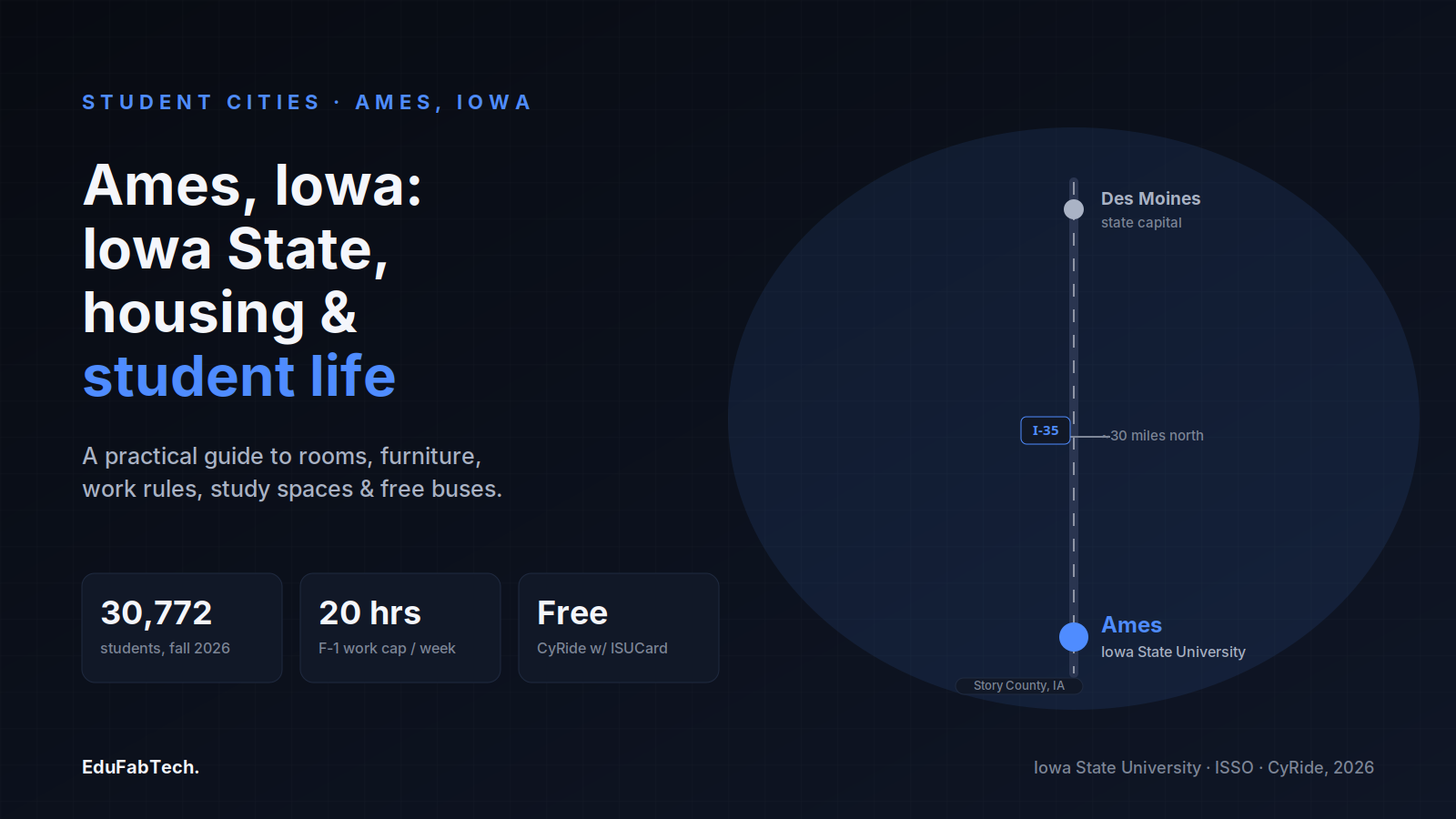
Ames sits in Story County in central Iowa, roughly 30 miles north of the state capital, Des Moines, along Interstate 35 and the Union Pacific main line. It is, in the plainest sense, a university town: Iowa State University anchors the west-central part of the city, and the rhythm of the place — when traffic thickens, when apartments fill, when Main Street is busy — follows the academic calendar more than anything else. For a student arriving here, local or from abroad, that single fact shapes almost every practical decision below.
Iowa State began as the Iowa State Agricultural College and Model Farm, founded on 22 March 1858 when Governor Ralph P. Lowe signed the bill, according to the university library's own history timeline (Iowa State University Library). The same timeline records that Iowa accepted the federal Morrill Land-Grant Act on 11 September 1862, "the first state in the U.S. to do so," and that the college opened to students on 17 March 1869. That land-grant origin still explains the university's centre of gravity: practical science, agriculture and engineering taught to a broad public.
Today Iowa State is a large research university organised into colleges including Agriculture and Life Sciences, Engineering, Business, Design, Liberal Arts and Sciences, Health and Human Sciences, and Veterinary Medicine. The Iowa State University College of Business — the Debbie and Jerry Ivy College of Business, housed in the Gerdin Business Building on central campus — teaches business analytics, finance, accounting and related majors. Iowa State's Office of the Registrar recorded a total fall 2026 enrolment of 30,772 students — 26,306 undergraduates, 3,817 graduate students and 649 in professional programmes (Iowa State University Office of the Registrar, 2026). You can browse everything students list locally on EduFabTech's Ames city page.
Campustown, Downtown and how the city is laid out
Two commercial districts matter most to students, and they are not the same place. Campustown sits immediately south of central campus, clustered around Welch Avenue and Lincoln Way — the east–west artery that effectively forms the campus's southern edge — and it is where you find late-opening food, bars, bubble tea and the densest block of student apartments. Downtown Ames, about two miles northeast along the rail corridor, runs down Main Street and is the older civic core: the farmers' market, independent shops, the public library and the city offices. Knowing which district a listing is near tells you a great deal about rent, noise and how far you will walk.
Ames is compact and flat, which makes cycling and walking realistic for much of the year, but the climate is genuinely continental: hot, humid summers and cold winters with snow and wind that make a reliable bus route worth more than a short lease saved. Campus life leans heavily on Iowa State athletics — football at Jack Trice Stadium, basketball at Hilton Coliseum — and on the Memorial Union as a social hub. It is a calmer, smaller place than a big-city campus; students who want constant nightlife sometimes find that a drawback, while those who want to concentrate often find it the opposite.
Where students live, and when to start looking
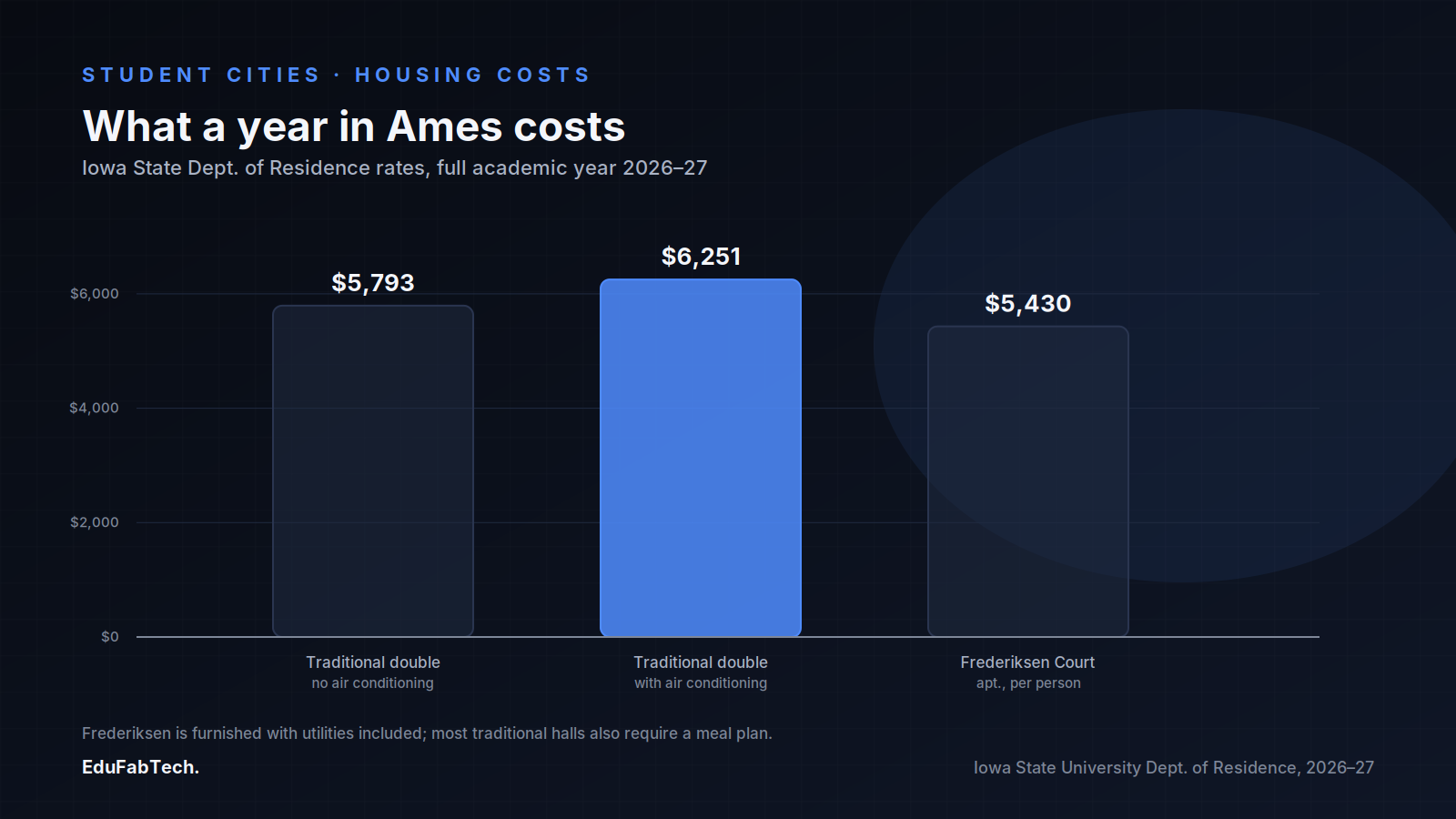
Most first-year undergraduates begin in university housing run by Iowa State's Department of Residence, which spans traditional residence halls, suite-style buildings and the Frederiksen Court and Schilletter/University Village apartment communities. The Department of Residence lists its 2026–27 academic-year rates at $5,793 for a traditional double room without air conditioning and $6,251 for one with it, and $5,430 per person for a four-person, two-bedroom Frederiksen Court apartment, with Frederiksen furnished and all utilities included (Iowa State University Department of Residence, 2026–27). Those are full-year figures, and traditional halls other than a few named buildings require a meal plan on top.
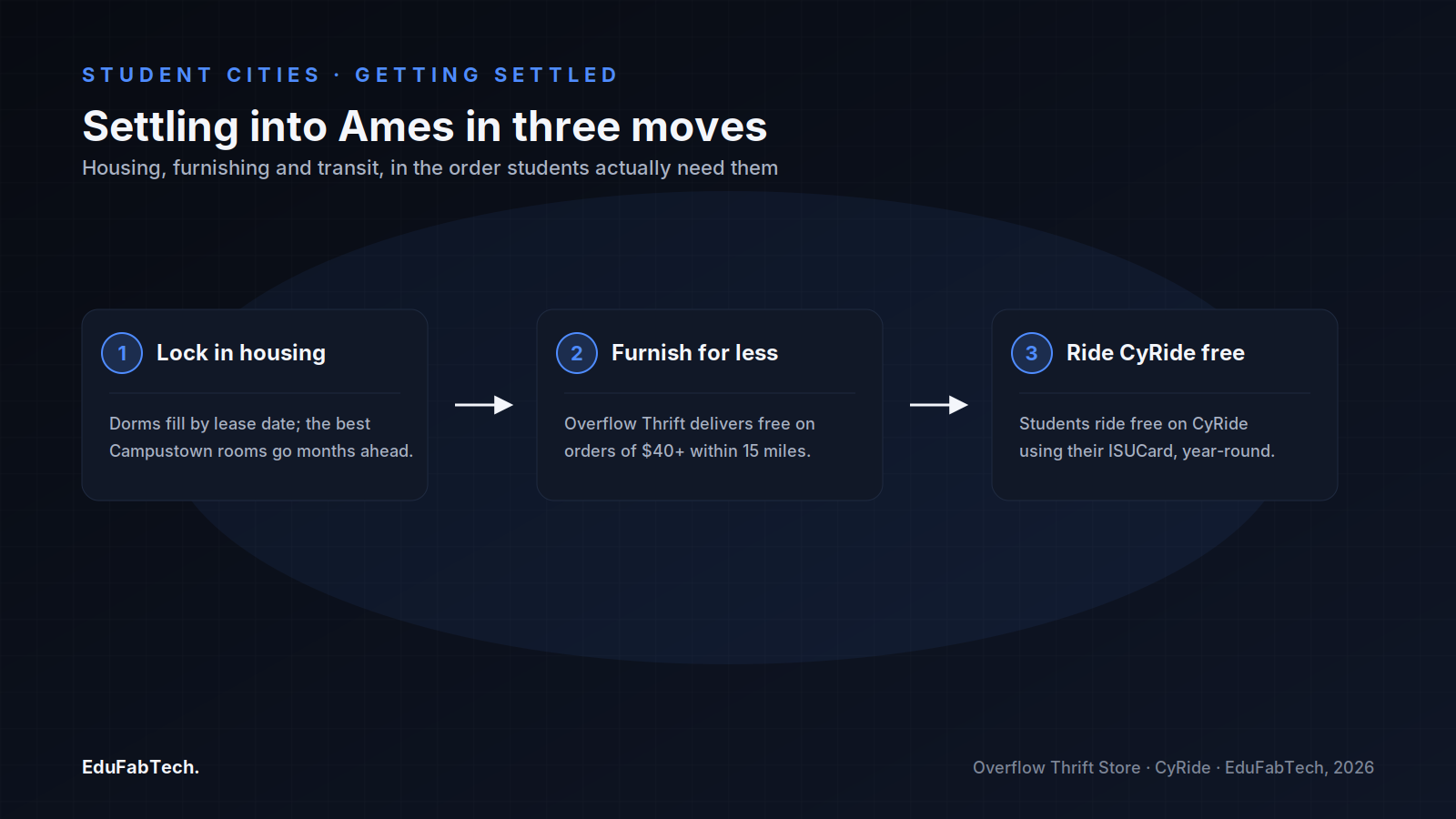
Beyond the dormitories, many second-year and graduate students move to the private market — the apartment blocks of Campustown, the quieter streets north and west of campus, and houses shared among several tenants. In a town where leases turn over with the academic year, the practical pattern is to start looking well before you need the room: the best-located Campustown units are often spoken for months ahead, while late summer can leave gaps as people change plans. EduFabTech's Ames rooms page and the listings near Iowa State University are a starting point for seeing what is available and roughly what it costs before you commit to anything.
Before paying a cent, check the basics for Ames specifically: whether CyRide serves the street (it changes the real cost of living far out), whether heating and snow clearance are the landlord's job through an Iowa winter, and whether the lease runs the academic year or a full twelve months. Ask what is included — in the dormitories utilities and internet are bundled, but in private flats they rarely are.
Renting without being caught out
Rental scams in a town like Ames tend to appear where demand is tightest and newest arrivals have least local knowledge: Campustown flats advertised at suspiciously low rent, "landlords" who say they are out of state and cannot show the unit, and pressure to reserve a room sight-unseen before the August rush. The safe habit is simple and local. See the actual apartment in person, or have someone you trust in Ames see it, before any money changes hands; a real Ames landlord or leasing office will let you tour the unit. Never send a deposit or "holding fee" by bank wire, gift card or cryptocurrency to secure a room — legitimate deposits in Iowa are paid under a written lease, and a request to pay any other way is the clearest warning sign. If a deal is only available if you pay immediately and privately, treat that urgency itself as the red flag.
Furnishing a room for very little
A bare apartment near campus does not have to cost much to fill. Overflow Thrift Store, which runs several Ames shops (on Lincoln Way and Duff Avenue, with a dedicated furniture store on Kitty Hawk Drive), sells second-hand furniture, housewares and clothing, and — useful when you have no car — delivers furniture purchases of $40 or more free of charge anywhere within 15 miles of the Ames city limits (Overflow Thrift Store). Goodwill of Central Iowa also has an Ames store for the same kind of basics. For food and local makers, the Ames Main Street Farmers' Market sets up on the 200–400 blocks of Main Street on Saturday mornings from May through October, a long-running fixture of Downtown Ames (Downtown Ames). The city's end-of-semester move-out, when leases end together in spring, is also when a lot of usable furniture is given away. EduFabTech collects local offers on its Ames second-hand page.
Working part-time while you study
If you hold an F-1 student visa, the rules on working are strict and worth reading at the source rather than from hearsay. Iowa State's International Students and Scholars Office (ISSO) states that during the fall and spring semesters F-1 students "are allowed to work up to a maximum of 20 total hours per week" on campus, and that they may work more than 20 hours during recognised breaks — winter, Thanksgiving/fall, spring and summer (Iowa State University ISSO). Off-campus employment and any work beyond these on-campus limits involves separate federal authorisation, so check with the ISSO before accepting any job; this guide is not legal advice, and your own status governs what you may do. On-campus jobs — dining, the library, labs, administrative offices — are the usual first option, and EduFabTech's Ames jobs page lists local openings students post.
Libraries and places to study
The W. Robert and Ellen Sorge Parks Library is the main study building on campus, and it is built for long sessions. The university library describes a range of bookable study spaces — group study rooms sized for two to six people and individual study rooms and pods — each reservable for up to three hours at a time (Iowa State University Library). During finals the library extends its hours considerably, and the newer Central Parks area adds sound-dampened booth-style pods for focused or quiet work. Beyond campus, the Ames Public Library downtown and the many Campustown cafés give you options off university wifi. EduFabTech also lists desks and quiet spots students share on its Ames study-spaces page.
Getting around on CyRide
Ames runs its own transit system, CyRide, operated by the city in partnership with Iowa State and the student government, and its routes are built around campus and the apartment belts students actually live in. The practical headline for students: CyRide's fares page states that current Iowa State students ride using their ISUCard without paying a separate fare, because the service is funded in part through student fees, while the general cash fare for other riders is $1.00 (CyRide). That makes living a little further out viable, so long as the route is frequent. On Friday and Saturday nights during the school year, CyRide's Moonlight Express runs late routes across town. Because the free ride is tied to your ISUCard, keep it on you.
Costs, the honest trade-offs, and your first weeks
On cost, the figures you can rely on are the university's own: the 2026–27 Department of Residence rates above give a dated, verifiable baseline for on-campus living, and the private market in Campustown generally runs higher per person for the best-located units than the quieter streets further out. Treat any other number you see without a dated source with caution, and build your budget from the dormitory and apartment figures the university publishes plus the free CyRide ride, which is a real saving.
What is genuinely good about studying in Ames: it is affordable by US university-town standards, compact enough to live without a car, served by an unusually good free bus for its size, and quiet in a way that suits serious study. What is hard: the winters are long and cold, the social scene is smaller and more campus-centred than a big city's, the job and housing markets swing hard with the academic year, and students without transport feel the distance to Des Moines for anything the town itself does not have. None of that is hidden — it is simply the shape of a mid-sized prairie university town, and most students adjust to it quickly.
A short checklist for your first weeks in Ames:
- Collect your ISUCard early — it is your free CyRide pass as well as your campus ID.
- Learn the two or three CyRide routes that connect your room to campus, and check their frequency and the Moonlight Express times.
- If you are on an F-1 visa, complete your paperwork with the ISSO before starting any on-campus job, and confirm the 20-hour term-time limit applies to you.
- View any private apartment in person before paying, and pay a deposit only under a written lease — never by wire, gift card or crypto.
- Furnish from Overflow, Goodwill and end-of-semester giveaways rather than buying new; arrange free delivery if your purchase qualifies and you have no car.
- Book a Parks Library study room in advance during busy weeks, and find a backup café in Campustown or downtown.
- Stock up for winter early — a continental Iowa winter arrives in earnest, and warm clothing is cheaper second-hand.
A quick question for readers
Do you work part-time while you study?
Many students work to pay the bills. See how common it is — and how many hours people really do.
Pick an answer, create a free account in a minute, and your vote counts. Already a member? Sign in
Comments 0
CommentNo comments yet. Members start the conversation.
Source: Iowa State University Department of Residence
Sources (5)
- Iowa State University Department of Residence. Rates & Fees (2026–27 Academic Year). Iowa State University, 2026. housing.iastate.edu ↗ · checked 11 Oct 2026
- Iowa State University Library. University History Timeline 1858–1874. Iowa State University, 2008. digital.lib.iastate.edu ↗ · checked 11 Oct 2026
- International Students and Scholars Office. On-Campus Employment for F-1 Students. Iowa State University, 2025. isso.dso.iastate.edu ↗ · checked 11 Oct 2026
- CyRide. Fares. City of Ames / CyRide, 2026. cyride.com ↗ · checked 11 Oct 2026
- Office of the Registrar. Enrollment Statistics (Fall 2026). Iowa State University, 2026. registrar.iastate.edu ↗ · checked 11 Oct 2026