Studying in Anderson, South Carolina: universities, housing and student life
A practical guide to Anderson University, the nearby Upstate campuses, where students live, what it costs, and how to get around a small South Carolina city where a car still matters.
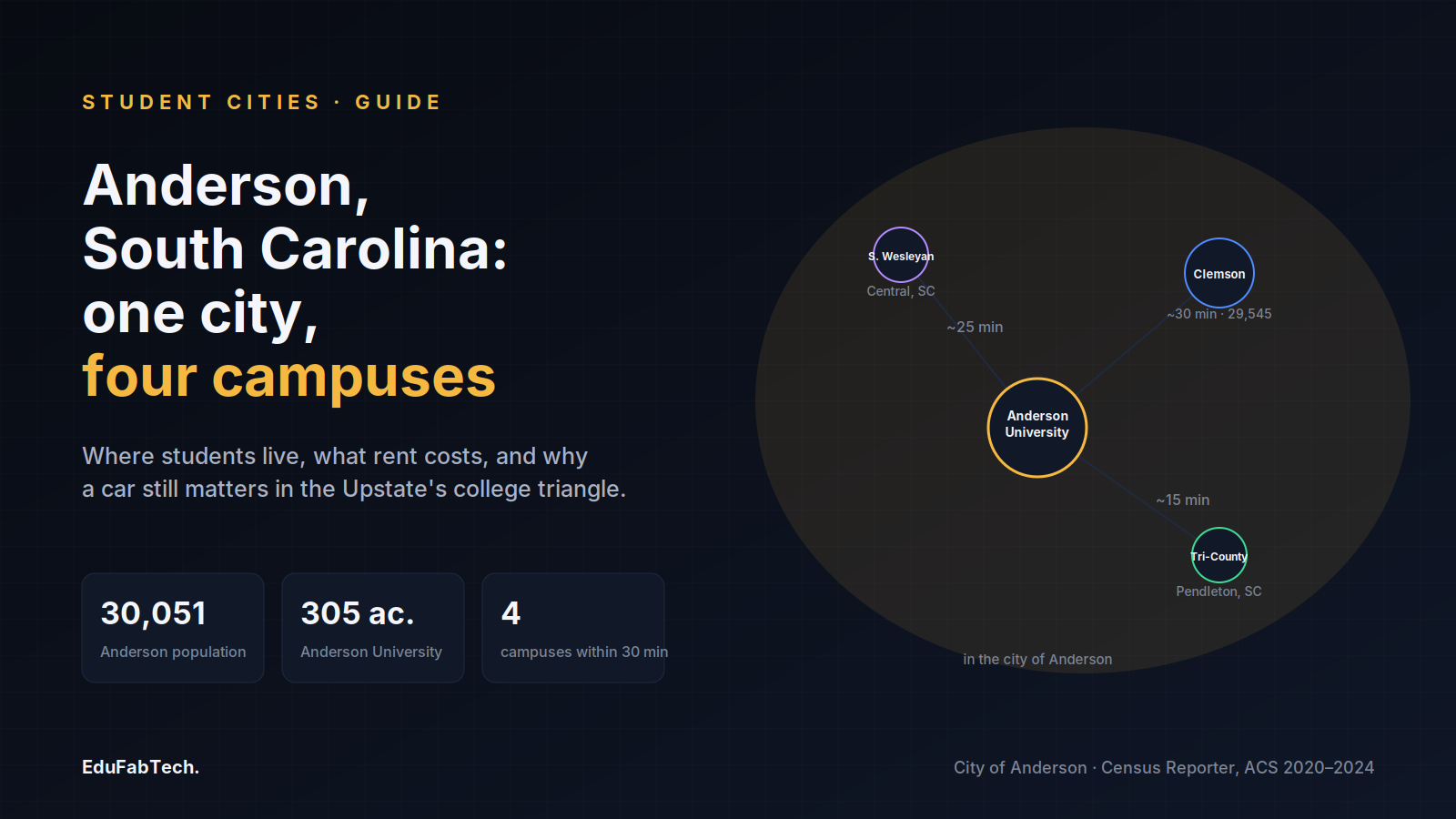
Anderson sits in the northwestern corner of South Carolina, in the belt of the state people call the Upstate, roughly half an hour by road from Greenville and a short drive from Lake Hartwell and the Georgia line. According to the City of Anderson, the town was named for General Robert Anderson, a Revolutionary War officer, founded in December 1826 and incorporated in 1833. Its nickname, the Electric City, is literal: the same source records that Anderson was the first city in the South to have an unlimited supply of electric power, and that the first cotton gin in the world to be run by electricity operated in Anderson County in 1897, fed by hydroelectric current carried from the rivers nearby.
That history left a compact, walkable downtown around Main Street and a city that is small by most standards. The U.S. Census Bureau's American Community Survey for 2020–2024, as compiled by Census Reporter, puts Anderson's population at about 30,051 and median household income at roughly $46,933. Those numbers tell you something a student will feel quickly: this is an affordable place to live by the standards of the fast-growing Upstate, but it is not a dense university town where everything happens on foot.
What makes Anderson a student city is less the city itself than its position. One university sits inside the city limits, and three more campuses lie within a half-hour drive, strung along the lakes and small towns between Anderson and Clemson. Choosing where to live here means choosing where you sit in that triangle.
Universities in and around the Electric City
Anderson University is the institution actually in town, on a campus the university describes as 305 acres in the city of Anderson, serving, by its own account, nearly 3,500 students from 28 states and 32 countries and affiliated with the South Carolina Baptist Convention (Anderson University). It is a residential, faith-based university offering bachelor's, master's and doctoral programmes, with much of campus life organised around the Alumni Lawn a short walk from downtown. If you are studying in the city of Anderson itself, this is almost certainly your campus.
Clemson University lies about 30 minutes north, in the town of Clemson. Clemson's own fact guide describes a 1,400-acre main campus in the foothills of the Blue Ridge Mountains along the shores of Lake Hartwell, with total enrolment of 29,545 for 2025–2026 (Clemson University). It is the large public research university of the area, and its presence shapes the whole housing and jobs market around Anderson. Many students who are priced out of the Clemson and Central area look to Anderson for cheaper rooms and commute.
Southern Wesleyan University is in Central, the small town between Anderson and Clemson. The university's history page records that it was founded in 1906 as the Wesleyan Methodist Bible Institute, became Central Wesleyan College in 1973, and took its present name in 1994 (Southern Wesleyan University). It is a small Christian university with its library, Rickman Library, on the Central campus.
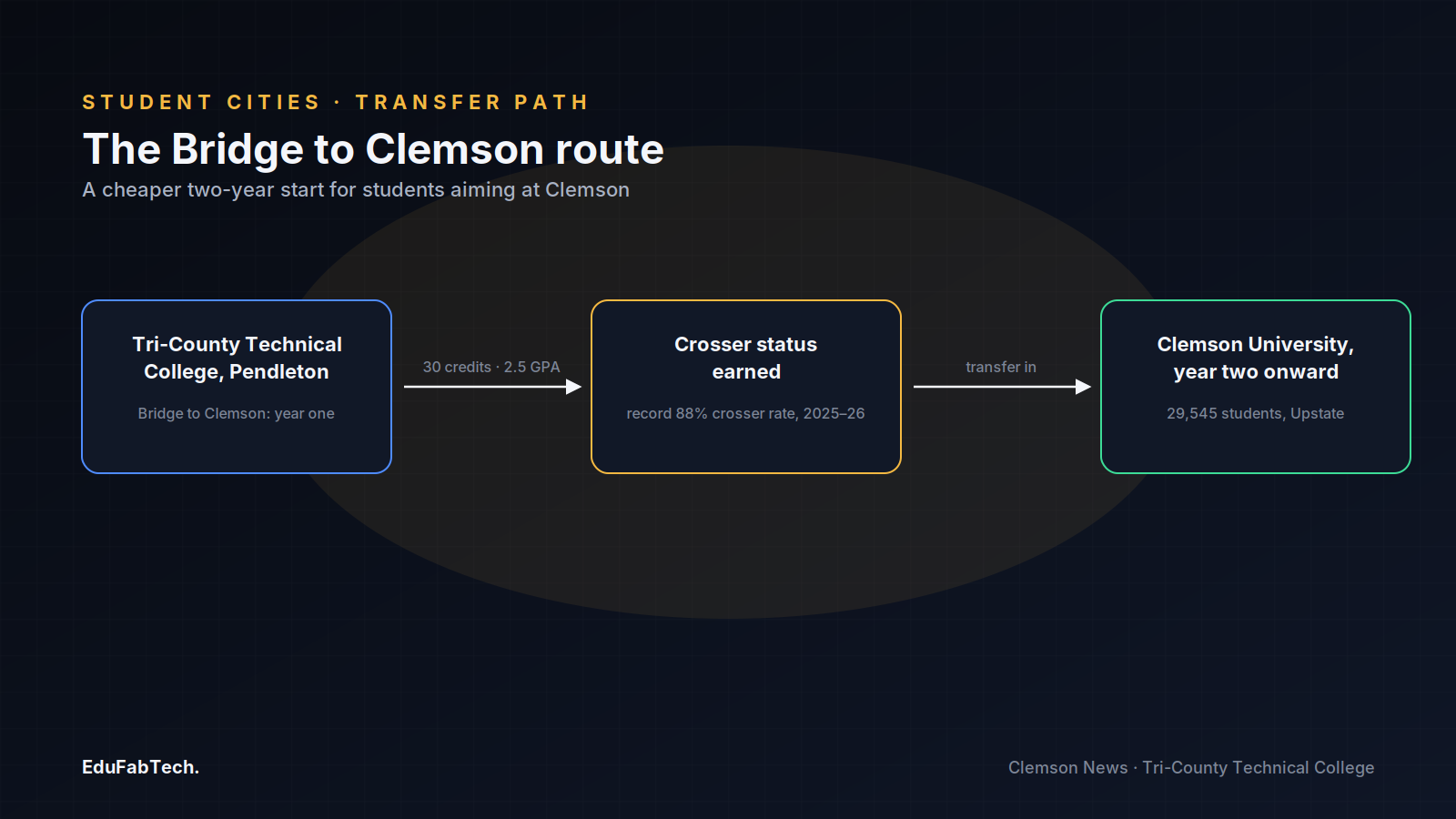
Tri-County Technical College, in Pendleton just north of Anderson, is worth knowing even if you are not enrolled there. The college runs the long-standing Bridge to Clemson programme: students admitted through Bridge live on the Clemson campus but take their first-year classes at Tri-County, and after earning 30 credits with at least a 2.5 grade point average they move into Clemson for the second year, according to Clemson's admissions office. Clemson News reported that the programme closed its 20th year in 2025–26 with a record 88 percent "crosser" rate — the share who completed the requirements to transfer in (Clemson News). Tri-County also offers its own associate degrees and transfer tracks across a range of fields. For a student weighing cost against a four-year degree, the two-year technical route through Pendleton is a real option. The small Erskine College in Due West, further south, is a separate liberal-arts option but far enough away that it belongs to a different daily orbit.
Rooms, dormitories and the commuter question
Where you live depends almost entirely on which campus you attend. Anderson University is residential and houses a large share of its undergraduates on or beside campus, in standard halls, suite-style buildings such as Myers Hall, and apartment- and townhome-style units at places the university calls College Park and Fair Commons. First-year students generally start in the dormitories through the university's residence life office, and the application opens well before the autumn term — the practical rule is to apply as soon as your admission is confirmed, because the suite and townhome options fill first.
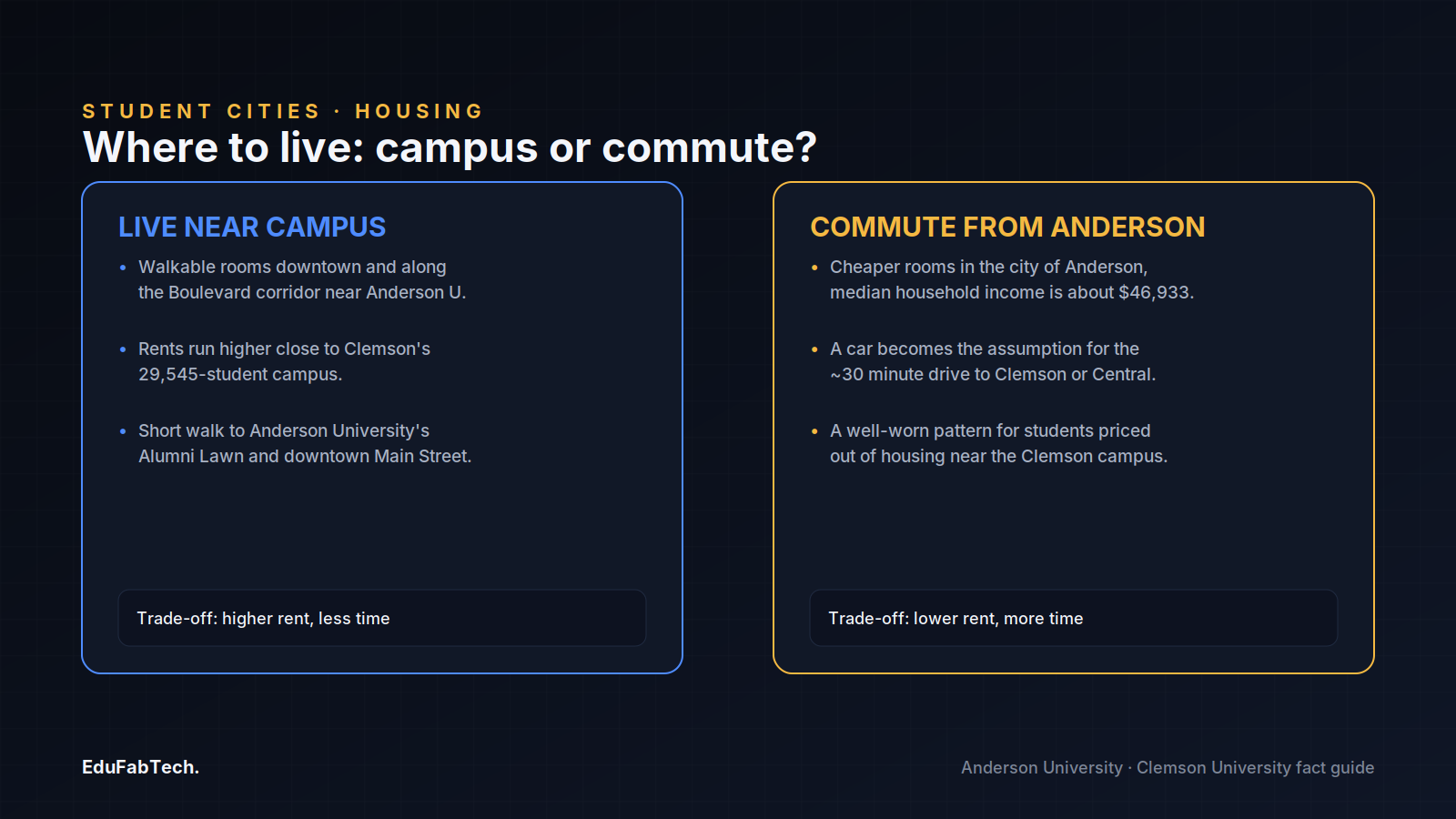
Students who want to live off campus, or who attend Clemson, Southern Wesleyan or Tri-County and want cheaper rent, have a different calculation. Downtown Anderson and the residential streets around the Boulevard corridor near Anderson University hold most of the city's walkable rental stock; beyond that, housing spreads out along the roads toward Clemson and Lake Hartwell, and a car becomes the assumption rather than the exception. Because rents close to the Clemson campus are higher, a well-worn pattern is to rent in or near Anderson and commute the 30 minutes north. That saves money and costs time; decide honestly which you have more of.
Before you commit to anything off campus, see the actual unit in person or have someone you trust see it, read the full lease before signing, and confirm who pays for water, power and trash — in an older downtown house these are not always included. You can start with EduFabTech's own local listings for the city at /in/united-states/anderson and the rooms page at /in/united-states/anderson/rooms, and if you are tied to a specific campus, the listings filtered to /near/clemson-university and /near/southern-wesleyan-university narrow the search.
Paying a deposit without getting burned
Rental fraud in a city like Anderson tends to follow a pattern: a listing with an unusually low rent for a house near downtown or close to a campus, a "landlord" who is conveniently out of town, and pressure to send a deposit to hold the place before you have seen it. The single rule that defeats almost all of it is simple — never send money by bank wire, gift card or cryptocurrency to reserve a room, and never pay a deposit before you have stood inside the unit or had a trusted person do so and confirmed the person collecting the money controls the property.
In Anderson specifically, a security deposit of around one month's rent, paid by a traceable method once a written lease is signed, is normal; a demand for several months up front, or for cash only, is a warning sign. If a deal is for a property near the Clemson campus but every conversation steers you toward paying remotely "because of the distance," treat that as the risk it is. Keep every message and receipt. Nobody legitimate will lose a tenancy because you insisted on seeing the place and signing a real lease first.
Furnishing a room on an Upstate budget
A first room in Anderson is easiest to furnish second-hand, and the city's thrift and resale scene is genuinely useful. Nationally known charity thrift shops operate in Anderson's retail corridors alongside local consignment stores, and the surrounding county is dotted with the kind of flea markets and yard sales the Upstate is known for, strongest in late summer as the previous year's students move out. The move-out weeks in May and early August are when desks, mini-fridges and microwaves appear cheapest, because other students are shedding them.
It is worth checking what is being given away before you buy anything: departing students and local households often post furniture free simply to clear it. EduFabTech's local pages collect these in one place — second-hand goods at /in/united-states/anderson/second-hand, larger items at /in/united-states/anderson/furniture, and give-aways at /in/united-states/anderson/free-stuff. When you buy a mattress or upholstered item second-hand, inspect it in daylight before handing over money, and arrange your own transport, because a small city has few delivery options for cheap used goods.
Working while you study
Part-time work is possible but modest in a city this size: on-campus roles at the universities, and retail, food service and warehouse jobs along Anderson's commercial strips and out toward the I-85 corridor. Local openings as students post and find them are collected at /in/united-states/anderson/jobs.
If you are an international student, the rules are set by the United States federal government, not the university or the employer, and they are strict. F-1 students are generally limited in how and where they may work — on-campus employment is the most straightforward category and is capped at 20 hours per week while school is in session, and off-campus work usually requires specific authorisation tied to your programme. The authoritative guidance is the Department of Homeland Security's Student and Exchange Visitor Program, whose Study in the States site explains the categories. This guide is not legal advice; before you accept any job, confirm what you are permitted to do with your institution's Designated School Official in the international student office, because getting it wrong can affect your visa status.
Where to read and study
On the Anderson University campus, the Thrift Library is the main academic study space; the university's library describes a $7.5 million building that opened in 2007, holding more than 72,000 physical volumes alongside more than 1.8 million ebooks and about 200 research databases (Anderson University). Clemson students have the six-floor Robert Muldrow Cooper Library as their main library on the Clemson campus, and Southern Wesleyan has Rickman Library in Central.
Off campus, the public option is the Anderson County Library's main branch at 300 North McDuffie Street in downtown Anderson, free to residents and a quiet, air-conditioned place to work when you want to be off campus (Anderson County Library). Downtown's cafés give you a few more daytime options within walking distance of the Anderson University campus. More desks and study-space listings for the city are gathered at /in/united-states/anderson/study-spaces.
Getting around without much transit
Anderson has public transport, but you should understand its limits before you rely on it. The city runs Electric City Transit, whose fares the City of Anderson lists as 50 cents for adults and 25 cents for K-12 students, seniors and riders with disabilities, with buses running Monday to Friday, 6:30 a.m. to 6:30 p.m., on six colour-coded routes (City of Anderson). Two things follow from that. First, the fare is low, but there is no university-specific student discount — a college student pays the 50-cent adult fare. Second, and more important, there is no evening or weekend service, so the bus cannot be your way home from a late shift or a Saturday.
In practice, most students in and around Anderson rely on a car, and the city is built for one: the campuses are linked by short highway drives, and Anderson sits close to Interstate 85 between Atlanta and Charlotte. If you bring a car, budget for parking permits on campus and for the game-day congestion that Clemson home weekends push across the whole area. If you do not, choose your room for its walking distance to campus and to a grocery, and expect to lean on lifts from classmates for anything beyond the daytime bus network.
What it costs
Housing is the figure most worth pinning down, and the universities publish theirs. For 2026–2027, Anderson University lists on-campus room costs per year of $6,810 for a main-campus double room, $6,260 for a triple or quad, and $8,880 for a main-campus single, with apartment-style College Park rooms running higher at $7,460 for a double and $9,490 for a single; meal plans are charged separately, from $4,400 to $6,600 a year (Anderson University). For Clemson, the 2026–2027 estimated cost of attendance projects housing at $9,304 and food at $5,576 for the year (Clemson University). These are the institutions' own dormitory and meal figures, not off-campus rents.
For life off campus, the clearest local anchor is income rather than a verified citywide student rent: the American Community Survey for 2020–2024 reports Anderson's median household income at about $46,933 (Census Reporter), which signals a lower-cost housing market than Greenville or the immediate Clemson area. A reliable, student-specific average monthly rent for Anderson is not something a single authoritative source publishes cleanly, so treat any single off-campus figure with caution and compare several current listings before you budget.
The trade-offs, and a first-weeks checklist
What is good about Anderson for a student is real: it is affordable, the downtown has been revived into something walkable, Anderson University is small and close-knit, and the city sits within easy reach of Lake Hartwell, the Blue Ridge foothills and the larger pull of Greenville. What is hard is equally real. Public transport is daytime-only and weekday-only, so most people need a car; the city is small, so nightlife and the part-time job market are limited; Upstate summers are hot and humid; and off-campus student housing inside Anderson itself is thinner than in a dedicated college town, which is why so many students commute from here to Clemson or live on campus.
A short checklist for the first weeks:
- Confirm your housing first — apply early for an Anderson University hall, or, if renting, see the unit in person and sign a written lease before paying anything.
- Never wire a deposit or pay by gift card or crypto to "hold" a room; one month's deposit by a traceable method after signing is the local norm.
- Sort out transport honestly: if you have no car, pick a room within walking distance of campus and a grocery, and learn the Electric City Transit routes and their weekday-only hours.
- International students: visit your Designated School Official in the international office and confirm exactly what work you are allowed before accepting any job.
- Get a library card at the Anderson County Library's McDuffie Street branch and find your study spot on campus in the first week, before deadlines arrive.
- Furnish from the move-out sales and give-away listings in May and August, and check EduFabTech's second-hand and jobs pages as you settle in.
A quick question for readers
Do you work part-time while you study?
Many students work to pay the bills. See how common it is — and how many hours people really do.
Pick an answer, create a free account in a minute, and your vote counts. Already a member? Sign in
Comments 0
CommentNo comments yet. Members start the conversation.
Source: Anderson University
Sources (5)
- Anderson University. Tuition and Fees 2026–2027. Anderson University, 2026. andersonuniversity.edu ↗ · checked 11 Oct 2026
- Clemson University. Estimated Cost of Attendance 2026–2027. Clemson University, 2026. clemson.edu ↗ · checked 11 Oct 2026
- City of Anderson. About Anderson. City of Anderson, South Carolina, 2026. cityofandersonsc.com ↗ · checked 11 Oct 2026
- City of Anderson. Riding the Electric City Transit. City of Anderson, South Carolina, 2026. cityofandersonsc.com ↗ · checked 11 Oct 2026
- Census Reporter. Anderson, SC — American Community Survey 2020–2024 profile. Census Reporter / U.S. Census Bureau, 2024. censusreporter.org ↗ · checked 11 Oct 2026