Studying in Bozeman: universities, housing and student life
A practical, sourced guide to Montana State University, finding a room in a tight rental market, second-hand shopping, part-time work, study spaces and getting around Bozeman by bus.
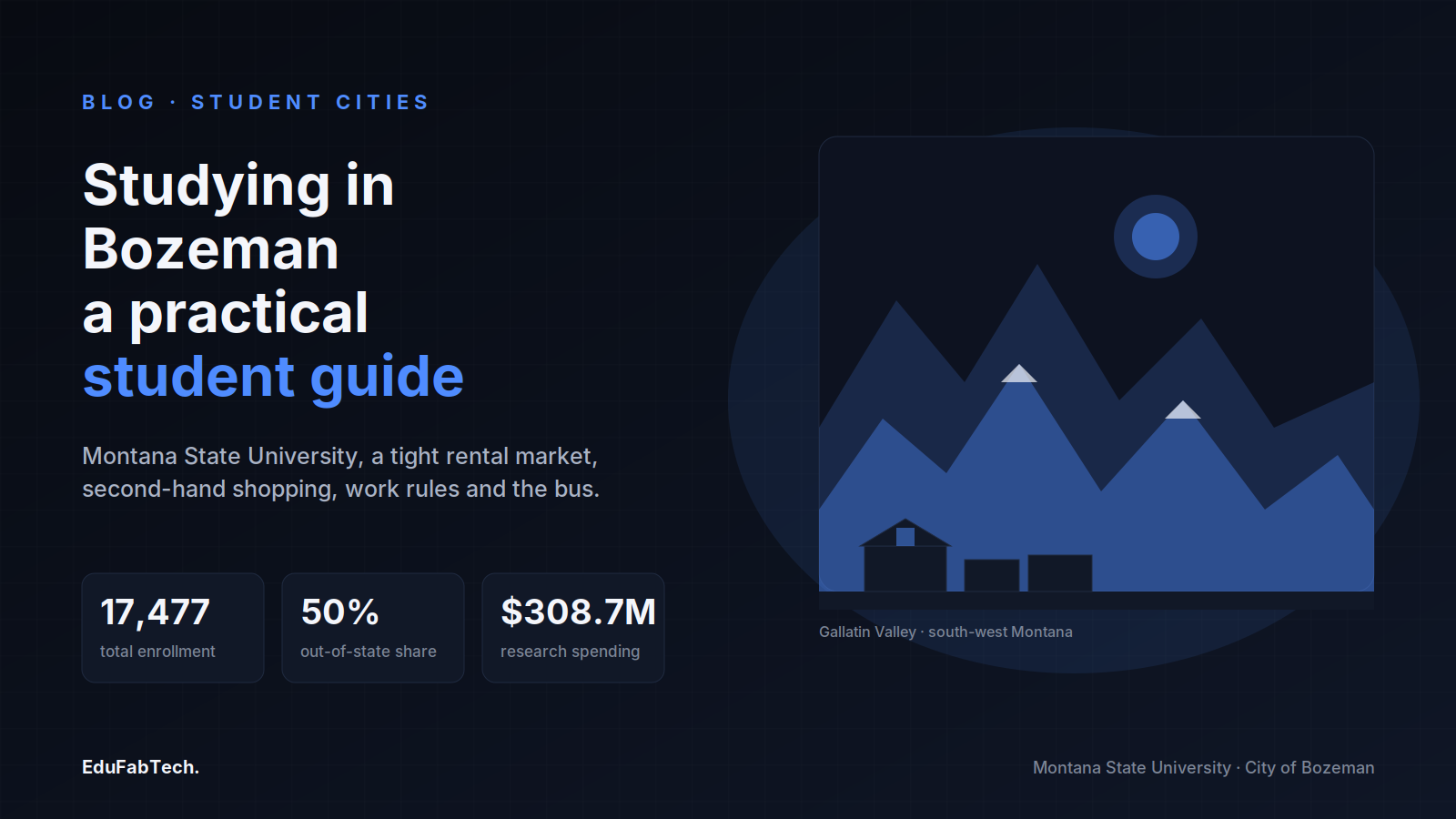
Bozeman sits in the Gallatin Valley in south-west Montana, ringed by the Bridger, Gallatin and Tobacco Root ranges, about an hour and a half north of Yellowstone National Park. It is a small city that has grown quickly: a railroad and agricultural town that became a university town and, more recently, a destination for people who ski, climb and fish. For a student the practical consequences of that geography are a long, cold winter, a short walk or bike ride from most neighbourhoods to the mountains, and a housing market under constant pressure from newcomers.
The reason most students are here is Montana State University, whose campus occupies the south side of town. Montana State University describes itself on its own site as Montana's first land-grant university, established in 1893, with a total enrolment of 17,477 and an even split — 50% residents and 50% non-residents. That non-resident half means a large share of students arrive from out of state or from abroad, and the town's rhythms bend around the academic calendar.
This guide is for anyone weighing up studying in Bozeman — a Montanan, a student from elsewhere in the United States, or someone arriving on a visa from overseas. It covers the university, where people live and how to find a room without being cheated, furnishing a place cheaply, working while you study, study spaces, the bus, and the honest trade-offs of a town this size and this expensive.
Montana State University, and what studying here is like
Montana State University is the research anchor of the state. The university reports $308.7 million in annual research expenditures, which it says makes it the largest research enterprise in Montana, and it is strongest in science, engineering and agriculture — a profile you would expect of a land-grant institution. Engineering is concentrated in the Norm Asbjornson College of Engineering, named for an alumnus whose gift funded its building; if you are looking at engineering programmes, that is the college you will be enrolled in, and listings close to its buildings are collected on EduFabTech at /near/norm-asbjornson-college-of-engineering.
The campus is walkable and centred on an older historic core — the Montana State University Historic District, built around the brick halls that date to the university's early decades. Most first- and second-year academic life happens within a few blocks of the Strand Union Building (the student union, usually called the SUB), which is also where the Off-Campus Student Life office sits. Listings right around the main campus are gathered at /near/montana-state-university, and those near the historic core at /near/montana-state-university-historic-district.
Where students live in Bozeman
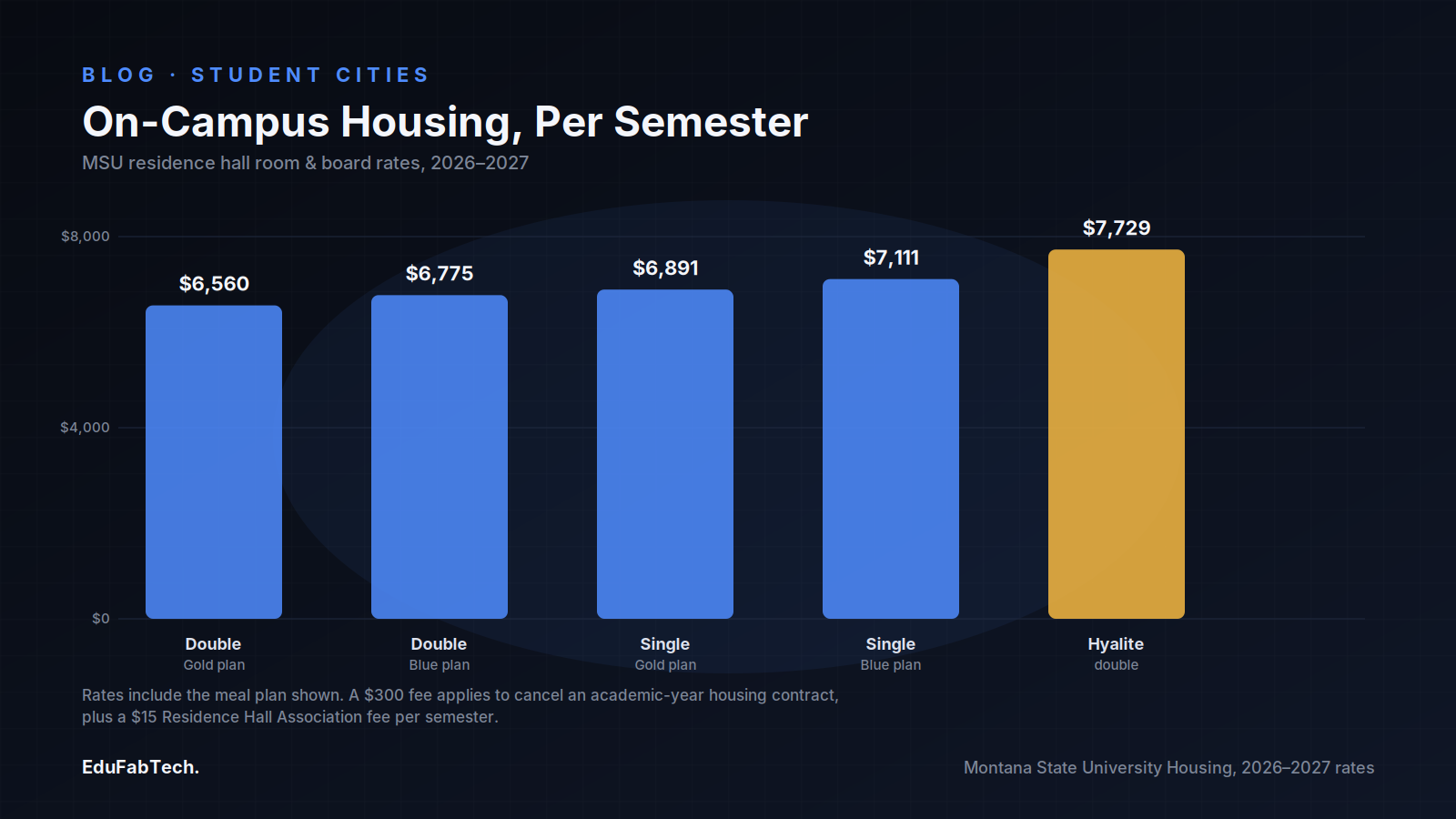
First-year students who want the simplest arrangement live in the residence halls on the south and west sides of campus — Hapner, Langford, Yellowstone, Hyalite, the Johnstone Center and the newer Headwaters complex. Montana State University's housing office publishes its 2026–2027 room and board rates per semester: a standard double room runs $6,775 on the seven-day Blue meal plan or $6,560 on the five-day Gold plan, and a single room $7,111 or $6,891, with hall-specific rates rising to $7,729 for a Hyalite double. A $300 charge applies if you cancel the academic-year housing contract, and there is a $15-per-semester Residence Hall Association fee. These are the clearest dated housing figures in the city, because they come straight from the provider.
Off campus, students spread into the neighbourhoods north and west of the university — the grid streets south of Main, the areas around Kagy and South Willson, and newer apartment developments pushing west toward Ferguson Avenue and out toward Four Corners and Belgrade as rents bite. Houses shared between several students are common; so are basement and garage conversions, which is why inspecting a place in person matters here more than in a city of purpose-built blocks. EduFabTech's room listings for the city are at /in/united-states/bozeman/rooms, and everything for the city in one place at /in/united-states/bozeman.
Renting without getting caught out
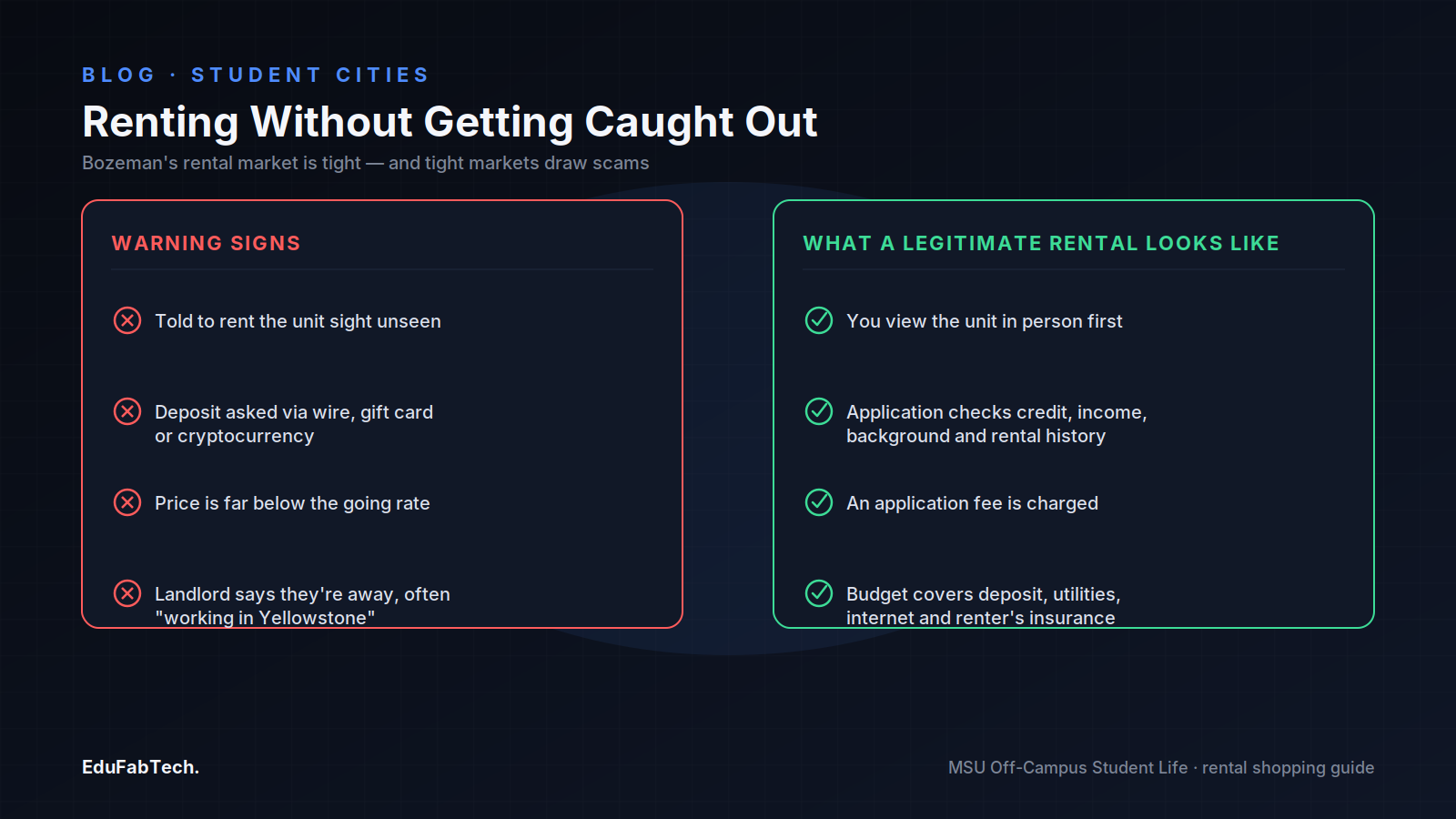
Bozeman's rental market is tight, and a tight market is exactly where rental scams thrive. Montana State University's Off-Campus Student Life office, in its guidance on shopping for a rental, tells students to "look early and often, especially in Bozeman's tight rental market" and warns plainly: "Never rent a property sight unseen." It also singles out one channel — be careful with Craigslist, because "if it looks too good to be true, it probably is" — which is where most Bozeman rental fraud shows up: a listing far below the going rate, a landlord who says they are out of town (often "working in Yellowstone" or out of state), and a request to wire a deposit to hold the place.
Treat any of those as a stop sign. See the actual unit, or have someone you trust see it, before money changes hands. A legitimate Bozeman landlord will, per the same office, usually run a rental application that checks credit, income, background and rental history, and will charge an application fee — paperwork a scammer skips. Never send a deposit or "holding fee" by bank wire transfer, gift card or cryptocurrency; those payments cannot be reversed and a request for them is the single most reliable sign of fraud. Budget for the real up-front costs the office lists — deposits, first month's rent, utilities, internet and renter's insurance — rather than rent alone.
Furnishing a room second-hand
Because so many students cycle through Bozeman each year, there is a steady second-hand supply, and buying used is the sensible way to furnish a room. The best-known charity thrift store downtown is Sacks Thrift at 138 West Mendenhall Street; according to the Help Center, the nonprofit that runs it, Sacks has operated since 1986 and puts its proceeds toward Help Center programmes including a 24-hour crisis line, selling donated clothing, furniture and household goods. Second Hand Rose, run by volunteers in the basement of the Bozeman Senior Center at 807 North Tracy Avenue, is a good source of kitchenware, linens and small household items, with proceeds supporting the centre. For larger pieces, the Habitat for Humanity of Gallatin Valley ReStore in neighbouring Belgrade sells donated furniture, appliances and building materials, with proceeds funding local home-building.
At the start and end of each semester, furniture also moves between students directly and is often given away rather than sold. EduFabTech collects local second-hand goods at /in/united-states/bozeman/second-hand, furniture specifically at /in/united-states/bozeman/furniture, and things offered free at /in/united-states/bozeman/free-stuff — worth checking in August and again in May, when departing students clear out.
Working while you study
On-campus jobs — in dining, the library, labs and offices — are the usual first paid work for students, and they are built around class schedules. For international students the rules are federal, not local, and they are specific. Montana State University's International Student & Scholar Services office states on its employment page that F-1 students "are permitted to work up to 20-hours per week in most cases during the academic year, and more than 20-hours per week during vacation periods between semesters." The same office explains that off-campus work generally requires separate authorisation — Curricular Practical Training (CPT) tied to your programme, or Optional Practical Training (OPT) after study, with a possible 24-month extension for STEM fields.
None of that is legal advice, and the details change with individual circumstances, so the office's own instruction — always check with an International Student Advisor before accepting any work — is the one to follow. Verify your own situation with ISSS rather than with a prospective employer. Part-time openings aimed at students, on and off campus, are listed on EduFabTech at /in/united-states/bozeman/jobs.
Libraries and places to study
The main academic study space is the Renne Library on campus. According to the library's own guide, the basement and first and second floors are active study spaces that support "discussion, interaction, noise from conversation, technology, and equipment," while the third and fourth floors are "quieter, more contemplative spaces to work alone or around others." Students can reserve group rooms and tables — seven rooms on the first floor, nine rooms and seven tables on the second, and one room on the fourth — using a campus NetID and password, with a limit of three hours a day per person.
Away from campus, the Bozeman Public Library at 626 East Main Street is open to the public and, per the City of Bozeman, keeps evening hours on weekdays and shorter weekend hours — useful when you want a quiet desk that is not full of classmates, or a change of scene downtown. More study desks and spaces around the city are catalogued on EduFabTech at /in/united-states/bozeman/study-spaces.
Getting around without a car
You can live in Bozeman as a student without a car, and the bus that makes this possible is Streamline. Montana State University's sustainability office describes Streamline on its transportation page as "Bozeman's fare free bus service" and a programme of the HRDC (the Human Resource Development Council), running five weekday routes that serve the MSU campus, residential neighbourhoods and downtown. The service is partly funded through student fees, so there is no separate card or fare to manage — you board and ride.
That said, Bozeman is spread out, winters are hard, and bus frequency is limited outside peak hours, so many students combine the bus with a bike in the warmer months and share rides in winter. If you choose housing, weigh it against the Streamline routes: a place on a bus line is worth more to a car-free student than a slightly cheaper room a long, cold walk from the nearest stop.
The good and the hard
The good is easy to see. Bozeman is small, safe by most measures, and sits within minutes of world-class skiing, climbing, hiking and fly fishing, which shapes an outdoors-first student culture you will not find in a big city. The university is the state's research centre, strong in STEM, and small enough that undergraduates can reach labs and faculty.
The hard part is overwhelmingly cost and housing. Bozeman has been one of the fastest-growing small cities in the United States, and demand from non-student newcomers pushes rents up and vacancy down — the reason the university itself calls the rental market "tight" and urges students to start searching early. The residence-hall rates above show the on-campus baseline; off campus you are competing with well-paid professionals, often for older housing. Winters are long and genuinely cold, which raises heating bills and makes a car-free life harder than it looks in September. If you arrive without housing lined up, give yourself real time on the ground to search, and do not sign for a place you have not seen.
Your first few weeks
- If you are an international student, meet International Student & Scholar Services in person early and confirm, in writing, what employment you are allowed under your F-1 status before accepting any job.
- Do not wire deposits. See any off-campus room yourself — or have a trusted person see it — and pay only after a written lease; walk away from "out of town" landlords asking for gift cards, wire transfers or crypto.
- Learn the Streamline routes that reach your housing and campus, and factor winter travel into where you live.
- Get a campus NetID working so you can reserve study rooms at Renne Library, and find your quiet floor versus active floor.
- Furnish from Sacks Thrift, the ReStore and student give-aways rather than buying new; check the free and second-hand listings at the start of term.
- Budget beyond rent — deposit, utilities, internet, renter's insurance and warm clothing for a Montana winter.
- Use the SUB and the Off-Campus Student Life office; they handle roommate searches, housing questions and referrals, and events worth knowing about are collected at /in/united-states/bozeman/events.
A quick question for readers
Do you work part-time while you study?
Many students work to pay the bills. See how common it is — and how many hours people really do.
Pick an answer, create a free account in a minute, and your vote counts. Already a member? Sign in
Comments 0
CommentNo comments yet. Members start the conversation.
Source: Montana State University
Sources (5)
- Montana State University. About Montana State University. Montana State University, 2026. montana.edu ↗ · checked 15 Oct 2026
- University Student Housing. Room and Board Rates 2026–2027. Montana State University, 2026. montana.edu ↗ · checked 15 Oct 2026
- International Student & Scholar Services. Employment. Montana State University, 2026. montana.edu ↗ · checked 15 Oct 2026
- Help Center, Inc.. Sacks Thrift. Help Center, Inc., 2026. helpcenterinc.org ↗ · checked 15 Oct 2026
- City of Bozeman. Bozeman Public Library. City of Bozeman, 2026. bozemanmt.gov ↗ · checked 15 Oct 2026