Studying in Columbia, United States: universities, housing and student life
A practical, sourced guide to studying in South Carolina's capital — its three degree-granting campuses, where students live, what rooms and transit cost, and the honest trade-offs.
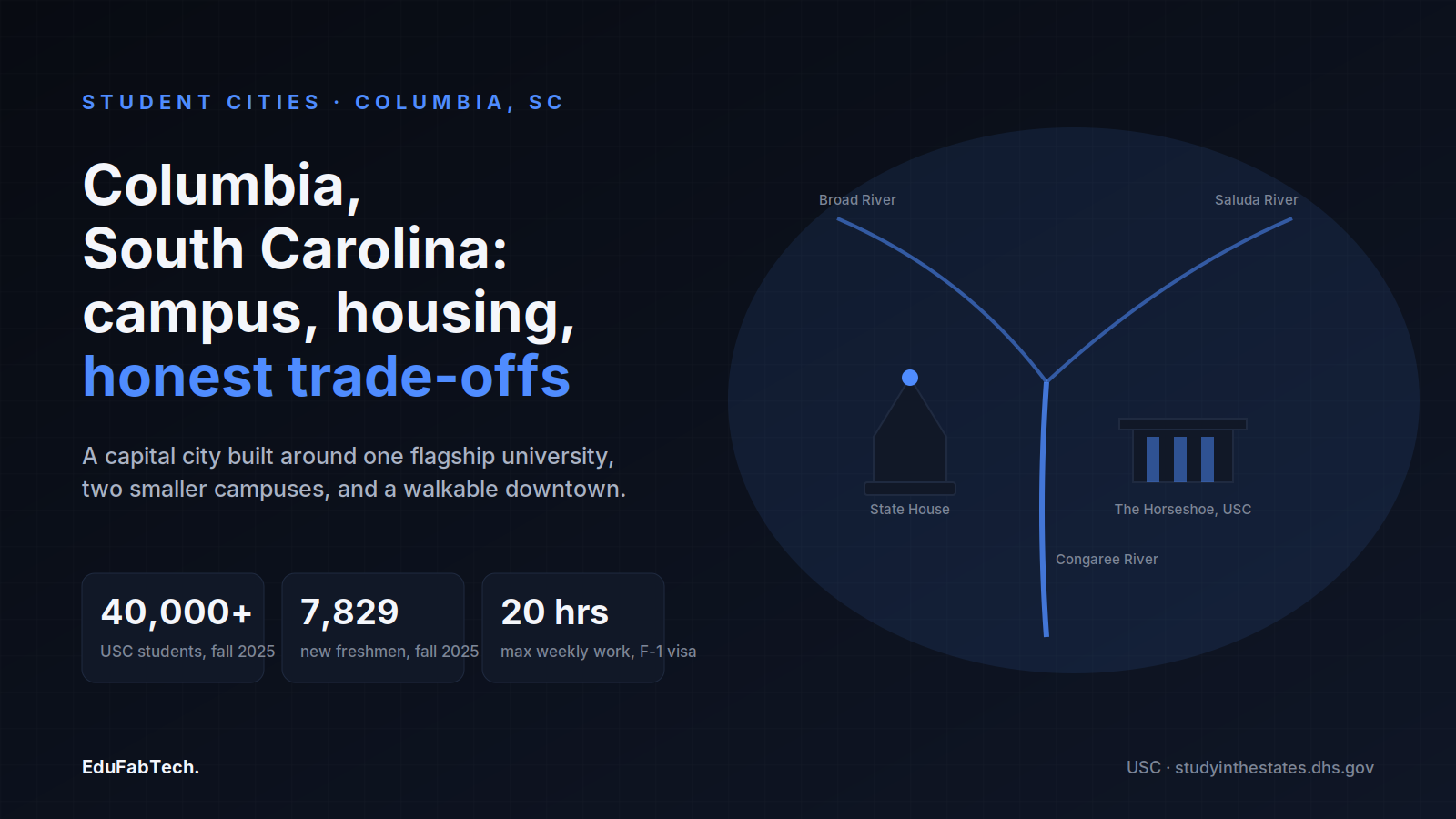
Columbia sits at the geographic centre of South Carolina, where the Broad and Saluda rivers join to form the Congaree. It is the state capital, and the dome of the South Carolina State House is close enough to the main university campus that students cross between the two in a lunch break. That overlap of government town and college town shapes almost everything about studying here: the largest employer and the largest landlord of students stand a few blocks apart, and the rhythm of the place swings between legislative sessions and football Saturdays.
For a student arriving from another state or another country, Columbia offers a compact downtown, a dominant flagship university, and two smaller campuses with distinct missions. This guide walks through who grants degrees here, where people actually live, what a room and a bus ride cost, the rules around part-time work, and the parts of the city that are genuinely hard. Every figure below is tied to the page it came from.
Three campuses in and around the capital
The University of South Carolina is the reason most students come to Columbia. According to the university's own history page, it was chartered in 1801 as South Carolina College and is today the state's flagship, organised into colleges and schools spanning arts and sciences, business, engineering and computing, law, medicine, nursing, pharmacy and more (sc.edu). Its core is the Historic Horseshoe, a shaded quadrangle of early-nineteenth-century buildings off Sumter Street that still houses classrooms and dormitories. USC announced that it enrolled a record 7,829 new freshmen on the Columbia campus for the fall 2025 semester — more than 4,000 of them, or 51 percent, South Carolina residents — with overall campus enrolment passing 40,000 students for the first time (USC, 2025). That scale is worth picturing before you arrive: lecture halls, dining queues and the bus system all run at a size that smaller college towns never reach.
Studying at USC means being downtown rather than on an isolated campus. The buildings are woven into working streets, and much of student social life spills a short walk east into Five Points and north-west into the Vista, two districts of bars, restaurants and small shops that fill with students in term time. The trade-off is that the campus has no single edge — you are in the city from the first day.
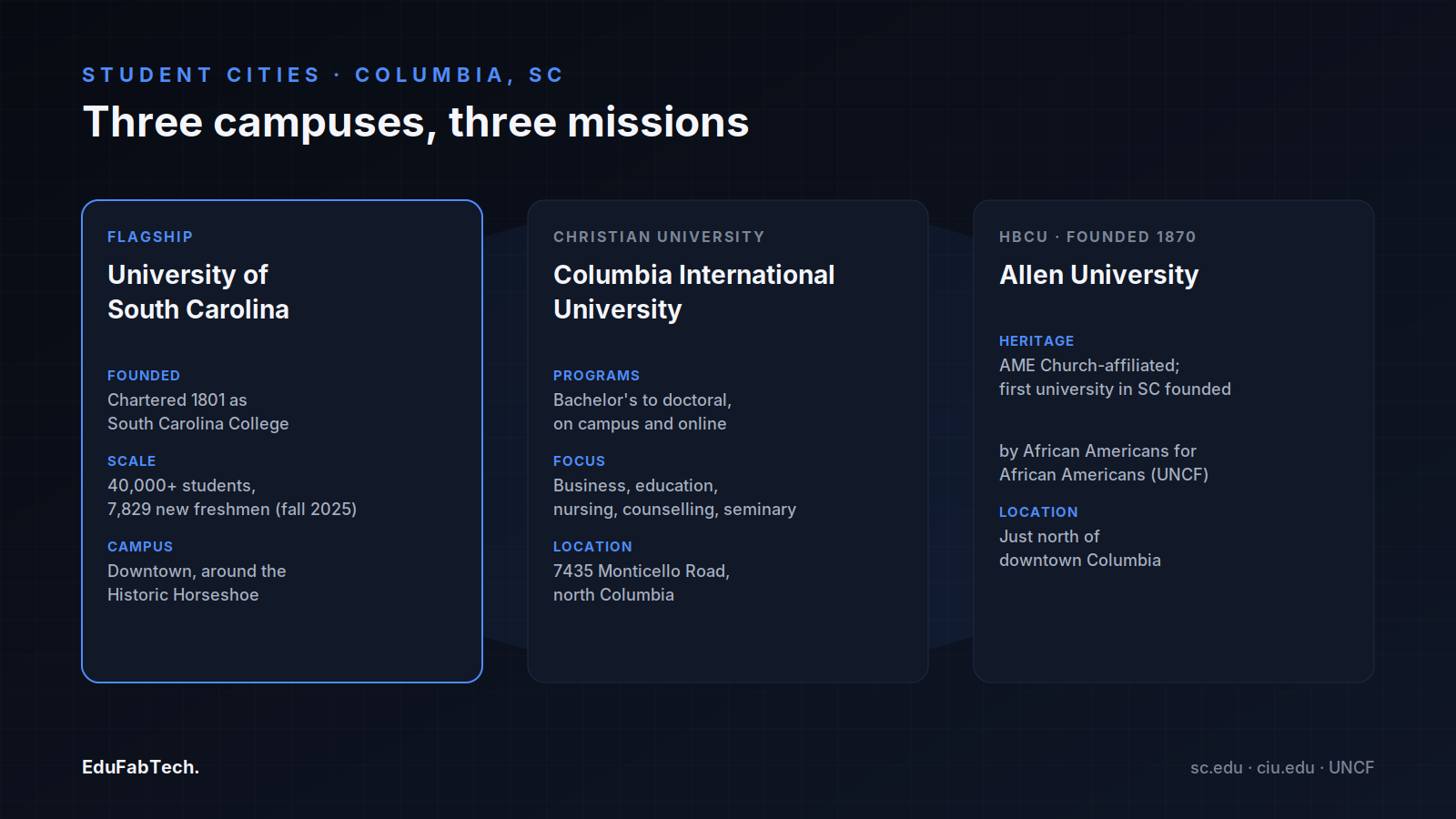
Columbia International University is a smaller, Christ-centred university on the north side of the city, at 7435 Monticello Road. Its own site describes it as offering accredited bachelor's, master's and doctoral programmes, on campus and online, across fields from business and education to nursing, counselling and seminary study (ciu.edu). Allen University, just north of downtown, is a historically Black university founded in 1870 and rooted in the African Methodist Episcopal Church; the United Negro College Fund records it as the first university in South Carolina founded by African Americans for the education of African Americans (UNCF). A fourth option some students weigh is Columbia College, a private liberal-arts college founded in 1854 by the Methodist Church that long enrolled only women and has since opened its residential programme to men, according to the South Carolina Encyclopedia (scencyclopedia.org). You can browse everything listed for the city on EduFabTech's Columbia student page.
Where students live
First-year USC students mostly live on campus, in halls ranging from the historic rooms on the Horseshoe to the newer Campus Village complex. After that, the pattern is predictable and tied to geography. Five Points and the blocks immediately around Greene Street are the closest and most sought-after — walkable to class, loud at weekends, and priced accordingly. Shandon and Rosewood, the older residential neighbourhoods south-east of campus, trade some walkability for quieter streets and houses shared between three or four students. North, towards the Vista and Main Street, you find converted downtown apartments; across the Congaree River, Cayce and West Columbia are often cheaper and still within a reasonable commute, though you will usually need a bus or a bike to bridge the river.
The honest rule for timing is that the good, close rooms near USC are chased early. Leases for the autumn term are commonly signed in the preceding winter and spring, so a student planning for a September start is looking seriously by February or March. International students arriving later in the cycle will find more of what is left is further out, which makes the COMET routes below worth checking before you commit. You can compare current listings on EduFabTech's rooms page and see what sits near the main campus via its University of South Carolina listings.
Renting without being caught out
Columbia's rental scams follow the student calendar. They tend to surface in the spring-to-summer scramble, when demand is highest and genuine rooms turn over quickly, and they cluster around the areas students most want — Five Points, Shandon, the streets a short walk from the Horseshoe. The classic version is a listing priced a little below everything comparable, a "landlord" who is conveniently out of town, and pressure to secure it immediately.
A few habits protect you. See the actual unit in person, or have someone you trust see it, before any money changes hands; be wary of anyone who cannot let you inside the specific room. Expect a normal local deposit — typically around one month's rent plus the first month — and get the amount, the term and what the deposit covers written into the lease. Above all, never send money by bank wire transfer, gift card or cryptocurrency to "hold" a room; no legitimate Columbia landlord needs payment in a form that cannot be traced or reversed. Pay by a method that leaves a record, and keep copies of everything. If a deal only works if you act before you can view the place, treat that as the warning it is.
Furnishing a room: Soda City and the second-hand trail
An empty room is cheapest to fill from the city's own markets. The anchor is Soda City Market, the open-air street market that takes over the 1300-to-1600 blocks of Main Street every Saturday from 9 a.m. to 1 p.m., year-round, with produce, food vendors, makers and bric-a-brac (sodacitysc.com). It is as much a weekly social fixture as a shopping trip, and it is a short walk or a free downtown trolley ride from most central housing.
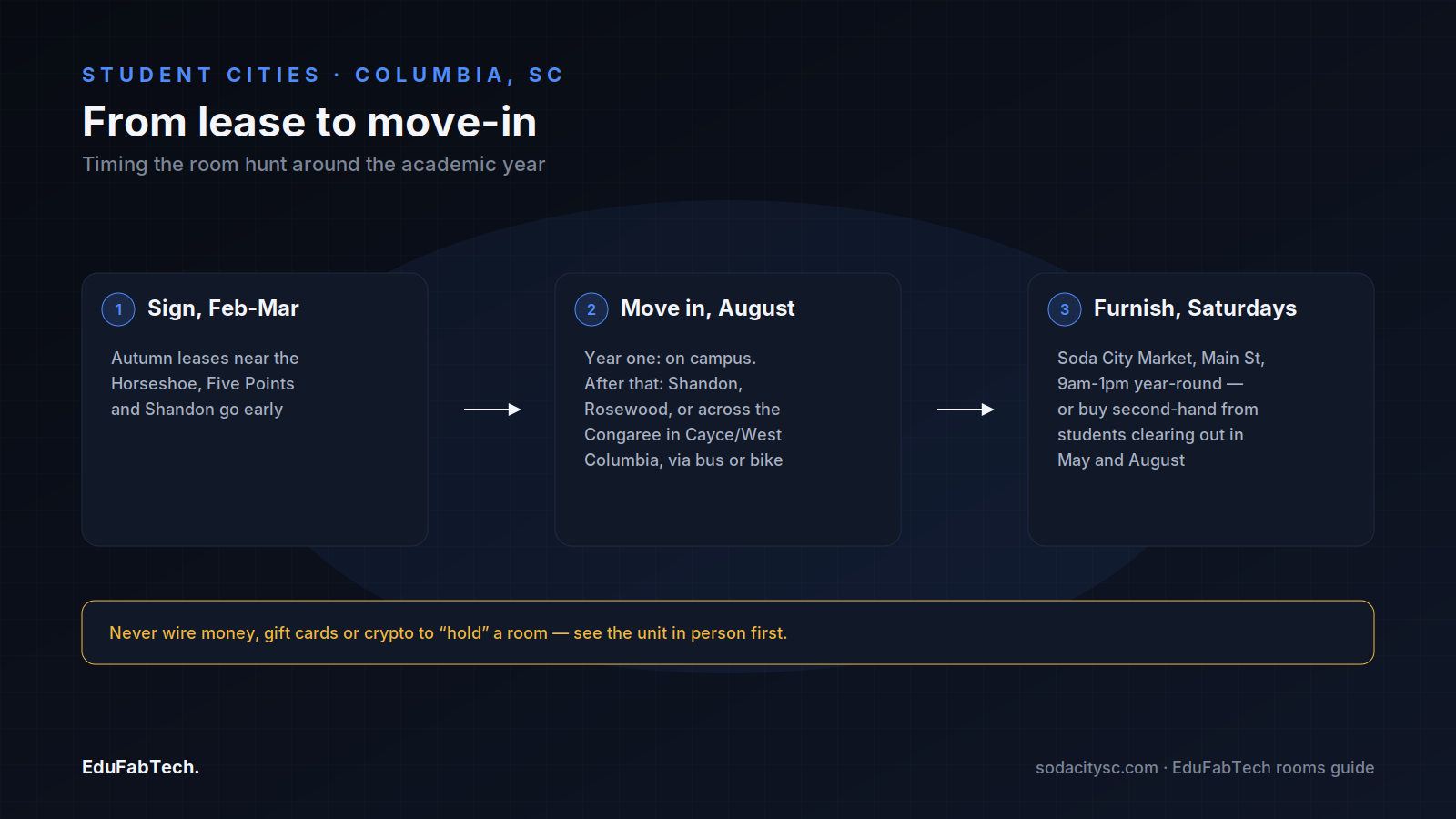
For the furniture, kitchen kit and bikes that make a room liveable, the cheapest route is other students — especially in May and August, when leases end and whole flats are cleared out at once. EduFabTech keeps a local page for second-hand things in Columbia, worth watching around those turnover weeks. Buy the bulky, heavy things close to campus so you are not paying to move a desk across the river.
Working while you study
If you are an international student, the rules on work are set by federal immigration law, not by the university, and it is worth reading them from the source rather than from word of mouth. The U.S. Department of Homeland Security's Study in the States guidance states plainly that an F-1 student in on-campus employment "may not work more than 20 hours per week when school is in session," and that such work needs approval from the student's designated school official (studyinthestates.dhs.gov). Off-campus and practical-training options have their own conditions and authorisations. This guide is not legal advice; for your own situation, confirm with your campus international-student office and the official page before you accept any job. Domestic students face no such cap, and a large flagship plus a downtown service economy means campus jobs, cafés and events work are the usual starting points — EduFabTech lists local openings on its Columbia jobs page.
Libraries and places to study
On campus, the Thomas Cooper Library is USC's main library and the default place to work; the university extended its weekend opening for the 2025-26 academic year, keeping it open until 9 p.m. on Fridays and Saturdays in response to student requests, with hours that stretch later during term and finals (USC, 2025). Current opening times are posted on University Libraries' hours page.
Off campus — and open to everyone, not only USC students — the Richland Library Main branch at 1431 Assembly Street downtown offers several floors of study rooms, lounges and meeting spaces, plus studios including a makerspace, according to the library's own location page (richlandlibrary.com). For students at Columbia International University or Allen University, or anyone living away from the Horseshoe, it is a genuinely useful second workspace in the heart of town. EduFabTech also collects quieter desks and bookable rooms on its study-spaces page.
Getting around on the COMET
Columbia's public transit is run by the Central Midlands Regional Transit Authority, branded The COMET, covering Richland and Lexington counties. On the general network, a single one-way fare is $2.00, or $1.00 at the discount rate, an All-Day Pass is $4.00, and a 31-Day Pass is $40.00, according to the COMET's Passes & Fares page (catchthecometsc.gov). For USC students the more useful fact is that they do not pay at all: USC students, faculty and staff ride USC Transit free with a valid CarolinaCard, the COMET states, across a set of daytime and evening campus routes (The COMET, USC Transit). The COMET also runs a free trolley-and-bus service, the Soda Cap Connector, linking Five Points, Main Street, the Vista and across the river into Cayce and West Columbia (The COMET, Soda Cap), which is how many students reach Soda City without driving. Columbia is a car-oriented city overall, so if you live across the river or out past Rosewood, check which routes actually serve your street before you sign a lease.
What it costs, honestly
The one housing figure you can pin to a dated, official page is the university's own. For the 2026-2027 academic year, USC Housing's published residence-hall rates run from $3,528 per semester for a space in Bates House to $8,062 per semester for a single studio or one-bedroom at Park Place, with most traditional halls such as Capstone and Columbia Hall sitting around $4,267 per semester (USC Housing, 2026-2027). Those are per-semester rates for a single academic year, and they bundle different room types, so compare like with like when you budget.
Off-campus rents are harder to state precisely, because they vary by neighbourhood, by how many people share a house and by how close you are to the Horseshoe, and there is no single reliable municipal figure I would quote here for a student room. What is safe to say is the shape of it: Five Points and the walk-to-class blocks sit at the top, Cayce, West Columbia and the outer neighbourhoods at the bottom, and sharing a house with others is how most students bring the per-person cost down. Transit is a small, fixed line in the budget given the free USC service, and the Saturday market keeps food and furnishing costs modest if you shop there.
The trade-offs, and a first-weeks checklist
What is good about Columbia for a student is concrete. It is a real capital city with a downtown campus, so culture, government internships, the State House and the river are all within reach on foot or a free bus. Housing, while not cheap near campus, is markedly less expensive than in the big coastal college cities, and the free USC transit removes a cost that bites students elsewhere. The market culture and the public library give you places to be that do not require spending.
What is hard is equally concrete. Summers and early autumn are genuinely hot and humid, which is worth planning your walk-and-bike commute around. The city is built for cars, so living cheaply across the river can mean a real dependence on bus timetables. The sheer size of USC means first-year services, dining and housing operate at crowd scale, and the best rooms near campus are gone early to students who start looking in winter. And because student social life concentrates in Five Points, the nearby streets are lively late at weekends — a plus or a minus depending on where you sleep.
A short checklist for the first weeks:
- Collect your CarolinaCard early if you are at USC — it is both your library card and your free USC Transit pass (The COMET).
- Walk or ride the COMET routes that serve your actual street before term starts, and save the Passes & Fares page if you will use the general network (catchthecometsc.gov).
- If you are an international student, confirm the on-campus work rules with your designated school official and the DHS guidance before accepting any job (studyinthestates.dhs.gov).
- Note library hours for Thomas Cooper and the Richland Library Main branch so you have a study plan from week one (richlandlibrary.com).
- Go to Soda City on a Saturday morning for food, furnishings and a first sense of the city (sodacitysc.com), and check EduFabTech's local second-hand listings during the May and August move-out weeks.
A quick question for readers
Do you work part-time while you study?
Many students work to pay the bills. See how common it is — and how many hours people really do.
Pick an answer, create a free account in a minute, and your vote counts. Already a member? Sign in
Comments 0
CommentNo comments yet. Members start the conversation.
Source: University of South Carolina
Sources (5)
- University of South Carolina. Our History. University of South Carolina, 2026. sc.edu ↗ · checked 10 Oct 2026
- University of South Carolina Housing. Fall 2026 – Spring 2027 Residence Hall Rates and Fees. University of South Carolina, 2026. sc.edu ↗ · checked 10 Oct 2026
- Central Midlands Regional Transit Authority. Passes & Fares. The COMET, 2026. catchthecometsc.gov ↗ · checked 10 Oct 2026
- U.S. Department of Homeland Security. Working in the United States. Study in the States, 2026. studyinthestates.dhs.gov ↗ · checked 10 Oct 2026
- Richland Library. Richland Library Main. Richland Library, 2026. richlandlibrary.com ↗ · checked 10 Oct 2026