Studying in Corvallis: Oregon State University, housing and student life
A practical, sourced guide to living and studying in Corvallis, Oregon — the universities, where students find rooms, what housing costs, the fare-free bus, work rules for international students, and the honest trade-offs.
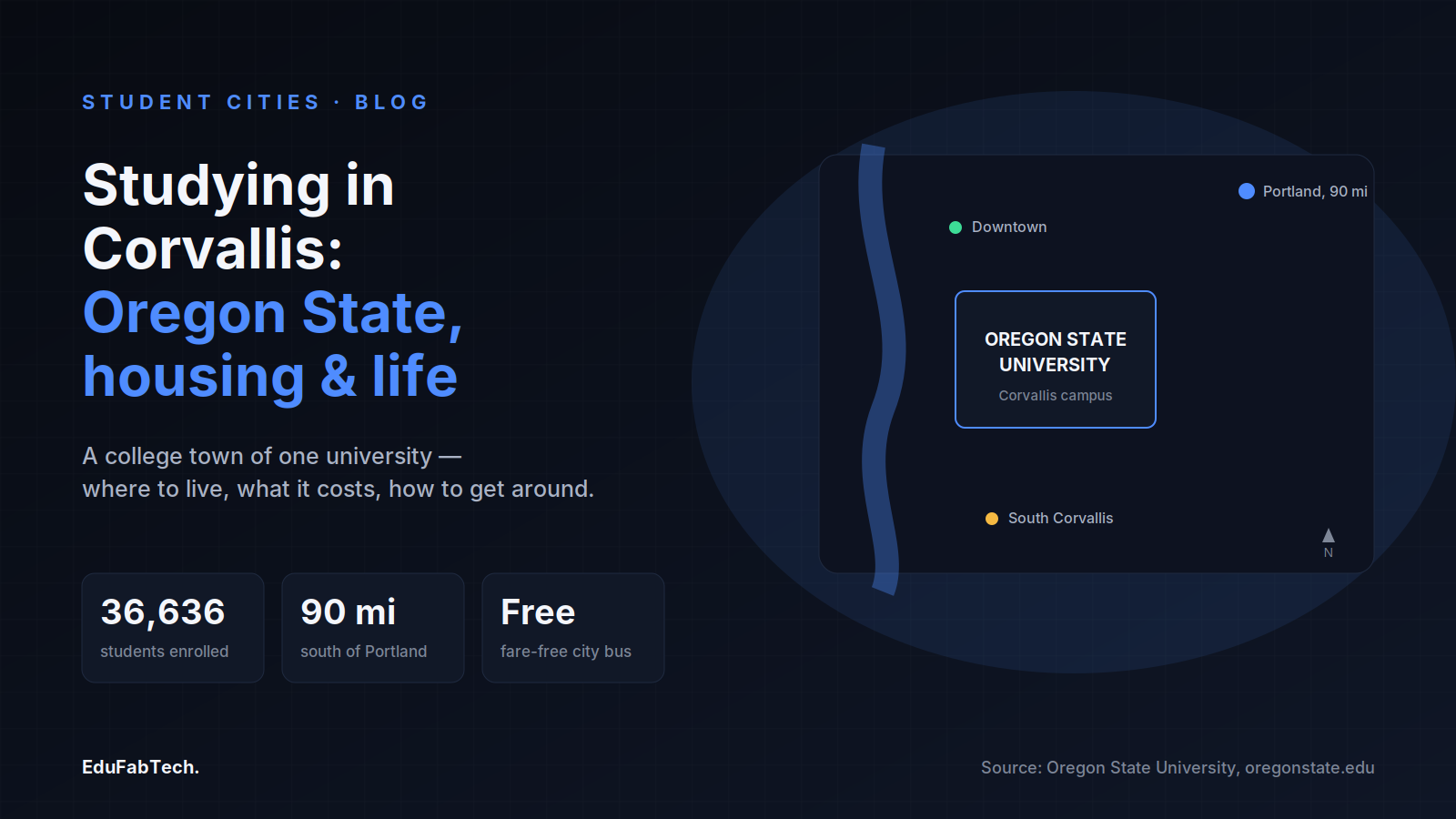
Corvallis sits in the middle of Oregon's Willamette Valley, on the west bank of the Willamette River, with the forested ridge of Marys Peak and the Coast Range rising to the west. It is a small city whose daily rhythm is set almost entirely by one institution: Oregon State University. The university's admissions office notes that Corvallis lies about 90 miles south of Portland, which means the nearest big-city airport, concert hall and major hospital network are an hour and a half away by car. For a student, that distance is the first thing to understand about the place — Corvallis is compact, walkable and quiet, and when you want a metropolis you travel to find one.
Oregon State is the city's defining feature and its largest employer. The university states on its About Oregon State page that it enrols 36,636 students across all campuses — 30,782 undergraduates and 5,854 graduate students — organised into 11 colleges, and that it draws more research funding than any other public university in Oregon. The same page records an unusual distinction: Oregon State is one of only three universities in the United States to hold land-, sea-, space- and sun-grant designations at once, a reflection of long-standing strengths in agriculture, forestry, oceanography, engineering and the atmospheric sciences. The main campus, a mix of brick halls and open lawns, spreads west of downtown; Reser Stadium and the athletic complex anchor its south-west corner.
The official framing you will read everywhere is that Corvallis is, in the admissions office's words, the number-one college town in the Pacific Northwest. That is a marketing claim rather than an independent ranking, but the underlying point is fair: this is a town built around students, with a twice-weekly farmers' market, a riverfront park and a downtown you can cross on foot in ten minutes. Linn–Benton Community College, in neighbouring Albany, shares many students with OSU through transfer and co-enrolment programmes, and the two are linked by regional buses.
The live-on year, and where students go after it
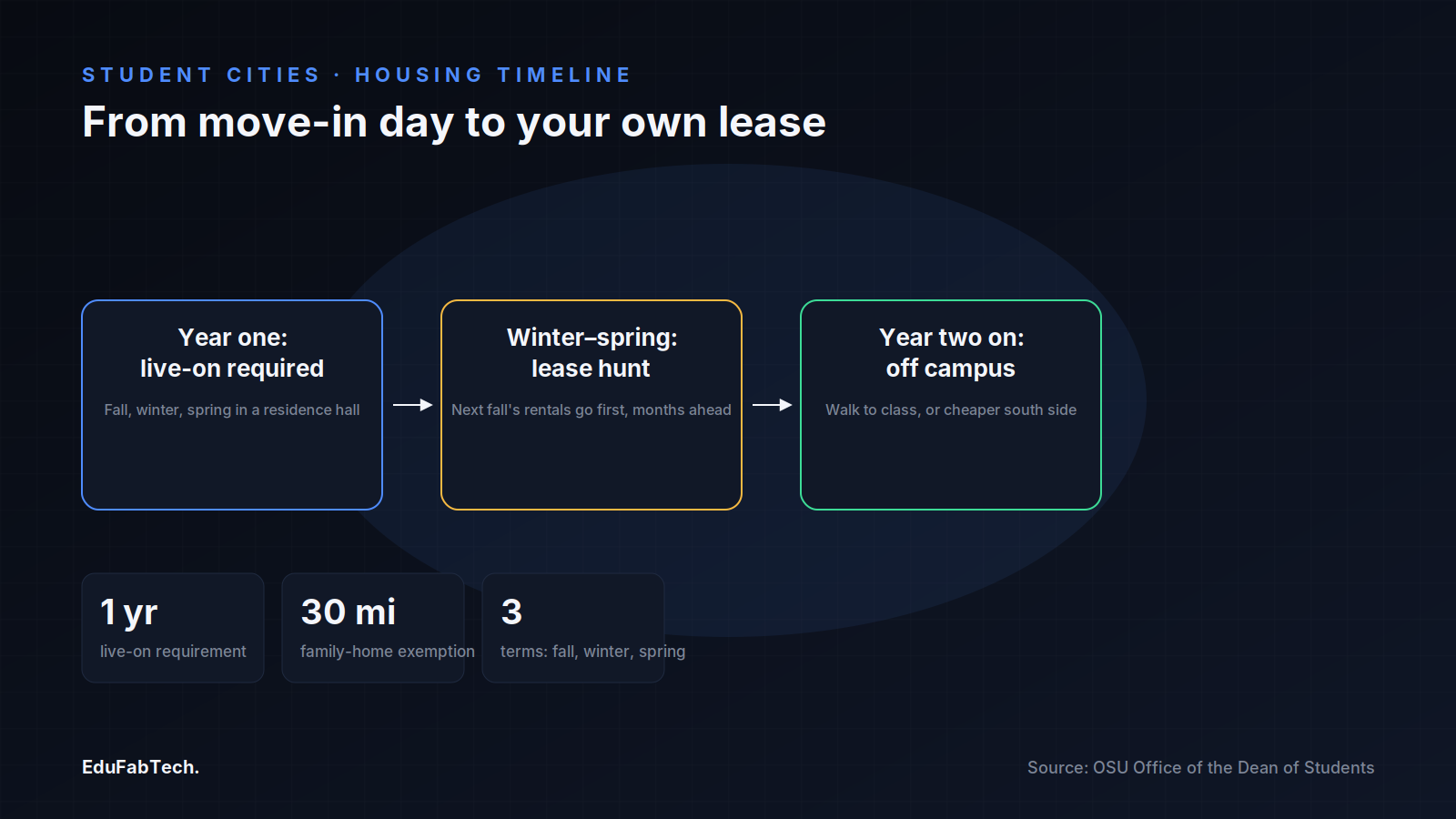
Housing in Corvallis divides sharply into two phases, and knowing which one you are in saves a lot of confusion. First-year undergraduates usually do not get to choose. Under the university's First-Year Experience live-on residency requirement, students who enrol at the Corvallis campus within one year of finishing high school are required to live in a university residence hall for their first academic year, which for autumn entrants means the fall, winter and spring terms. There are exemptions — one applies to students planning to live with immediate family at a home outside a 30-mile driving radius of campus — but they must be applied for formally through the Office of the Dean of Students. If you are a first-year student, plan on a residence hall and budget accordingly.
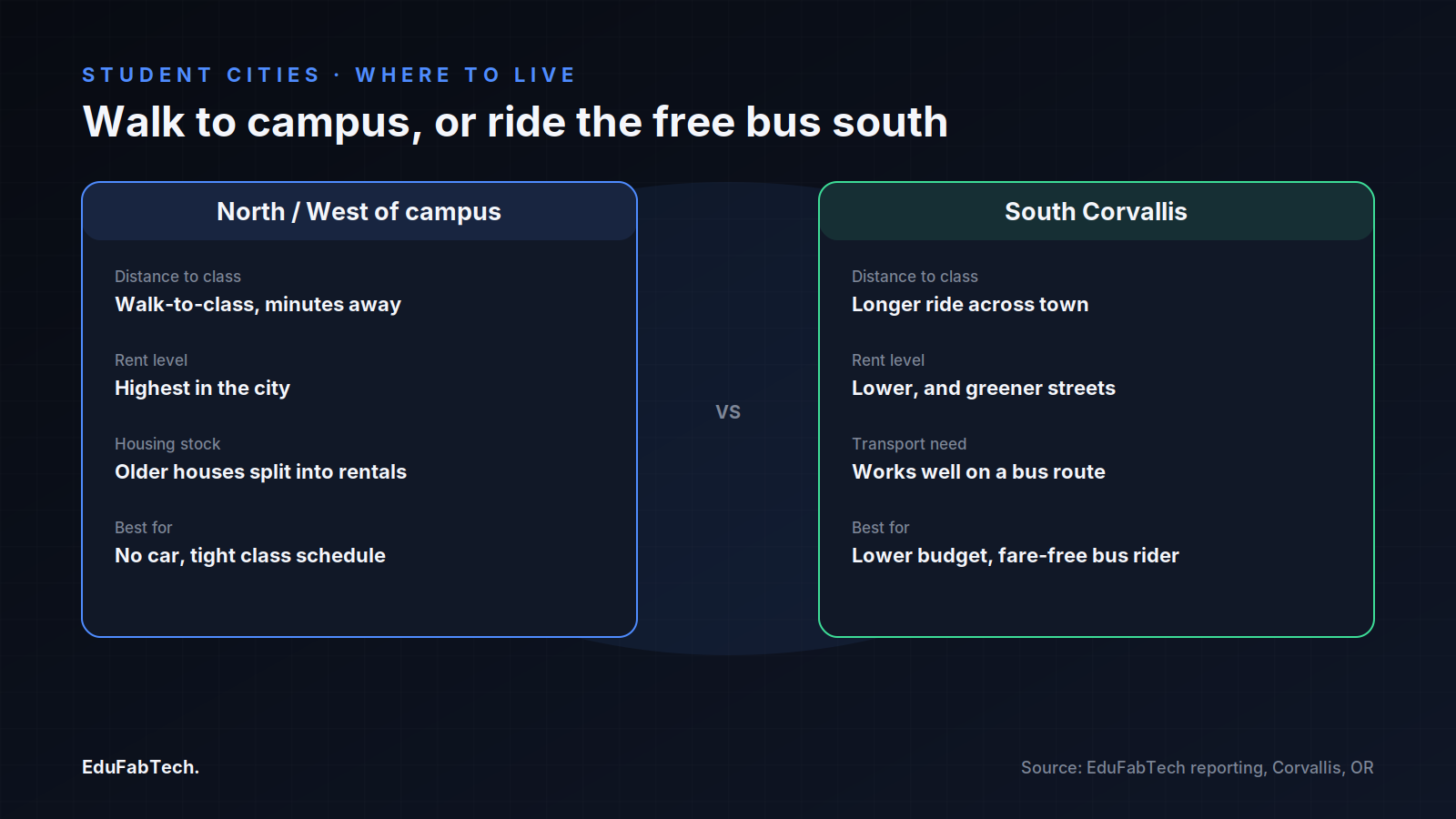
From the second year onward, most students move off campus, and the geography becomes simple. The blocks immediately north and west of campus — the older neighbourhoods of houses divided into student rentals — are the classic walk-to-class zone. South Corvallis, across the city centre toward the river's southern reach, is cheaper and greener but a longer ride in. Because the town is small and the rental stock is heavily student-driven, the market moves on the academic calendar: leases for the following September are commonly advertised and signed in the winter and early spring, long before summer. Waiting until August to look is possible but leaves you with the thinnest choice and the highest prices.
International and graduate students who arrive without a car should weigh location against rent carefully. A cheaper room in south Corvallis or out toward the highway can still work well if it sits on a bus route, because the bus — as the costs section below explains — does not charge a fare. A room that looks central but sits off the network can end up less convenient than one further out.
Signing a lease without losing a deposit
Corvallis is a low-crime town, but its rental scams follow the same pattern as every university housing market: the pressure peaks exactly when students are most anxious to secure a room, in late winter and again in the August scramble. The listings to distrust are the ones that undercut the going rate, show only stock photos, and come from a "landlord" who is conveniently out of state or abroad and asks you to secure the room before you have seen it.
The protective habits are concrete. See the actual unit in person, or send someone you trust, before any money changes hands — a genuine Corvallis landlord or property manager can show you the room or arrange a video walk-through. Never send a deposit or "holding fee" by bank wire transfer, gift card or cryptocurrency; those are the methods scammers insist on precisely because the money cannot be recovered. A normal deposit here is paid by cheque or card once you have a signed lease and have met the person renting to you, and it is held against damage, not demanded to "reserve" a room sight unseen. Get the lease terms, the deposit amount and the move-in date in writing, and read what the lease says about the twelve-month versus academic-year term before you sign. EduFabTech's own rooms listings for Corvallis and the broader city page are a starting point, as are the postings near campus at Oregon State University; wherever you search, the in-person rule does not change.
Furnishing a room for very little
A room you move into in September is usually empty, and Corvallis has an unusually good second-hand economy for a city its size, partly because thousands of students cycle through it each year and leave furniture behind. The standout is the Vina Moses Center's free thrift store on NW Garfield Avenue, where clothes, kitchenware, home goods and household items are given away at no cost; Benton County residents may shop once a month, and first-time visitors complete a short form at the desk. For paid second-hand goods, St. Vincent de Paul on NW 25th Street carries clothing, shoes and household items at low prices, and Goodwill on N Professional Drive sells furniture, clothing and books.
The city's markets are worth building into your week for food as much as furnishing. The Corvallis Farmers' Market runs on First Street downtown, by the riverfront, on Wednesdays and Saturdays from 9am to 1pm, April through November; the Saturday market carries 50 to 70 vendors and the Wednesday one around 20 to 30. For year-round groceries, First Alternative Natural Foods Co-op is a community-owned store with locations in north and south Corvallis. For furniture, giveaways and the end-of-term clear-outs when graduating students offload everything at once, EduFabTech lists second-hand items, furniture and things given away free in the city.
Part-time work, and the rules international students must follow
Many students work part time, and the roles that fit a class schedule — dining halls, the library, research labs, campus offices, downtown cafés and shops — are mostly within walking or short bus distance. For domestic students the main constraint is your own timetable.
For international students in F-1 status the constraints are legal, and they matter. As a general rule, F-1 students may work on campus up to 20 hours per week while classes are in session, and off-campus work normally requires specific authorisation tied to your programme. Oregon State's International Services office explains one of the main routes, Curricular Practical Training, which lets students take degree-related off-campus work for credit, generally after they have been enrolled full-time for three terms (nine months); the office issues a CPT-authorised Form I-20 that you must hold before starting. This is not legal advice, and the rules change: the authoritative sources are the U.S. government's SEVP guidance and your own designated school official at OSU International Services, who should sign off on any work before you begin it. Current campus openings in the city are collected on EduFabTech's Corvallis jobs page.
Libraries and places to study
The hub of study life is the Valley Library in the centre of campus. Oregon State's study-rooms page lets students reserve group and individual rooms, and the building mixes silent floors with open group tables. It is the natural default, but a town this size has quieter alternatives for the days when the library is full near exams: the Corvallis-Benton County public library downtown, the cafés along Monroe Avenue at the edge of campus, and departmental reading rooms. EduFabTech also maps study spaces around the city for students who prefer a desk away from campus.
Getting around: a town where the bus is free
Corvallis is genuinely small enough to walk or cycle across, and it is built for both, with flat terrain and extensive bike lanes. The piece of local knowledge that surprises most newcomers is that the city bus costs nothing. According to OSU Transportation Services, the Corvallis Transit System provides fare-free service throughout the city, with nine routes serving the OSU campus seven days a week — there is no ticket, no fare card and no student pass to buy, because every rider travels free. The same page notes that the Philomath Connection runs fare-free service between Philomath and the Corvallis campus on weekdays, and the university's own Beaver Bus supplements the city network around campus. For the hour-and-a-half trips to Portland, intercity coaches and the regional rail connection at Albany are the usual options; a car is useful for leaving town but close to unnecessary for daily life in it.
What it costs
The clearest dated figures come from the university's own housing office. For the 2026-27 year, University Housing & Dining Services lists per-term residence-hall rates on its room and dining rates page: an economy triple at $2,714 per term, a standard double at $4,437 per term, and a single with shared restroom at $5,388 per term. Because Oregon State runs on a three-term (trimester) calendar, these multiply across the year — the page gives the annual cost of a Buxton Hall double as $13,311, before a dining plan, with its Dining Plan 3 adding $3,975 for the year. A residence-hall contract is a substantial commitment, and for first-year students required to live on campus it is effectively fixed.
For off-campus rents, a useful official benchmark is the fair market rent the federal Department of Housing and Urban Development sets each year, which the City of Corvallis publishes on its Fair Market Rent Trends page. For 2026 the city lists an efficiency (studio) at $1,350, a one-bedroom at $1,451 and a two-bedroom at $1,824 per month — figures that have risen each year on the city's table, from a 2024 two-bedroom of $1,570. These are HUD reference rents, not an average of advertised listings, but they give a defensible floor for budgeting and show the direction of travel. Sharing a two- or three-bedroom unit, as most students do, is what brings the per-person figure down to something manageable.
The good and the hard
What is good about Corvallis for a student is also what is limiting. It is safe, small, green and walkable; the bus is free; the campus is a serious research university with strengths that pull students from around the world; and the farmers' market, river path and surrounding forests give a quality of outdoor life that larger college cities cannot match. The town's scale means you are rarely more than twenty minutes from anywhere you need to be.
The hard parts follow from the same facts. Rents have climbed steadily, as the city's own fair-market-rent table shows, and a town this small has limited housing supply, so the good rooms go early and the August latecomer pays for it. The weather is the Willamette Valley's: mild but persistently grey and wet through the long winter, which some students find hard. And Corvallis is isolated — a night out, a major concert, a specialist appointment or an international flight usually means the trip to Portland or Eugene. If you want a dense, anonymous big-city student life, this is not it; if you want a compact town organised around one university, it is close to ideal.
A checklist for the first weeks
- If you are a first-year student, confirm your residence-hall assignment and move-in date with University Housing & Dining Services, and check whether you qualify for a live-on exemption before assuming you can rent off campus.
- If you are renting, never pay a deposit before seeing the unit in person or by live video, and never pay by wire transfer, gift card or cryptocurrency.
- Get your OSU ID early — it is your access to the library, buildings and campus services — and learn the Corvallis Transit System routes near your room; the bus is free, so use it.
- International students: meet a designated school official at OSU International Services before taking any job, and confirm your work authorisation in writing.
- Furnish from Vina Moses, St. Vincent de Paul and Goodwill, and watch for end-of-term giveaways; the free-stuff and second-hand listings are busiest in June and September.
- Scout a backup study spot — a public-library reading room or a café near campus — for the weeks when the Valley Library fills up.
A quick question for readers
Do you work part-time while you study?
Many students work to pay the bills. See how common it is — and how many hours people really do.
Pick an answer, create a free account in a minute, and your vote counts. Already a member? Sign in
Comments 0
CommentNo comments yet. Members start the conversation.
Source: Oregon State University
Sources (5)
- Oregon State University. About Oregon State. Oregon State University, 2026. oregonstate.edu ↗ · checked 12 Oct 2026
- University Housing & Dining Services. 2026-27 Room and Dining Rates, Common Charges. Oregon State University, 2026. uhds.oregonstate.edu ↗ · checked 12 Oct 2026
- City of Corvallis. Fair Market Rent Trends. City of Corvallis Community Development, 2026. corvallisoregon.gov ↗ · checked 12 Oct 2026
- OSU Transportation Services. Transit. Oregon State University, 2026. transportation.oregonstate.edu ↗ · checked 12 Oct 2026
- OSU International Services. Curricular Practical Training. Oregon State University, 2026. internationalservices.oregonstate.edu ↗ · checked 12 Oct 2026