Studying in Dayton: universities, housing and student life
A practical, sourced guide to the universities around Dayton, Ohio, where students live, what a room costs, how to get around, and the honest trade-offs of the Gem City.
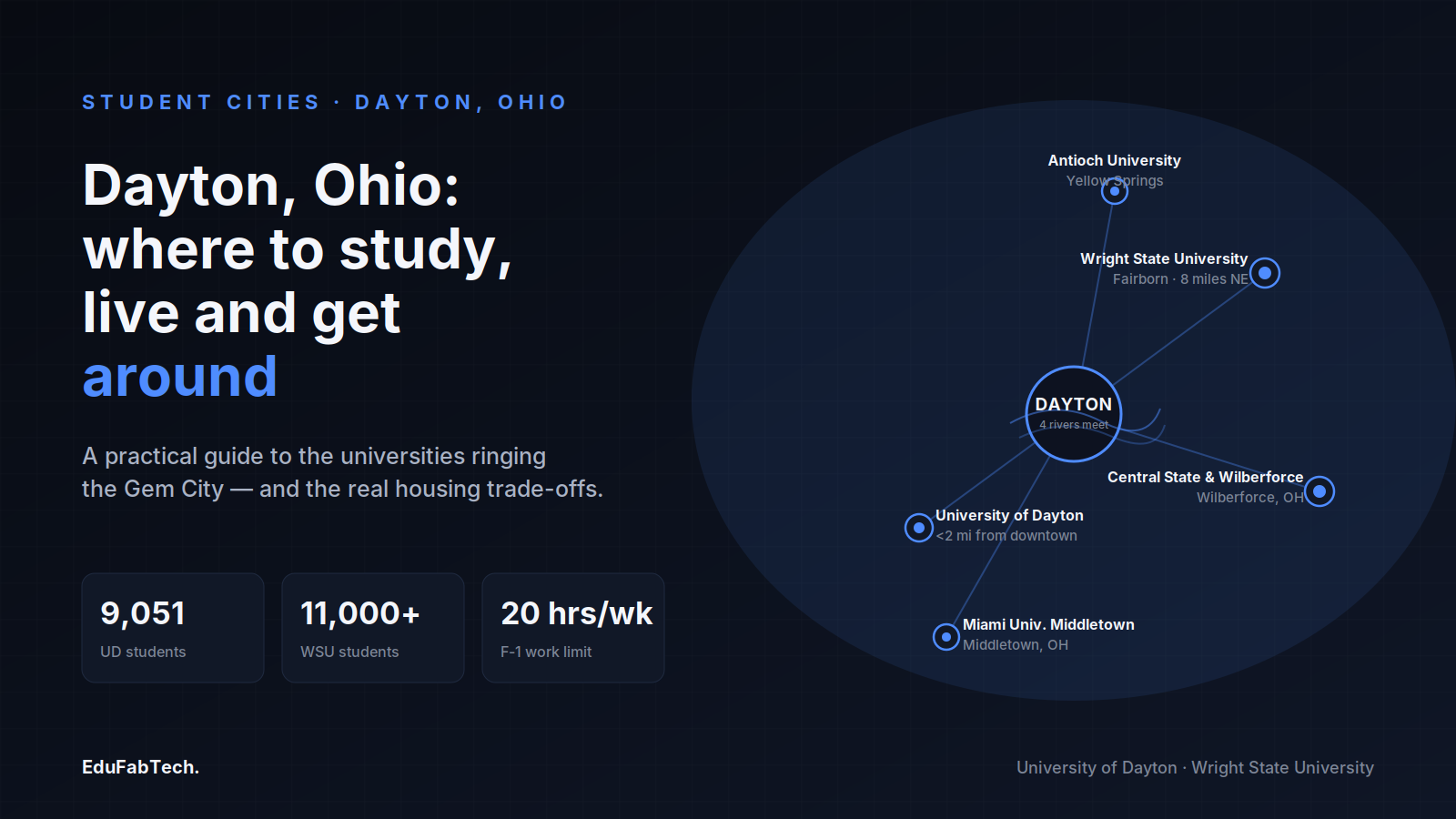
Dayton sits in south-western Ohio at a meeting of rivers — the Great Miami, the Mad, the Stillwater and Wolf Creek all converge within the city — and that geography has shaped it since the nineteenth century. It calls itself the Gem City, and it is where Orville and Wilbur Wright built and flew the first practical aeroplane out of a bicycle shop. For students, the useful thing to understand first is that Dayton is not a single campus town. Its universities are scattered in a wide ring across Montgomery and Greene counties, and where you study largely decides where you live and how you get around.
The University of Dayton, the biggest name in the city proper, describes its own campus as sitting "on the banks of the Great Miami River in south-west Ohio, less than two miles from downtown Dayton," according to the University of Dayton's about page. Several other institutions ring it: a large public university in Fairborn to the north-east, two historically Black universities out near Xenia, and a Miami University regional campus down in Middletown. Each has its own rhythm, and none of them is the default.
This guide walks through those universities, the neighbourhoods students actually choose, what a room costs with the figures sourced, how the buses work, where to study, and the parts of Dayton that are genuinely hard. If you are arriving from abroad, a note on work rules and visa authorities is included too. You can also browse current student listings across Dayton on EduFabTech as you read.
The universities around the Gem City
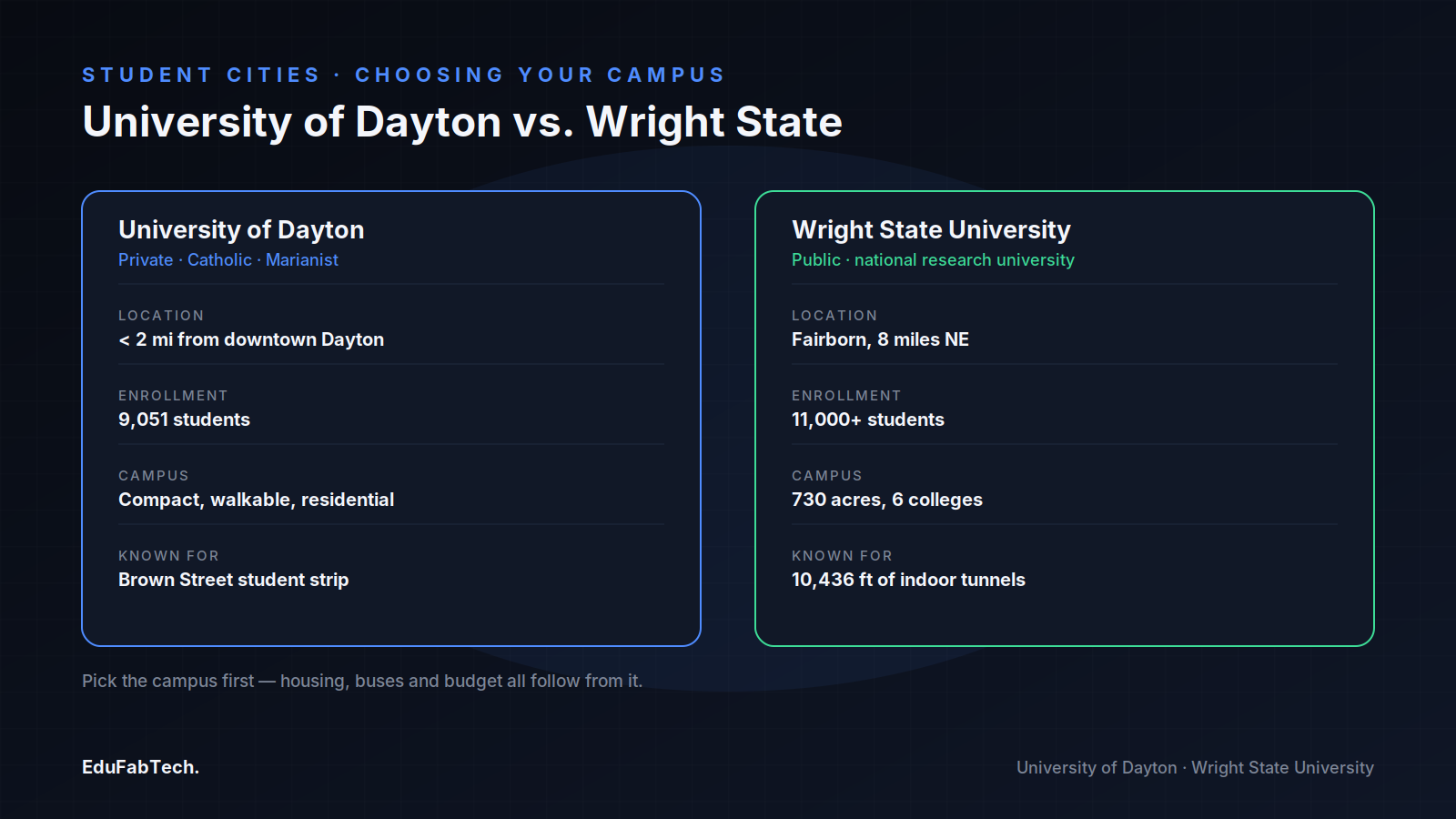
The University of Dayton is a private, Catholic and Marianist research university founded in 1850; the university's own history dates its origin to St. Mary's School for Boys, opened that July. Today it enrols 9,051 undergraduate, graduate and law students and ranks, per the National Science Foundation, as the "No. 1 Catholic university for engineering research and development," according to the University of Dayton. Its compact campus, engineering strength and strong on-campus residential culture define student life in the heart of the city.
Wright State University, eight miles north-east in Fairborn, is the region's main public option. Wright State describes itself as a national public university in Dayton with more than 11,000 students, 315 academic programmes, six colleges and a medical school across 730 acres, according to Wright State University. It is named for the Wright brothers, leans into the area's aerospace heritage, and is known for a practical quirk that matters in an Ohio winter: nearly two miles of pedestrian tunnels (10,436 feet) connect its buildings, per the same page.
Out toward Xenia, in the village of Wilberforce, sit two historically Black universities. Central State University "began as the combined Normal and Industrial Department in 1887" and spent more than 120 years pursuing land-grant status before achieving it in 2014, according to Central State University; it is an 1890 land-grant institution with notable programmes in agriculture and water-resources management. Next door, Wilberforce University was, in its own words, "the nation's first private historically Black college and university (HBCU) and the first college entirely owned and operated by African Americans," founded in 1856, per UNCF's profile of Wilberforce University.
Antioch University keeps its administrative base in Yellow Springs, the small, famously independent-minded village north-east of Dayton, and grants bachelor's, master's and doctoral degrees largely through low-residency and online formats, as its about page sets out; it is distinct from Antioch College, a separate institution on the same village campus. Further south, Miami University Middletown is a regional campus of Miami University offering associate and bachelor's degrees — including nursing, engineering technology and criminal justice — that can be completed locally, per Miami University. One more worth knowing if you are in health sciences: Kettering College, in the suburb of Kettering, is a division of Kettering Health granting nursing, physician-assistant, occupational-therapy and imaging degrees on the Kettering Health main campus, according to Kettering College.
Where students settle
Because the campuses are spread out, there is no single student quarter. University of Dayton undergraduates cluster tightly: most live on campus or in the university-owned student neighbourhood of porch-fronted houses immediately south of the Historic Campus, within walking distance of the Brown Street strip of cafés and bars. If you are heading to UD, start with on-campus options and the listings near the University of Dayton before looking further out.
Wright State students more often rent in Fairborn and Beavercreek, in the apartment complexes along Colonel Glenn Highway and University Boulevard, where a car or a reliable bus connection is close to essential; see what is available near Wright State University. Central State and Wilberforce students tend to live on or very near their campuses in Wilberforce, a rural setting where on-campus housing matters most — the listings near Central State University are the practical starting point. City-wide, students who want a lively, walkable base often look at the Oregon District just south-east of downtown, while Oakwood and Kettering offer quieter, residential streets.
Begin the search early. For an autumn start, serious looking in late spring to midsummer gives you the widest choice of university housing and off-campus rooms; the best-located houses near UD and the cheaper apartments near Wright State go first. Our rooms listings for Dayton are a reasonable place to compare what is open now.
Renting without being caught out
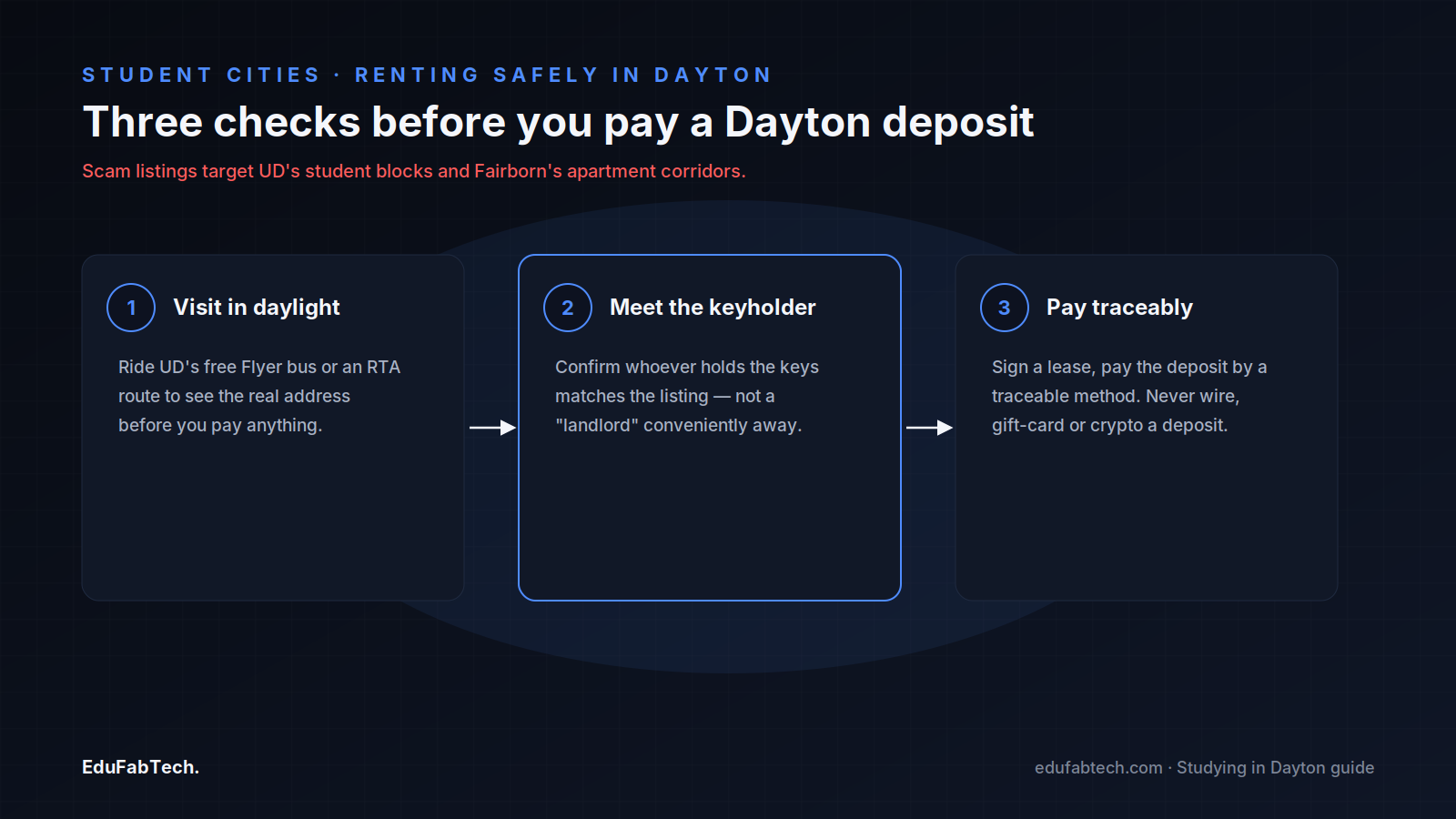
The scams that target Dayton students follow a pattern. They show up as too-cheap off-campus listings around UD's student neighbourhood or in the Fairborn apartment corridors near Wright State, often with photographs lifted from a real listing and a "landlord" who is conveniently out of town. The defence is simple and local: see the actual house or unit in person before you pay anything. If you are already in the city, use UD's free Flyer bus or an RTA route to visit in daylight, meet whoever holds the keys at the property itself, and confirm the address is a real, occupied building.
Never send a deposit by bank wire, gift card or cryptocurrency to "hold" a room — no legitimate Dayton landlord or university office asks for that, and money sent those ways is effectively gone. A normal arrangement is a signed lease and a security deposit paid by a traceable method once you have seen the place. If a listing pressures you to pay instantly to beat other applicants, treat that as a warning, not an opportunity. For furnishing and move-in extras you can wait until you arrive — see the free-stuff listings for things students give away at term's end.
Furnishing a room cheaply, and the 2nd Street Market
Dayton's best-known public market is a genuine asset for a student setting up a room and a kitchen. The 2nd Street Market, run by Five Rivers MetroParks, occupies a restored 1911 freight house at 600 E. Second Street and opens Fridays 11am–3pm, Saturdays 9am–3pm and Sundays 11am–3pm, year-round except the major holidays, according to Five Rivers MetroParks. Its stalls of local growers, bakers and artisans are the cheap, fresh end of a weekly food shop, and the artisan vendors are useful for small household bits.
For furniture and the bigger items, thrift and second-hand are the realistic route. Rather than name private shops, start with EduFabTech's second-hand listings and second-hand furniture for Dayton, which collect what local students are selling and giving away — desks, chairs, mini-fridges and kitchenware tend to turn over fastest around the start and end of each semester.
Working while you study
Part-time work is common, and the rules differ sharply depending on your status. Domestic students are limited mainly by their own schedules and Ohio labour rules. International students on an F-1 visa face federal limits: if you take on-campus employment, "you may not work more than 20 hours per week when school is in session," according to the U.S. Department of Homeland Security's Study in the States. Off-campus work, including Curricular and Optional Practical Training, has its own rules and generally requires authorisation arranged through your designated school official before you start.
This is a summary, not legal advice: confirm your own situation with your university's international-student office and the official DHS guidance before accepting any job. For what is currently advertised locally, EduFabTech keeps a page of Dayton jobs and part-time work, much of it campus-adjacent.
Libraries and places to study
Each university has its own library — UD's Roesch Library and Wright State's Dunbar Library anchor their campuses — but the city's public system is worth knowing too. The Dayton Metro Library's Main Library, at 215 E. Third Street downtown, was rebuilt with more than 30 study and collaboration spaces ranging from small rooms to large halls, with group rooms that can be booked online, according to the Dayton Metro Library; the same page notes the main floor operates as a designated "Quiet Space" in the afternoons. It is free, central and on RTA routes — a sensible fallback when campus libraries are full during exams. EduFabTech also lists study spaces and desks around the city.
Getting around Dayton
Public transport in the region is run by the Greater Dayton Regional Transit Authority (RTA), whose buses — including a distinctive network of electric trolleybuses in the core — are now cashless, paid through the Tapp Pay card or app. A single regular boarding costs $2.40, with a daily cap of $5.50 and a 31-day rolling monthly cap of $70.00; reduced fares are half those amounts for eligible riders, and children 12 and under ride free, according to Greater Dayton RTA.
University of Dayton students get a better deal than the standard fare suggests. UD runs the free Flyer circulator around campus and downtown, and "thanks to the partnership with UD, students can ride free when presenting their FlyerCard" on RTA's Route 55, a service UD sponsors to give students access to groceries in Oakwood and Kettering, according to Greater Dayton RTA. Beyond those arrangements, Dayton is a car-oriented metro; students at the outlying campuses in particular should expect to drive or to plan bus trips carefully.
What a student actually spends
Dayton is one of the more affordable mid-sized American cities to study in, which is a large part of its appeal. For off-campus renters, the U.S. Census Bureau's QuickFacts put the median gross rent in Dayton city at $918 for the 2020–2024 period, against a median household income of $45,247 and a city population of about 136,346 as of July 2024, according to the U.S. Census Bureau. Student rooms near UD or in the Fairborn complexes can run above that citywide median, but the baseline is low by national standards.
On-campus costs are documented clearly. For the 2026–27 academic year, the University of Dayton lists its first-year Marycrest and Stuart complex rooms at $5,070 per term for a double and $6,180 per term for a single, according to the University of Dayton undergraduate catalog — roughly $10,140 across the year for a standard double before meals.
| University of Dayton housing, 2026–27 | Per term |
|---|---|
| Marycrest / Stuart double room | $5,070 |
| Marycrest single room | $6,180 |
These are the clearest dated housing figures available; off-campus rents vary too much by street and condition to quote a single reliable student number, so treat the Census median as the city-wide floor rather than a quote for a room near campus.
The honest trade-offs
What is good about Dayton for students is real: low rents by American standards, a compact and walkable UD campus two miles from downtown, a genuine public market, and strong engineering and health-sciences programmes feeding a regional aerospace and medical economy. The arts scene around the Oregon District punches above the city's size.
What is hard is also real. The metro is spread out and built for cars, so students at Wright State, Central State and the Middletown campus will find getting around without a vehicle slow. The population has edged down — the Census records a 1.0% decline from 2020 to 2024 — and some neighbourhoods show the strain of a post-industrial economy. Winters are grey and cold, which is part of why Wright State built those tunnels. And the dispersed campuses mean there is no single, dense "student city" feel; your experience depends heavily on which university you join.
First weeks: a short checklist
- Sort housing before anything else — confirm university housing or see any off-campus room in person; never wire a deposit to hold a place.
- Set up RTA's Tapp Pay (card or app), and if you are at UD, pick up your FlyerCard for the free Flyer and Route 55.
- Register for your university library, and book a tour or reserve a group room at the Dayton Metro Library Main branch downtown as a backup study space.
- International students: meet your designated school official early to confirm work rules before taking any job.
- Furnish gradually — hit the 2nd Street Market on a Saturday and check local second-hand and free-stuff listings rather than buying everything new.
- If you do not have a car, map your weekly journeys on RTA first; it changes which neighbourhoods are realistic.
A quick question for readers
Do you work part-time while you study?
Many students work to pay the bills. See how common it is — and how many hours people really do.
Pick an answer, create a free account in a minute, and your vote counts. Already a member? Sign in
Comments 0
CommentNo comments yet. Members start the conversation.
Source: University of Dayton
Sources (5)
- University of Dayton. Room and Board, per term, August 2026 through May 2027. University of Dayton Undergraduate Catalog, 2026. catalog.udayton.edu ↗ · checked 8 Oct 2026
- Wright State University. About Wright State. Wright State University, 2026. wright.edu ↗ · checked 8 Oct 2026
- Greater Dayton RTA. Fares. Greater Dayton Regional Transit Authority, 2026. iriderta.org ↗ · checked 8 Oct 2026
- U.S. Census Bureau. QuickFacts: Dayton city, Ohio. U.S. Census Bureau, 2024. census.gov ↗ · checked 8 Oct 2026
- U.S. Department of Homeland Security. Working in the United States. Study in the States, 2026. studyinthestates.dhs.gov ↗ · checked 8 Oct 2026