Studying in Fargo: universities, housing and student life across the Red River
A practical, sourced guide to studying in Fargo–Moorhead — the two public campuses, where students live, what a room costs, how the free U-Pass works, and the honest trade-offs of a very cold metro.
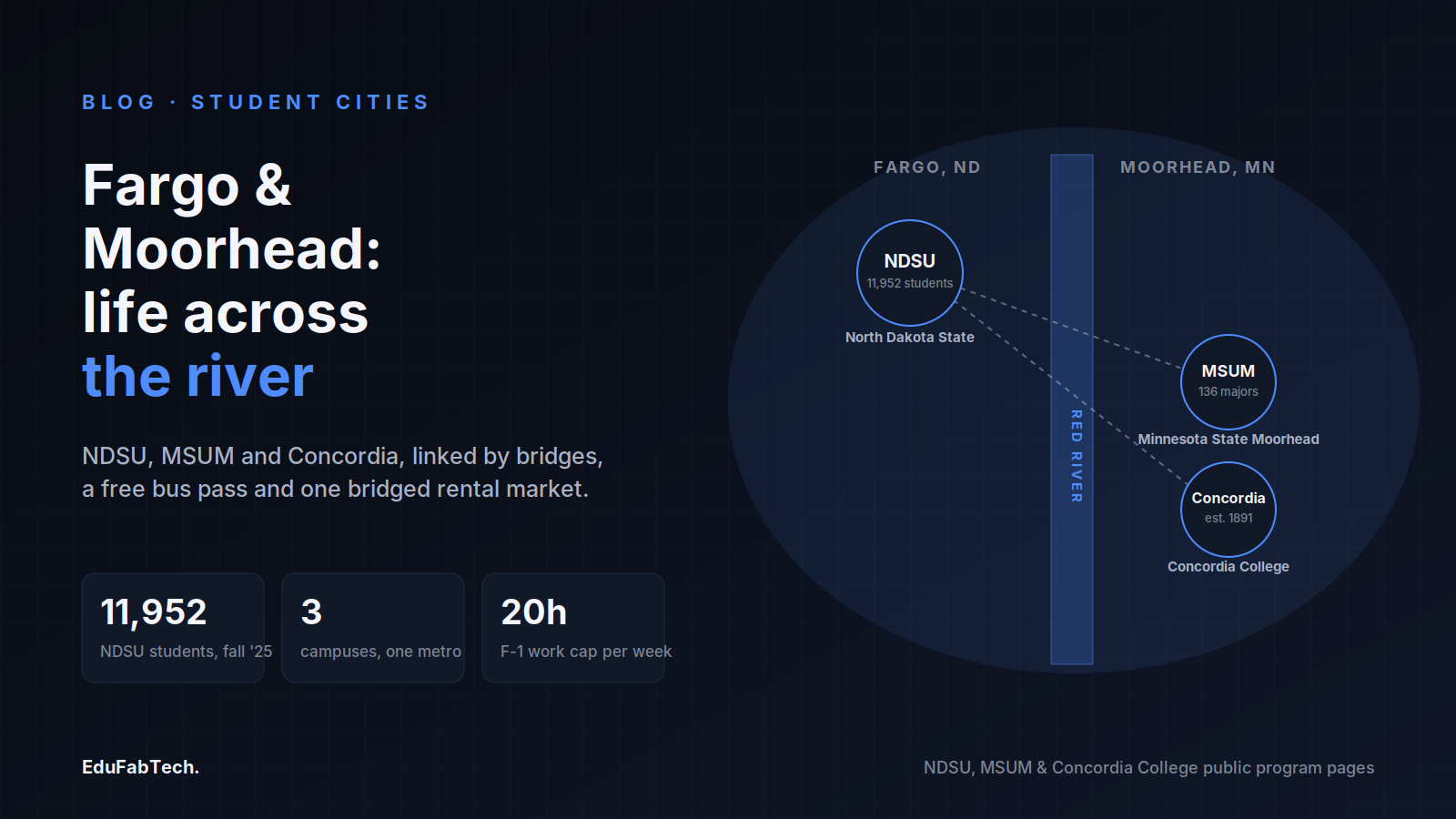
Fargo sits on the flat floor of the Red River Valley, on the North Dakota bank of the Red River of the North. The river is also a state line: cross one of the bridges downtown and you are in Moorhead, Minnesota. For a student that matters more than it sounds, because the two sides of the river hold three degree-granting institutions and one shared bus system, and the choices you make about where to live, where to work and how to get to class usually straddle the water. This guide walks through the campuses, the rooms, the costs you can actually verify, and the parts of Fargo that take newcomers by surprise — the winter above all.
The metro is small and self-contained. Downtown Fargo, rebuilt over two decades through the city's Renaissance Zone redevelopment, is a short ride or walk from the main university campus, and most of student life happens inside a compact triangle between North Dakota State University, the downtown core, and the Moorhead campuses across the river. You do not need a car to make this work, which is not true of every American city this size.
North Dakota State University (NDSU) is the anchor. It describes itself on its own pages as having been founded in 1890 as North Dakota Agricultural College, taking the North Dakota State University name in 1960, and it remains the state's only land-grant institution. The same page reports 11,952 students enrolled in Fall 2025, an R1 Carnegie research classification, and 103 undergraduate majors alongside 120 graduate programs. The campus is in north Fargo, close to the river and a few minutes from downtown, and it is best known for agriculture, engineering, pharmacy and the health sciences — and, in the autumn, for a Football Championship Subdivision team that fills the Fargodome and briefly makes the whole city about the Bison.
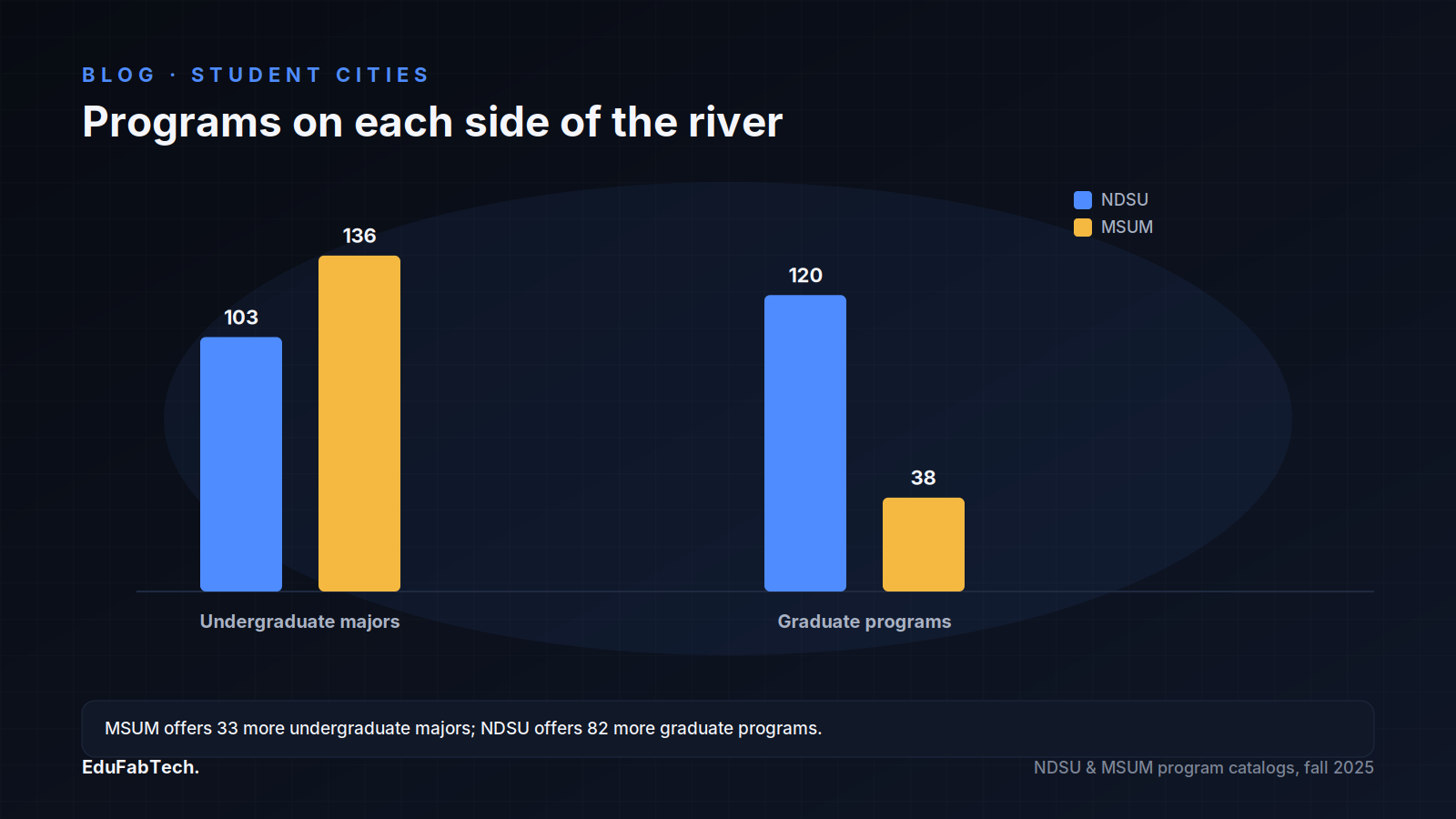
Across the river in Moorhead, Minnesota State University Moorhead (MSUM) is a mid-sized public university in the Minnesota State system. Its own site lists 136 undergraduate majors, emphases and options and 38 graduate majors and certificates, an average class size of 19.6, and NCAA Division II Dragon athletics. A few blocks away, Concordia College — a private, four-year liberal arts college — says on its site that it was founded in 1891 and is a college of the Evangelical Lutheran Church in America, enrolls more than 2,000 students from 36 states and 52 countries, and runs the renowned Concordia Language Villages. The three institutions sit close enough that cross-registration and a shared transit arrangement are part of ordinary student life here, so a class or a library on the "other" campus is rarely out of reach.
North Fargo, downtown, and the Moorhead side: where students actually settle
On-campus housing is the simplest starting point and the one with the clearest published prices. Beyond the residence halls, most NDSU undergraduates spread into the older residential grid immediately south and east of campus — the Roosevelt neighbourhood of north Fargo — where single-family houses have been subdivided into rentals and small apartment buildings. Walk or bike distance to class is the main draw. Downtown Fargo is the other pole: as the Renaissance Zone filled in, loft apartments appeared above shops and offices, and NDSU itself keeps academic buildings and some housing downtown, so living there still leaves you on a bus route to the main campus.
If you are at MSUM or Concordia, the equation flips across the river: Moorhead's streets around the two campuses are the obvious first look, and they tend to be a little quieter and a little cheaper than north Fargo. Because the metro is bridged and bused, Fargo students sometimes rent in Moorhead and vice versa; just check which MATBUS route actually serves the address before you sign, because the river crossings funnel the network through a few bridges.
When to start looking depends on which door you are coming through. For a guaranteed room, apply for university housing as early as the application opens for your start term rather than waiting for an offer letter to feel final. For off-campus rentals near NDSU, the turnover clusters around the academic year, and the best-located houses in the Roosevelt streets are spoken for months ahead — begin in late winter or early spring for an autumn move-in rather than arriving in August and hoping. You can see what is currently listed around each campus on EduFabTech's pages for North Dakota State University, Minnesota State University Moorhead and Concordia College, and a general view of rooms in Fargo.
Renting without being cheated in a small market
Fargo's rental market is small, which cuts both ways. There are fewer listings than in a big coastal city, so a well-priced room near campus attracts a rush — and that pressure is exactly what a scam exploits. The pattern to watch for here is the "too-good" house in the Roosevelt streets or a downtown loft offered below the going rate by someone who says they are out of state and cannot show it in person. That is the warning sign, not the price alone.
Protect yourself with a few fixed rules. See the actual unit before you pay anything — in a bridged metro that is easy, so there is no reason to rent a Moorhead apartment sight-unseen from Fargo or the reverse. A normal arrangement here is a signed lease plus a security deposit (North Dakota and Minnesota both regulate how deposits are held and returned, so ask for the deposit terms in writing). Never send money to "hold" a place by bank wire transfer, gift card or cryptocurrency: no legitimate Fargo landlord needs any of those, and once sent they are gone. If you are abroad and cannot visit, ask the university's housing or international-student office before you commit, and lean on the on-campus halls for your first term while you learn the neighbourhoods. Browsing verified room listings and the wider set of Fargo student listings on EduFabTech is a safer way to start than chasing a bargain from a stranger.
Furnishing a room for very little
You will arrive, most likely, with a suitcase and an empty room. Fargo makes the first fill-up cheap if you time it. The city's signature gathering is the Red River Market, which the Fargo Park District runs on Saturdays from 10 a.m. to 2 p.m. at Broadway Square downtown (201 Broadway) through the end of October, with around 60 local vendors; the same page notes all vendors accept SNAP/EBT on eligible products and the market matches purchases up to $15 per person per visit. It is a produce-and-makers market rather than a furniture source, but it is the fastest way to learn the downtown and stock a kitchen seasonally.

For the furniture itself, the student calendar is your friend: the heaviest second-hand supply appears at the end of the academic year, when leases turn over in the Roosevelt streets and people give away or sell desks, chairs and microwaves rather than move them. Watch for end-of-term giveaways around both campuses, thrift stores across the metro, and the usual community exchanges. EduFabTech keeps running local pages for second-hand things, used furniture and items given away free in Fargo, which is where a lot of that end-of-lease stock surfaces.
Part-time work and what the visa rules allow
Many students work part-time, and the rules differ sharply depending on your status. Domestic students can take any job the labour market offers; the binding constraints are your timetable and the Minnesota or North Dakota minimum wage that applies where you actually work, which is worth checking since the two states set different floors.
International students on an F-1 visa are more tightly bound, and the authority is federal, not local. U.S. Immigration and Customs Enforcement, through the Student and Exchange Visitor Program, states that F-1 students may generally work on campus up to 20 hours per week while school is in session and full-time during official breaks, and that off-campus work requires specific authorization arranged through your school's Designated School Official before you begin. Treat that page, and your campus international-student office, as the source of truth; this guide is not legal advice, and the details change. On-campus jobs at NDSU, MSUM and Concordia are the obvious first place to look because they fit inside the F-1 rules by design. Current openings around the metro are gathered on EduFabTech's Fargo jobs page.
Libraries and places to study
The NDSU Main Library is the centre of study life on the Fargo side, with reservable group study rooms, individual study rooms, quiet areas and computer clusters, and extended hours around exam periods. Across the river, MSUM's Livingston Lord Library and Concordia's Carl B. Ylvisaker Library serve the Moorhead campuses, and because the three institutions cooperate, a student ID generally opens more study space than one campus alone provides. Beyond the libraries, downtown Fargo's cafés and the public library branches give you somewhere to work that is not a dorm desk. EduFabTech lists bookable study spaces and desks in Fargo if the campus rooms are full during exams.
Getting around: the free U-Pass and a bused metro
Fargo–Moorhead's public transport is Metro Area Transit, universally called MATBUS, and for students it is close to free. Under the College U-Pass Program, the operator says students from NDSU, MSUM and M State ride free with a current college ID, Concordia students, staff and faculty ride free, and NDSU additionally funds MATBUS service on and near its campus; no special pass is needed beyond your ID card. The same page lists which routes serve each campus — Concordia on routes 1 and 3, MSUM on 2, 3 and 5, and NDSU on route 13 plus campus circulators 31, 33 and 34 that run only when classes are in session — and gives weekday service running from about 6:15 a.m. to 10:15 p.m. NDSU also runs a free on-demand service around campus. For a metro this cold, a transit system you can ride without buying a ticket is one of the quiet advantages of studying here.
That said, the network is built for a spread-out prairie metro, so frequencies are modest and evenings and Sundays are thin. Many students still cycle in the warmer half of the year and keep the bus for winter; if you plan to rely on transit, choosing a room on a route that directly serves your campus matters more than squeezing the rent down by a few dollars.
What a year actually costs
Housing is the cost you can pin down most precisely, because the universities publish it. For 2026-27, NDSU's residence-hall rates run from a shared double in Burgum Hall at $4,435 for the academic year up to $5,900 in the Mathew Living Learning Center, with most standard doubles between about $4,885 and $5,400; students also pay non-refundable hall activity dues capped at $100. Across the river, MSUM's residence-hall rates for 2026-27 start at $6,744 a year for a double in Holmquist and reach $7,684 for doubles in Dahl and the Snarr halls, with meal plans charged separately at roughly $853 to $2,094 per semester.
For a fuller picture, NDSU's 2026-27 estimated cost of attendance for a full-time student puts tuition at $10,460 for North Dakota residents, $15,690 for other U.S. states and $18,305 for international students on F and J visas, with on-campus housing budgeted at $5,164, a meal plan at $5,762 and student fees at $1,721 — a total of $23,107 for residents and $30,952 for international students before indirect costs such as books and personal expenses. Those are the figures to plan against; off-campus rents near the Roosevelt streets vary too much to quote a single reliable number, so budget from your own quotes and confirm what the deposit and utilities add.
The honest trade-offs — and the cold
The case for Fargo is real. It is an affordable, low-crime, fast-growing metro with two public universities, a private college, a genuinely walkable rebuilt downtown, and transit you ride free as a student. The research base at NDSU is serious, class sizes at MSUM are small, and the whole metro is compact enough that you can live without a car.
The hard part is the climate, and it is harder than newcomers expect. Fargo sits in the northern Great Plains, and winter is long, dark and genuinely dangerous when wind and cold combine; January daytime highs commonly sit below freezing and nights fall well below zero Fahrenheit, with wind across the flat valley making it feel colder still. Factor in proper winter clothing as a real cost, not an afterthought, and value housing and routes that minimise time outdoors from December to March. The other honest caveats: it is a small market, so rental choice and nightlife are limited next to a big city; bus service thins in the evenings; and the flat valley that makes cycling easy also means the Red River floods in spring, a recurring event the metro manages but worth understanding before you pick a low-lying address.
A short checklist for your first weeks
- Confirm your room: either accept the university housing offer or, for off-campus, see the unit in person and get the lease and deposit terms in writing before paying.
- Never wire, gift-card or crypto a deposit to "hold" a place you have not seen.
- Get your student ID early — it is your free MATBUS U-Pass and your after-hours library key.
- Map your campus bus route and a backup, and note the thin evening and Sunday service.
- International students: meet your Designated School Official and read the SEVP rules before taking any job.
- Buy real winter gear before December — a warm coat, boots, gloves and a hat are survival items here, not accessories.
- Furnish from end-of-term second-hand stock and the metro's thrift and giveaway channels rather than buying new.
- Walk downtown and cross a bridge to the Moorhead campuses early, so the whole metro — not just your block — feels like yours.
Studied honestly, Fargo rewards a practical student: cheap to live in by American standards, easy to get around without a car, and small enough that the university, the river and the downtown all fit into one life. Prepare for the winter, rent carefully in a tight market, and the rest is manageable. You can keep an eye on what is happening across the metro through EduFabTech's Fargo events page.
A quick question for readers
Do you work part-time while you study?
Many students work to pay the bills. See how common it is — and how many hours people really do.
Pick an answer, create a free account in a minute, and your vote counts. Already a member? Sign in
Comments 0
CommentNo comments yet. Members start the conversation.
Source: North Dakota State University
Sources (5)
- North Dakota State University. 2026-27 Residence Hall Rates. North Dakota State University, 2026. ndsu.edu ↗ · checked 13 Oct 2026
- North Dakota State University. 2026-27 Estimated Costs of Attendance. North Dakota State University, 2026. ndsu.edu ↗ · checked 13 Oct 2026
- Minnesota State University Moorhead. Residence Hall Room Rates. Minnesota State University Moorhead, 2026. mnstate.edu ↗ · checked 13 Oct 2026
- Metro Area Transit (MATBUS). College U-Pass Program. MATBUS (Fargo-Moorhead), 2026. matbus.com ↗ · checked 13 Oct 2026
- U.S. Immigration and Customs Enforcement. SEVP: Employment. ICE, 2026. ice.gov ↗ · checked 13 Oct 2026