Studying in Fayetteville, Arkansas: universities, housing and student life
A practical, sourced guide to the University of Arkansas, where students live, what a room costs, how the free campus buses work, and the honest trade-offs of a hilly Ozark college town.
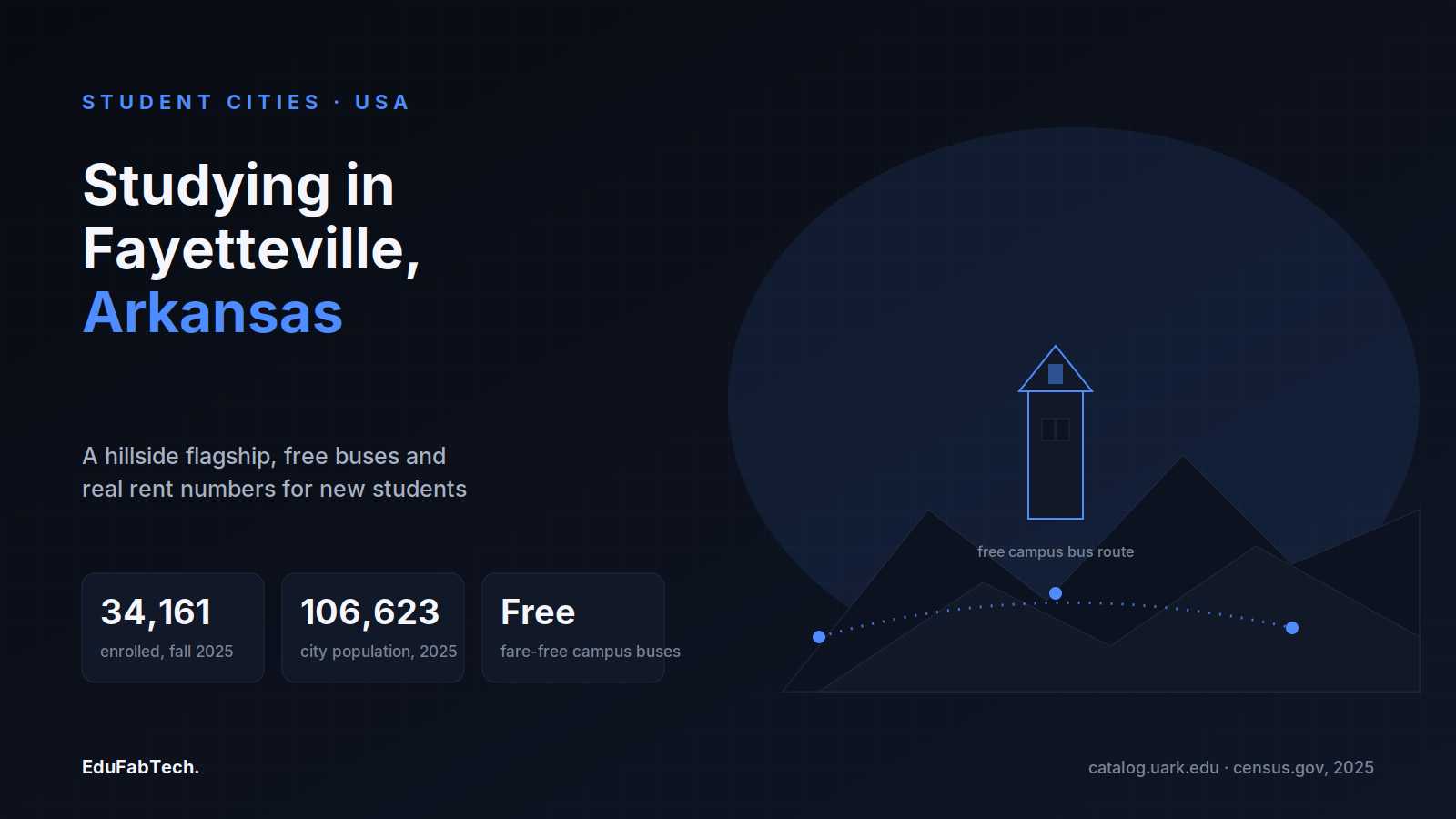
Fayetteville sits at the southern end of the Ozark Mountains, where the Boston Mountains rise behind a downtown built on a grid of hills. The campus is one of those hills: the University of Arkansas climbs from the old quad near the historic square up toward the football stadium, and almost nothing in this town is flat. That geography shapes student life more than any brochure will admit — it decides which bus you catch, how far you are willing to walk in August heat, and why a bicycle here needs good brakes more than good gears.
It is also a two-speed place. Fayetteville anchors a fast-growing metropolitan area that runs north through Springdale, Rogers and Bentonville, and the U.S. Census Bureau's QuickFacts (census.gov) put the city's population at 106,623 as of 1 July 2025, up 13.1% since the 2020 census. The university and the town have grown together, and a student arriving today lands in a place that feels both like a self-contained college town and like the edge of a booming region.
This guide is for students coming to Fayetteville — from across Arkansas, from other states, or from abroad. It names the one university in the city, where people actually live, what a room costs with figures you can check, how the free buses work, and what is genuinely hard about the place. Listings and local pages are collected on EduFabTech at /in/united-states/fayetteville.
A flagship on a hill: the University of Arkansas
The University of Arkansas is the only university based in Fayetteville, and it is the flagship of the University of Arkansas System. According to the university's own catalog (catalog.uark.edu), it was founded in 1871 as a land-grant college and state university, and total enrollment reached 34,161 in fall 2025. The same page describes 10 colleges and schools offering more than 200 academic programs, including bachelor's degrees in more than 90 areas of study.
Studying here means studying on a working land-grant campus: engineering, agriculture, business (the Sam M. Walton College of Business), architecture and the humanities all sit within a short, steep walk of each other. The academic year runs on two main semesters, fall from mid-August and spring from mid-January, with a summer term on top. Football matters more than a newcomer might expect — on autumn Saturdays the stadium fills and the town reorganises itself around the game — but the daily rhythm for most students is the ordinary one of lectures, labs and library nights.
If you are a prospective international student, the practical first contact is the university's international office, which issues the immigration document you need before a visa interview and houses your designated school official — the person every later paragraph about work and status refers back to.
Where students live
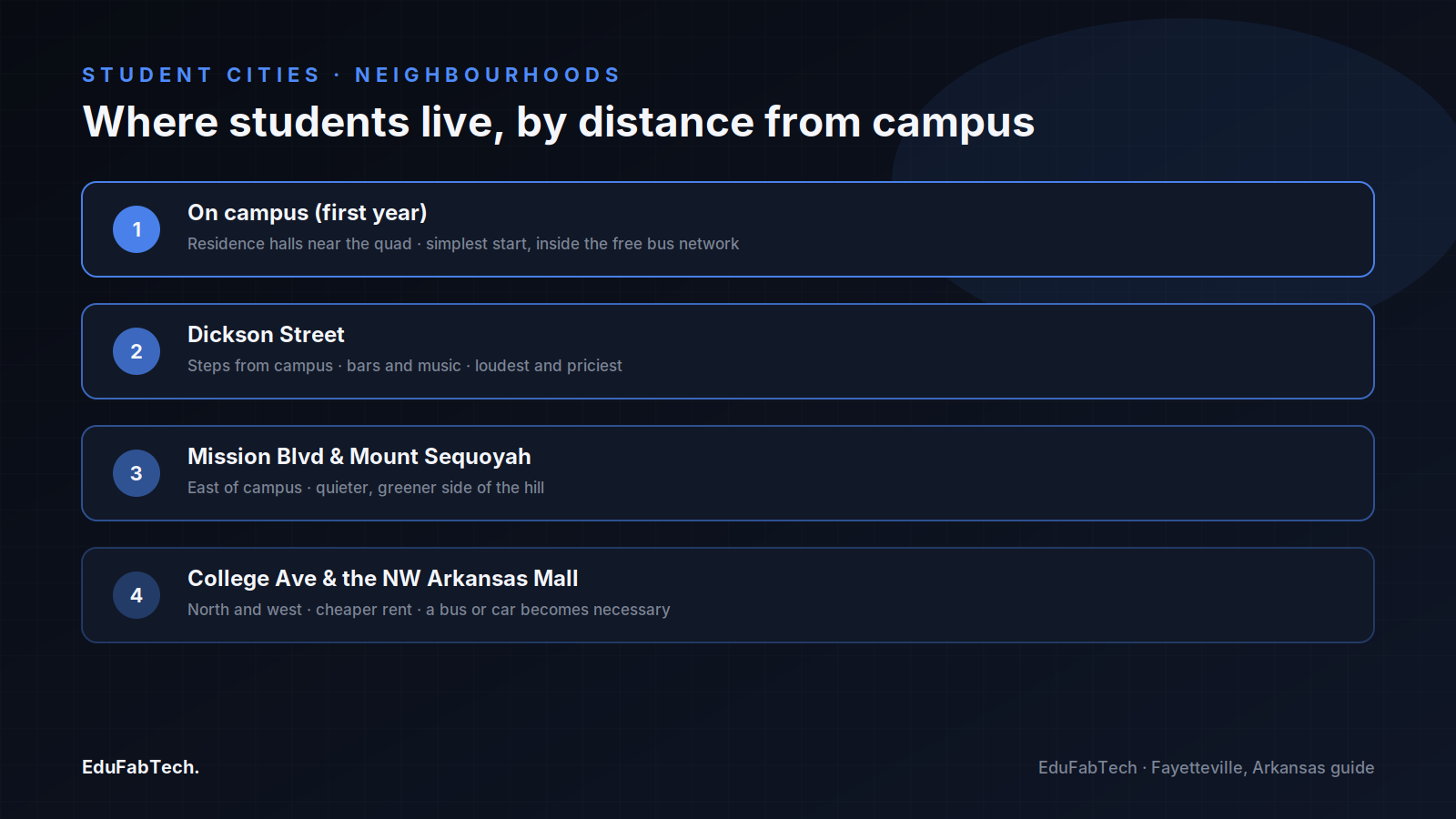
First-year undergraduates generally live on campus, in residence halls that spread from the older cluster near the historic quad to the newer Northwest Quad and the Adohi and Maple Hill complexes higher up the hill. Living on campus for a year is the simplest way to learn the geography before you commit to a lease, and it puts you inside the free campus bus network from day one.
Off campus, students sort themselves by how far they are willing to be from the hill. The blocks immediately around Dickson Street — Fayetteville's bar-and-music strip linking campus to the downtown square — are the loudest and most convenient, and priced accordingly. East of campus, the neighbourhoods off Mission Boulevard and around Mount Sequoyah are quieter and greener. North and west, along College Avenue and toward the Northwest Arkansas Mall, rents ease but you become dependent on a bus or a car. Purpose-built student apartment blocks have multiplied on the fringes of town over the past decade; many sit on Razorback Transit routes, which is worth checking before anything else.
Start looking earlier than feels reasonable. Leases for the following August are commonly signed in the winter and early spring, and the best-located, bus-served places go first. Rooms and whole-flat listings for the city are gathered at /in/united-states/fayetteville/rooms, and listings close to the main campus at /near/university-of-arkansas.
Renting without being cheated
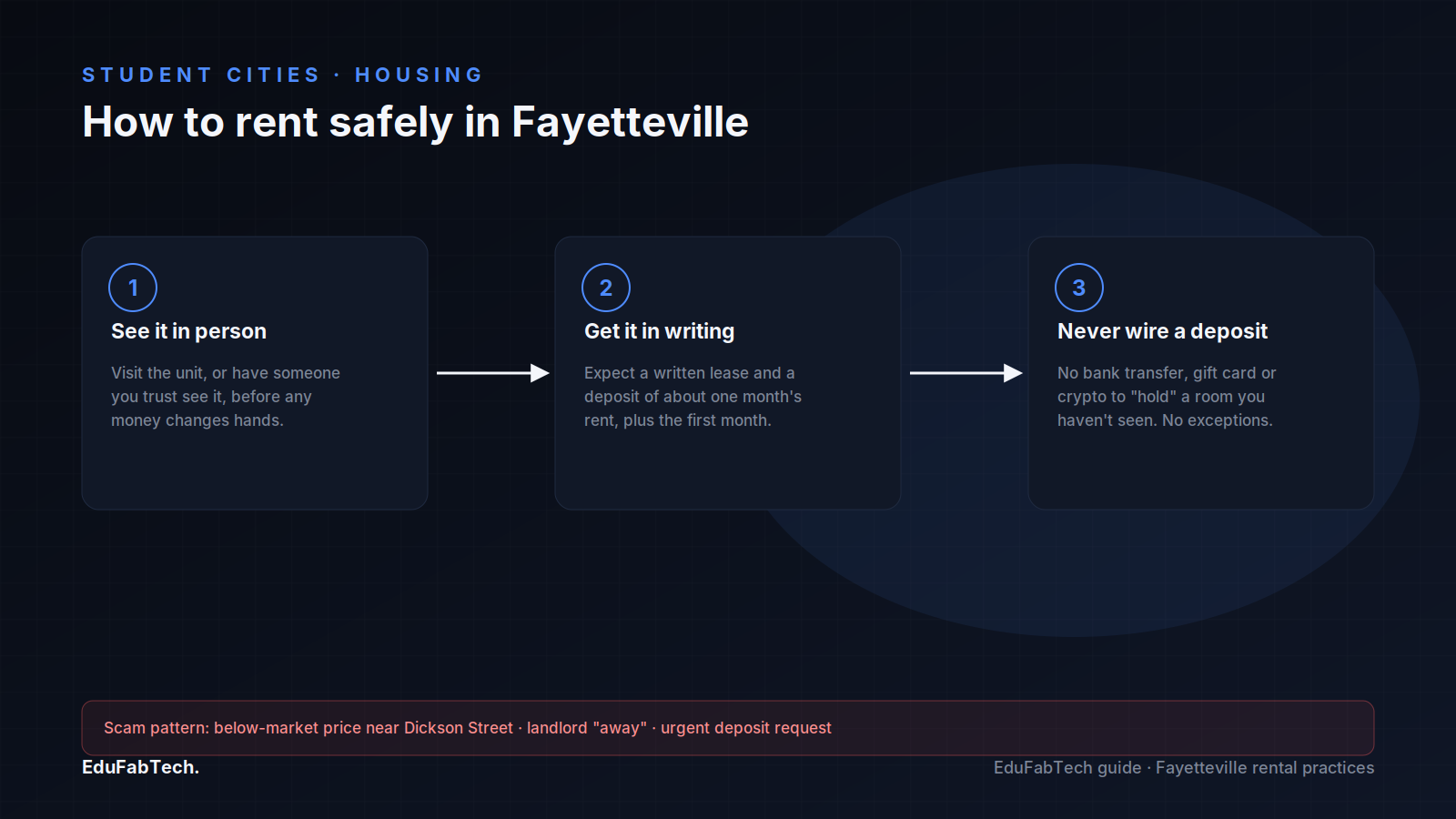
Rental scams in a college town like Fayetteville follow a pattern. A "listing" appears for a house or apartment near Dickson Street or on a popular bus route, priced a little below everything comparable, and the person behind it is suddenly out of town — travelling, on a mission, posted elsewhere — and wants a deposit to "hold" it before you can see inside. That is the warning sign, every time.
Protect yourself with a few habits that fit how renting works here. See the actual unit in person, or have someone you trust see it, before any money changes hands; an empty hilltop duplex in January is easy to photograph and hard to fake in a video call. Expect a written lease and, typically, a security deposit of around one month's rent plus the first month up front — not several months wired in advance. Never send a deposit by bank transfer, gift card or cryptocurrency to hold a room, because those payments are effectively irreversible and no legitimate Fayetteville landlord needs them. If a deal only works when you pay before you look, walk away.
Furnishing a room: thrift stores and the Saturday market
Fayetteville makes it easy to furnish a room cheaply if you time it right. The ends of semesters, especially the May move-out, leave a flood of furniture, kitchenware and bikes changing hands, and the city has a deep second-hand culture to absorb it. Thrift and resale shops cluster along North College Avenue and around the town, from national chains to local charity stores, and student-to-student handovers do the rest.
The city's signature market is the Fayetteville Farmers' Market, which the market's own history (fayettevillefarmersmarket.org) dates to 1973 and which requires that every vendor grows or makes their goods within Washington, Madison, Benton or Carroll counties. It runs on the downtown square on Saturday mornings, with additional Tuesday and Thursday mornings from May to September, and moves indoors from January to March — it is the best weekly place to meet the town and stock a kitchen with local produce rather than furniture. For actual furniture and household goods, EduFabTech collects second-hand items at /in/united-states/fayetteville/second-hand, furniture specifically at /in/united-states/fayetteville/furniture, and things given away for nothing at /in/united-states/fayetteville/free-stuff.
Working while you study
Many students take part-time work, and in Fayetteville that usually means on-campus jobs, cafés and restaurants along Dickson Street, or shifts in the shops on College Avenue. Wages, hours and your right to work depend entirely on your status, and the rules are strictest for international students.
If you are on an F-1 student visa, the U.S. Department of Homeland Security's Study in the States site (studyinthestates.dhs.gov) states plainly that if you participate in on-campus employment you "may not work more than 20 hours per week when school is in session," and that to apply you must talk to your designated school official. That official — your DSO in the university's international office — is the authority on what you may and may not do, including off-campus options that depend on specific authorisation. Treat the DHS page and your DSO as the real sources here; nothing in a guide like this is legal advice. Local openings that students post are listed at /in/united-states/fayetteville/jobs.
Libraries and places to study
On campus, the hub is David W. Mullins Library, which has come through a multi-year renovation. The University Libraries (libraries.uark.edu) describe bookable study rooms ranging from individual spaces for two up to group rooms for six, alongside quiet areas and reading rooms — worth knowing in the week before finals, when seats vanish. Graduate students and faculty have their own carrels and rooms within the building.
Off campus, the Fayetteville Public Library at 401 West Mountain Street, beside the downtown square, is a serious study option in its own right. The library (faylib.org) offers study rooms, the Hunt Family Center for Innovation and quiet reading space open to anyone, which matters when the campus closes for a holiday but your deadlines do not. More student study spaces and desks around town are gathered at /in/united-states/fayetteville/study-spaces.
Getting around Fayetteville and Northwest Arkansas
The single best thing about moving around Fayetteville as a student is that the campus bus system is free. The university's transportation office (parking.uark.edu) describes Razorback Transit as "a fare-free bus service that runs on campus and throughout Fayetteville," and its stops are open to the public — so a room on a Razorback route is, in effect, a room with free commuting attached. The same office describes a companion service, SafeRide, as a safe means of transportation for students in an uncomfortable or inconvenient situation.
To reach the rest of Northwest Arkansas, the regional operator is Ozark Regional Transit. Its schedule pages (ozark.org) show fixed routes that connect Fayetteville north through Springdale and Rogers to Bentonville, and its separate on-demand service (ozark.org) is charged at $1.25 per trip for up to five riders. Between the campus and regional systems you can live largely car-free in Fayetteville, though evenings and Sundays test your patience, and many students eventually buy a bike or a cheap car for the hills and the gaps in the timetable.
What it costs
Housing is the figure that decides your budget, so start with ones you can verify. For students who stay on campus, University Housing's published rates for the 2026-2027 academic year (housing.uark.edu) list the most affordable double rooms — including Futrall, Humphreys, Pomfret and Yocum halls — at $4,205 per semester, while premium options such as Adohi Hall semi-suites run $6,067.50 for a double and $7,338.50 for a single, and the Northwest Quad halls list single rooms at $6,095 per semester. Those are per-semester, per-person figures, and most come paired with a meal plan.
For off-campus renting, the broad benchmark is the U.S. Census Bureau's QuickFacts (census.gov), which reports a median gross rent of $1,065 for 2020–2024 across all of Fayetteville — a city-wide median for whole units, not a student-room price, and already somewhat behind a fast-rising market, so treat it as a floor rather than a quote. A shared house split among students typically lands below that per person; a studio near Dickson Street can sit well above it. Beyond rent, the free campus bus removes a transport cost that weighs on students in many other towns.
The good, the hard, and a checklist for the first weeks
What is good about Fayetteville is easy to feel. It is a genuine college town where the university, the music of Dickson Street and the downtown square are woven together; the surrounding Ozarks put serious hiking and cycling within minutes; and the fare-free campus bus plus a comparatively moderate cost of living make it more forgiving than many flagship cities. The region's growth means jobs and new amenities keep arriving.
What is hard is also real. The hills are relentless — a flat commute does not exist — and summers are hot and humid while winters bring occasional ice that shuts the slopes of campus down. Rents are rising with the metro's boom, so the Census median already understates what a newcomer pays near campus. Without a car, evenings and Sundays can feel isolating once Razorback Transit winds down, and a town built around one large university empties noticeably between semesters. None of this is a reason to stay away; it is a reason to choose your neighbourhood and your bus route deliberately.
A short checklist for the first few weeks:
- Confirm your status paperwork first. If you are an international student, meet your DSO at the university's international office before you take any job or change anything about your enrolment.
- Learn one or two Razorback Transit routes that serve both your home and campus, and check the night and Saturday hours before you rely on them.
- See any off-campus room in person before paying, expect roughly first month plus one month's deposit, and never wire money to "hold" a place.
- Furnish after the semester rush — the end-of-term move-out and the Saturday market on the square will save you more than any big-box store.
- Get a library routine early. Learn to reserve a Mullins study room, and keep the Fayetteville Public Library as your holiday back-up.
- Browse local listings for rooms, jobs, second-hand goods and events on EduFabTech at /in/united-states/fayetteville/events before you pay retail for anything.
A quick question for readers
Do you work part-time while you study?
Many students work to pay the bills. See how common it is — and how many hours people really do.
Pick an answer, create a free account in a minute, and your vote counts. Already a member? Sign in
Comments 0
CommentNo comments yet. Members start the conversation.
Source: University of Arkansas
Sources (5)
- University of Arkansas. General Information. University of Arkansas (catalog), 2025. catalog.uark.edu ↗ · checked 12 Oct 2026
- University Housing. Housing Rates 2026-2027. University of Arkansas, 2026. housing.uark.edu ↗ · checked 12 Oct 2026
- U.S. Census Bureau. QuickFacts: Fayetteville city, Arkansas. U.S. Census Bureau, 2025. census.gov ↗ · checked 12 Oct 2026
- Study in the States. Working in the United States. U.S. Department of Homeland Security, 2025. studyinthestates.dhs.gov ↗ · checked 12 Oct 2026
- Fayetteville Farmers' Market. About Us. Fayetteville Farmers' Market, 2025. fayettevillefarmersmarket.org ↗ · checked 12 Oct 2026