Studying in Fort Collins: universities, housing and student life
A practical guide to Colorado State University and life in Fort Collins — dormitory costs, where students live, second-hand shops, the fare-free bus, study spaces and the honest trade-offs.
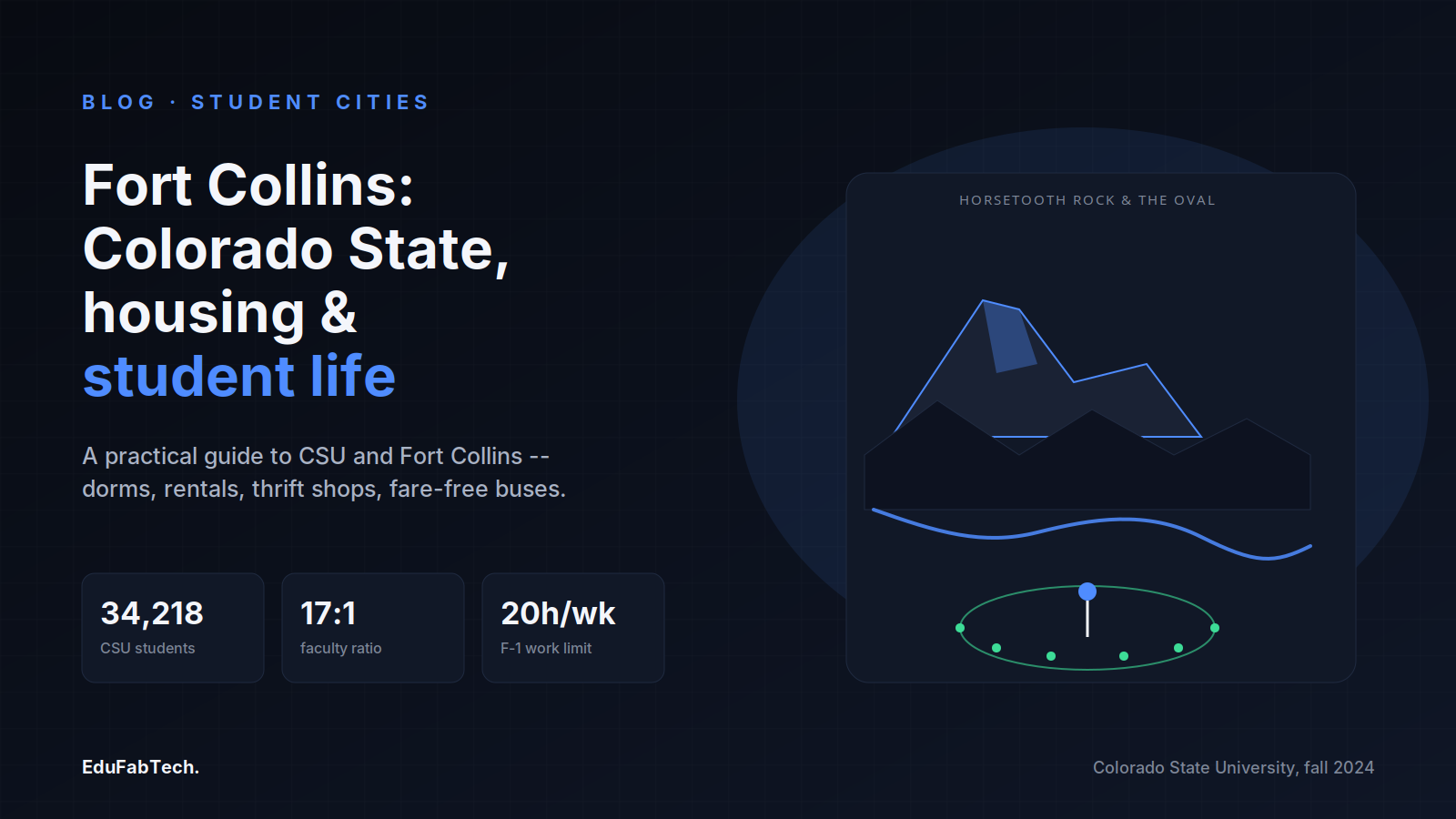
Fort Collins sits where the Great Plains run into the Rocky Mountains, in northern Colorado about an hour's drive north of Denver along the Front Range. The Cache la Poudre River comes down out of the canyon at the north edge of town; to the west, Horsetooth Reservoir and the tilted slab of Horsetooth Rock close off the view. The city grew up around an 1860s army post and an agricultural colony, and its brick-fronted Old Town — angled streets, a central plaza, a dense cluster of independent shops and breweries — is still the social centre. For a student, the useful fact is that the city and its biggest university are effectively the same place: the campus begins a few blocks from Old Town and the town arranges itself around it.
That university is Colorado State University, founded in 1870 as the state's land-grant institution and still its only one, according to Colorado State University. Its main campus is in the heart of Fort Collins, a mostly pedestrian-and-bicycle campus with limited car access through the middle. The university counted 34,218 students on the Fort Collins campus in fall 2024 and reports an undergraduate student-to-faculty ratio of 17 to 1, per Colorado State University. In a town whose year-round population is well under a quarter of a million, a student body that size shapes the rhythm of the place — the buses, the rental market, the thrift shops and the queues at coffee counters all run on the academic calendar.
This guide is for anyone weighing up studying here, whether you are moving across the state or arriving from abroad. It covers the university, where people live and how to rent without being cheated, furnishing a room cheaply, the rules on part-time work, the libraries, getting around, what things cost with figures you can check, and an honest account of what is good and what is hard.
Colorado State University: one big campus at the city's centre
CSU is a Carnegie-classified research university with a land-grant mandate, which in practice means a spread of applied and agricultural programmes alongside the liberal arts and sciences. It is best known for veterinary medicine, agriculture, engineering and environmental science; the university reports that its Doctor of Veterinary Medicine programme ranked third nationally in U.S. News & World Report's 2026 edition, and that it has held a Platinum sustainability rating from the Association for the Advancement of Sustainability in Higher Education for five consecutive years, according to Colorado State University. The campus carries an atmosphere to match: a working veterinary teaching hospital, agricultural research land, and a student body that spills onto the Oval — the elm-lined lawn at the old front door of the university — the moment the weather turns.
Two things are worth knowing before you arrive. First, the university runs on a RamCard, the student ID that doubles as building access, library entry, meal-plan card and — as explained below — your bus pass. Second, CSU is the dominant but not the only option in the region; the city also hosts Front Range Community College's Larimer Campus, and many students begin there before transferring. If you are a degree-seeker, Colorado State is almost certainly the name on your offer letter.
Where students live, and the first-year rule you can't skip
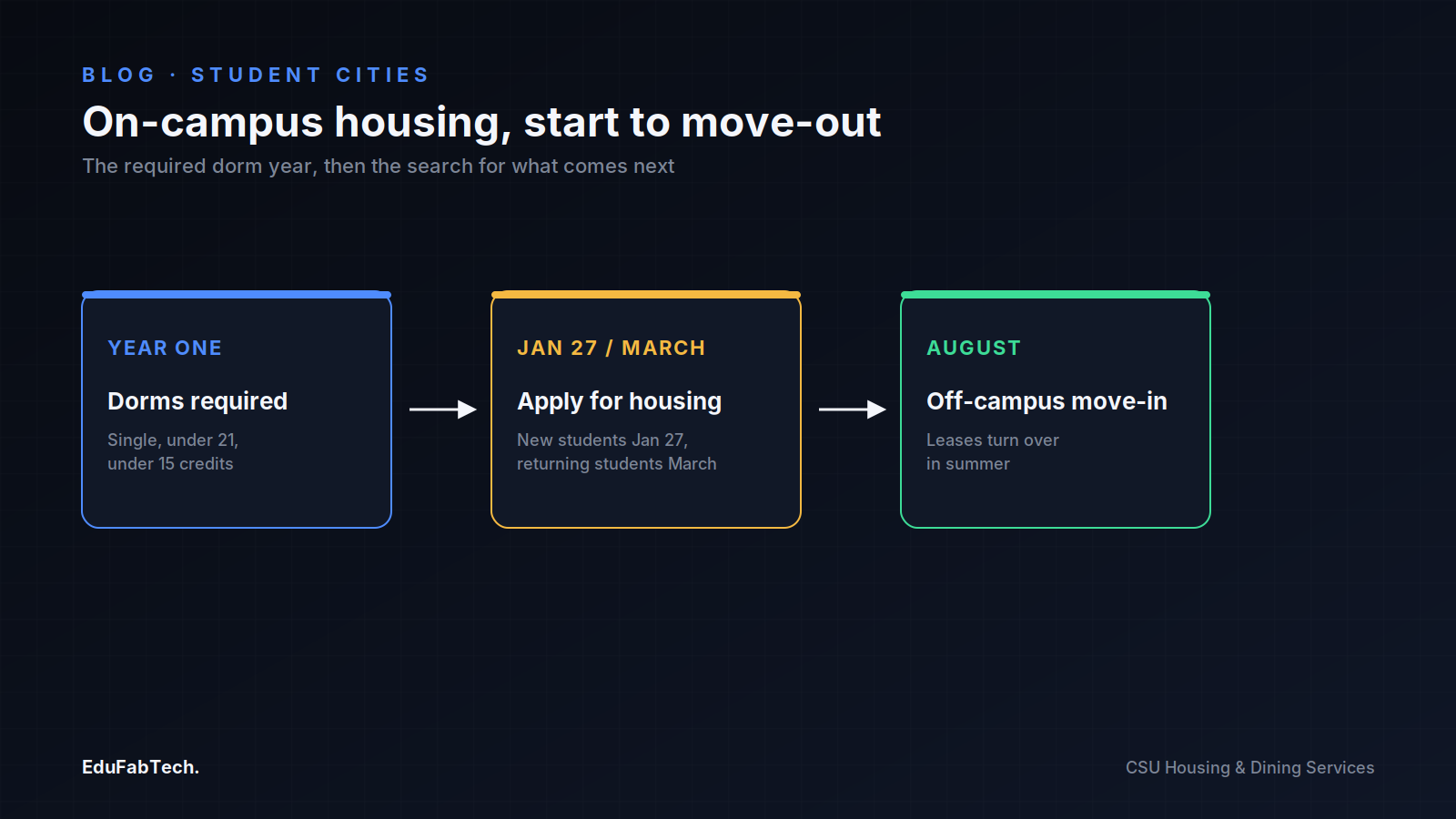
Most first-year undergraduates live on campus, and for many that is not a choice. Colorado State requires newly admitted first-year students, and transfer students with fewer than 15 post-secondary credits, who are single, under 21, and not living with a parent in the Fort Collins area, to live in the residence halls for their first two consecutive terms, per CSU Housing & Dining Services. The same page notes that Advanced Placement and concurrent high-school credits do not count toward the 15-credit exemption — a detail that catches people out.
The halls themselves run from older community-style buildings, where a shared bathroom serves the floor, to the suite-style and Laurel Village options with private or shared bathrooms. After the first year, students scatter outward. The blocks immediately west of campus around Elizabeth Street — the district locals call Campus West — are the classic student quarter: older houses split into rooms, cheap food, and a short walk or bike to class. South of campus along the Mason corridor and out toward the shopping on South College Avenue you find more apartment complexes; Old Town and the near-north neighbourhoods are pricier and quieter. You can browse what is currently listed in the city on EduFabTech's Fort Collins rooms page and the wider Fort Collins listings.
When to start looking depends on which side of the fence you are on. For on-campus housing, the new-student application opens on 27 January for the following year, and returning students apply between early and late March, per CSU Housing & Dining Services. For off-campus rooms, leases in a university town turn over in summer for an August move-in, and the best-value rooms near campus go early in the spring. Arriving in July expecting to find a cheap room within cycling distance of the Oval is the single most common planning mistake.
Renting without losing a deposit
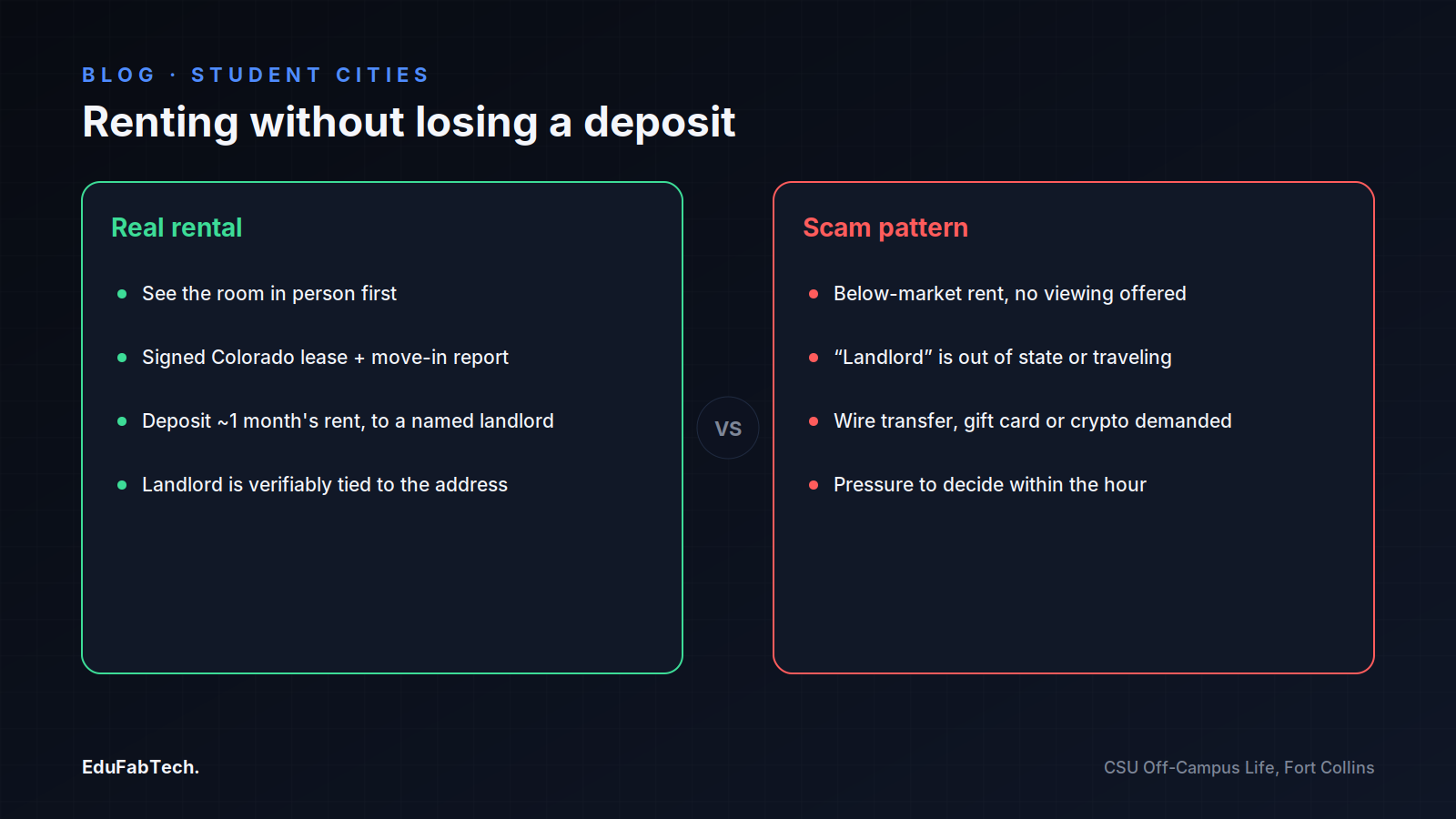
Fort Collins has a tight rental market and a steady churn of students, which is exactly the condition rental scams exploit. The pattern here is familiar: a listing with a below-market rent for a house near Campus West or a flat on the MAX line, a "landlord" who is conveniently out of state or travelling, and a request to wire a deposit or first month's rent to "hold" the room before you have seen it. Never send money by bank wire, gift card or cryptocurrency to secure a room — those payments are effectively impossible to recover, and no legitimate Fort Collins landlord needs them to hold a place.
Protect yourself with steps that are specific to the way renting works here. See the actual unit in person, or have someone you trust see it, before paying anything; a scammer copies photos from a real listing but cannot open the door. A standard arrangement locally is a lease plus a security deposit (often roughly one month's rent) paid to a named landlord or property manager, with a signed Colorado lease and a move-in condition report — not cash handed over on a doorstep. Confirm the person collecting the money is tied to the address. If a "landlord" refuses a viewing, pressures you to decide within the hour, or asks for payment in a form you cannot trace, walk away. CSU's Off-Campus Life office exists partly to help students read leases before they sign, and using it costs nothing.
Furnishing a room on the cheap: South College thrift and the Old Town market
Because the student population turns over every year, Fort Collins has an unusually deep second-hand economy, and most of it is strung along South College Avenue. Arc Thrift Stores at 2701 South College Avenue is the big one — furniture, electronics, clothing, housewares and a large book section, run to support people with intellectual and developmental disabilities, according to the Fort Collins Area Convention & Visitors Bureau. The same guide lists Eco-Thrift on North Howes Street, the two-floor Brand Spanking Used and the vintage specialist Wear It Again, Sam downtown on South College, and Repeat Boutique further south. Between them they will furnish a first room for a fraction of new-furniture prices.
For food and the weekend ritual, the Larimer County Farmers' Market sets up Saturdays from 9am to 1pm at 200 West Oak Street, in the Larimer County Courthouse parking lot in Old Town, running mid-May to the end of October; it has operated since 1976, and 2026 marks its 50th anniversary, according to Larimer County Extension. It is a short walk from campus and a good way to meet the town outside the university. For the things students give away when they move out — and they give away a lot each August — EduFabTech tracks second-hand items, used furniture and free stuff in the city.
Part-time work, and the rules international students must follow
On-campus jobs — dining halls, the library, research and teaching assistantships, labs — are the normal first job for students here, and they are the only ones available to most international students without extra paperwork. If you are on an F-1 or J-1 visa, the limits are not optional. Colorado State's International Student and Scholar Services states that F-1 and J-1 students maintaining status may work on campus a maximum of 20 hours per week while school is in session, and full-time during breaks, and that a new student may start as early as 30 days before the start date on their I-20 or DS-2019, per CSU International Student and Scholar Services. Off-campus work, and anything beyond on-campus employment, requires specific federal authorisation.
These are federal immigration rules administered by U.S. Citizenship and Immigration Services, not university policy, and they are not something to take advice on from classmates or landlords. Confirm anything about your own situation with ISSS before you accept work — this guide is not legal advice. Domestic students face no such cap and more options; current openings of both kinds are collected on EduFabTech's Fort Collins jobs page. One practical note for international students: you will likely need a Social Security number for payroll, which ISSS can walk you through once you have a job offer.
Morgan Library and where people actually study
The centre of academic life after dark is Morgan Library, the main university library near the heart of campus. It has group and individual study rooms, and the space called the Library Cube stays open after the main building closes for students carrying a CSU ID; after 9pm a RamCard is required to enter Morgan Library at all, according to CSU Libraries. In exam weeks the building shifts to extended late-night hours.
Beyond the library, the Lory Student Center is the daytime hub for group work and quieter corners between classes, and departmental buildings keep their own study rooms. Off campus, Old Town's cafés and the Poudre River Public Library District branches give you somewhere to work that is not the university. EduFabTech also lists bookable desks and study spaces around the city, and rooms and listings close to the university on its near Colorado State University page.
Getting around: a fare-free bus town built for bikes
Fort Collins is one of the easier US college towns to live in without a car, for two reasons. The first is that the city bus system, Transfort, is fare-free: "Transfort is fare-free and no fares are being collected," the operator states on its frequently-asked-questions page. That applies to everyone, so students ride the whole network at no cost, and CSU confirms that "individuals may ride any of the local routes throughout the city for free" on its transit and shuttles page. The spine of the system is MAX, a bus-rapid-transit line running on the dedicated Mason corridor between the South Transit Center and Old Town, with stations beside campus. Within campus, CSU runs the free Around the Horn shuttle, which the same page describes as giving 10-minute service across campus on weekdays and connecting to MAX at University Station. For weekend late nights, CSU's student-run RamRide offers safe rides you request through its app, according to CSU RamRide.
The second reason is that Fort Collins is a serious cycling town — flat, grid-planned, and threaded with off-street paths including the Spring Creek and Poudre trails. Many students do not own a car at all. If you do bring one, note that the central campus is built to keep cars out and parking is managed and limited; a bike and a free bus pass will usually serve you better than a parking permit.
What things cost — figures you can check
Housing is the figure most worth pinning down, and the university publishes its own. For 2026-2027, a community-style double room — a shared room with a bathroom down the hall, in halls such as Durward, Edwards, Ingersoll, Newsom and Westfall — is listed at $3,900 per semester, with suite-style economy doubles at $4,195, community-style doubles in Laurel Village at $4,315, and prices climbing to $6,840 per semester for a suite-style single with a private bathroom, according to CSU Housing & Dining Services. Those are room-only rates; a meal plan is charged on top, with the 21-meals-a-week plan listed at $4,745 per semester plus $200 of RamCash, and the 14-meal plan at $3,845 plus $200, on the same page. Applying for a hall also means a refundable $500 housing deposit and a non-refundable $100 application charge, per CSU Housing & Dining Services.
Off-campus rents are harder to source to a single official figure, because the city does not publish one and private listing-site averages change monthly; treat any single number with caution and compare several current listings before you budget. The dormitory rates above are the most reliable anchor you have. Beyond rent, the big savings in Fort Collins are the ones already described — the fare-free bus removes a transport line from the budget, and the South College thrift shops cut the cost of furnishing a room to very little.
The honest trade-offs
What is genuinely good here: the town is compact, safe-feeling and walkable, the bus is free, the outdoors is immediate — trails, the reservoir and the mountains are minutes away — and a research university this size brings jobs, culture and a steady supply of cheap second-hand goods. Old Town gives the place a real centre, which many college towns lack.
What is hard: cost and housing supply, mainly. Fort Collins is a desirable Front Range city, and rents reflect that; the tight market around campus means you must plan your room search months ahead, and leaving it to August is a recipe for paying too much or living far out. The weather is a real factor — winters are cold with hard snow, the elevation sits close to a mile above sea level so the sun is strong and the air is dry, and newcomers from humid or low-lying places feel it. The town is also somewhat isolated: Denver is an hour away by car but there is no quick train, so a weekend elsewhere takes planning. And a city this closely tied to one university can feel small if you want the anonymity of a big metro.
A checklist for your first weeks
- Collect your RamCard as soon as you arrive — it is your building access, library entry, meal card and free bus pass in one.
- If you are an international student, visit ISSS early, confirm the 20-hour on-campus work limit applies to you, and start the Social Security number process once you have a job offer.
- Learn the MAX line and the route to campus before classes start; the bus is free, so there is no reason to pay for parking in week one.
- If you still need a room, view it in person and never wire a deposit or pay by gift card to "hold" a place you have not seen.
- Furnish from Arc Thrift and the other South College second-hand shops, and watch the August giveaways as students move out.
- Find a study room or quiet corner in Morgan Library for your first big assignment, and have a backup spot before exam weeks fill every seat.
- Walk Old Town and the Saturday farmers' market early — it is the fastest way to feel like you live here rather than just study here.
For everything the city has on offer beyond this guide — rooms, jobs, second-hand goods and events — the full set of Fort Collins listings is a good place to keep looking as term gets going.
A quick question for readers
Do you work part-time while you study?
Many students work to pay the bills. See how common it is — and how many hours people really do.
Pick an answer, create a free account in a minute, and your vote counts. Already a member? Sign in
Comments 0
CommentNo comments yet. Members start the conversation.
Source: Colorado State University Housing & Dining Services
Sources (5)
- Colorado State University Housing & Dining Services. 2026-2027 Rates & Hall Information. Colorado State University, 2026. housing.colostate.edu ↗ · checked 14 Oct 2026
- Colorado State University Housing & Dining Services. Application & Assignments — Halls. Colorado State University, 2026. housing.colostate.edu ↗ · checked 14 Oct 2026
- International Student and Scholar Services. Hiring International Students. Colorado State University, 2026. international.colostate.edu ↗ · checked 14 Oct 2026
- Transfort. Answers to Your Questions About Transfort. City of Fort Collins, 2026. ridetransfort.com ↗ · checked 14 Oct 2026
- Larimer County Extension. Larimer County Farmers' Market. Larimer County, 2026. larimer.gov ↗ · checked 14 Oct 2026