Studying in Fort Lauderdale: universities, housing and student life
A practical guide to studying in and around Fort Lauderdale — its universities across three counties, where students rent, how to avoid room scams, where to study, getting around, and the honest trade-offs.
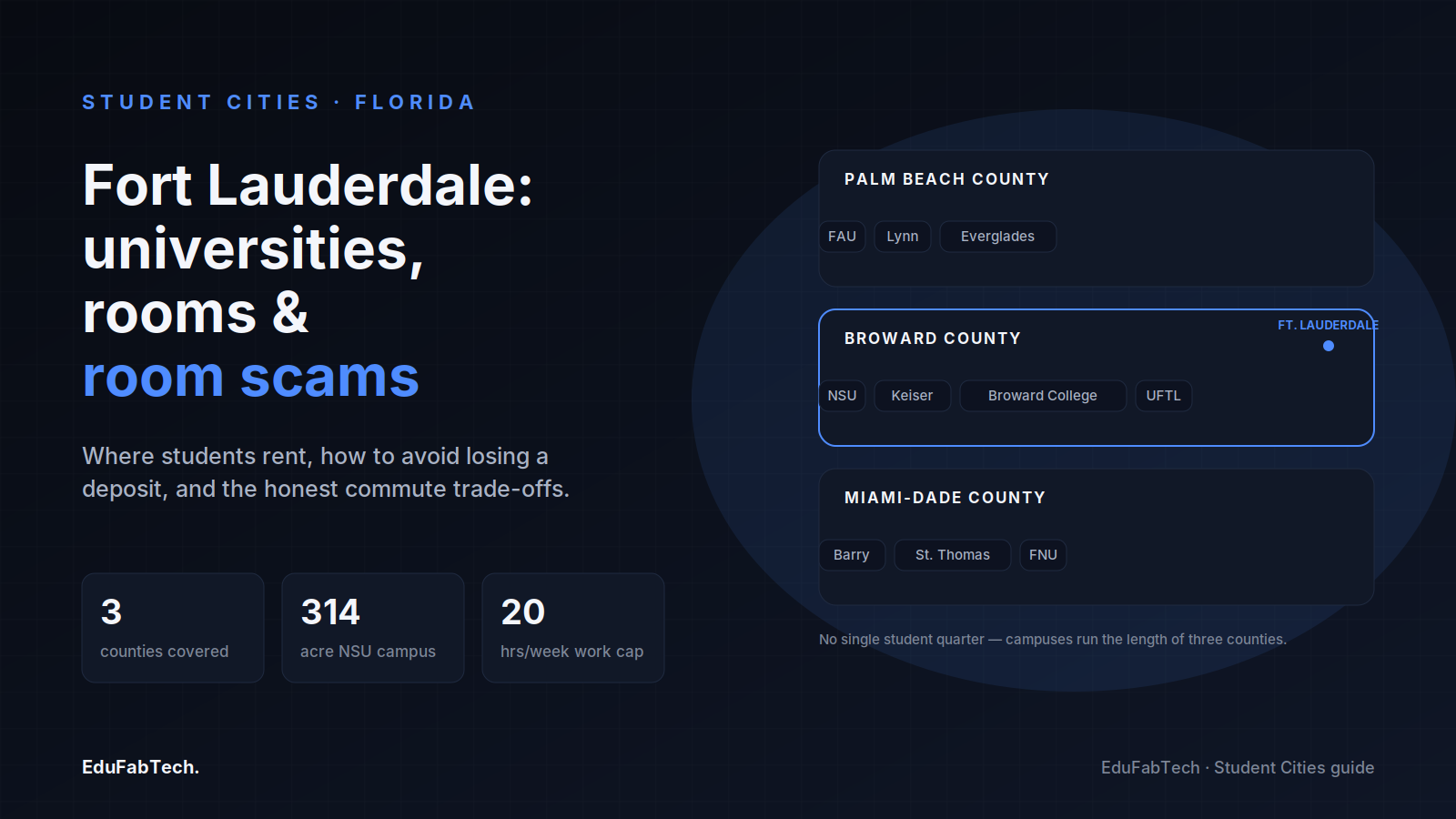
Fort Lauderdale is not a college town in the way that phrase usually works. No single campus sets the rhythm of the place. The city sits in the middle of a dense band of universities that runs the length of Broward County and spills north into Palm Beach County and south into Miami-Dade, so students here are scattered across a dozen institutions and three counties rather than gathered on one quad.
The city itself is built on water. The New River threads through downtown, a grid of canals earned it the old nickname "Venice of America," and the Atlantic beach runs along the eastern edge while subdivisions and office parks sprawl west toward the Everglades. Public transport is thin for a metropolitan area this size, so where you live and how you reach class matter more here than in a compact campus town.
What follows is a practical guide — whether you grew up in Broward or are arriving from abroad — to the universities around Fort Lauderdale, the neighbourhoods people actually rent in, how to find a room without losing a deposit, where to study, and what the honest trade-offs are. Current student listings across the city are collected on EduFabTech's Fort Lauderdale pages.
The universities, named
Nova Southeastern University (NSU) is the institution most people mean when they say they are "at Nova." Its main campus is in Davie, immediately west of Fort Lauderdale; NSU's own site describes it as a 314-acre flagship campus that is home to 12 colleges, centers and schools and the first institution in Florida to grant both M.D. and D.O. medical degrees (nova.edu). The M.D. programme is the Dr. Kiran C. Patel College of Allopathic Medicine, based on that Davie campus. Listings near NSU concentrate in Davie and the suburbs around it.
Florida Atlantic University (FAU) is the large public option, with its main campus in Boca Raton about forty minutes north and teaching sites down in Broward. FAU states that in 2025 the Carnegie Classification designated it "R1: Very High Research Spending and Doctorate Production," one of only 21 institutions nationally to hold both the R1 and Opportunity University classifications (fau.edu).
Keiser University began in Fort Lauderdale: the university's history page says Dr. Arthur Keiser and his mother, Evelyn Keiser, opened The Keiser School in Fort Lauderdale in 1977, starting in a two-room storefront (keiseruniversity.edu). Its Fort Lauderdale campus is at 1500 NW 49th Street; its larger residential "Flagship" campus is in West Palm Beach, not the city itself.
Several more degree-granting institutions ring the city. Lynn University, in Boca Raton, began in 1962 as Marymount College and was renamed in 1991; it emphasises a large international enrolment (lynn.edu). Barry University, a Catholic university founded in 1940 by the Adrian Dominican Sisters, sits on a Miami Shores campus in northern Miami-Dade (barry.edu). St. Thomas University, in Miami Gardens, traces its roots to American Augustinians expelled from Cuba and was founded in 1961 as Biscayne College (stu.edu). Everglades University, with its main campus in Boca Raton, is accredited by SACSCOC to award bachelor's and master's degrees and is known for programmes such as aviation/aerospace and alternative and renewable energy management (evergladesuniversity.edu). Florida National University, in Hialeah, dates to the early 1980s and adopted university status in 2012 (fnu.edu). The University of Fort Lauderdale, in Lauderhill, is a Christian institution accredited by TRACS that grants associate through doctoral degrees (uftl.edu). JW Bible College, in Lighthouse Point, is a small theology college affiliated with an Assembly of God ministry.
From Davie to Wilton Manors: where students rent
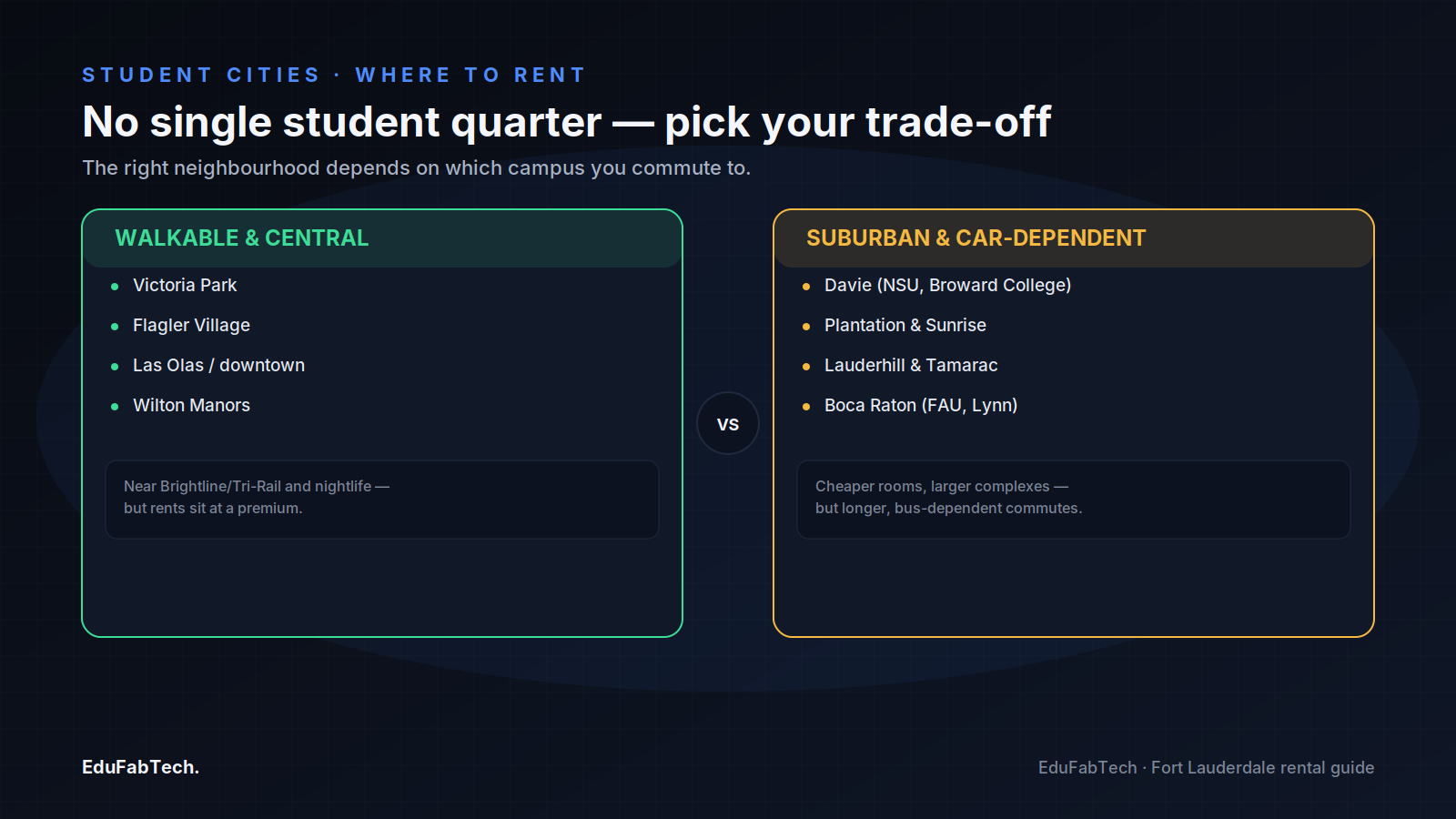
Because the campuses are scattered, there is no one "student quarter." A few areas recur, and the right one depends mostly on which campus you commute to and whether you have a car.
Davie is the obvious base for NSU and for Broward College's main campus, which share the same stretch of Davie Road. The town grew from early-1900s farming and cattle land and has deliberately kept a western, equestrian character — horse trails, ranch-style lots and a rodeo arena sit alongside the university complex. Rooms here are relatively cheap for the area and close to class, but it is suburban and car-oriented.
Victoria Park, just north of downtown, is a walkable neighbourhood of older homes and tree-lined streets popular with younger renters; it is central and pricier. Next to it, Flagler Village is the downtown arts district (the FAT Village warehouses host art walks), heavily rental and increasingly built up with new apartment blocks — lively, close to the Brightline and Tri-Rail stations, and among the more expensive places to rent. Las Olas and the downtown core put you within walking distance of restaurants, the riverfront and transit, at a premium.
Wilton Manors, a small city immediately north, is walkable, has an established LGBTQ+ community and a compact main street, and tends to sit between the downtown and suburban price points. Further out, the western suburbs — Plantation, Sunrise, Lauderhill and Tamarac — are where rooms get cheaper and apartment complexes are larger; the trade-off is longer, more bus-dependent commutes. If you will study at FAU or Lynn, Boca Raton to the north is its own, generally costlier, rental market. You can browse rooms across these areas on EduFabTech's rooms page.
Finding a room, and the scams that circle this city
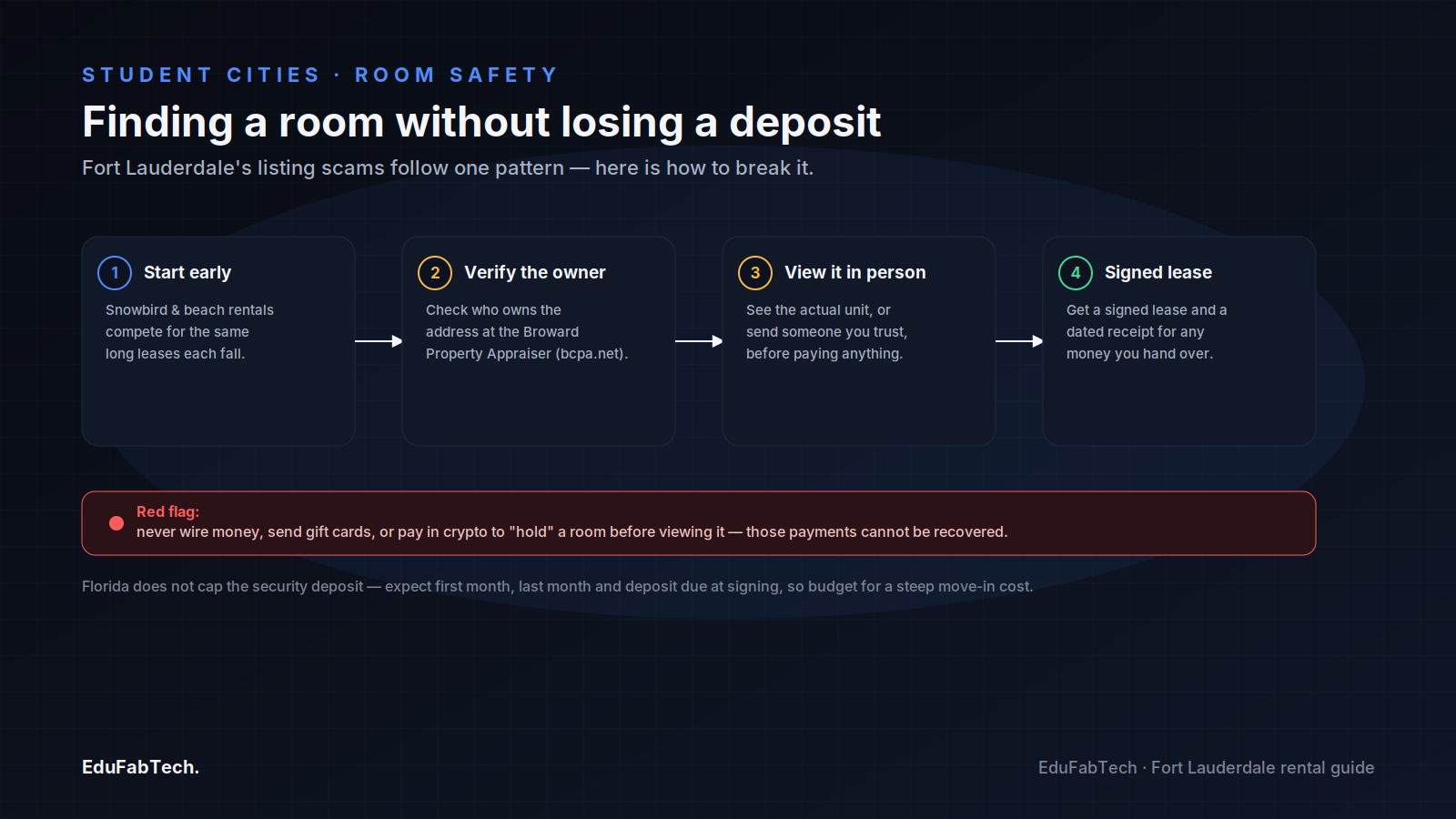
Start early. In a region where winter "snowbird" tenants and short-term beach rentals compete for the same apartments, the cheapest long leases go well before the autumn term. Expect landlords to ask for first month, last month and a security deposit up front; Florida does not cap the security deposit, so the cash required to move in can be steep.
The scams here follow a pattern. A listing — often a real downtown or beach-area apartment copied from elsewhere — is offered below market, the "owner" claims to be out of state or travelling, and you are pressed to send a deposit to "hold" the unit before viewing. Do not. Never send money by bank wire, gift card or cryptocurrency to reserve a room; those payments cannot be recovered. See the actual unit in person, or have someone you trust see it, before paying anything. Because every parcel in the county is public record, you can check who really owns an address through the Broward County Property Appraiser (bcpa.net) and be wary if the name does not match the person collecting your deposit. Get a signed lease and a dated receipt for any money you hand over.
Furnishing it without overspending
Fort Lauderdale's best-known second-hand destination is the Fort Lauderdale Swap Shop at 3291 West Sunrise Boulevard, a sprawling daily flea market that Miami New Times has described as one of the world's biggest, with thousands of vendors (miaminewtimes.com). It is a realistic place to pick up a fan, kitchen basics or a desk cheaply, though you will need a way to carry things home. For furniture and household items that other students sell or give away as leases turn over, EduFabTech's local second-hand listings are worth watching — the end of each semester, when people leave the region entirely, is the best time to look.
Working while you study
If you are on an F-1 student visa, the rules on work are set federally and are strict. The U.S. Citizenship and Immigration Services (USCIS) Policy Manual states that F-1 status permits a student with their Designated School Official's approval to work on-campus up to 20 hours per week while school is in session, and that F-1 students engaged in on-campus employment are not required to apply for employment authorization with USCIS (uscis.gov). Off-campus work, including training tied to your field of study, is more tightly controlled and needs specific authorization. This is general information, not legal advice: confirm your own situation with your university's international-student office and the official SEVP "Study in the States" guidance before accepting any job. Local part-time openings students post and look for are collected on the jobs page.
Libraries and places to study
The standout is the Alvin Sherman Library, Research, and Information Technology Center on the NSU campus in Davie, which the university describes as the largest library in the state of Florida (nova.edu). It is a joint-use library: anyone who lives, works or studies in Broward County can get a free card, and its public building hours run seven days a week from early morning to late evening (library.nova.edu). Broward College's A. Hugh Adams Central Campus library, also on Davie Road, offers single and group study rooms you can book (broward.edu). The county's public system, Broward County Library, adds free study space across the city, including the African-American Research Library and Cultural Center on Sistrunk Boulevard. More desks and quiet rooms students share are on the study-spaces page.
Getting around
The county bus operator is Broward County Transit (BCT). Its fares page lists a one-way adult cash fare of US$2.00 and, usefully, a 31-Day College Student bus pass for US$50, bought in person with a current college photo ID or class schedule; riders aged 18 or under pay US$40 for the 31-day youth pass (broward.org). Within Fort Lauderdale itself, the City runs the free LauderGO! Community Shuttle, with five routes linking the beach, Las Olas, downtown, Flagler Village and connections to the wider transit network at no charge (fortlauderdale.gov). Two rail services run the coast: Tri-Rail, the regional commuter line, and Brightline, the faster intercity service that connects Fort Lauderdale with Miami, West Palm Beach and Orlando. Even so, this remains a car-shaped region, and many students end up driving.
Costs, honestly
For on-campus housing there is a concrete, dated figure: NSU's housing office lists Fall 2026 residence rates from a triple room in Leo Goodwin Sr. Hall at US$3,700 per semester and a two-bedroom quad in the Cultural Living Center at US$4,050 per semester, with declining-balance meal plans starting at US$765 — rates it notes are pending Board of Trustees approval and subject to change (housing.nova.edu). Most students, though, rent off-campus, and the private market in Fort Lauderdale is expensive by Florida standards; sharing an apartment with others in the western suburbs is usually the way to keep monthly rent manageable. Reliable, current citywide rent statistics for students specifically are hard to source, so treat any single advertised rent as a starting point for negotiation, not a benchmark.
What is good, and what is hard
The good: a genuine choice of institutions within an hour's drive, from a research university to community-college and faith-based options; warm weather year-round; a real beach; free local shuttles in the core; and an unusually large public-academic library on your doorstep in Davie. For international students, Lynn and NSU bring sizeable overseas communities.
The hard: housing is costly and competitive, and the seasonal rental market works against newcomers. The campuses are spread across three counties, so without a car you build your life around bus timetables. The climate cuts both ways — summers are hot and humid, the Atlantic hurricane season runs from June into November, and low-lying Fort Lauderdale is prone to heavy-rain street flooding. None of this is a reason to stay away, but it should shape where you rent and how you plan to commute.
A checklist for the first weeks
- Confirm which campus you actually attend, and choose a neighbourhood by its commute to that campus, not by the city centre.
- If you are on an F-1 visa, meet your international-student office before taking any job, and keep your immigration documents current.
- View any room in person before paying; verify the owner through the Broward County Property Appraiser; never wire a deposit or pay in gift cards or crypto.
- If you will use the bus, buy the BCT 31-Day College Student pass in person and keep your student ID to hand.
- Get a joint-use library card for the Alvin Sherman Library and scout a quiet study spot before deadlines arrive.
- Furnish from the Swap Shop and end-of-semester giveaways rather than buying new.
- Have a wet-season plan: know which roads near you flood, and keep documents off the floor.
A quick question for readers
Do you work part-time while you study?
Many students work to pay the bills. See how common it is — and how many hours people really do.
Pick an answer, create a free account in a minute, and your vote counts. Already a member? Sign in
Comments 0
CommentNo comments yet. Members start the conversation.
Source: Nova Southeastern University
Sources (5)
- Nova Southeastern University. Housing Costs. Nova Southeastern University, 2026. housing.nova.edu ↗ · checked 11 Oct 2026
- Broward County. BCT Fares and Passes. Broward County Transit, 2026. broward.org ↗ · checked 11 Oct 2026
- U.S. Citizenship and Immigration Services. Policy Manual, Volume 2, Part F, Chapter 6: Employment. USCIS, 2025. uscis.gov ↗ · checked 11 Oct 2026
- City of Fort Lauderdale. LauderGO! Community Shuttle. City of Fort Lauderdale, 2026. fortlauderdale.gov ↗ · checked 11 Oct 2026
- Florida Atlantic University. Road to R1. Florida Atlantic University, 2025. fau.edu ↗ · checked 11 Oct 2026