Studying in Hamilton, Ohio: universities, housing and student life
A practical guide to studying in Hamilton, Ohio — its in-city Miami University campus, the big universities 15 to 20 miles away, where students rent, what it costs, and how to get around.
A river town between Oxford and Cincinnati
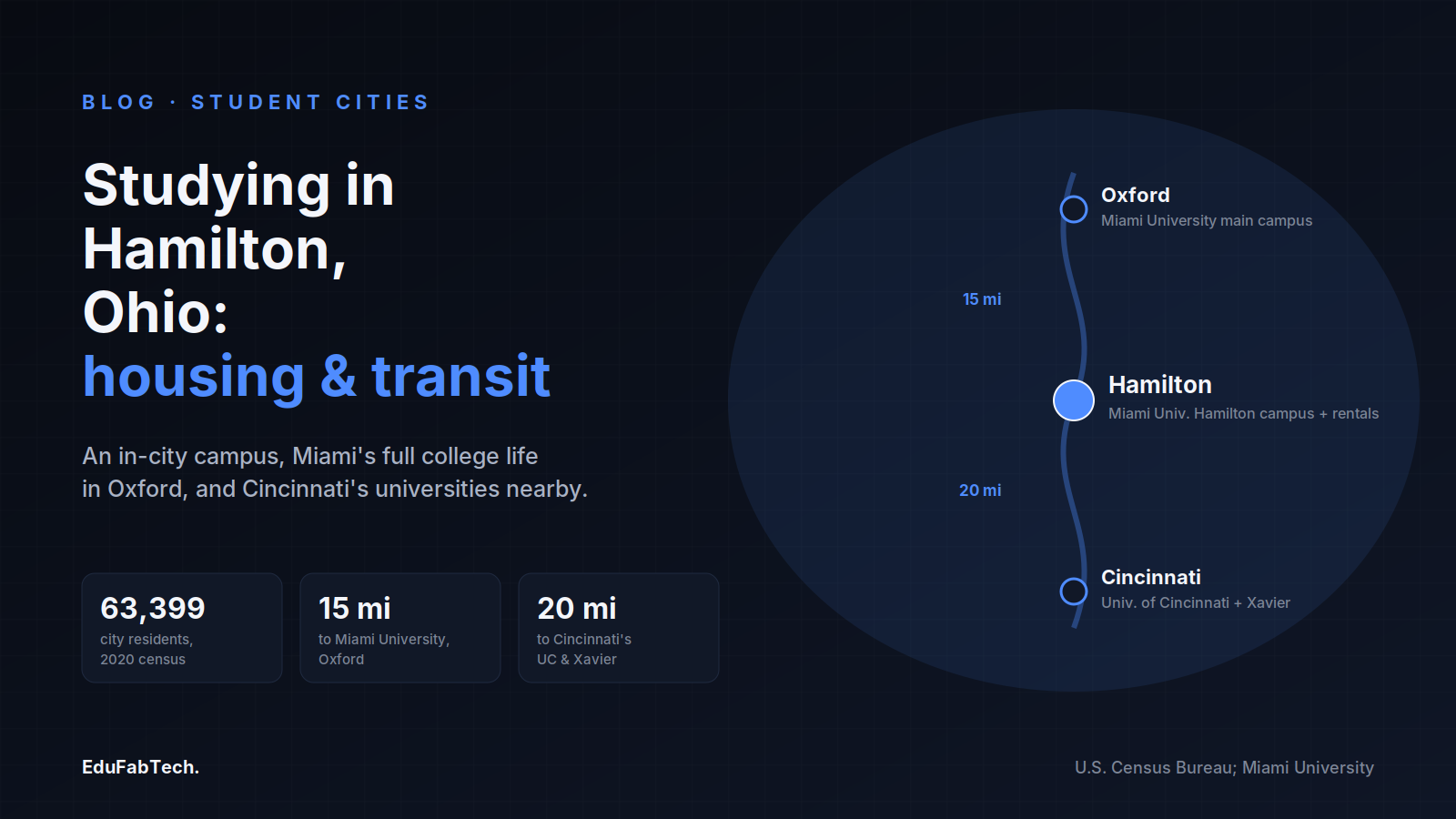
Hamilton sits on the Great Miami River in southwest Ohio, the county seat of Butler County and, after Cincinnati itself, the second-largest city in the Cincinnati metropolitan area. The U.S. Census Bureau's QuickFacts recorded 63,399 residents at the 2020 census. It is a former manufacturing town that has spent two decades rebuilding its downtown around the river — most visibly at RiversEdge at Marcum Park, which the American Planning Association describes as a six-acre recreation and event space, the first major park in downtown Hamilton. The city brands itself the "City of Sculpture," and the restored German Village and Rossville districts give the centre a denser, older feel than most Ohio towns its size.
For a student, where Hamilton sits matters more than how big it is. Oxford, home to Miami University's main campus, is roughly 15 miles to the northwest. Downtown Cincinnati, with the University of Cincinnati and Xavier University, is about 20 miles to the south. And Hamilton has its own Miami University regional campus on the north side of town. So "studying in Hamilton" can describe three quite different lives: a commuter enrolled at the in-city campus, a Miami student who keeps a cheaper room in Hamilton and drives to Oxford, or a Cincinnati student who finds downtown rents steep and looks north.
That three-way pull shapes everything below. Hamilton is an affordable, working river city rather than a classic one-university college town, and its student population is spread across commuter campuses and the larger universities nearby rather than packed into a single quad. The upside is cost and quiet; the trade-off is that a car or a transit plan is often part of the deal.
The universities within reach
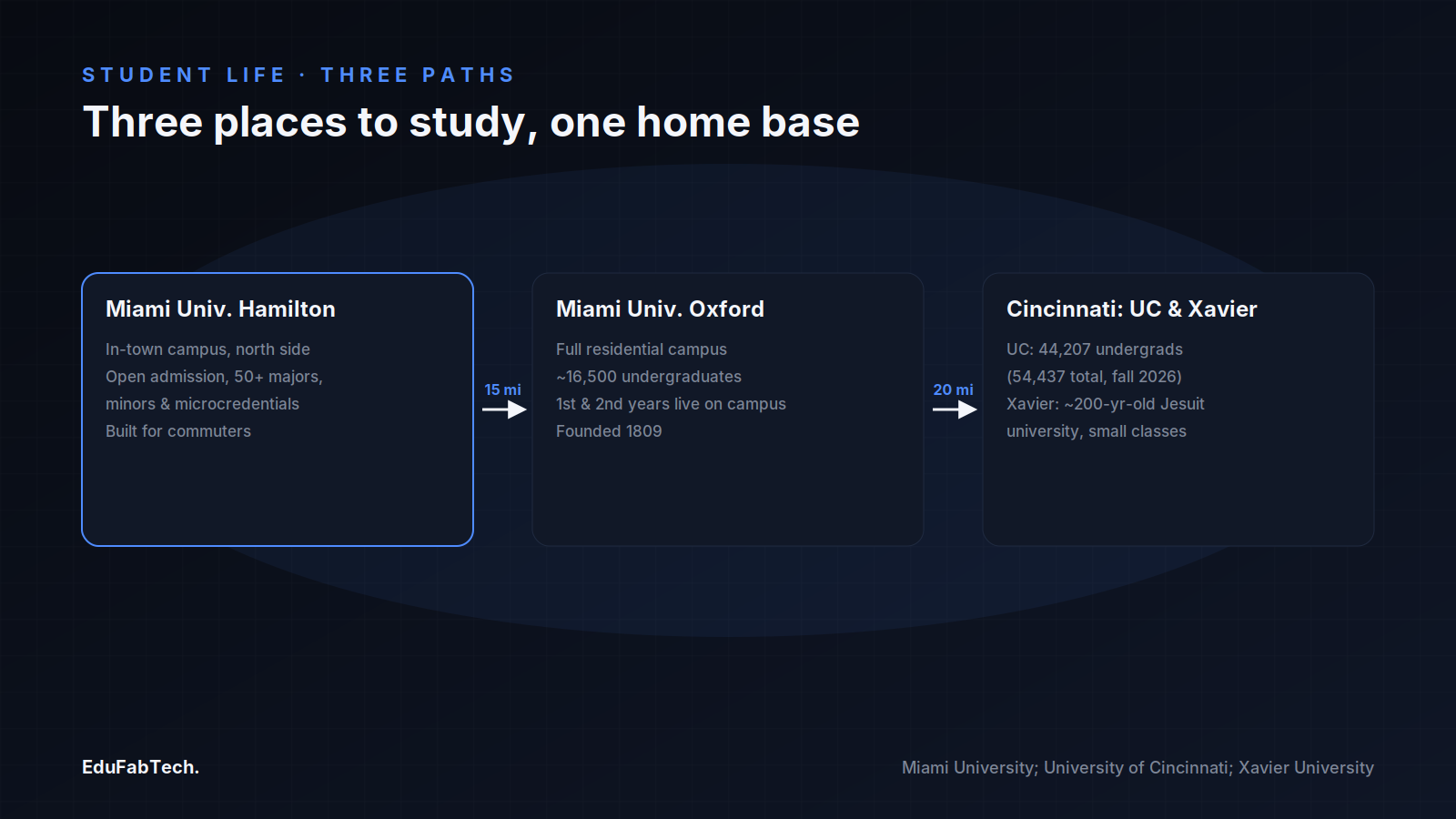
The campus physically in Hamilton is Miami University Hamilton, at 1601 University Boulevard on the city's north side. According to Miami University, it is the largest of the university's regional campuses, keeps an open-admission policy for first-time students, and teaches through the Regional College of Liberal Arts and Applied Science, which lists more than 50 majors, minors and microcredentials. The campus houses a $10 million Nursing Innovation Hub, an Advanced Manufacturing hub run with Butler Tech, and the Rentschler Library. It is built for people who commute, start a degree close to home, or finish it online.
The full residential experience is in Oxford, about 15 miles away. Miami University dates its founding to 1809 and, per the university's Oxford campus profile, enrols roughly 16,500 undergraduates and more than 2,000 graduate students, requires first- and second-year students to live on campus, and with more than 3,700 employees is the largest employer in Butler County. A second regional campus, Miami University Middletown, lies east of Hamilton and offers bachelor's and associate degrees through the same regional college, as the Miami Regionals pages describe.
Twenty miles south, in Cincinnati, are two more options. The University of Cincinnati is a public research university founded in 1819; UC reported a record headcount of 54,437 students for fall 2026, including 44,207 undergraduates across its campuses. Engineering there is taught through the University of Cincinnati College of Engineering and Applied Science, the college long tied to UC's cooperative-education programme of alternating paid work and study. Xavier University, on Cincinnati's east side, describes itself on its about pages as a nearly 200-year-old Jesuit Catholic university built around small classes and service. Two further institutions on the historical record for this area no longer grant degrees and are not covered here (see the note at the end).
Where students live, and renting without being cheated
Because Miami's regional campuses are built around commuting students, most people enrolled at Miami Hamilton live at home or rent a room in town rather than in a dormitory. The neighbourhoods students gravitate to are the walkable older districts near the centre — German Village and Dayton Lane on the east bank, Rossville across the river — plus the quieter, cheaper streets of Lindenwald to the south. Hamilton is genuinely affordable by national standards: the U.S. Census Bureau put the city's median gross rent at $1,007 a month in its 2020–2024 American Community Survey estimate, and Census Reporter gives a median household income of about $55,166 (ACS 2024 five-year data) — figures for all households, not students alone, but a useful benchmark when a listing looks far above or below them.
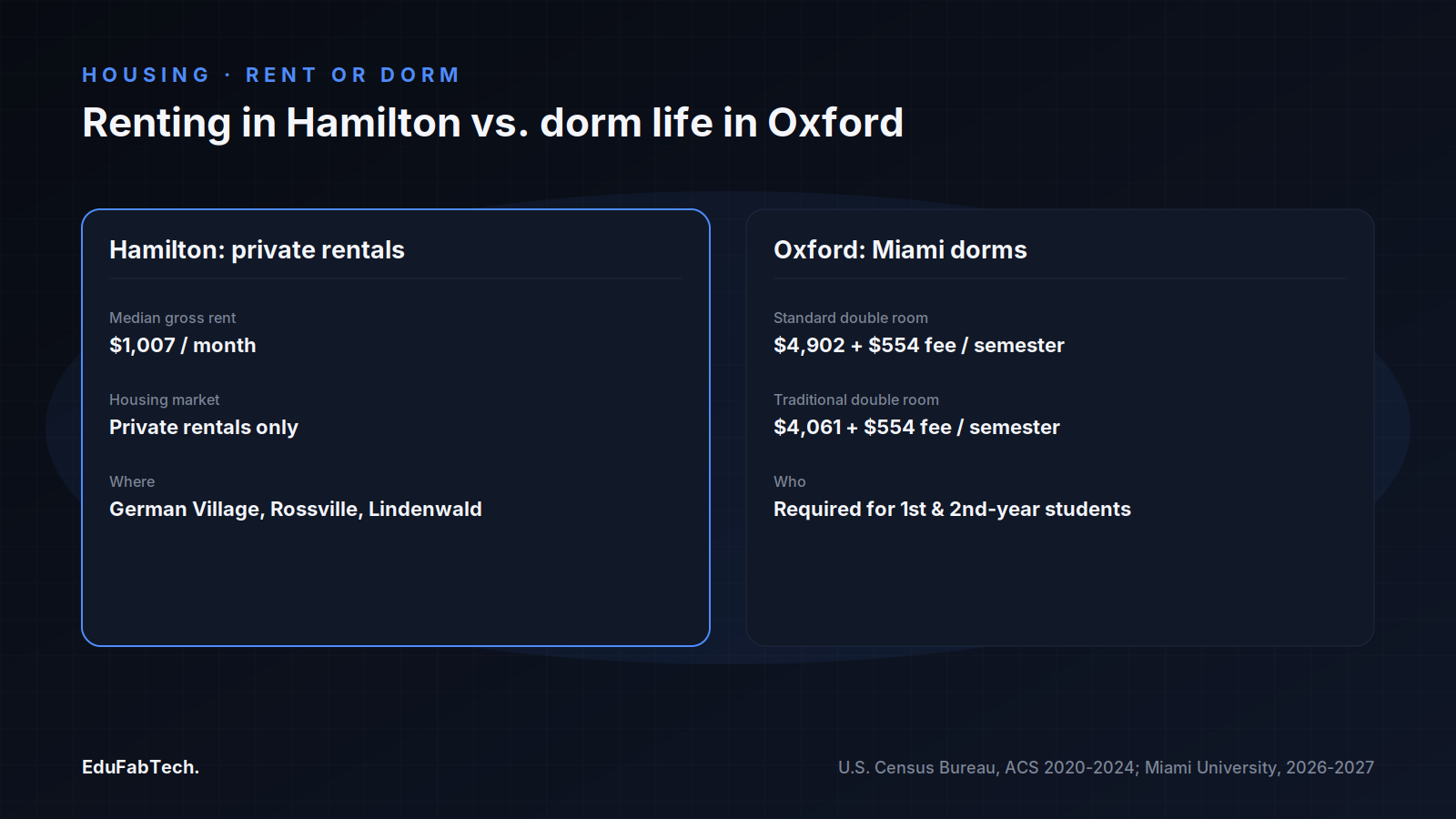
If you want full dormitory life, that means Oxford. Miami University's 2026–2027 housing rates list a standard double room at $4,902 per semester plus a $554 residential fee, and a traditional (non-renovated) double at $4,061 plus the same fee — per person, per semester. The University of Cincinnati and Xavier run their own residence halls in Cincinnati. In Hamilton itself there is no campus housing to apply for, so the search is a private-market one.
That makes scam awareness specific here. The listings to distrust in Hamilton are the too-cheap ones for a restored German Village or downtown apartment, or a house near the University Boulevard campus, where the "owner" is conveniently out of state and wants money before you can see it. Normal local practice is straightforward: view the actual unit in person, meet whoever holds the keys, read the lease, and pay a security deposit — commonly around one month's rent — only after signing, to a named person or a traceable account. Never send money by bank wire, gift card or cryptocurrency to "hold" a room you have not stood inside. No legitimate Hamilton landlord needs a deposit before a viewing. EduFabTech's own rooms listings for Hamilton are a place to start, and the listings near Miami University help if you are splitting time with Oxford.
| Item | Figure | Source (year) |
|---|---|---|
| Hamilton median gross rent | $1,007 / month | U.S. Census Bureau, ACS 2020–2024 |
| Miami Oxford standard double | $4,902 + $554 fee / semester | Miami University, 2026–2027 |
| Miami Oxford traditional double | $4,061 + $554 fee / semester | Miami University, 2026–2027 |
| BCRTA BGo curb-to-curb ride | $5.00 each way | BCRTA, 2026 |
Furnishing a room: Hamilton's markets and second-hand
A bare room is cheapest to fill from the city's own markets. The Hamilton Flea runs as a curated monthly artisan market in downtown's Marcum Park — good for handmade goods, prints and one-off finds rather than a weekly grocery run. Hamilton's Historic Farmers Market sets up around the Butler County Courthouse at 101 High Street every Saturday from 8 a.m. to noon, with its 2026 season running 23 May to 3 October and free parking during market hours — the place for produce, plants and honey. For the bigger pieces a room needs — a desk, a mattress frame, a chair — the second-hand route is usually cheaper than any shop; EduFabTech keeps separate Hamilton pages for second-hand items and used furniture, which is often how departing students clear out in May and August.
Working while you study
Rules for international students are set nationally, not by the city. The U.S. Department of Homeland Security's Study in the States guidance states that an F-1 student may work on campus no more than 20 hours per week while school is in session, and that off-campus employment generally requires completion of one full academic year plus authorisation arranged through your school's Designated School Official — such as curricular or optional practical training, with any Employment Authorization Document issued by U.S. Citizenship and Immigration Services. Treat that page, and your DSO, as the authority; nothing here is legal advice, and visa conditions change. For what is actually hiring locally, EduFabTech's Hamilton jobs page is a starting point, but confirm your own eligibility before you accept anything.
Libraries and quiet desks
Hamilton's public library system is Lane Libraries. The main Hamilton Lane Library at 300 North Third Street stays open until 8 p.m. Monday through Thursday, with shorter weekend hours, and the system also runs the Smith Library of Regional History and the Lane Community Technology Center at 228 Court Street for computer and printing access. On the north side, the Rentschler Library serves the Miami University Hamilton campus, and Miami students with a card can reach the far larger collections at Oxford. These are the reliable free desks in town; EduFabTech also lists bookable study spaces in Hamilton for exam weeks when the library fills up.
Getting around Butler County
The local operator is the Butler County Regional Transit Authority (BCRTA), whose buses you ride and pay for through the BGo app (powered by Via) and the regional EZfare system. BCRTA's fixed Regional routes and the Oxford–Miami University routes run fare-free, and its on-demand BGo curb-to-curb service costs $5.00 each way, per the operator's fare breakdown. That matters most to Miami students shuttling between Hamilton, Middletown and Oxford. Within Hamilton, the rebuilt downtown and the river districts are walkable, but the campuses and Cincinnati are not — a car, a carpool or a planned bus route is realistic for anyone commuting daily to Oxford or UC.
What is good and what is hard
The honest case for Hamilton is cost and location: rents well below the big-metro average, a revived riverfront downtown with markets and music, and three real universities reachable without living in any of their shadows. The honest difficulties are the flip side of the same geography. There is no single student quarter and no in-city dormitory, so first-year social life is thinner than in Oxford or uptown Cincinnati, and you assemble your own routine. Winters are grey and cold, the river and rail lines carve the city into pieces that slow short trips, and without a car the daily Oxford or Cincinnati commute depends on matching your schedule to the free routes. Hamilton rewards the practical, cost-focused student more than one chasing a stadium-and-Greek-row experience.
A checklist for your first weeks
- Confirm which campus you actually attend — Hamilton, Oxford, Middletown, UC or Xavier — because it decides your commute, your library card and your housing options.
- View any room in person and pay a deposit only after signing a lease to a named person; never wire money, buy gift cards or send cryptocurrency to hold a place.
- Check your figures against the Census Bureau's $1,007 median rent and treat listings far below it as suspect.
- Install the BGo app, note which BCRTA routes are free, and plan the Oxford or Cincinnati trip before term starts.
- Get a Lane Libraries card and scout the Hamilton Lane Library and your campus library for quiet desks early.
- International students: meet your DSO and read the Study in the States work rules before taking any job.
- Furnish from the Hamilton Flea, the Historic Farmers Market and second-hand listings rather than buying everything new.
Notes — skipped institutions: Western College for Women (Oxford) — merged into Miami University in 1974 and no longer a separate degree-granting institution; Miami Valley College (Springboro) — a Quaker college that closed in 1883; Oxford Female Institute (Oxford) — absorbed by Miami University in 1928 and now the Oxford Community Arts Center.
A quick question for readers
Do you work part-time while you study?
Many students work to pay the bills. See how common it is — and how many hours people really do.
Pick an answer, create a free account in a minute, and your vote counts. Already a member? Sign in
Comments 0
CommentNo comments yet. Members start the conversation.
Source: U.S. Census Bureau
Sources (5)
- U.S. Census Bureau. QuickFacts: Hamilton city, Ohio. U.S. Census Bureau, 2024. census.gov ↗ · checked 13 Oct 2026
- Miami University. Housing Rates 2026-2027. Miami University, 2026. miamioh.edu ↗ · checked 13 Oct 2026
- University of Cincinnati. Record enrollment continues at the University of Cincinnati. University of Cincinnati, 2026. uc.edu ↗ · checked 13 Oct 2026
- Butler County Regional Transit Authority. BGo Fare Price Breakdown. BCRTA, 2026. butlercountyrta.com ↗ · checked 13 Oct 2026
- U.S. Department of Homeland Security. Working in the United States (Study in the States). DHS, Student and Exchange Visitor Program, 2026. studyinthestates.dhs.gov ↗ · checked 13 Oct 2026