Studying in Harrisonburg: universities, housing and student life
A practical guide to James Madison University, Eastern Mennonite University and life in Virginia's Shenandoah Valley — housing, costs, work rules, markets, transport and study spaces, each figure sourced.
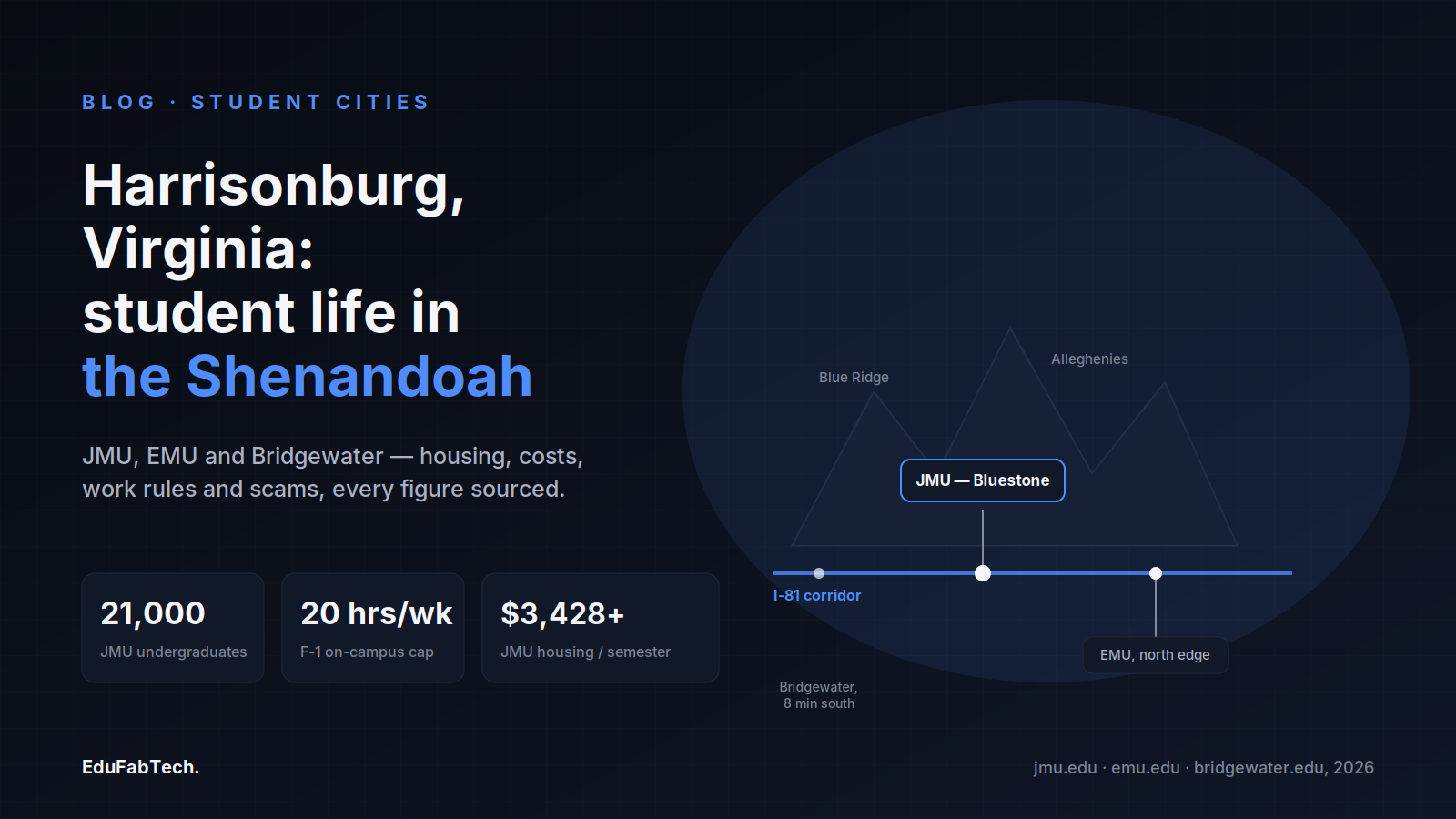
Harrisonburg sits in the middle of Virginia's Shenandoah Valley, hemmed by the Blue Ridge to the east and the Allegheny ridges to the west, strung along the Interstate 81 corridor that carries most of the traffic through the central valley. It markets itself as "the Friendly City," and for a place of its size it carries an unusual mix: a large public university, a small Mennonite one, an old agricultural downtown that has turned into a dense cluster of restaurants and cafés, and one of the more diverse populations in rural Virginia, shaped by decades of refugee resettlement. For a student, the result is a town where university life and ordinary valley life are tangled together rather than walled off on a campus.
Most students here are undergraduates at James Madison University, whose campus physically straddles Interstate 81 — the older "Bluestone" side and the newer east campus are joined by a pedestrian bridge over the motorway. But the student population is not one institution. A church-affiliated university on the north edge of town and a liberal-arts college eight minutes south in Bridgewater add a few thousand more, and they draw a noticeably different crowd.
This guide walks through the universities, where people actually find rooms, how to avoid the rental scams that circulate here every August, what part-time work rules apply, where to study, how to get around without a car, and what it honestly costs — with each figure tied to the page it came from. If you want current listings while you read, EduFabTech keeps everything for the city at /in/united-states/harrisonburg.
The universities in and around Harrisonburg
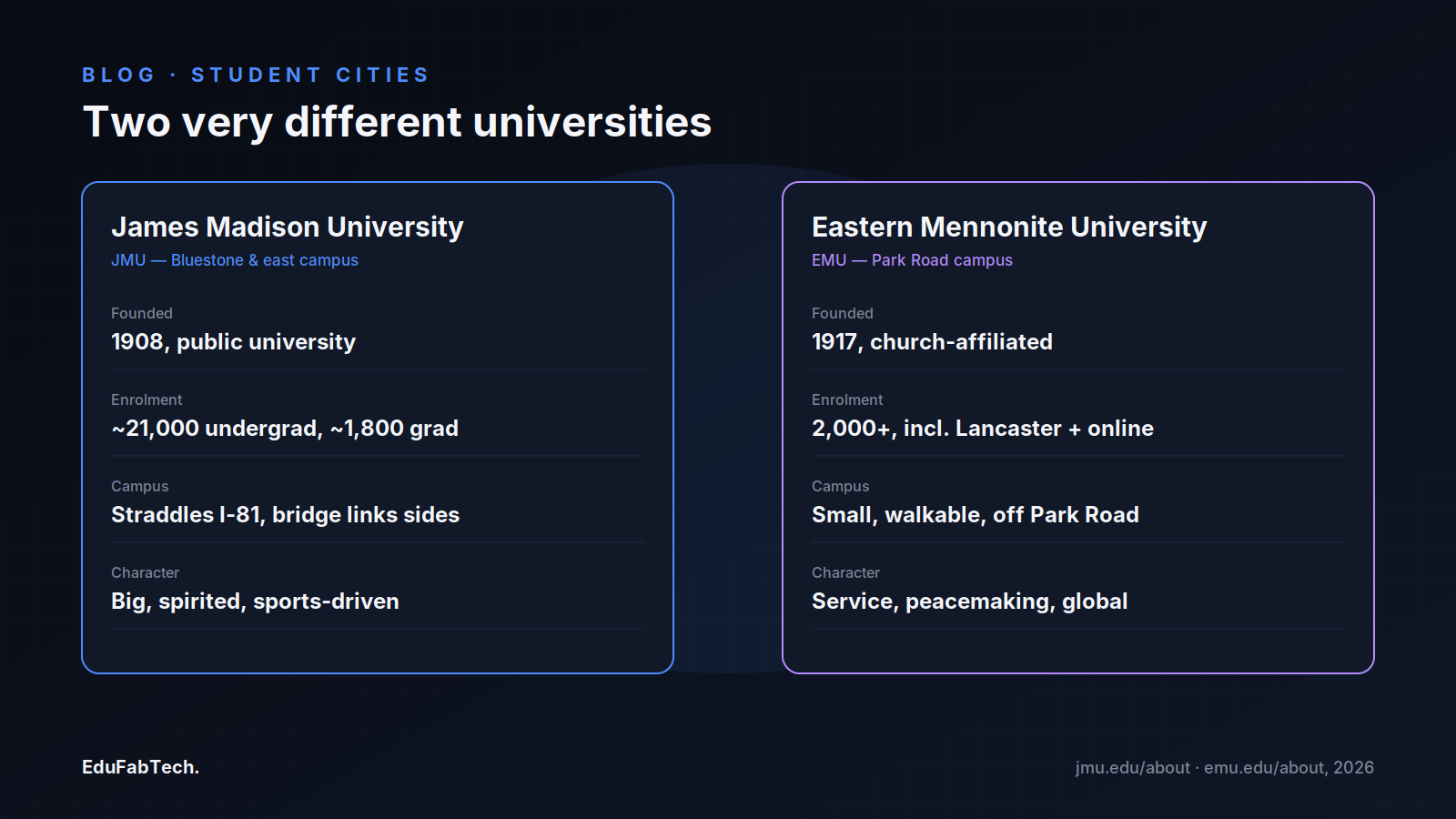
James Madison University (JMU) is the anchor. Its own About page states that JMU was founded in 1908 and is a public university in the Shenandoah Valley with more than 130 programs of study, enrolling roughly 21,000 undergraduates and about 1,800 graduate students (jmu.edu/about, 2026). It began as a women's teaching college and kept a strong reputation for undergraduate teaching as it grew; the dominant feel on campus is a big, spirited, sports-conscious state school — the football crowd fills Bridgeforth Stadium, purple and gold are everywhere, and the student culture is more mainstream American-college than bohemian. If you are weighing rooms close to it, /near/james-madison-university collects nearby listings.
Eastern Mennonite University (EMU) is a very different place a short way north, off Park Road. EMU's own site says it was founded in 1917 and serves more than 2,000 students across its Harrisonburg campus, a Lancaster site and online programs, built around commitments to "service to others, peacemaking, and care for the environment" (emu.edu/about, 2026). Its graduate Center for Justice and Peacebuilding, which grants master's degrees in conflict transformation and restorative justice, gives EMU an international profile well out of proportion to its size and draws students from conflict-affected regions worldwide. The campus is small, walkable and quiet; listings around it sit at /near/eastern-mennonite-university.
Bridgewater College is not in Harrisonburg proper but in the town of Bridgewater, which the college's facts page places about eight minutes south, where it has been coeducational since its founding in 1880 and now enrols roughly 1,450 students across more than 60 majors and minors, fielding NCAA Division III teams (bridgewater.edu facts, 2026). It is a genuinely separate small-town college experience, but close enough that students sometimes live between the two; nearby rooms are at /near/bridgewater-college.
Where students live
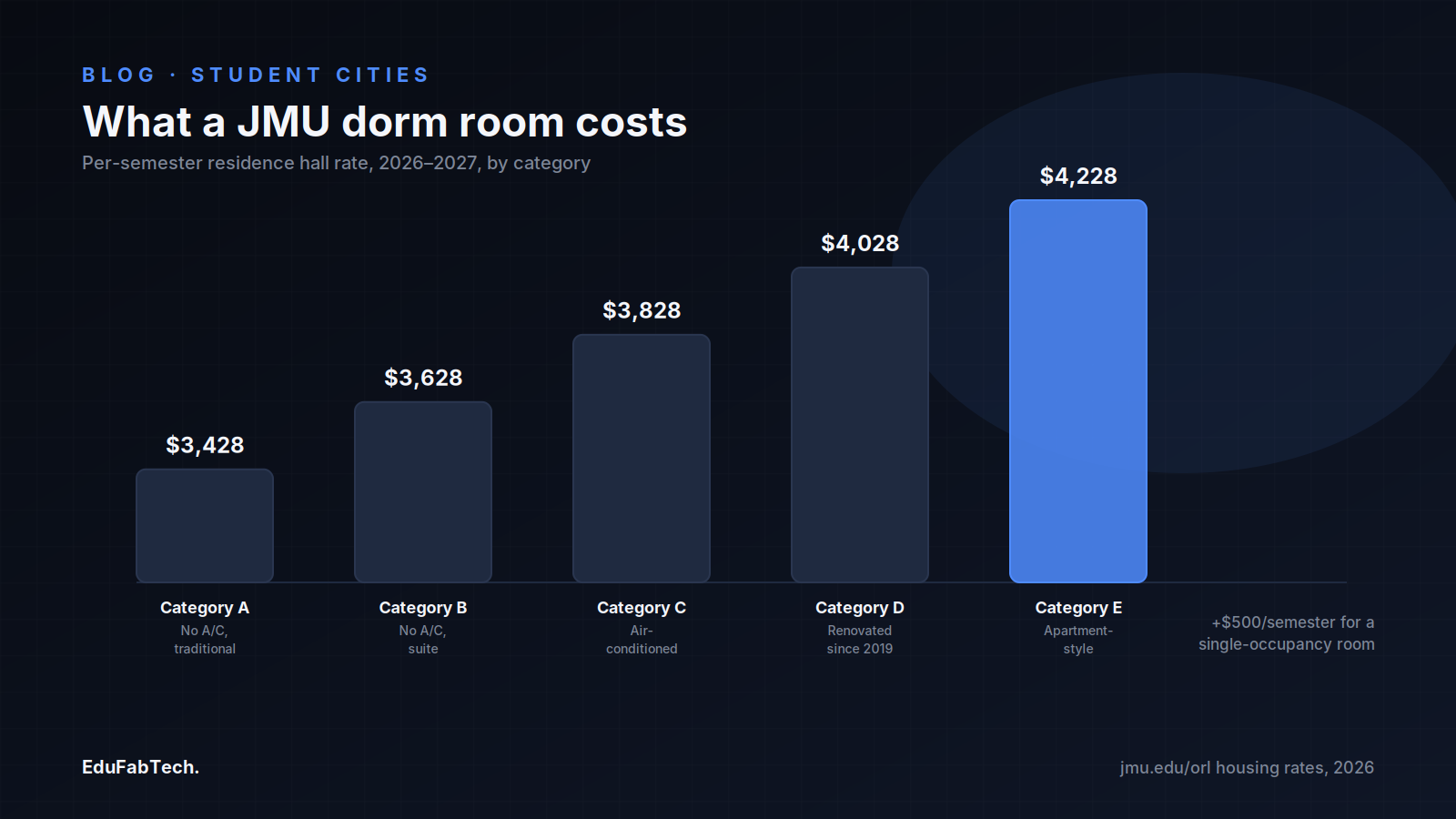
JMU guarantees and expects first-year students in its residence halls, and the on-campus stock is split into five price "categories" by air conditioning and age. For 2026-2027 JMU lists these per-semester rates: Category A (non-air-conditioned, traditional) at $3,428; Category B (non-air-conditioned, suite-style) at $3,628; Category C (air-conditioned) at $3,828; Category D (air-conditioned, built or renovated since 2019) at $4,028; and Category E (apartment-style) at $4,228, with a single-occupancy room adding $500 per semester (jmu.edu/orl housing rates, 2026).
| JMU hall category (2026-27) | Per semester |
|---|---|
| A — traditional, no A/C | $3,428 |
| B — suite, no A/C | $3,628 |
| C — air-conditioned | $3,828 |
| D — renovated since 2019 | $4,028 |
| E — apartment-style | $4,228 |
After first year, most JMU students move off campus into the ring of purpose-built apartment complexes south and east of the university — the clusters along Port Republic Road, Devon Lane, Reservoir Street and toward the South Main Street corridor. These are leased by the bed, usually on a twelve-month contract with individual bedroom-and-bathroom suites around a shared kitchen, and they fill early: leases for the following August are commonly signed the preceding autumn or winter. EMU and Bridgewater students lean more toward older houses and smaller apartments near their campuses and in the neighbourhoods around downtown, which can be cheaper but turn over faster. Current rooms across the city are gathered at /in/united-states/harrisonburg/rooms.
A practical note on timing specific to this town: because the big complexes pre-lease so far ahead, the panic is not usually "no rooms exist" but "the good rooms on a direct bus line went in November." If you are arriving from abroad and cannot view in person, that early cycle is where you are most exposed to the scams described next.
Renting without being scammed in Harrisonburg
The fraud pattern here is seasonal and predictable. Fake "rooms" appear in the summer run-up to the JMU lease year, usually as sublets or single bedrooms advertised in student social-media groups and classifieds rather than through the large complexes' own leasing offices — a listing priced noticeably below the going rate for a Port Republic Road suite, from someone who is conveniently "out of town" and wants a deposit to "hold" it before you can see it. The defence is the same every year: see the actual unit before any money changes hands. For the managed complexes, that means walking into the on-site leasing office or taking a live video tour of the specific bed you are being offered; for a private room, it means a visit or a live video call showing the room and the person who controls it.
Never send money by bank wire, gift card or cryptocurrency to reserve a room — no legitimate Harrisonburg landlord or complex needs payment in those forms, and they are the clearest sign of a scam. Normal here is an application through a leasing office, a signed lease, and a security deposit paid by a traceable method once you have the keys lined up. Read what the deposit covers and when it is returned before you sign. If you are comparing options sight-unseen, EduFabTech's room and free-stuff pages (rooms, /in/united-states/harrisonburg/free-stuff) are a starting point, not a substitute for seeing the place.
Furnishing a room for very little
Harrisonburg is an unusually good town for second-hand furnishing, largely because of its Mennonite institutions. Gift & Thrift, at 731 Mt. Clinton Pike, is a large non-profit store whose proceeds support the relief and peacebuilding work of Mennonite Central Committee; its own history page records that it was founded in 1982 by ten local churches and moved into its current Mt. Clinton Pike building in 2004 (giftandthrift.org history). The same site also houses Booksavers of Virginia for cheap used books and the A Bowl of Good café — a single stop for furniture, kitchen things and a textbook or two. For the broader hunt, EduFabTech lists local second-hand goods at /in/united-states/harrisonburg/second-hand and furniture specifically at /in/united-states/harrisonburg/furniture.
For food and the weekly rhythm of downtown, the Harrisonburg Farmers Market runs at the Turner Pavilion, 228 South Liberty Street behind City Hall: Tuesdays and Saturdays 8 a.m. to 1 p.m. from April through November, then Saturdays 9 a.m. to 1 p.m. from December through March, as a producer-only market (harrisonburgfarmersmarket.com). It is a short walk or bus ride from most student housing and a reliable way to eat well on a budget during the growing season.
Working while you study
If you are an international student, work rules are strict and are set by United States immigration law, not by the university. JMU's International Student & Scholar Services states that F-1 students may work on campus but that employment "must be limited to 20 hours per week while school is in session," with full-time hours permitted during school breaks, and warns that working more than 20 hours in session can lead to termination of immigration status (jmu.edu ISSS on-campus employment, 2026). Off-campus work for F-1 students generally requires separate authorisation such as Curricular Practical Training, which has its own eligibility rules. This is general information, not legal advice: check your own status against the official rules at the U.S. government's Study in the States and your Designated School Official before accepting any job.
On-campus jobs — dining, the libraries, recreation, departmental assistant roles — are the realistic starting point and are open to international and domestic students alike, though some funding streams such as Federal Work-Study are not available on an F-1 visa. Local part-time work off campus in the restaurants and shops is plentiful for students who are authorised to take it. EduFabTech's local board is at /in/united-states/harrisonburg/jobs.
Libraries and places to study
JMU runs two main libraries, Rose and Carrier. JMU Libraries' study-spaces page describes an always-available 24-hour space in Rose Library that you swipe into with your JACard at any hour, alongside quiet reading rooms, group study rooms and computer labs across its locations (lib.jmu.edu study spaces). Between them they cover most study moods without leaving campus; for exact closing times the libraries keep a daily hours page.
Off campus, the public option is the Massanutten Regional Library, whose Central Library sits downtown at 174 South Main Street; the system was founded in 1928 and runs seven branches across Harrisonburg, Rockingham and Page counties (mrlib.org locations). It is a good neutral workspace for EMU, Bridgewater and JMU students alike, and useful in summer when campus buildings cut their hours. More desks and quiet corners around the city are indexed at /in/united-states/harrisonburg/study-spaces.
Getting around the Friendly City
This is one place where Harrisonburg is genuinely easy. The City of Harrisonburg's Department of Public Transportation, now branded HB Connect, states that it is operating fare-free service until further notice — the whole system, for everyone, with no fare card to buy (harrisonburgva.gov bus fares). JMU adds that it contracts with the department to provide fare-free service to and around campus for students, faculty and staff, that every off-campus apartment complex is served by at least one direct route to campus, and that the inner-campus shuttle arrives roughly every five minutes from 7 a.m. to 7 p.m. on class days (jmu.edu transit). The MyStop app gives live bus tracking.
In practice that means you can live in the student apartment ring, commute to class by bus, and reach downtown and the Farmers Market without a car — a real saving. The limits are the usual small-city ones: evening and weekend frequency thins out, routes contract when JMU is not in session, and anything in the wider valley beyond the bus network effectively needs a car or a lift.
What it costs, and the honest trade-offs
For a dated anchor beyond the dorm rates above, JMU's 2026-2027 undergraduate cost-of-attendance worksheet lists tuition and fees of $15,120 for Virginia residents and $32,970 for out-of-state students, plus a housing-and-food estimate of $15,120 ($7,676 housing and $7,444 meals) used for financial-aid purposes (jmu.edu cost of attendance, 2026). The in-state figure is the large advantage for Virginians; for out-of-state and international students the gap is the single biggest line in the budget.
The good: Harrisonburg is a walkable, bus-friendly town with cheap second-hand furnishing, a serious food and market culture downtown, a genuinely diverse population, and the valley and mountains on the doorstep for anyone who hikes or skis. The hard: it is a small city, so the nightlife and job market are smaller than a metro area's; the big apartment complexes pre-lease far in advance and lock you into twelve-month contracts, so a late start narrows your options to units on worse bus lines; and the valley's weather swings from humid summers to cold, sometimes snowy winters that the I-81 commute does not love. None of this is unusual for a valley college town, but it is worth knowing before you sign a lease you cannot easily leave.
A checklist for your first weeks
- Pick up your student ID (the JACard at JMU) early — it is your key to the library 24-hour space and the fare-free buses.
- Download MyStop and work out the one or two bus routes between your room and campus before classes start.
- If you are on an F-1 visa, meet your Designated School Official and confirm the 20-hour on-campus work limit in writing before taking any job (JMU ISSS, 2026).
- Furnish from Gift & Thrift and the Farmers Market rather than buying new; check free-stuff listings in the move-in weeks when leavers give things away.
- Never wire money, buy gift cards or send crypto to hold a room; see the actual unit or take a live video tour first.
- Scope out both a campus library spot and the downtown Massanutten Central Library for the weeks when one or the other is closed.
- Browse what's on at /in/united-states/harrisonburg/events to meet people outside your own campus bubble.
A quick question for readers
Do you work part-time while you study?
Many students work to pay the bills. See how common it is — and how many hours people really do.
Pick an answer, create a free account in a minute, and your vote counts. Already a member? Sign in
Comments 0
CommentNo comments yet. Members start the conversation.
Source: James Madison University
Sources (5)
- James Madison University. On-Campus Housing Rates (2026-2027). James Madison University, 2026. jmu.edu ↗ · checked 12 Oct 2026
- James Madison University. Cost of Attendance – Undergraduate (2026-2027). James Madison University, 2026. jmu.edu ↗ · checked 12 Oct 2026
- James Madison University. On-Campus Employment for International Students. JMU International Student & Scholar Services, 2026. jmu.edu ↗ · checked 12 Oct 2026
- City of Harrisonburg. HB Connect Bus Fares. City of Harrisonburg Department of Public Transportation, 2026. harrisonburgva.gov ↗ · checked 12 Oct 2026
- Eastern Mennonite University. About EMU. Eastern Mennonite University, 2026. emu.edu ↗ · checked 12 Oct 2026