Studying in Iowa City: universities, housing and student life
A practical, sourced guide to the University of Iowa, where students live, what a room costs, how to get around on free buses, and the honest trade-offs of a small Big Ten city on the Iowa River.
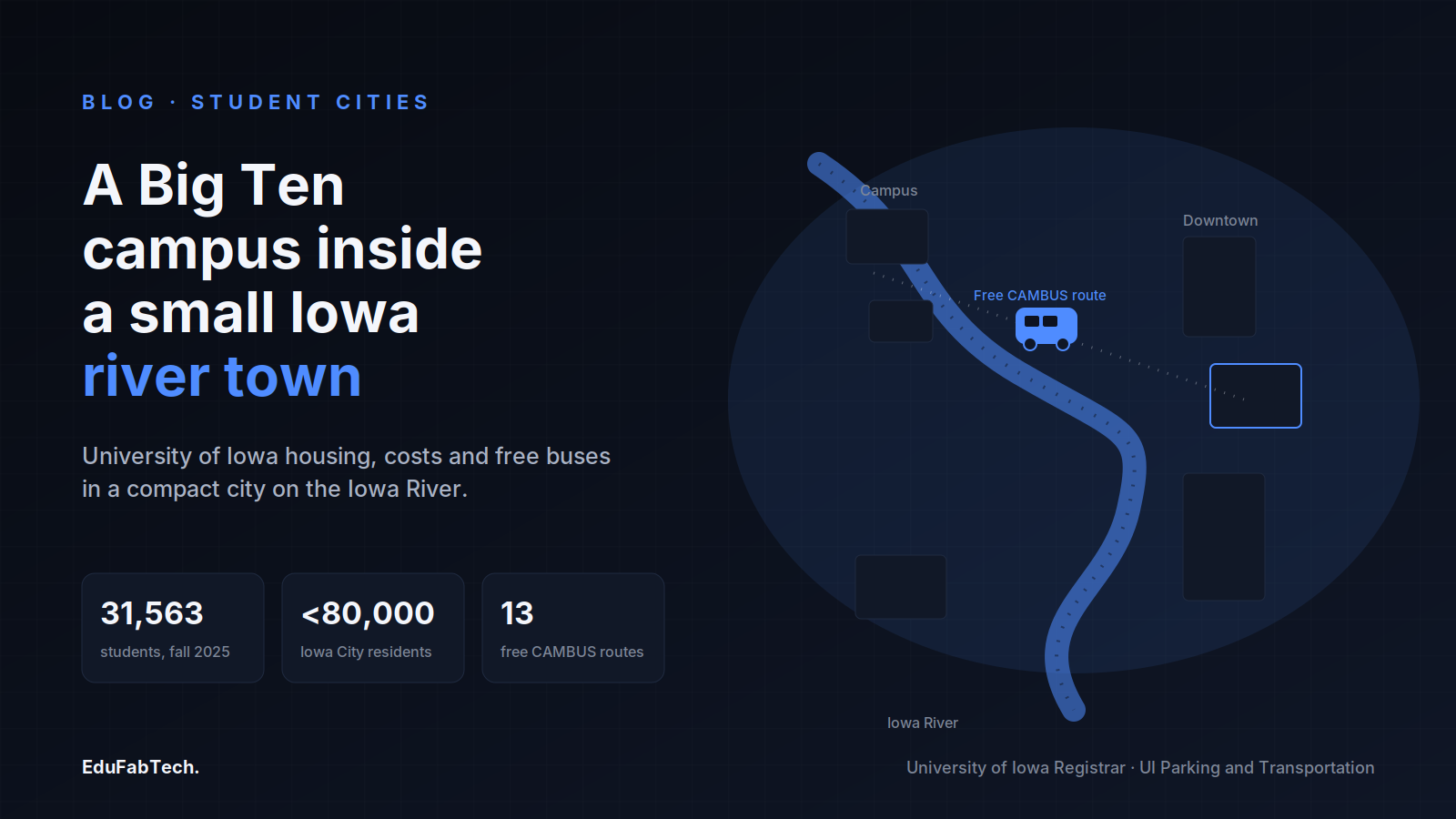
A Big Ten campus folded into a small city on the Iowa River
Iowa City sits in eastern Iowa, roughly a few hours by road from Chicago, Minneapolis and St. Louis, and the University of Iowa does not so much sit beside the town as run through it. The campus straddles the Iowa River, and its downtown edge blends straight into the city's pedestrian mall, so the line between "campus" and "Iowa City" is blurry in a way it is not in most college towns. The University of Iowa's own admissions pages describe a Big Ten institution on the banks of the river, and note that it was the first state university to admit men and women on an equal basis, in 1855, according to the University of Iowa.
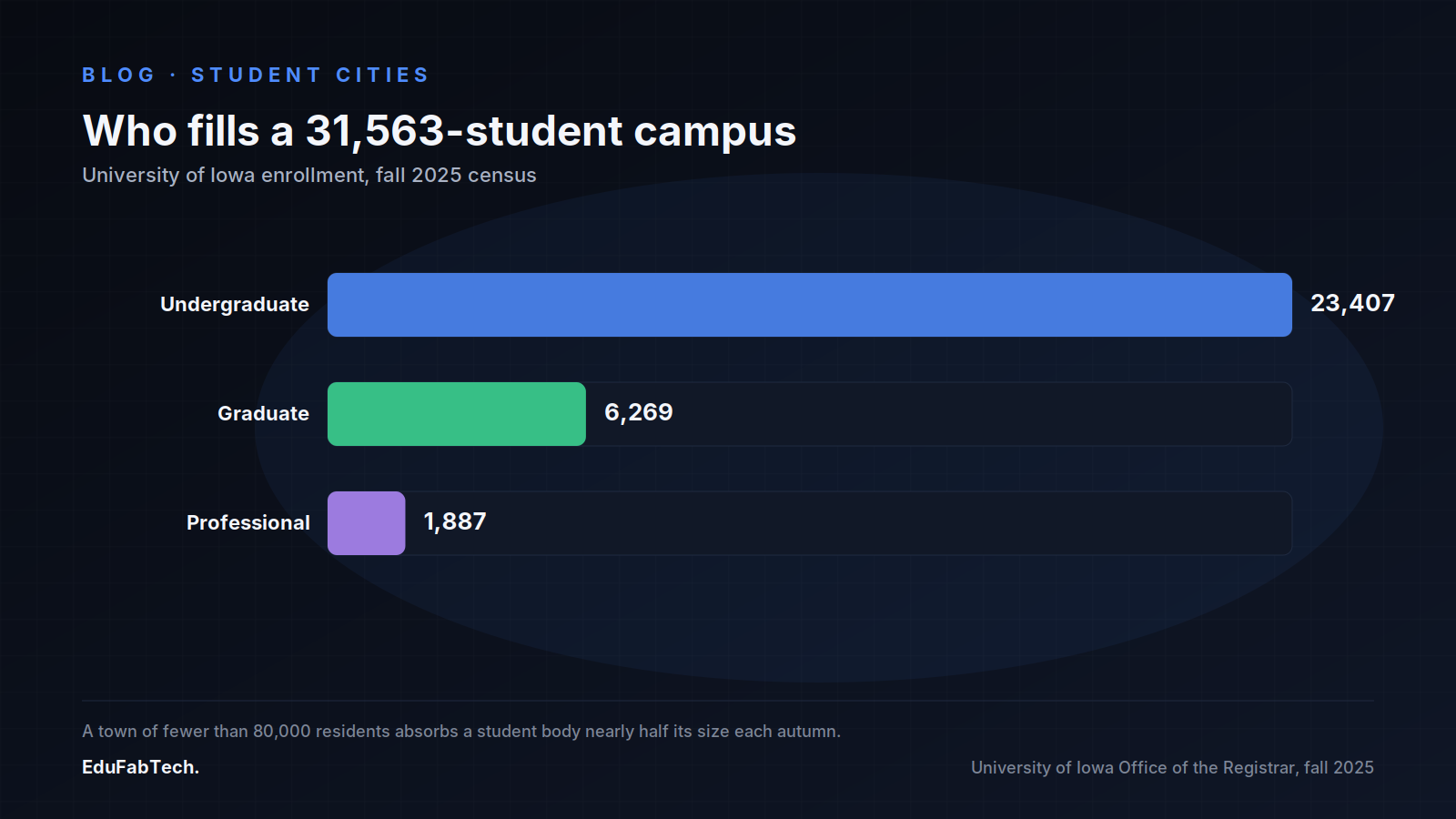
The university is large for such a compact city. The University of Iowa Office of the Registrar recorded 31,563 students in its fall 2025 census — 23,407 undergraduates, 6,269 graduate students and 1,887 professional students. That means a town of fewer than 80,000 people absorbs a student body nearly half its size each autumn, which shapes everything from rents to how full the buses are in September.
What Iowa City is known for is no secret. The Iowa Writers' Workshop began at the University of Iowa in 1936 and pioneered the teaching of creative writing at the university level, as the Iowa City UNESCO City of Literature organisation describes it; in November 2008 UNESCO named Iowa City the world's third City of Literature, after Edinburgh and Melbourne, according to the University of Iowa. Health sciences are the other anchor: University of Iowa Hospitals & Clinics, the state's academic medical centre and a Level I trauma centre, sits on the west side of campus near Kinnick Stadium, per UI Health Care. If you are drawn here, it is usually for writing, medicine and the health sciences, or the engineering and science programmes clustered along the river — plus the simple fact that a research university this size inside a walkable town is unusual.
Neighbourhoods students actually pick, from the Northside to Riverfront Crossings
Because campus and downtown overlap, where you live is mostly a question of how far you are willing to walk and what you will pay for the last five minutes. The Northside, directly north of downtown and next to campus, is the classic grad-student and upper-year area: older houses, Hickory Hill Park at its edge, quieter streets. Downtown and College Hill (just east, around the historic houses and sorority/fraternity blocks) put you on top of classes, cafés and bars, at the highest rents and the most noise. Riverfront Crossings, the newer-build district south of downtown, has the tall purpose-built blocks; Longfellow, southeast, is leafier and a short bike ride in. The City of Iowa City's neighbourhood pages are a sober way to read each area before you commit.
Many undergraduates start in University Housing & Dining residence halls — Catlett, Currier, Burge, Mayflower and others along the river and on the east side — and move out after first year. If you want to be further from the student core, Coralville and North Liberty, the adjoining towns to the northwest, have more apartments and are tied back to campus by bus. A full picture of current listings across the city is on EduFabTech's Iowa City page and the listings near the University of Iowa.
Signing a lease here without losing a deposit
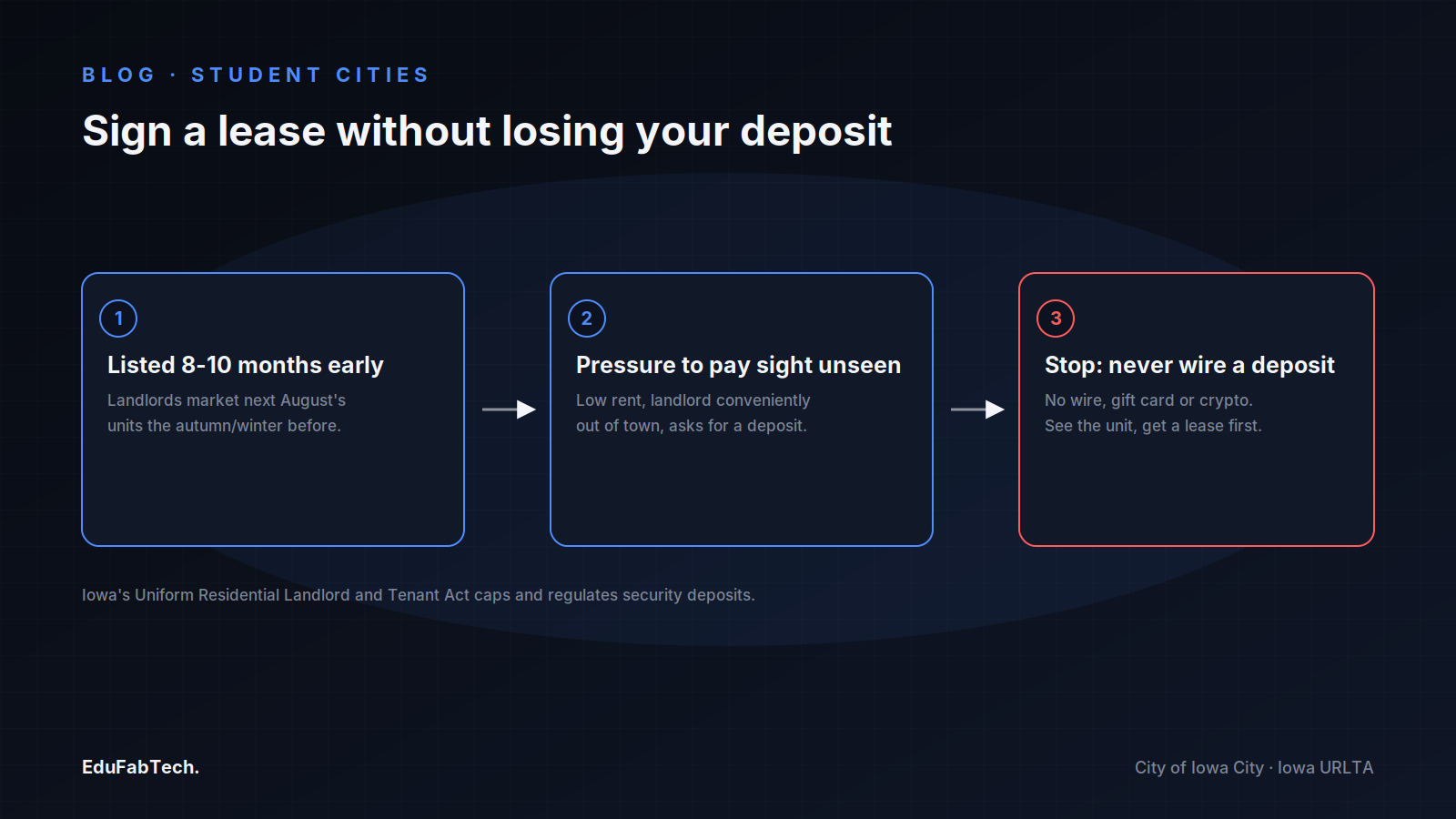
Iowa City runs on an unusually early leasing cycle. Landlords often market the next August's units in the preceding autumn and winter, so students hunting for a downtown or Northside place frequently sign eight to ten months ahead — long before they have seen how a building behaves in February. Starting early helps, but it also pressures people into paying before viewing, which is exactly where things go wrong.
The scams that appear here follow a pattern: a "listing" at a suspiciously low rent near campus, a landlord who is conveniently out of town, and a request to wire a deposit or holding fee to secure it sight unseen. Treat any of that as a stop sign. See the unit in person (or have someone you trust see it), meet whoever you are paying, and get a written lease before money changes hands. Never send a deposit by bank wire, gift card or cryptocurrency to "hold" a room — those payments are effectively unrecoverable, and no legitimate Iowa City landlord needs them. Iowa's landlord–tenant law caps and regulates security deposits and sets rules for their return; read the lease against the state's Uniform Residential Landlord and Tenant Act before signing. For rooms and sublets posted by other students, EduFabTech keeps a local rooms listing for the city.
Furnishing a room on Highway 6, and a Saturday market downtown
Furnishing cheaply is easy here because the second-hand trade is concentrated and genuinely good. Several of the larger shops sit along Highway 6 East, a short ride from campus: Crowded Closet, a thrift shop at 851 Hwy 6 E that has run for more than four decades and channels its proceeds to the Mennonite Central Committee, per the Crowded Closet shop; the large Stuff Etc. consignment store; and a busy Goodwill on the same stretch. Between them you can furnish a first apartment — desk, lamps, kitchen kit — for very little.
In the warmer half of the year, the Iowa City Farmers Market at the Chauncey Swan ramp and park downtown runs Saturdays from 7:30 a.m. to noon, roughly May through late October, and is managed by the city's Parks and Recreation department, according to the City of Iowa City. It is as much a social fixture as a grocery run. For the hand-me-down economy that moves fastest at move-in and move-out — late July, early August, and the end of spring term — EduFabTech tracks local second-hand things, furniture, and items being given away free.
Part-time work, and what changes if you are international
For students who can work freely, campus jobs and downtown service work are the usual options, and EduFabTech lists openings on its Iowa City jobs page. The rules are different if you are on a visa, and they are not advice to take casually. The University of Iowa's International Students and Scholars Services states that F-1 students may work on campus up to 20 hours per week during the fall and spring semesters, and full-time (up to 40 hours per week) during official university breaks, per ISSS. Off-campus work, and training options such as CPT and OPT, carry separate authorisation requirements. This is a summary, not legal advice: confirm your own situation with ISSS and check the federal rules published by U.S. Citizenship and Immigration Services at USCIS before you accept any job.
Where to study, from the Learning Commons to the ped mall
The University of Iowa Main Library, between campus and downtown, is built around a first-floor Learning Commons with collaborative tables, booths and group study rooms where talk at a reasonable volume is fine, plus four-hour study rooms that current undergraduates can reserve at the service desk and a quiet graduate study room (Room 2001) on the second floor, open to any graduate student with a valid Iowa One Card, according to the University of Iowa Libraries. Group and study rooms can be reserved through the libraries' booking system. Beyond the Main Library, departmental libraries — including the Hardin Library for the Health Sciences near the hospital — spread desks across campus.
Off campus, the Iowa City Public Library sits on the downtown pedestrian mall at the corner of College and Linn Streets, open to residents and students alike, per the Iowa City Public Library. It is a genuine alternative when the university buildings are packed near exams, and it keeps you downtown. For desks, quiet corners and shared study spots that other students post, EduFabTech keeps an Iowa City study-spaces listing.
Getting around: two bus systems, both free, and a bike
Iowa City is one of the easier US college towns to live in without a car, largely because of its buses. The university's own system, CAMBUS, is fare-free and open to everyone — not just students — running 13 fixed routes and carrying more than three million rides a year, according to University of Iowa Parking and Transportation. It is the backbone for moving between the river campus, the hospital and the residence halls.
The city's separate operator, Iowa City Transit, reaches the neighbourhoods and the edges of town. It has run fare-free since August 2023; as the Daily Iowan reported in April 2026, the two-year pilot ended with fiscal year 2025 and the city now funds the service year to year — partly through a utility franchise-fee increase from 1% to 2% that took effect on 1 July 2025 — rather than guaranteeing it indefinitely, so check the current status before you rely on it. Coralville runs its own buses linking the adjoining town to campus. Many students simply cycle: the core is small and flat enough that a bike plus a free bus pass covers most of a semester. If you do bring a car, downtown parking is limited and metered, which is one more reason not to.
What it costs
Tuition depends heavily on residency. For 2026–27, the University of Iowa estimates tuition and mandatory fees of $11,971 for Iowa residents and $34,247 for non-residents at the undergraduate level, according to the University of Iowa Office of Admissions. The same office estimates housing and food at $14,022 for the 2026–27 year for undergraduates living on campus — the clearest single dated housing figure the university publishes, though it notes actual costs vary with the room and meal plan chosen.
The university's financial-aid cost breakdown for 2026–27 adds indirect estimates of about $950 for books and supplies, $1,254 for transportation and $3,648 for personal expenses for undergraduates, per University of Iowa Student Financial Aid. Off-campus rents vary widely by neighbourhood and are not published as a single official figure; expect downtown and College Hill to cost more than Longfellow or Coralville for the same space, and budget on the university's housing-and-food estimate as a floor rather than a promise.
| Item (2026–27, University of Iowa) | Amount (USD) |
|---|---|
| Tuition & fees — Iowa resident, undergraduate | $11,971 |
| Tuition & fees — non-resident, undergraduate | $34,247 |
| Housing & food, on campus | $14,022 |
| Books & supplies (estimate) | $950 |
| Transportation (estimate) | $1,254 |
The honest trade-offs, and a checklist for the first weeks
What is good here is the scale. A large research university, a UNESCO literary scene, a teaching hospital and a walkable downtown are packed into a town small enough to cross on a bike, and the two free bus systems mean transport is close to a non-issue. The literary and arts culture — readings, Prairie Lights, Hancher Auditorium — is real and unusually accessible for a city this size.
What is hard is also tied to the scale. The early leasing cycle pressures students into committing to apartments many months ahead, the best-located rooms go first and cost the most, and September's crush makes housing feel tighter than the numbers suggest. The isolation is real too: Iowa City is hours from the nearest big metro, and the weather swings from humid summers to genuinely cold, snowy winters that you will be walking or waiting at bus stops through. For international students, the 20-hour on-campus work limit means paid work cannot be the plan for covering fees.
A short checklist for the first weeks:
- See any room in person before paying, and never wire a deposit or pay by gift card or crypto to "hold" it.
- Start the apartment search early if you want downtown or the Northside — many leases are signed the autumn before.
- Get your student ID and ride CAMBUS and Iowa City Transit free from day one; skip the car if you can.
- International students: see ISSS before accepting any job, and confirm the current rules at USCIS.
- Furnish from the Highway 6 thrift shops and the Saturday Farmers Market; check EduFabTech's Iowa City events for move-in sales and giveaways.
- Scout study spots early — the Main Library Learning Commons and the Iowa City Public Library both fill up near exams.
A quick question for readers
Do you work part-time while you study?
Many students work to pay the bills. See how common it is — and how many hours people really do.
Pick an answer, create a free account in a minute, and your vote counts. Already a member? Sign in
Comments 0
CommentNo comments yet. Members start the conversation.
Source: University of Iowa
Sources (5)
- University of Iowa Office of Admissions. Tuition and Estimated Costs, 2026–27. University of Iowa, 2026. admissions.uiowa.edu ↗ · checked 10 Oct 2026
- University of Iowa International Students and Scholars Services. F-1 Students: On-campus Employment. University of Iowa, 2026. international.uiowa.edu ↗ · checked 10 Oct 2026
- University of Iowa Parking and Transportation. CAMBUS. University of Iowa, 2026. transportation.uiowa.edu ↗ · checked 10 Oct 2026
- City of Iowa City Parks and Recreation. Iowa City Farmers Market. City of Iowa City, 2026. icgov.org ↗ · checked 10 Oct 2026
- The Daily Iowan. Iowa City fare-free buses program approaches third year, city searches for financial stability. The Daily Iowan, 2026. dailyiowan.com ↗ · checked 10 Oct 2026