Studying in Jacksonville, United States: universities, housing and student life
A practical guide to UNF, Jacksonville University and FSCJ, and to finding a room, a bus pass and a part-time job in Florida's largest city — with sourced figures.
A city laid out around a river, not a campus
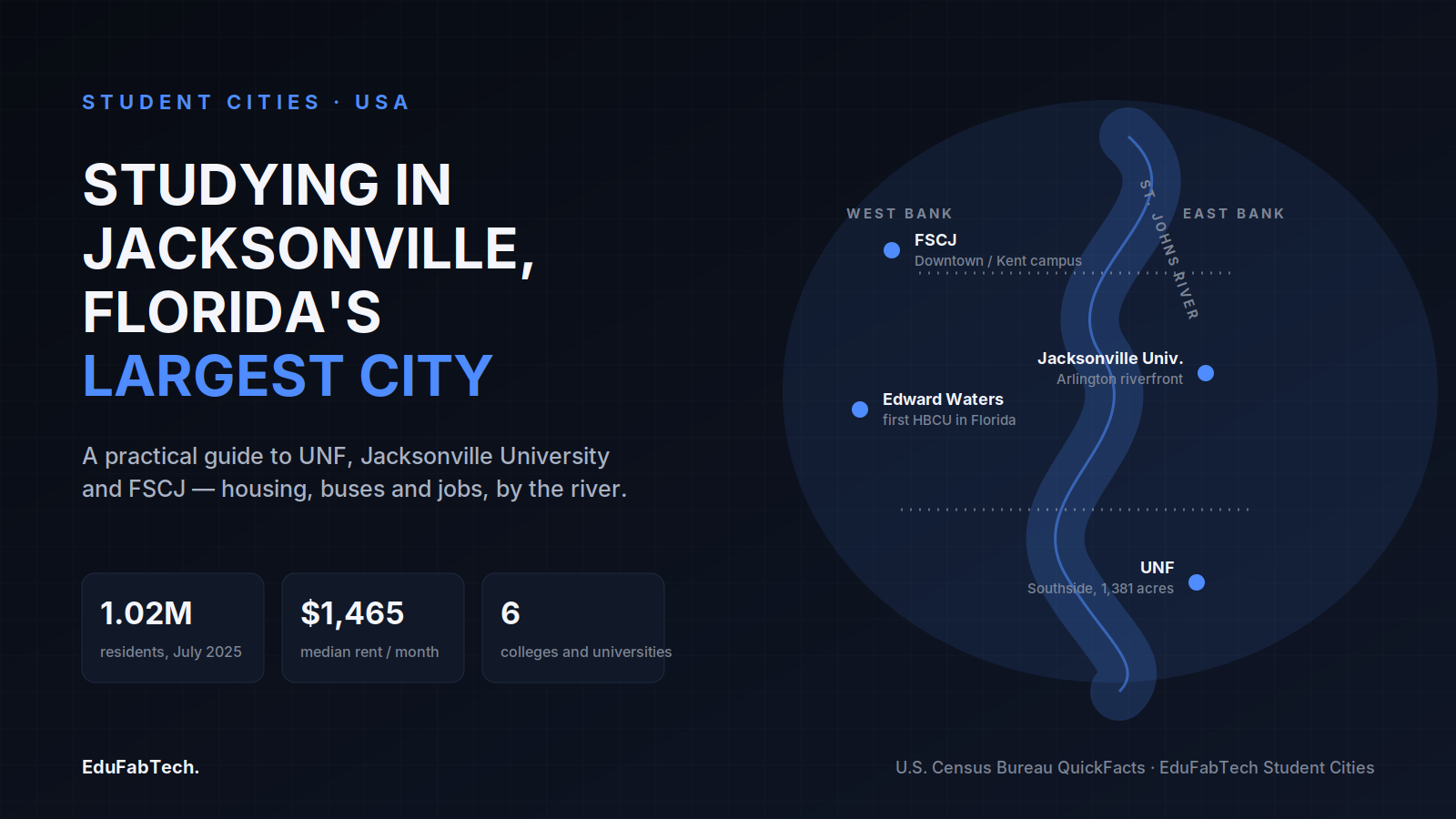
Jacksonville does not behave like most university towns. It sprawls across both banks of the St. Johns River in north-east Florida, and its colleges sit in different quarters of a city the U.S. Census Bureau estimated at 1,017,689 residents as of 1 July 2025 (U.S. Census Bureau QuickFacts). There is no single student district where everything clusters; instead you learn the geography — Downtown and the historic grid of Riverside and Avondale on the west bank, San Marco and the university-heavy Southside and Arlington on the east, and the separate beach towns a half-hour drive out. Where you choose to live decides how much of your week you will spend in a car or on a bus.
That matters because Jacksonville was built for driving. The river splits the city, a handful of bridges carry the traffic across it, and distances between the campuses are measured in highway miles. A student used to a compact European or Asian city will find the scale disorienting at first: the campus you study on, the flea market you furnish your room from, and the beach you visit on a free Saturday can be forty minutes apart. None of that is a reason to avoid the city — rents are lower than in Miami or Orlando, and the character is genuinely its own — but it shapes every practical decision below.
What follows is a guide to the universities, to finding somewhere to live without being cheated, to furnishing it cheaply, to working, studying and getting around — with every figure tied to the body that published it. Listings on EduFabTech for the city sit at /in/united-states/jacksonville-fl.
The universities, and what studying at each is like
The largest is the University of North Florida, a public institution on the Southside. Its own catalogue describes a 1,381-acre campus "halfway between downtown and the beach," wrapped around wetlands and nature trails (UNF Catalog, About UNF). UNF's faculty handbook records that the university was authorized by the Florida Legislature in 1965 and opened in 1972 as an upper-division and graduate institution with a roughly 2,000-member student body (UNF Faculty Handbook, Chapter 1). It is organised into six colleges — Brooks College of Health, Coggin College of Business, the College of Arts and Sciences, the College of Computing, Engineering and Construction, the Silverfield College of Education and Human Services, and the Hicks Honors College (UNF Catalog). The nature-preserve setting is the thing students mention first; the trade-off is that the campus is well south of downtown, so without a car you lean on the bus.
Jacksonville University is the private counterpart, established in 1934 and set on a 235-acre riverfront campus with about three-quarters of a mile of St. Johns River frontage in the Arlington area, across the river from downtown (Jacksonville University, Jacksonville Campus). It is a smaller private university whose best-known programmes include nursing, business, marine science and aviation, and the oak-lined riverfront is its signature. Expect smaller classes than UNF and a higher sticker price that comes with being private.
Florida State College at Jacksonville (FSCJ) is the open-access state college, and for many local and international students it is the affordable entry point — associate degrees, certificates and a growing set of bachelor's programmes. FSCJ spreads across several campuses rather than one: a Downtown campus on West State Street, the Kent Campus on Roosevelt Boulevard, the North Campus on Capper Road, and the South Campus on Beach Boulevard, plus specialist centres (FSCJ, Downtown Campus). Because the campuses are scattered, check which one actually teaches your programme before you sign a lease nearby.
Three smaller institutions round out the picture. Edward Waters University, on Kings Road north-west of downtown, is Jacksonville's only historically Black university; founded in 1866 by the African Methodist Episcopal Church, it describes itself as Florida's first independent institution of higher learning and first HBCU (Edward Waters University). Jones College, founded in Jacksonville in 1918, is a long-standing degree-granting non-profit on the city's Southside. Trinity Baptist College, founded in 1974, began operating as Trinity College of Jacksonville in 2025 and grants associate, bachelor's and master's degrees from its Westside campus.
Where students settle, bank by bank
There is no one answer to where to live, because the campuses pull in different directions. Around UNF, students concentrate on the Southside and in Arlington, close to Beach Boulevard and the St. Johns Town Center; those wanting a shorter beach run look to the corridors heading east toward Jacksonville Beach and Atlantic Beach. Jacksonville University students mostly stay in Arlington on the east bank near their own campus. Students at FSCJ's Downtown and Kent campuses, and at Edward Waters, tend to look toward the walkable historic neighbourhoods of Riverside, Avondale and San Marco, which have older apartments, small shops and more street life than the Southside subdivisions. Browse rooms listed near the largest campus at /near/university-of-north-florida.
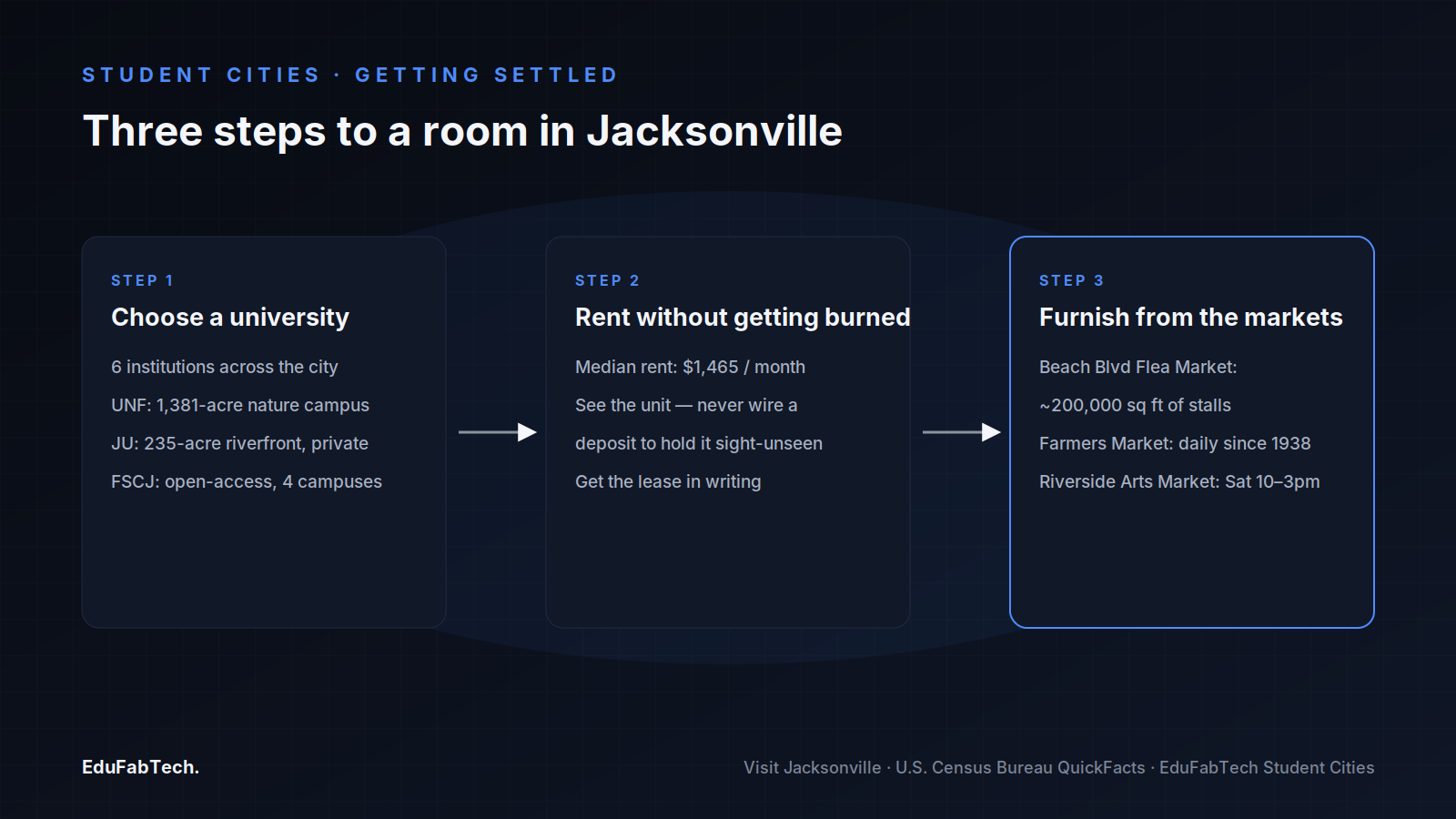
For a benchmark on the private market, the U.S. Census Bureau's QuickFacts put the median gross rent in Jacksonville at $1,465 a month for the 2020–2024 period (U.S. Census Bureau QuickFacts). That is a citywide median across all housing, so a shared apartment room runs below it and a new one-bedroom near the Town Center above it; treat it as the middle of the range, not a quote. General EduFabTech room listings for the city are at /in/united-states/jacksonville-fl/rooms.
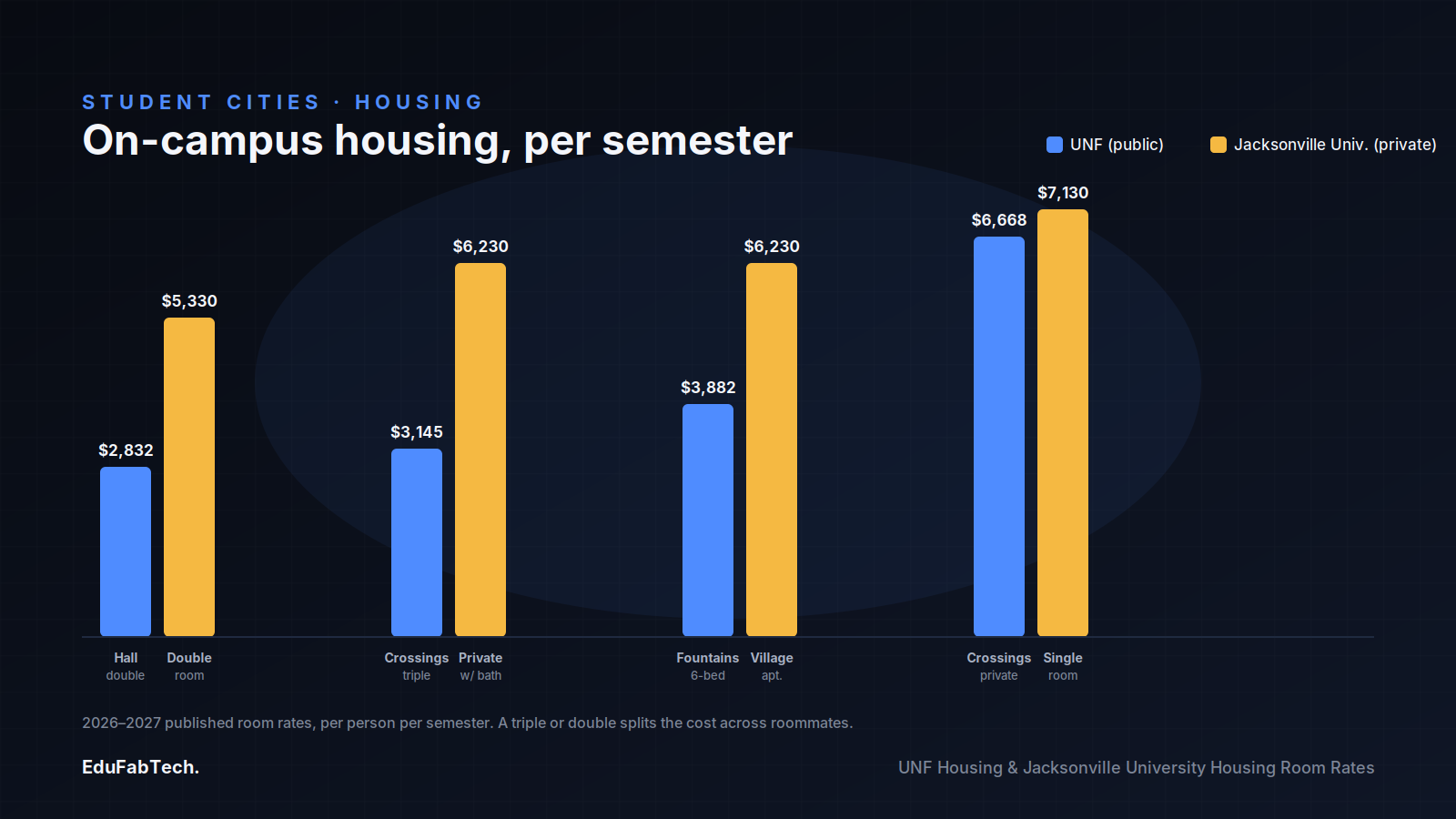
On-campus housing gives you a fixed, published price, which is useful as a reference point. For 2026–2027, the University of North Florida lists per-person, per-semester rates including a double in Osprey Hall at $2,832, a triple in Osprey Crossings at $3,145, a private bedroom in a six-bed Osprey Fountains suite at $3,882, and a private room in Osprey Crossings at $6,668 (UNF Housing Room Rates). Jacksonville University's published 2026–2027 rates are higher: a double room is $5,330 per semester, a private room with bath $6,230, a single $7,130, and a bedroom in a Village apartment $6,230 (Jacksonville University Housing Room Rates). FSCJ is primarily a commuter college, so most of its students live off campus from the start.
Renting off campus without losing your deposit
Most students here rent privately after the first year, and the scams follow a predictable Jacksonville pattern: a listing for a house or apartment in a desirable spot — a Riverside bungalow, a unit near the St. Johns Town Center — priced slightly below the going rate, with a "landlord" who is conveniently out of state and wants a holding deposit before you can see it. A normal local deposit is one month's rent plus, sometimes, a separate pet or security fee paid when you sign a written lease; it is never a wire transfer to hold a place sight-unseen.
Protect yourself with a few habits that are specific to how renting works here. See the actual unit in person, or send someone you trust — in a sprawling city it is easy to be shown photos of a building you never visit. Confirm the person collecting money is the owner or a licensed manager before paying anything. And never send a deposit by bank wire, gift card or cryptocurrency "to hold" a room; those payments cannot be reversed, and legitimate Jacksonville landlords do not ask for them. Get the lease and every promise in writing. Check whether utilities and renter's insurance are included, because summer air-conditioning bills in Florida are real money. EduFabTech does not name private landlords or agencies; it lists rooms directly.
Furnishing a room from the city's markets
Jacksonville is unusually well supplied with second-hand and market shopping, which keeps the cost of setting up a room down. The Beach Boulevard Flea Market at 11041 Beach Blvd on the Southside runs year-round across roughly 200,000 square feet of vendor stalls, selling everything from furniture and household goods to tools (Visit Jacksonville) — it is the obvious first stop for a cheap desk, lamp or bed frame. The Jacksonville Farmers Market at 1810 W Beaver Street has operated since 1938 and runs daily, the best place for fresh produce by weight rather than supermarket prices (Visit Jacksonville). For weekend atmosphere, the Riverside Arts Market sets up every Saturday from 10 a.m. to 3 p.m. under the Fuller Warren Bridge at 715 Riverside Avenue, mixing local produce with crafts and music (Visit Jacksonville).
For furniture and kit specifically, EduFabTech's city pages collect second-hand goods, furniture and give-aways at /in/united-states/jacksonville-fl/second-hand — worth watching at the end of each semester, when departing students clear out their rooms.
Working while you study
Students on an F-1 visa should read the rules from the source rather than from word of mouth. The U.S. Student and Exchange Visitor Program states that F-1 students may work on campus up to 20 hours per week while school is in session, and may work full-time during official breaks; on-campus employment does not require separate work authorization from U.S. Citizenship and Immigration Services (U.S. Immigration and Customs Enforcement, SEVP Employment). Off-campus work generally requires prior authorization; the main pathways, Curricular Practical Training and Optional Practical Training, are tied to your programme of study (ICE SEVP). The specifics depend on your individual status, so confirm anything with your university's international student office before you accept a job — this guide is not legal advice. Local openings, including on-campus roles, are listed at /in/united-states/jacksonville-fl/jobs.
Libraries and places to study
UNF's Thomas G. Carpenter Library at 1 UNF Drive keeps long hours during the week and offers reservable group study rooms (UNF Library Hours), which makes it the default late-night spot for students on the Southside. Off campus, the Jacksonville Public Library runs its Main Library at 303 North Laura Street downtown, open Monday to Saturday, plus a network of neighbourhood branches across the city (Jacksonville Public Library, Main Library). The branch network is genuinely useful in a city this spread out: there is likely a free, quiet, air-conditioned reading room within a short bus ride of wherever you land. More desks and study spaces are listed at /in/united-states/jacksonville-fl/study-spaces.
Getting around a car-shaped city
Public transport is run by the Jacksonville Transportation Authority (JTA). A standard cash bus fare is $1.75 and a 31-day pass is $65, with a reduced-fare 31-day pass at $32; fares can be paid in cash on board or through the MyJTA app, which applies the lowest applicable fare automatically (JTA, Fares / Passes). JTA also runs a college-student reduced-fare programme under which eligible full- or part-time students can buy single rides for $1.00 and a 31-day pass for $35.00 through Token Transit enrolment (JTA, Fares / Passes) — worth setting up in your first week. Downtown, the Skyway automated people-mover is free to ride and links key downtown stops (JTA, Fares / Passes). Passes and reduced-fare STAR Cards can be sorted at the Jacksonville Regional Transportation Center at LaVilla, the downtown transit hub.
Be honest with yourself about the limits. The bus network covers the main corridors but runs infrequently on many routes, and the city's size means a cross-town trip can take well over an hour. Students without a car tend to pick housing deliberately close to their campus or on a direct bus line; those with a car gain enormous flexibility but take on insurance, parking and summer fuel costs. JTA also operates the St. Johns River Ferry, which carries pedestrians, cyclists and vehicles across the river's mouth toward the beaches for a fare.
The honest ledger: what is good, what is hard
The case for Jacksonville is straightforward. Housing is cheaper than in Florida's flashier cities — the Census median gross rent of $1,465 for 2020–2024 (U.S. Census Bureau) undercuts the coastal tourist markets — and Florida levies no state income tax, so a part-time wage stretches further. The beaches are a genuine amenity, the UNF campus is unusually green, and the historic neighbourhoods of Riverside, Avondale and San Marco give the city real texture.
The hard parts are equally real. The sprawl makes a car close to essential unless you plan your life tightly around campus and bus lines, and the transit network, while improving, will frustrate anyone used to frequent service. Summers are long, hot and humid, and Jacksonville sits in the Atlantic hurricane season, which can disrupt a semester. As in any large American city, safety and quality vary sharply by neighbourhood, so the single best thing you can do is visit an area at different times of day before committing to a lease.
A checklist for the first weeks
- Pick housing by your actual campus and your realistic transport — a UNF student and an FSCJ Downtown student should not be looking in the same place.
- See any room in person before paying; never wire a deposit or send gift cards or crypto to "hold" it.
- Enrol in JTA's college reduced-fare programme through Token Transit ($35.00 for a 31-day pass) and keep the MyJTA app for everyday fares (JTA).
- If you are an international student, meet your university's international office and confirm your work limits against the ICE SEVP rules before taking any job.
- Furnish from the Beach Boulevard Flea Market and the EduFabTech second-hand pages before buying anything new.
- Get a Jacksonville Public Library card for free study space and air-conditioning across the city's branches.
- Budget for summer electricity and, if you drive, car insurance — both are easy to underestimate in Florida.
A quick question for readers
Do you work part-time while you study?
Many students work to pay the bills. See how common it is — and how many hours people really do.
Pick an answer, create a free account in a minute, and your vote counts. Already a member? Sign in
Comments 0
CommentNo comments yet. Members start the conversation.
Source: University of North Florida
Sources (5)
- University of North Florida. Housing Room Rates: Fall 2026/Spring 2027. University of North Florida, 2026. unf.edu ↗ · checked 12 Oct 2026
- Jacksonville University. Housing Room Rates. Jacksonville University, 2026. ju.edu ↗ · checked 12 Oct 2026
- Jacksonville Transportation Authority. Fares / Passes. Jacksonville Transportation Authority, 2026. jtafla.com ↗ · checked 12 Oct 2026
- U.S. Census Bureau. QuickFacts: Jacksonville city, Florida. U.S. Census Bureau, 2025. census.gov ↗ · checked 12 Oct 2026
- U.S. Immigration and Customs Enforcement. SEVP: Employment. U.S. Department of Homeland Security, 2026. ice.gov ↗ · checked 12 Oct 2026