Studying in Laramie: universities, housing and student life
A practical, sourced guide to studying in Laramie, Wyoming — its two schools, where students live at 7,220 feet, what a room costs, how the free campus bus works, and what the altitude and winters really ask of you.
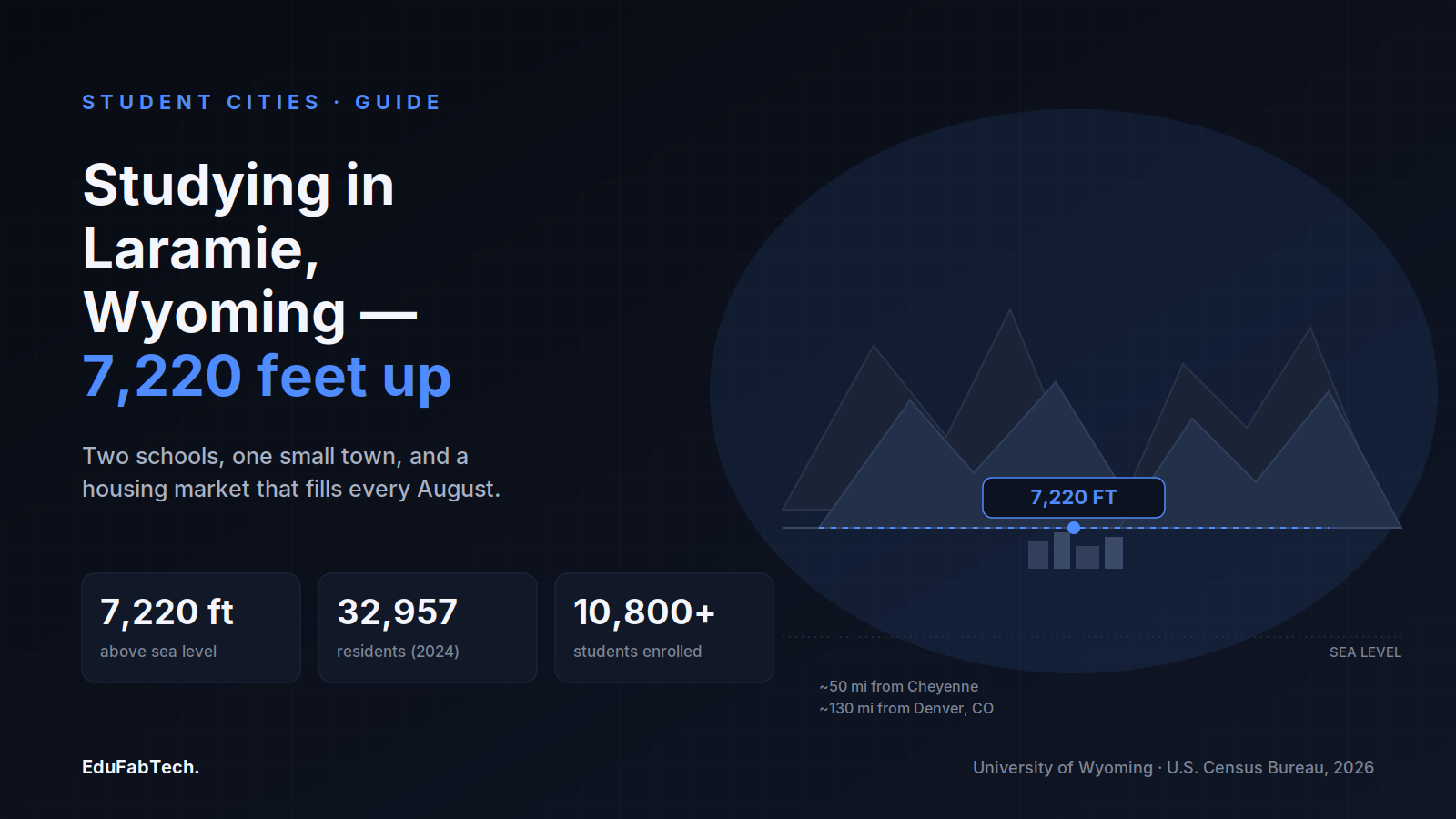
Laramie is a railroad town turned university town on a high, treeless plain in southeastern Wyoming. The University of Wyoming's own description of the city puts it at 7,220 feet above sea level, sitting between two mountain ranges, about 50 miles west of the state capital Cheyenne and roughly 130 miles north of Denver, Colorado (University of Wyoming, About Laramie, 2026). The altitude is not a footnote here: it shapes the weather, the way you breathe on your first walks across campus, and the length of the winter. If you are deciding whether to study here, start with that number and work outward.
It is also a small place. The U.S. Census Bureau's QuickFacts estimate for Laramie city was 32,957 people as of 1 July 2024 (U.S. Census Bureau QuickFacts, 2024), and the University of Wyoming reports enrolling more than 10,800 students (University of Wyoming, About Laramie, 2026). That ratio — roughly one student for every three residents — is the single fact that explains most of what follows: the town empties and fills with the academic calendar, the rental market tightens every August, and the social life of the place runs through the campus rather than around it.
What you get in return is compactness and a short walk to a genuinely used downtown. The university notes that Laramie's downtown was named one of the nation's top three main streets in 2022 (University of Wyoming, About Laramie, 2026), and in practice the historic blocks along Grand Avenue and Ivinson Avenue, a few minutes' walk west of campus, are where students eat, buy coffee and meet. The gridded streets numbered up from the railroad make orientation easy; the mountains on the horizon make it hard to get lost.
Two very different schools in one small city
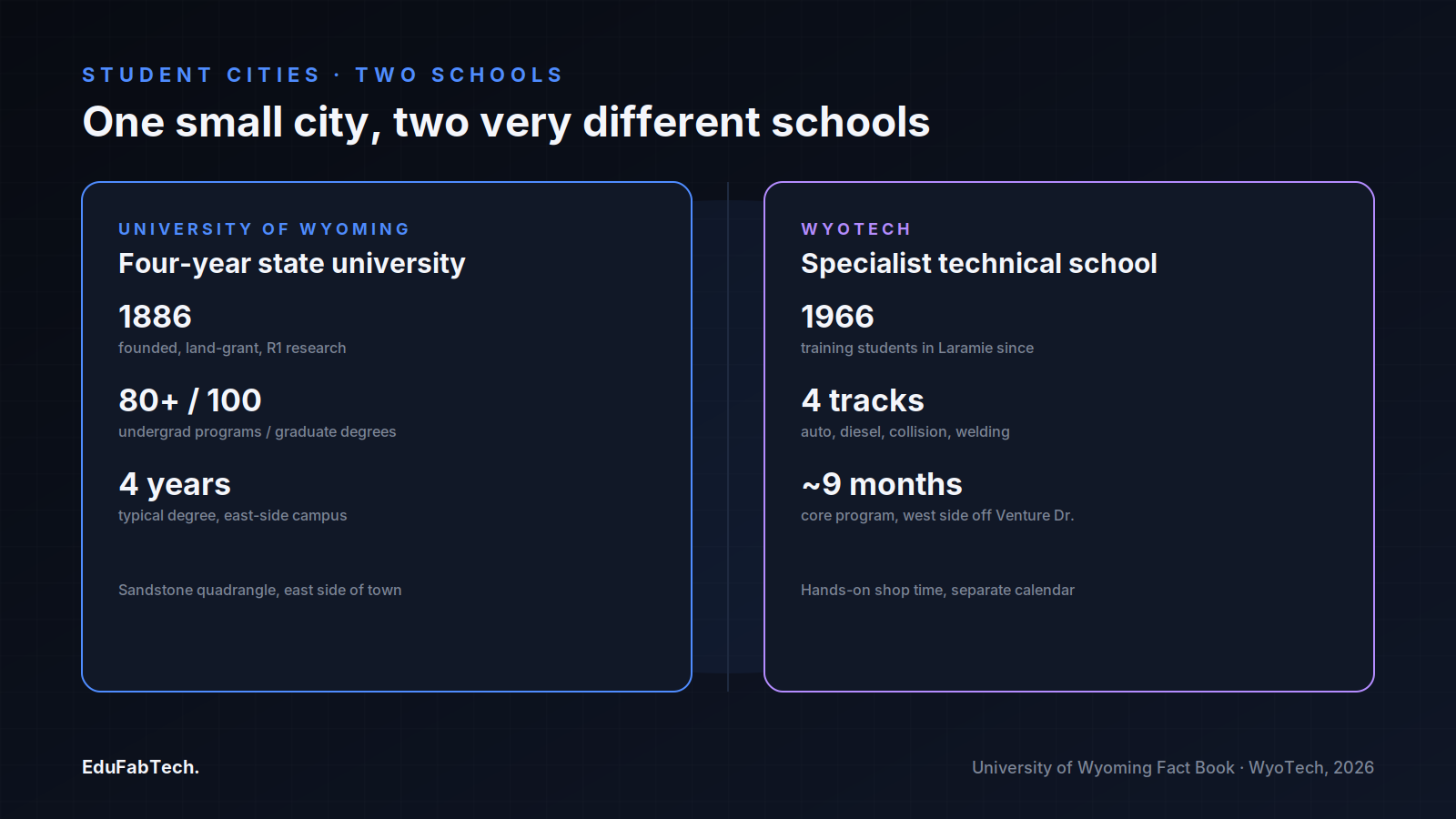
Laramie has two degree-granting institutions, and they could hardly be more different. The University of Wyoming is the larger and better known. It was founded in 1886 as the state's Morrill Act land-grant institution and remains Wyoming's only university, carrying the Carnegie R1 research classification and offering, by its own count, over 80 undergraduate programs and 100 graduate degrees (University of Wyoming Office of Institutional Analysis, UW Fact Book, 2026). Its main campus occupies a large tract on the east side of town, built in the local sandstone that gives the older quadrangle its warm colour. Because it is the whole state's university, the mix of programmes is unusually broad for a town this size — agriculture, engineering, law, education, energy and the health sciences all share the same walkable campus.
WyoTech is the other, and it is a specialist technical school rather than a university. On its own site it says it has been training students in Laramie since 1966 and runs core programmes in automotive, diesel, collision/refinishing and applied welding technology, each followed by a choice of three-month specialties, with students spending about half their time in the shop and finishing in roughly nine months (WyoTech, 2026). Its campus sits on the west side of town off Venture Drive. If you are coming to Laramie for a hands-on trade qualification rather than a four-year degree, this is the institution to look at; its calendar, housing arrangements and student culture are separate from the university's.
Studying at the University of Wyoming feels, day to day, like studying at a large institution in a small body. Class sizes benefit from the modest overall enrolment, yet the research footprint is real, and the single campus means the library, the union, the recreation centre and most departments are within a ten-minute walk of one another. For listings and services clustered around the two schools, EduFabTech keeps separate pages for University of Wyoming and WyoTech.
Where a room comes from, and when to start looking
Housing in Laramie divides cleanly into three kinds. The first is university residence halls, concentrated on the north and east of campus. The second is the belt of older houses and small apartment blocks in the streets immediately west and south of campus — roughly the area between the campus and downtown, and south along the numbered streets — which is where most upper-year and graduate students end up. The third is the newer apartment developments further out toward the edges of town, which generally need the bus or a bike.
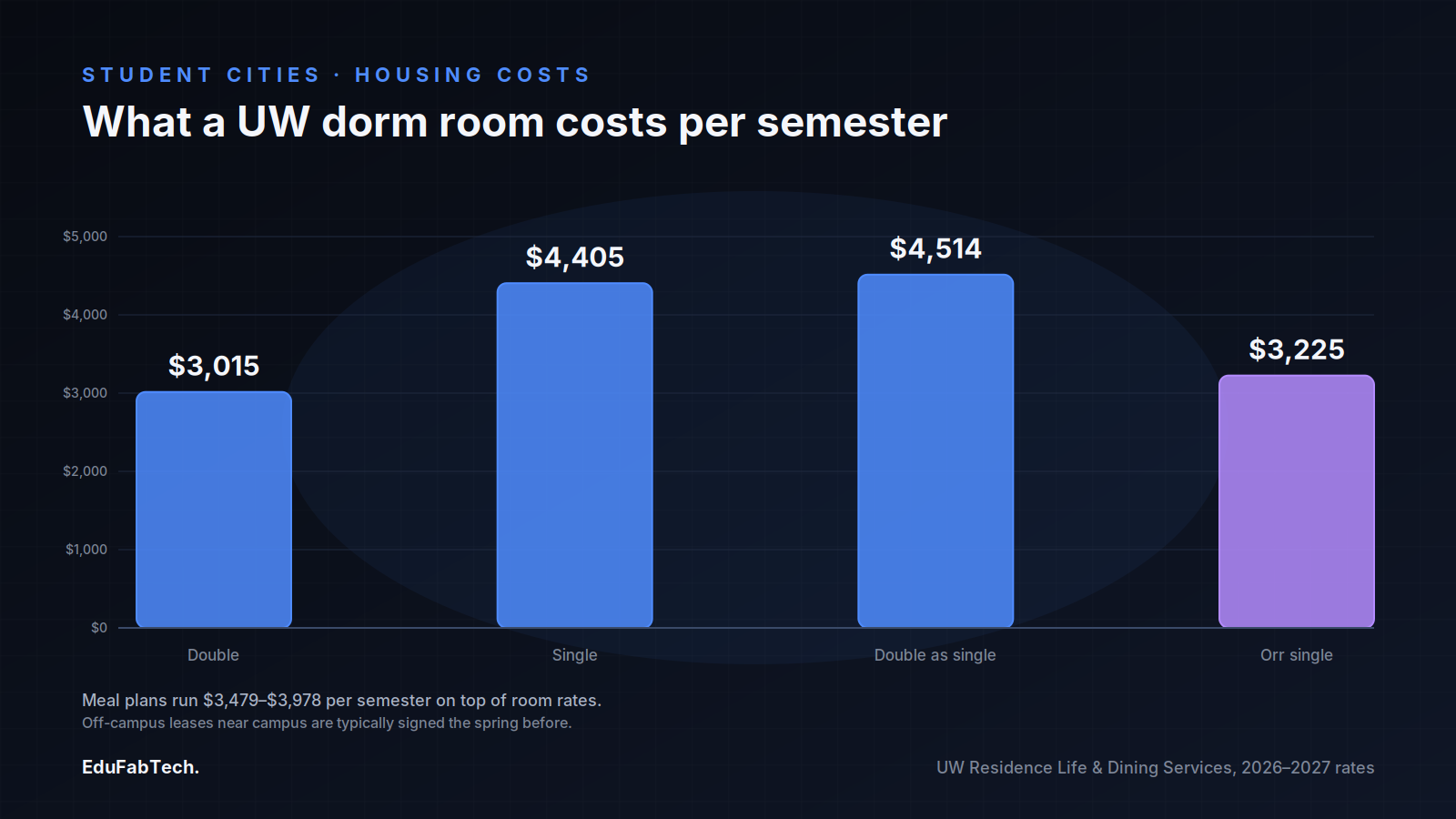
The university's Residence Life and Dining Services publishes its rates openly, which makes the dormitory the easiest option to price exactly. For the 2026–2027 year a standard double room runs $3,015 per person per semester and a standard single $4,405, with a "double as a single" at $4,514, while residential meal plans range from $3,479 to $3,978 per semester (University of Wyoming Residence Life & Dining Services, 2026–2027 rates). The university has also added an upperclassman and returning-student hall at Orr, with single rooms listed at $3,225 per semester on the same page, for students who want a hall contract beyond first year.
The off-campus market is where timing matters. Because the town is small and the student share of it is large, the good houses near campus are spoken for early — leases for the following August are often signed during the spring. If you are arriving for the autumn, begin looking in the preceding spring or early summer rather than in August, when what is left tends to be the least convenient and most expensive. Rooms and shared houses posted by EduFabTech users for the city are collected at rooms in Laramie, alongside the general Laramie listings.
On safety: the scams that appear in Laramie are the ordinary ones that follow any tight student market. A listing is posted for a house near Grand Avenue or in the west-of-campus streets at a rent that looks too good; the "owner" is conveniently out of state and asks you to send a deposit to hold it before you can see it. Do not. See the place in person, or have someone you trust see it, before any money changes hands, and meet whoever is renting it. A deposit paid by bank wire, gift card or cryptocurrency is effectively gone and cannot be reversed — legitimate Laramie landlords take a cheque or a normal transfer once you have a signed lease and have seen the unit. If you are abroad and cannot visit, lean on the university's housing office rather than paying a stranger to "reserve" a room.
Furnishing a room without buying new
A university town with a strong academic calendar produces a reliable second-hand cycle: every May, departing students shed furniture, bikes, kitchen kit and lamps, and every August the next cohort needs them. Laramie's downtown, compact and walkable, has thrift and consignment shops within reach of the campus, and the move-out weeks around the end of spring semester are when the best items appear cheaply or free on the curb. Rather than buying a new desk and mattress for a nine-month stay, plan to furnish from this flow. EduFabTech gathers local second-hand items, used furniture and things being given away free in the city, which is worth checking in the weeks before and after each semester turns over.
Two practical notes specific to Laramie. First, the altitude and dry climate mean a warm duvet, a humidifier and lip balm are early purchases, not luxuries; buy the bulky bedding second-hand if you can. Second, a bicycle is genuinely useful for the flat grid in the warmer months but needs to survive winter storage — a used, unfussy bike you are willing to leave outside is a better bet than anything expensive.
Part-time work and the rules that apply
Local students work the usual mix of campus jobs, downtown cafés and shops, and seasonal work. For international students the rules are federal and firm, and they are worth reading from the source rather than from hearsay. The U.S. Citizenship and Immigration Services states that F-1 students may not work off campus during their first academic year but may accept on-campus employment subject to conditions (USCIS, Students and Employment). The Department of Homeland Security's Study in the States guidance adds the hour limit: on-campus employment may not exceed 20 hours per week when school is in session (DHS, Working in the United States). Anything beyond on-campus work — the Curricular Practical Training and Optional Practical Training options tied to your programme — runs through your designated school official, which at the University of Wyoming is the International Students and Scholars office. This is not legal advice; confirm your own situation with that office before you accept any job. EduFabTech's Laramie jobs page lists local openings, but eligibility is yours to verify.
Libraries and places to study
The anchor is the William Robertson Coe Library, the University of Wyoming's main library since 1957 and, the libraries say, the largest in the state, with roughly 1,500 study spaces for group and individual work and a Student Learning Commons on Level 1 that brings tutoring, the writing centre and technology help under one roof (University of Wyoming Libraries, Coe Library, 2026). The range of spaces — quiet floors in the stacks, group areas, reservable rooms and collaborative pods — means you can usually find the kind of room your task needs rather than settling for whatever is free.
Off campus, the Albany County Public Library sits downtown at 310 S. 8th Street (Albany County Public Library, Location & Hours), a short walk from the historic blocks and a useful alternative when the campus library is at its busiest around exams. Between the two, plus downtown cafés, a student without a quiet room at home has places to work most days of the week; EduFabTech also lists bookable desks and study spaces in Laramie.
Getting around a town built for walking
Laramie is small enough that many students never need a car, and the campus bus makes that realistic. The University of Wyoming Transit System, branded Roundup, runs fixed routes centred on campus — an Express shuttle roughly every 10 minutes and a Link shuttle roughly every 20 minutes that reaches Walmart, Laramie County Community College's local centre and the outer residence halls — Monday to Friday from 6:30 a.m. to 6:30 p.m., and it is open to the public (University of Wyoming Transit System). The same service runs SafeRide, an on-call service that offers no-cost rides anywhere within city limits on late nights and weekends (University of Wyoming SafeRide). The fixed routes are fare-free, so there is no ticket or pass to buy — a meaningful saving, and a point in Laramie's favour for a car-free student.
Beyond the bus, the flat grid is good for cycling and walking in the warmer months; the limiting factor is weather, not distance. For leaving town, Cheyenne and Denver are the practical gateways by road, and an intercity coach stop links Laramie to that corridor. Within town, plan your winter commute around wind and ice rather than around mileage.
What it costs
The honest headline is that Laramie is relatively affordable by the standards of U.S. university towns, though the gap has narrowed. The clearest single rent figure comes from the Census Bureau: median gross rent in Laramie city was $925 per month over the 2020–2024 period, against a median household income of $55,613 in the same period (U.S. Census Bureau QuickFacts). That citywide median covers all households, not just student shares near campus, so a room in a shared house can sit below it and a newer apartment above it; treat it as a floor-to-ceiling guide, not a quote. On the dormitory side, the university's published $3,015-per-semester double and meal plans up to $3,978 per semester give you an exact, bookable comparison (University of Wyoming, 2026–2027 rates). Wyoming levies no state income tax, which affects take-home pay from any job you hold here, though that is a matter for your own tax situation rather than a saving you should bank in advance.
What is good, and what is hard
The good is specific. Laramie is compact, the campus is genuinely walkable, the main bus service costs nothing, and the surrounding landscape is close enough that hiking, climbing and skiing are weekend activities rather than expeditions — the university lists some 233 sunny days a year to go with it (University of Wyoming, About Laramie, 2026). Rent, measured by the Census median, remains lower than in many larger college cities. A small town with one dominant university also means a dense, friendly student culture where you are not anonymous.
The hard is equally specific, and it comes down to altitude, weather and scale. At 7,220 feet the winters are long and the university reports around 48 inches of snow a year (University of Wyoming, About Laramie, 2026); the wind on the plain can make a cold day colder, and the first weeks of thin air take adjustment. The small rental market tightens hard every August, so late arrivals pay for it in choice and price. And a town of about 33,000 is quiet — the nightlife, the shopping and the job market are modest, and a trip to a big city means a drive. Whether those are deal-breakers depends on what you want from your years here; they are not hidden, and you should decide about them before you arrive, not after.
A short checklist for the first weeks
- Sort housing before late summer if you can; if you must arrive without it, book a few nights somewhere and view rooms in person before paying anything.
- Never send a deposit by wire, gift card or cryptocurrency to "hold" a place you have not seen — pay only after a signed lease and a viewing.
- Learn the two Roundup routes and the SafeRide number in your first week; both are free and cover most of what you need in town.
- Buy for the climate early: warm bedding, a humidifier and layers for wind and snow, second-hand where you can.
- If you are an international student, visit the International Students and Scholars office before accepting any job, and keep on-campus work within 20 hours a week while classes are in session (DHS, Working in the United States).
- Get a Coe Library tour and find your preferred floor before exam season fills it.
- Check EduFabTech's Laramie events and second-hand pages during the May and August turnover, when furniture and bikes change hands cheaply.
A quick question for readers
Do you work part-time while you study?
Many students work to pay the bills. See how common it is — and how many hours people really do.
Pick an answer, create a free account in a minute, and your vote counts. Already a member? Sign in
Comments 0
CommentNo comments yet. Members start the conversation.
Source: University of Wyoming
Sources (5)
- University of Wyoming. About Laramie. University of Wyoming, 2026. uwyo.edu ↗ · checked 13 Oct 2026
- University of Wyoming Residence Life & Dining Services. 2026-2027 Housing Rates. University of Wyoming, 2026. uwyo.edu ↗ · checked 13 Oct 2026
- U.S. Census Bureau. QuickFacts: Laramie city, Wyoming. U.S. Census Bureau, 2024. census.gov ↗ · checked 13 Oct 2026
- U.S. Department of Homeland Security. Working in the United States (Study in the States). U.S. Department of Homeland Security, 2026. studyinthestates.dhs.gov ↗ · checked 13 Oct 2026
- University of Wyoming Libraries. William Robertson Coe Library. University of Wyoming, 2026. uwyo.edu ↗ · checked 13 Oct 2026