Studying in Las Cruces: universities, housing and student life
A practical, sourced guide to studying in Las Cruces, New Mexico — New Mexico State University and Doña Ana Community College, where students live, what it costs, and how to get around.
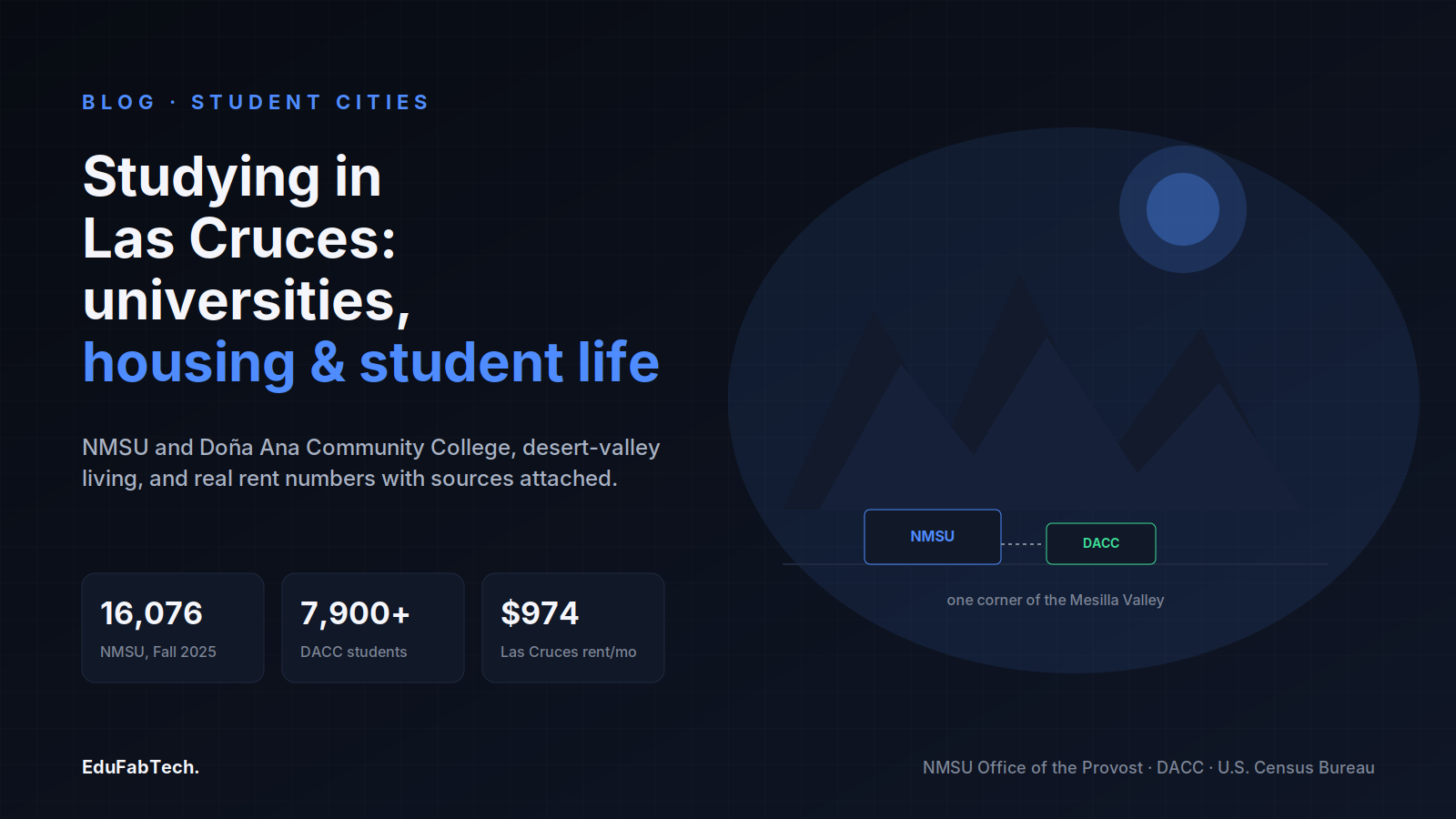
Las Cruces sits in the Mesilla Valley of southern New Mexico, strung along the Rio Grande with the jagged Organ Mountains rising to the east and the Chihuahuan Desert pressing in on every other side. It is roughly 45 miles northwest of El Paso, Texas, and the border at Santa Teresa, which shapes the rhythm of the place: bilingual, Mexican-influenced, sun-baked for most of the year, and far cheaper than the big university towns on either American coast. For a student, the city is small enough to cross in half an hour and warm enough that an outdoor seminar in November is normal.
The student population is anchored by two public institutions that share a corner of the city. New Mexico State University is the research-and-degree engine; Doña Ana Community College, which grew out of it and still sits within its system, is the open-door, workforce-focused partner next door. Between them they give Las Cruces a student body that is overwhelmingly local and Hispanic, with a steady minority of out-of-state and international students drawn by low costs and desert-science programmes.
This guide walks through the two institutions, where students actually sleep, what a room costs with sources attached, how the free city bus works, and the honest pros and cons of living here while you study. Where a figure appears, the institution and year are in the sentence so you can check it.
Two institutions, one corner of the valley
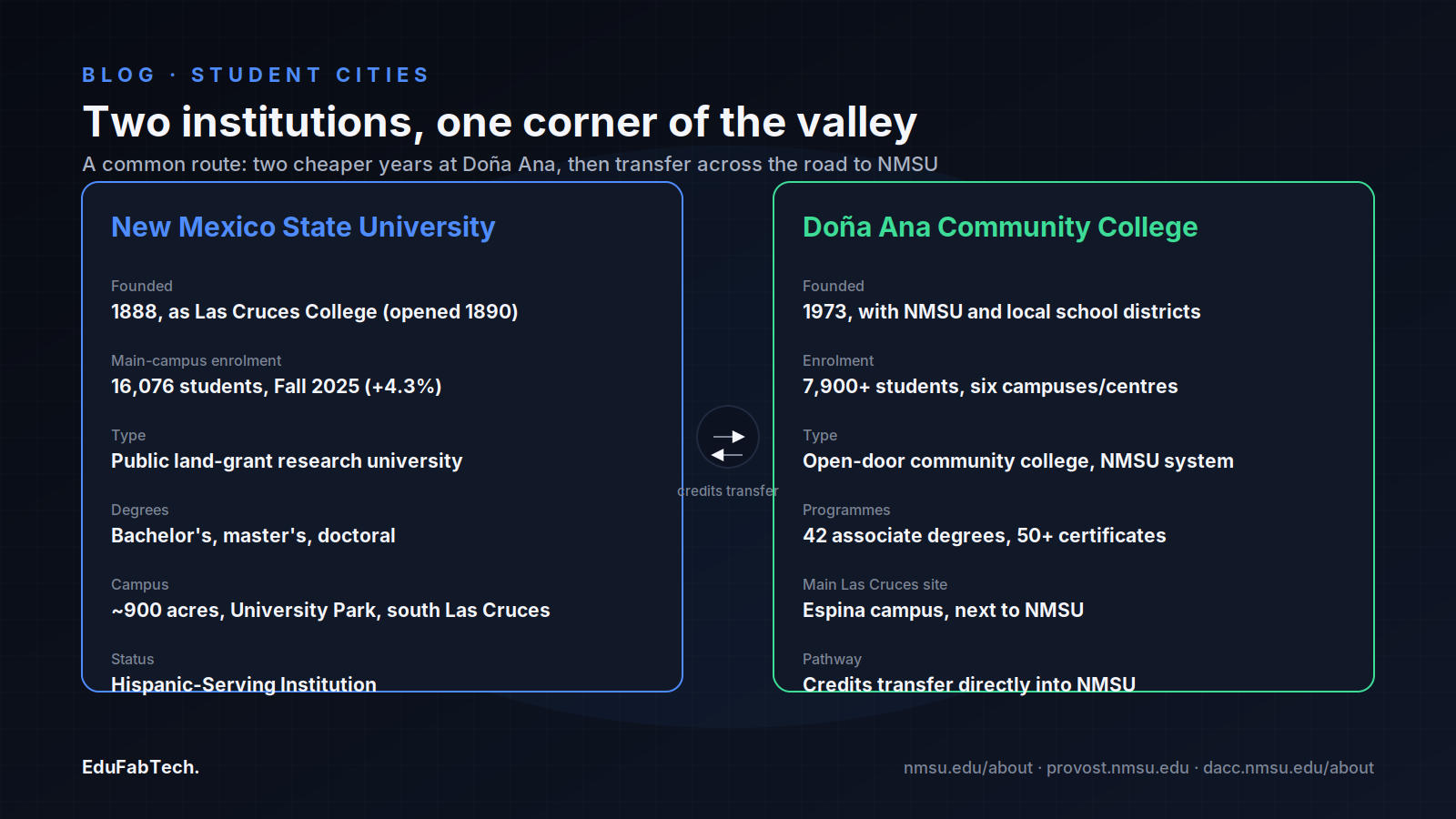
New Mexico State University is the state's land-grant university, and its main campus occupies about 900 acres in the University Park area on the south side of Las Cruces. The university's own About page describes it as a land-grant institution founded in 1888 as Las Cruces College, officially opening on January 21, 1890, and identifies it today as a Hispanic-Serving Institution (nmsu.edu/about). It is a full research university granting bachelor's, master's and doctoral degrees, with particular depth in agriculture, engineering and the space and physical sciences that the surrounding desert and nearby White Sands make natural. Students and the campus teams go by the same name: the Aggies.
The campus is not small. NMSU's Office of the Provost reported that Fall 2025 enrolment on the Las Cruces main campus rose to 16,076, a 4.3% increase on the previous year, with systemwide enrolment reaching 23,788, up 4.7%, and a one-year retention rate of 75.1% (provost.nmsu.edu). That makes it the larger of the two schools and the reason the city tilts toward a college-town feel near its southern edge.
Doña Ana Community College is the other half of the picture and, usefully for students on a budget, part of the same NMSU system. The college describes itself as founded in 1973 through a collaboration between NMSU and the Gadsden, Hatch and Las Cruces school districts, and it is governed by the NMSU Board of Regents under an operating agreement (dacc.nmsu.edu). DACC's About page states that it offers 42 associate degrees and more than 50 certificates in career-and-technical and general-education programmes and enrolled more than 7,900 students across six campuses and centres in a recent fall term (dacc.nmsu.edu/about). It runs several campuses and centres across Doña Ana County; in Las Cruces, the Espina campus sits beside NMSU, while the main administrative offices are on Sonoma Ranch Boulevard on the East Mesa. Because DACC credits transfer into NMSU, a common route is two cheaper years at Doña Ana followed by a transfer across the road.
Where students live
NMSU houses a minority of its students: most live off campus, so the two housing markets run in parallel. On campus, first-year residence halls cluster in University Park — Garcia, Juniper, Piñon and the Rhodes–Garrett–Hamiel complex — with apartment-style communities such as Chamisa Village and Vista Del Monte for returning and graduate students and a few family-housing options. Applying for a hall through NMSU Housing is the safest first move for anyone arriving from abroad, because there is no deposit to a stranger and no risk of a fake listing.
Off campus, students spread into the neighbourhoods immediately north and east of NMSU — around University Avenue, Idaho Avenue and Telshor Boulevard toward the mall — and into the older grid near downtown and historic Mesilla. Rents fall as you move away from the campus gate and toward the East Mesa. Most private rooms and apartments here are leased directly or through local property managers; shared houses are common and are usually how domestic students keep costs down.
Start looking earlier than you think. Demand peaks in July and August as leases turn over for the fall term, and the cheaper rooms near campus go first. Before you pay anything, see the place in person or have someone you trust see it — Las Cruces is compact enough that an in-person viewing is realistic even on short notice. Check that the unit has working evaporative or refrigerated cooling, because summer here is genuinely hot; confirm who pays for water and electricity; and read the lease term before signing.
On deposits and scams: the pattern to watch for in Las Cruces is the too-cheap room advertised to students sight-unseen, with the "landlord" claiming to be out of town and asking you to wire a deposit to hold it. Never send money by bank transfer, gift card or cryptocurrency to reserve a room you have not seen, and be wary of anyone who refuses an in-person viewing or a signed written lease. A normal local arrangement is a security deposit plus first month's rent paid after you have seen the unit and signed — not a wire to secure a listing. You can browse rooms and sublets collected for the city on EduFabTech's Las Cruces rooms page and filter for places near New Mexico State University.
What a room actually costs
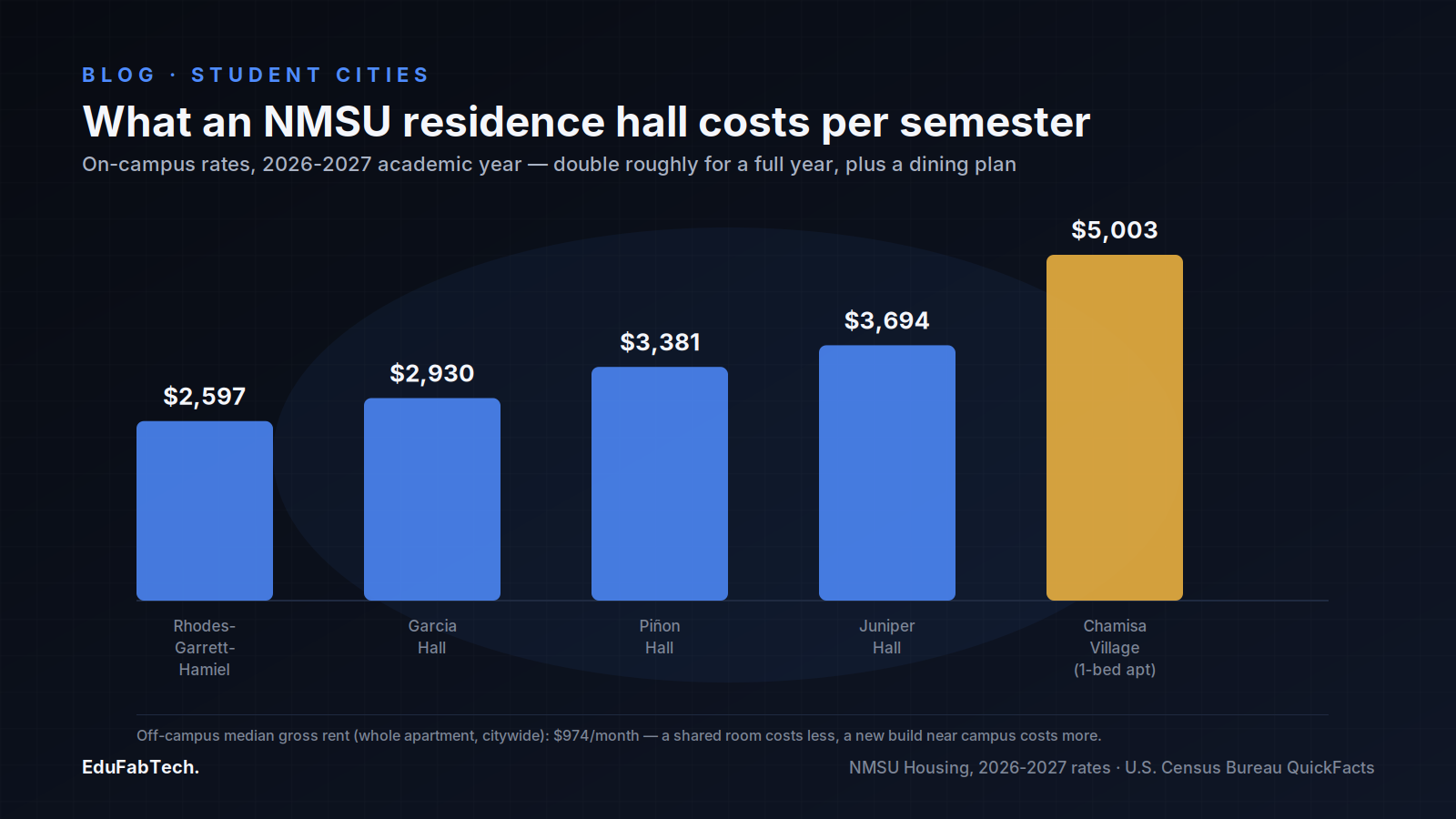
On-campus prices are published, dated and worth using as your anchor. For the 2026–2027 academic year, NMSU Housing lists residence-hall charges per semester, not per year: a double room in Garcia Hall at $2,930, a double in Piñon Hall at $3,381, a double in Juniper Hall at $3,694, and a double with a shared bath in Rhodes–Garrett–Hamiel at $2,597 (housing.nmsu.edu). Apartment communities run higher — a one-bedroom unit in Chamisa Village is listed at $5,003 per semester on the same page. Because these are per-semester figures charged at the start of fall and again at the start of spring, double them for a rough academic-year cost and add a dining plan.
Off campus, the city is cheaper than most American college towns, which is one of its genuine draws. The U.S. Census Bureau's QuickFacts for Las Cruces city reports a median gross rent of $974 for 2020–2024 (census.gov/quickfacts) — a whole-apartment figure for all households, so a room in a shared house costs less and a new build near campus costs more. Treat it as the midpoint of a market, not a student quote. NMSU's own cost-of-attendance pages are the place to sanity-check total yearly budgets including food, books and fees.
Furnishing a room on the cheap
Once you have the room, the cheapest way to fill it is second-hand. Las Cruces has a strong market culture for a city its size. The Farmers & Crafts Market of Las Cruces runs twice a week — Saturdays from 8:30am to 1:00pm across seven blocks of downtown Main Street, and Wednesdays at the same hours on the Plaza de Las Cruces — with more than 200 local merchants according to the market's own site (farmersandcraftsmarketoflascruces.com). It is more produce, food and crafts than furniture, but it is the best weekly introduction to the city and a good place to meet people.
For actual furniture and kit, student turnover at the end of each semester floods the local second-hand channels with desks, mini-fridges and bikes, often cheaply or free as people move out. EduFabTech keeps running lists for the city: second-hand furniture and things people are giving away on the free-stuff page. Buy locally and collect in person; the same caution about never wiring money to someone you have not met applies to a $40 desk as much as to a lease.
Working while you study
Part-time work is realistic here, mostly on campus or in retail and food service along the Telshor and University corridors, and student jobs for the city are collected on EduFabTech's Las Cruces jobs page. The rules differ sharply by immigration status, and this is not legal advice — check your own case with the official office.
For international students, NMSU's International Student & Scholar Services is the designated office and the authority to follow. Its FAQ states plainly that for F-1 students, "employment is limited to 20 hours per week on campus during the fall and spring semesters," and that students cannot begin Curricular Practical Training (CPT) or Optional Practical Training (OPT) until ISSS has authorised it (isss.nmsu.edu/faqs). Before you take any job, confirm your eligibility with ISSS rather than a landlord, employer or friend — the consequences of getting it wrong fall on your visa status, not theirs. The underlying federal rules are set by the U.S. government's Student and Exchange Visitor Program, which ISSS interprets for your specific case.
Libraries and places to study
The university runs two libraries on the Las Cruces campus, and both are open to students who need a quiet desk: Branson Library and Zuhl Library, whose hours and locations are posted on the NMSU Library site (lib.nmsu.edu/hours). Zuhl keeps long late-night hours during fall and spring terms, which matters in a city where most other study space closes early. DACC students have library and learning-centre space on their own campuses as well. Beyond the libraries, downtown Main Street and the cafés near the Plaza give you daytime options, and EduFabTech lists bookable desks and quiet rooms on its Las Cruces study-spaces page.
Getting around: the free bus and the car question
Las Cruces has an unusually generous public-transport arrangement for a city its size. The city's RoadRUNNER Transit operates a network of fixed routes plus Dial-a-Ride, serving the city limits, NMSU and the Town of Mesilla, and it is currently zero fare — the city states that RoadRUNNER Transit and Dial-a-Ride "will remain zero fare until further notice" (lascruces.gov). On campus, NMSU runs its own Aggie Transit shuttles for students. In practice that means you can get between campus, downtown and the shopping corridors without paying a fare or buying a card, which takes real pressure off a student budget.
The honest caveat is coverage. A free bus is only useful where and when it runs, and in a spread-out desert city the routes are limited and stop early in the evening. Many students who live on the East Mesa or commute from outlying towns still rely on a car, and parking and fuel then become real costs. If you will live close to campus, you can do without a car; if you land on the edge of town, factor one in. For short trips the city is flat and bikeable for much of the year, though summer heat makes mid-afternoon cycling unpleasant.
The honest trade-offs
What is good about Las Cruces for a student is mostly about cost and calm. Rents and overall living costs are low by American standards, the campuses are walkable, the bus is free, and the climate means sunshine and outdoor life for most of the academic year. The Mexican and New Mexican food — especially the region's green chile — is cheap and excellent, and the small scale makes it easy to feel part of a place rather than lost in it.
What is hard is also real. Summer heat is intense, and cooling costs and the need for working air conditioning are not optional. The city is spread out and car-centric, so the free bus does not fully substitute for a vehicle if you live far from campus. Job options beyond campus and service work are thinner than in a big metro, and the nearest large city with an airport is El Paso, not Las Cruces itself. For international students in particular, the relative isolation and the border-region setting take some adjustment. None of this is a reason to stay away — but go in expecting a quiet, affordable desert town rather than a dense, fast college city.
A checklist for your first weeks
- If you can, apply for an NMSU residence hall first — it removes the deposit-scam risk entirely for your first year, with published 2026–2027 rates on the NMSU Housing site.
- If you rent off campus, view the place in person before paying, sign a written lease, and never wire a deposit or send gift cards or crypto to "hold" a room.
- Confirm cooling (evaporative or refrigerated), who pays utilities, and the lease term before signing — summer here is unforgiving.
- International students: contact ISSS before taking any job, and keep the 20-hours-per-week on-campus limit in mind during fall and spring.
- Download the RoadRUNNER Transit route map — the bus is free, so plan your room around where it actually runs.
- Furnish from the end-of-semester second-hand flood rather than buying new, and use the Saturday downtown market to learn the city.
- Get a library account and scout Branson and Zuhl for the hours and desks that fit your schedule.
A quick question for readers
Do you work part-time while you study?
Many students work to pay the bills. See how common it is — and how many hours people really do.
Pick an answer, create a free account in a minute, and your vote counts. Already a member? Sign in
Comments 0
CommentNo comments yet. Members start the conversation.
Source: New Mexico State University Housing
Sources (5)
- New Mexico State University Housing. 2026-2027 NMSU Housing Rates. New Mexico State University, 2026. housing.nmsu.edu ↗ · checked 14 Oct 2026
- NMSU Office of the Provost. We Are NMSU — Fall 2025 enrollment. New Mexico State University, 2025. provost.nmsu.edu ↗ · checked 14 Oct 2026
- Doña Ana Community College. About the College. Doña Ana Community College (NMSU system), 2026. dacc.nmsu.edu ↗ · checked 14 Oct 2026
- NMSU International Student & Scholar Services. FAQs. New Mexico State University, 2026. isss.nmsu.edu ↗ · checked 14 Oct 2026
- Farmers & Crafts Market of Las Cruces. Market schedule and locations. Farmers & Crafts Market of Las Cruces, 2026. farmersandcraftsmarketoflascruces.com ↗ · checked 14 Oct 2026