Studying in Lincoln, United States: universities, housing and student life
A practical, sourced guide to studying in Nebraska's capital — its universities, where students live, how to rent safely, part-time work rules, study spaces, transport and the honest trade-offs.
A prairie capital that keeps its students close
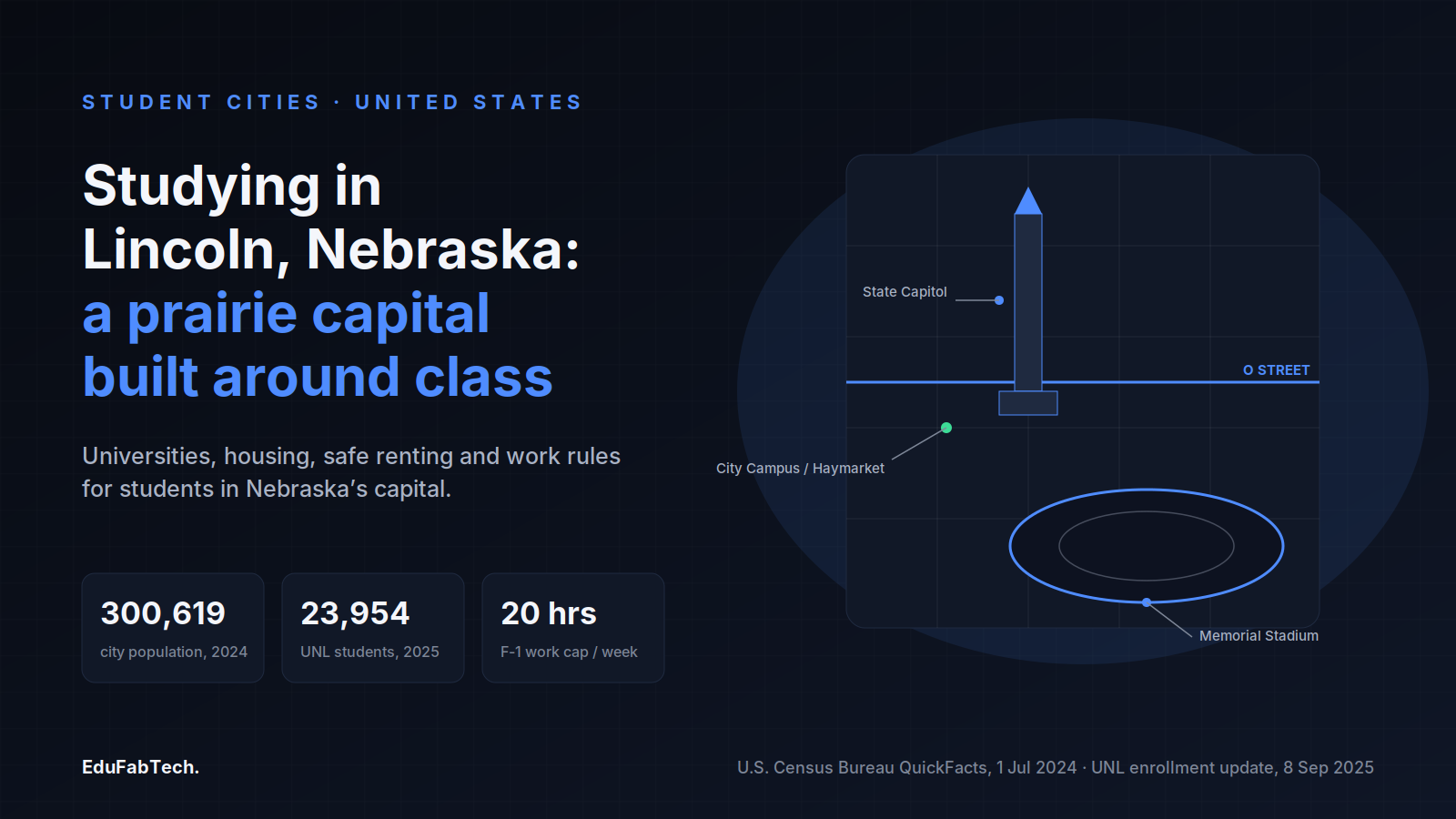
Lincoln is the capital of Nebraska and, for most of the year, a city organised around classrooms, the legislature and a football stadium. The U.S. Census Bureau's QuickFacts estimated the city's population at 300,619 as of 1 July 2024 (census.gov QuickFacts). It sits on flat tallgrass-prairie land in the state's southeast, a roughly hour's drive southwest of Omaha, laid out on a grid where the numbered streets run one way and the lettered streets ("O Street" is the main commercial spine) run the other. The Nebraska State Capitol tower rises over the low skyline; the Historic Haymarket, an old warehouse-and-rail district just west of downtown, holds most of the restaurants and bars students gravitate to.
The reason the city feels so student-shaped is that its largest campus sits downtown. The University of Nebraska–Lincoln's City Campus runs straight into the Haymarket, so the walk from a lecture hall to a coffee shop or the Pinnacle Bank Arena is short. On home football Saturdays, Memorial Stadium fills to a crowd larger than most Nebraska towns, and the centre of the city effectively shuts around the game. That rhythm — quiet mid-week, loud on game days, emptier over the long winter break — shapes the year more than it does in bigger metros.
What follows is a practical account for students coming to Lincoln, whether from elsewhere in Nebraska or from abroad: the institutions that grant degrees here, where people live and how to rent without being cheated, the cost of it, how to get around, and what is genuinely good and genuinely hard about the place.
The universities, and what studying here is like
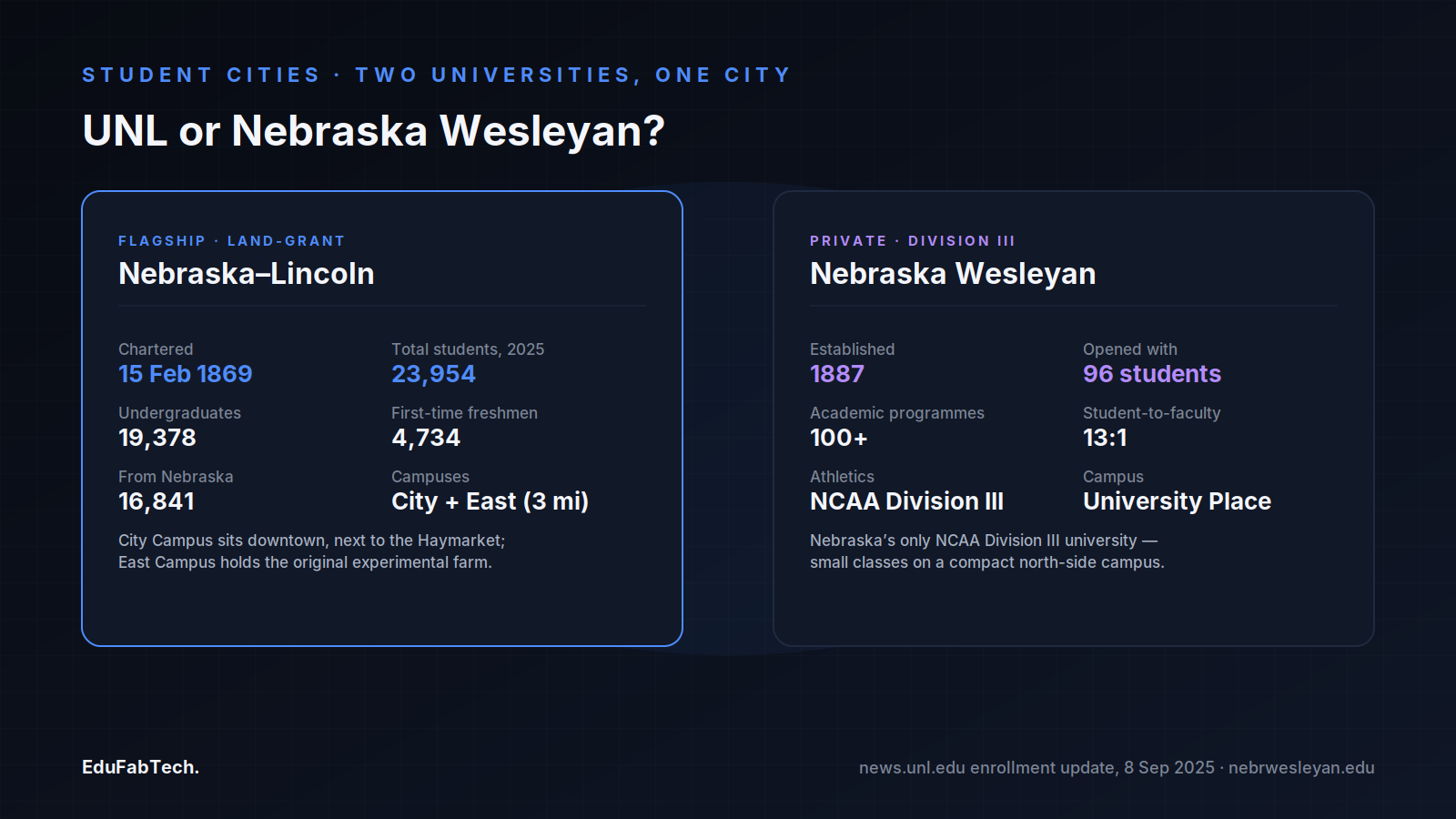
The University of Nebraska–Lincoln (UNL) is the anchor. It was chartered as a land-grant university on 15 February 1869 and was, by its own account, one of the first institutions west of the Mississippi River to award a doctorate — the first in 1896 — and the home of the world's first undergraduate psychology laboratory (unl.edu/about). In its enrollment update dated 8 September 2025, the university reported 23,954 students in total, 19,378 of them undergraduates, with 4,734 first-time freshmen and 16,841 students from Nebraska (news.unl.edu). UNL runs two linked campuses: City Campus downtown, which holds most arts, sciences, business and engineering, and East Campus about three miles east, built around the university's original experimental farm. Students move between them by bus, bike or on foot.
Two of UNL's degree-granting colleges are worth naming because prospective students search for them directly. The College of Agricultural Sciences and Natural Resources is based on East Campus and teaches agronomy, food science, animal science and natural-resource fields rooted in that farm heritage. The College of Journalism and Mass Communications, on City Campus, grants degrees in advertising, public relations, broadcasting and journalism. Both award their degrees through UNL rather than as separate institutions, so you apply and enrol through the university.
Nebraska Wesleyan University (NWU) is the other degree-granting university inside the city, and a very different experience. It was established in 1887 and opened that autumn with 96 students (nebrwesleyan.edu history). Its campus sits at 5000 Saint Paul Avenue in the historic University Place neighbourhood on the city's north side, a few miles from downtown. Nebraska Wesleyan lists more than 100 academic programmes, a 13:1 student-to-faculty ratio and the distinction of being Nebraska's only NCAA Division III university (nebrwesleyan.edu). Where UNL offers the scale and research of a flagship, NWU offers small classes and a compact campus.
You can browse student listings for both institutions on EduFabTech at /near/university-of-nebraska-lincoln and /near/nebraska-wesleyan-university, and for the agricultural campus specifically at /near/college-of-agricultural-sciences-and-natural-resources.
Neighbourhoods where students settle
Because UNL's City Campus is downtown, the densest student housing is immediately around it and in the blocks to the south. The Near South and Everett neighbourhoods, with their older houses divided into rentals, are classic student territory within walking or short-cycling distance of class. The Haymarket and downtown blocks hold newer, pricier apartment buildings; they put you closest to campus and nightlife but cost the most. Across the city, East Campus students often look at the quieter residential streets nearby, and Nebraska Wesleyan students cluster in University Place and Havelock to the north, both walkable old streetcar districts with their own small commercial strips.
First-year students at UNL typically start in the residence halls, and most traditional and suite halls carry a required meal plan. If you want to live further out for lower rent, the thing to weigh in Lincoln is the winter commute: a flat, grid-planned city is easy to cycle in September and genuinely hard in January. A room a mile from campus is a pleasant walk in autumn and a cold, windy slog on an icy morning. Listings for rooms across the city are collected at /in/united-states/lincoln/rooms, and the full set of student listings sits at /in/united-states/lincoln.
Renting without being cheated in Lincoln
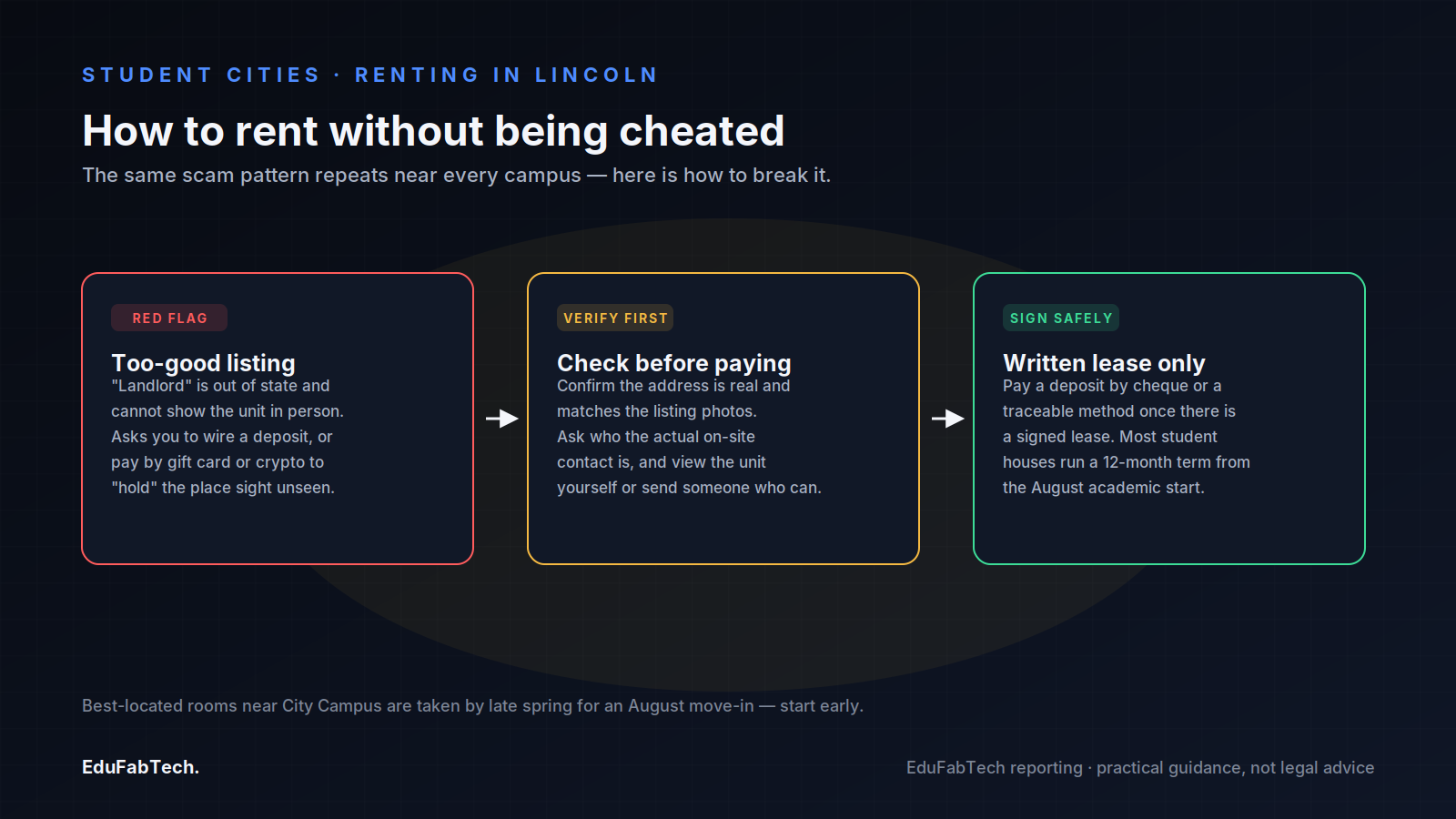
Most rental fraud in a city like Lincoln follows the same pattern: a listing for a house near the Near South or Haymarket at a rent that looks too good, a "landlord" who says they are out of state and cannot show it, and a request to wire a deposit to "hold" the place. Do not send money that way. A legitimate Lincoln landlord will let you see the unit — or have someone show it — before you sign, and will take a deposit by cheque or a traceable method once there is a written lease. Never pay a deposit or "holding fee" by bank wire transfer, gift card or cryptocurrency to someone you have not met and a property you have not entered.
Practical checks that work here: confirm the address is real and that the house matches the photos (a quick walk or map check catches reused images from other cities); ask whether the listing is one of the older subdivided houses that are common south of campus, and who the actual on-site contact is; and read the lease term, because many student houses let on a twelve-month cycle timed to the August academic start. Start looking early — the best-located rooms near City Campus go in late spring for an August move-in. If something is only offered sight-unseen with an urgent deposit, treat it as a scam regardless of how convincing the paperwork looks.
Furnishing a room: second-hand, free stuff and the Haymarket
Lincoln turns over a lot of used furniture every August and May as leases flip, which is the cheapest moment to furnish a room. The city's best-known market is the Historic Haymarket Farmers' Market, held on Saturday mornings through the warm season in the Haymarket around 7th and "P" Streets; alongside produce and crafts it carries vintage and second-hand finds, and it doubles as a weekly meeting point for the downtown student crowd. For desks, chairs, lamps and kitchen kit, students here lean on charity thrift shops and end-of-semester giveaways rather than buying new.
On EduFabTech you can search what other Lincoln students are selling or giving away: general second-hand goods at /in/united-states/lincoln/second-hand, used furniture at /in/united-states/lincoln/furniture, and items being given away free at /in/united-states/lincoln/free-stuff. The move-out weeks in May are the richest time to pick things up for nothing; the move-in weeks in August are when you will compete for them.
Part-time work, and the rules for international students
Term-time work is common, and on both campuses the easiest first jobs are on-campus ones — dining halls, libraries, landscape services, and assistantships for graduate students. For students on an F-1 visa, the University of Nebraska–Lincoln's International Student and Scholar Office states that on-campus employment does not require ISSO or USCIS approval but that you must obtain a Social Security number before you start, and that you may work a maximum of 20 hours per week during the fall and spring academic semesters, with full-time hours allowed during official breaks, holidays and summer vacation (global.unl.edu/isso). Off-campus work generally requires authorisation through Curricular Practical Training (CPT) or Optional Practical Training (OPT), which the same office administers.
These rules change with immigration policy, and the authority on your individual status is the ISSO for UNL students and the equivalent international office at Nebraska Wesleyan — check with them before accepting any job, and treat this guide as orientation, not legal advice. Current openings students post are gathered at /in/united-states/lincoln/jobs.
Libraries and places to study
UNL's main study building is Love Library on City Campus, which houses the Adele Coryell Hall Learning Commons. The Learning Commons includes reservable group study rooms and is built specifically for long, focused work; UNL Libraries lists it alongside the Dinsdale Family Learning Commons, the Architecture Library and other spaces, many with small and large rooms you can book for private study (libraries.unl.edu). Nebraska Wesleyan students have the Cochrane-Woods Library on their own campus.
Beyond the university buildings, the city-run Lincoln City Libraries have branches across town that students use for quiet desks and free Wi-Fi, and the Haymarket's cafés fill with laptop workers mid-week. If you want a reservable desk or a study-partner rather than a silent stack, Lincoln students trade spaces and sessions at /in/united-states/lincoln/study-spaces.
Getting around, and the weather you get around in
Lincoln's public transport is StarTran, run by the City of Lincoln's Transportation and Utilities department. The standard cash fare is $1.25, a day pass is $2.50, and a 31-consecutive-day pass is $17.00 (with an $8.00 low-income version), according to the city's fares page (lincoln.ne.gov). The important detail for UNL students is on that same page: UNL students ride free with a UNL Bus Pass and UNL Photo ID, and StarTran passes are handled through the Token Transit mobile app. That makes the bus a real option for the City–East Campus trip and for reaching parts of town a bike won't cover in bad weather.
Most students, though, get around Lincoln on foot and by bicycle. The grid is flat and the city has an extensive paved trail network; in autumn, cycling between the Haymarket, downtown and the Near South is the fastest way to move. The caveat is the climate. Lincoln has a continental climate with hot, humid summers and cold winters that bring snow, ice and hard wind off the open plains, and spring carries the region's tornado risk. Plan for a winter where walking or the bus beats cycling for weeks at a time, and factor warm clothing into your first-month budget.
Costs, the honest trade-offs, and a first-weeks checklist
Lincoln is, by U.S. standards, an affordable college city, which is its biggest draw. For a dated on-campus figure, UNL's published 2026-27 rates put a standard double room in a traditional residence hall at $7,960 for the full year, with other room types ranging up to $10,510 for an apartment-style studio; traditional and suite-style halls require a meal plan, listed from $1,030 to $3,530 per semester (housing.unl.edu/rates). Off campus, the U.S. Census Bureau's QuickFacts reported a median gross rent of $1,086 a month for Lincoln across 2020–2024 and a median household income of $71,867 over the same period (census.gov QuickFacts) — a city-wide figure, not a student-room price, but a useful anchor for what renting costs here relative to incomes.
What is good about Lincoln for students: rent and everyday costs are lower than in coastal college towns; the main campus is downtown, so housing, class and nightlife sit within a short walk; and free StarTran travel for UNL students removes a recurring cost. What is hard: the winters are long and genuinely cold, which shrinks the months you can cycle or walk comfortably; the city empties over breaks and can feel quiet if you are far from campus; and the best-placed rooms near City Campus are snapped up months ahead, so late arrivals end up further out and more dependent on the bus. For international students, Lincoln is also a smaller city than many expect of a U.S. "capital," with correspondingly fewer direct flights and transit options than a large metro.
A short checklist for the first weeks:
- Confirm your housing in writing and never wire a deposit for a place you have not seen in person.
- If you are an international student, visit the ISSO (UNL) or your international office before taking any job, and apply for a Social Security number before starting on-campus work.
- Claim your free StarTran pass through Token Transit if you are a UNL student, and learn the City–East Campus route.
- Book a Love Library or Learning Commons study room early in the term, before the finals crush.
- Furnish from May/August second-hand turnover — check free listings first.
- Buy proper winter clothing before December; the wind off the plains is the part newcomers underestimate.
Lincoln rewards students who settle in near campus and plan around the seasons: a compact, walkable, affordable capital for most of the year, with a hard winter and a quiet rhythm you learn to work with. For events and the wider picture of student life in the city, EduFabTech keeps a running list at /in/united-states/lincoln/events.
A quick question for readers
Do you work part-time while you study?
Many students work to pay the bills. See how common it is — and how many hours people really do.
Pick an answer, create a free account in a minute, and your vote counts. Already a member? Sign in
Comments 0
CommentNo comments yet. Members start the conversation.
Source: University of Nebraska–Lincoln
Sources (5)
- University of Nebraska–Lincoln. UNL tracks steady enrollment with growth in key academic areas. University of Nebraska–Lincoln, 2025. news.unl.edu ↗ · checked 10 Oct 2026
- University of Nebraska–Lincoln. 2026-27 Housing & Dining Rates. University of Nebraska–Lincoln Housing, 2026. housing.unl.edu ↗ · checked 10 Oct 2026
- City of Lincoln, Nebraska. StarTran Bus Passes and Fares. City of Lincoln Transportation & Utilities, 2026. lincoln.ne.gov ↗ · checked 10 Oct 2026
- University of Nebraska–Lincoln. Employment for F-1 Students. International Student and Scholar Office, 2026. global.unl.edu ↗ · checked 10 Oct 2026
- Nebraska Wesleyan University. History of Nebraska Wesleyan University. Nebraska Wesleyan University, 2026. nebrwesleyan.edu ↗ · checked 10 Oct 2026