Studying in Louisville: universities, housing and student life
A practical, honest guide to studying in Louisville, Kentucky — its universities, where students live, what a room costs, the markets worth knowing, getting around by TARC, and the work rules international students should check.
On the Ohio, between the Midwest and the South
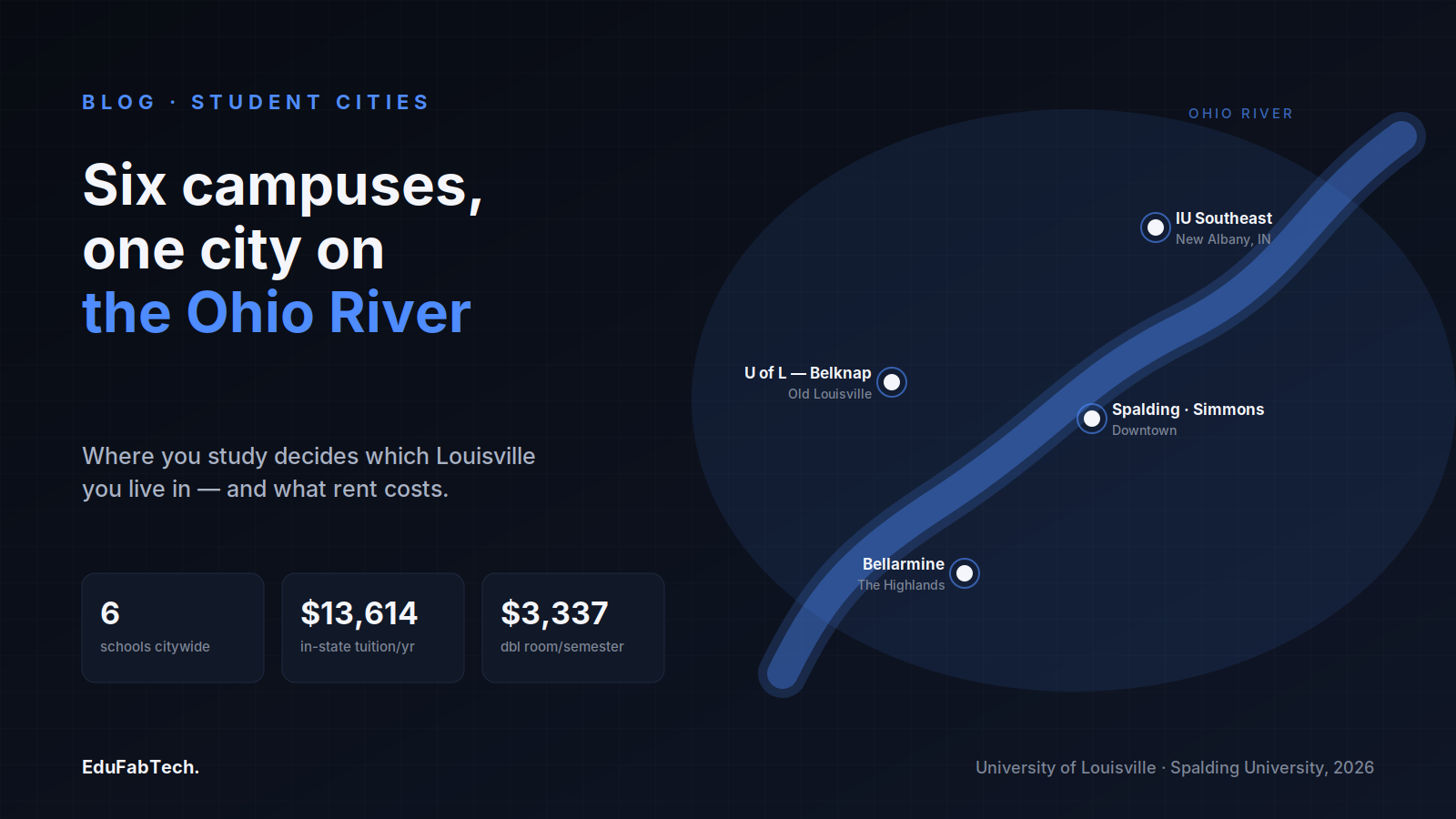
Louisville sits on a long bend of the Ohio River, looking across the water to Indiana. Spalding University, describing the city it has stood in for generations, calls it a place that "serves as a gateway between the Midwest and the South," with a vibrant downtown, historic neighbourhoods and an active arts and music scene (Spalding University). That in-between quality is something students notice quickly: the pace is slower than Chicago, the summers more humid than the upper Midwest, and the river is never far from the conversation — it shapes the weather, the bridges people commute over, and the fact that one of the area's universities is technically in another state.
For a student, Louisville is a mid-sized city that behaves like a cluster of villages. The campuses are not gathered in one quarter; they are scattered across the map, each anchoring its own patch of the city. The University of Louisville sits just south of downtown; Bellarmine is three miles south-east of it; Spalding and Simmons College of Kentucky are downtown within walking distance of each other; and Indiana University Southeast is across the river in New Albany. Where you study decides which Louisville you live in.
This guide walks through the universities, where students actually end up living, how to rent without losing money, where to furnish a room cheaply, what a year costs, and how to get around — with every figure tied to the office or agency that published it. It is written for students arriving from elsewhere in Kentucky, from across the United States, and from abroad.
The universities, and what studying here is like
The largest is the University of Louisville, a public research university whose main Belknap Campus spreads over 274 acres south of downtown in the Old Louisville neighbourhood. Its own visitor pages describe eight of the university's twelve academic colleges sitting on Belknap, a long-held "Tree Campus USA" recognition from the Arbor Day Foundation, and a full-size cast of Rodin's The Thinker outside Grawemeyer Hall (University of Louisville). Among those colleges is the University of Louisville College of Business, which sits on Belknap alongside the arts and sciences, engineering and the health programmes that run from the separate Health Sciences campus nearer downtown.
Bellarmine University is a private university on Newburg Road, about three miles south-east of downtown, describing its education as rooted in the liberal arts and an inclusive Catholic tradition and reached easily from the I-264 Watterson Expressway (Bellarmine University). It is smaller and more intimate than U of L, with a hilly, self-contained campus.
Spalding University calls itself the city's only downtown university, set among the offices and theatres of central Louisville; the university says that over 70 percent of Spalding alumni choose to remain in Louisville after graduation (Spalding University). A short walk away is Simmons College of Kentucky, which describes itself as "Kentucky's First HBCU," founded in 1879, and is accredited by the Association for Biblical Higher Education to grant certificates and degrees at the associate, baccalaureate and master's levels (Simmons College of Kentucky).
Across the Ohio River in New Albany, Indiana — six miles from downtown Louisville — is Indiana University Southeast, a public regional campus of Indiana University founded in 1941, with more than 65 student groups and organisations (Indiana University Southeast). For many Louisville students it is simply the campus on the other side of the bridges, but crossing a state line matters for things like tuition category and local rules, so treat it as a separate place when you plan. Finally, Louisville Bible College, in the city's south-eastern Highview area, is a small institution that trains preachers and church leaders and grants degrees in biblical studies (Louisville Bible College). You can see all of the city's student listings gathered on EduFabTech's Louisville page.
Where students settle
Old Louisville, the Victorian district immediately north of the U of L Belknap campus, is the obvious first choice for anyone studying there. It is one of the largest preserved Victorian neighbourhoods in the country, full of large old houses divided into flats and shared rooms, and you can often walk to class. The trade-off is that an old housing stock means uneven maintenance — draughty windows, tired heating, variable landlords — so what you are renting matters more than the pretty façade.
The Highlands, strung along Bardstown Road east of downtown, is where many students want to be socially: independent cafés, record shops, bars and late-night food, with Bellarmine on its southern edge. Rents there tend to be higher and parking tighter. Downtown and the adjacent NuLu (East Market) district suit Spalding and Simmons students and anyone who likes being in the centre, though the core quietens in the evenings. Students at IU Southeast more often live in New Albany itself or in the nearer Indiana suburbs, where rooms are cheaper and the commute does not involve a river crossing at rush hour.
U of L houses a large share of its first-years on campus, and the residence-hall system is the simplest safe option for a first year in a new city: you sign with the university, not a stranger. Beyond that, most students rent privately, either a room in a shared house or a small apartment. Browse what is currently available through rooms in Louisville, and for the two biggest campuses the proximity filters at near the University of Louisville and near Bellarmine University save a lot of map-squinting.
Renting without losing your deposit
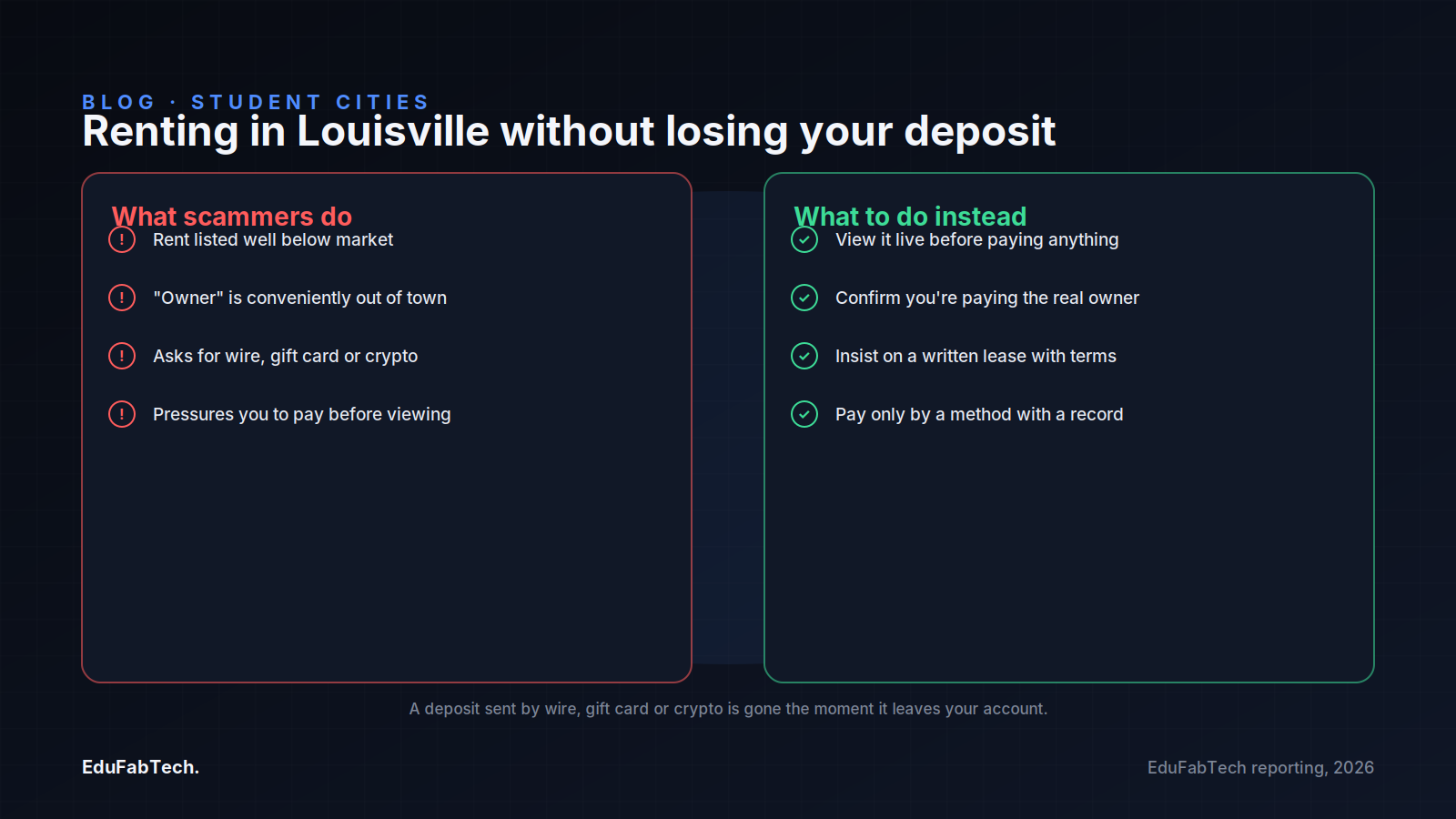
Most rental scams aimed at Louisville students follow the same script: a house in Old Louisville or near Bardstown Road is advertised well below the going rate, the "owner" is conveniently out of town, and you are asked to send a deposit to "hold" it before you can see inside. Do not. A deposit or first month's rent sent by bank wire, gift card or cryptocurrency is gone the moment it leaves your account, and no legitimate Louisville landlord needs to be paid that way to reserve a room.
See the place in person before paying anything, or if you are still abroad, ask someone you trust to view it and get a live video walk-through of the actual unit — not a photo set that could be lifted from anywhere. Confirm the person collecting money is the owner or the named property manager, insist on a written lease that lists the address and the deposit amount, and pay by a method that leaves a record. Treat "I'm out of state, just send the deposit and I'll mail the keys" as the warning sign it almost always is. If you arrive before you have found somewhere permanent, a university residence hall or a short stay buys you time to look properly.
Furnishing a room for next to nothing
Louisville is good terrain for furnishing a room cheaply, because the city has a strong flea-market and resale culture. The Flea Off Market, which runs on scheduled weekends at 1000 East Market Street in the NuLu/East Market district on the edge of downtown, is the best-known gathering of vintage, second-hand and maker stalls and a reliable place to find furniture, kitchen things and records (The Flea Off Market). For sheer volume, the indoor Peddler's Mall vendor halls around the metro — including the New Cut hall on the Outer Loop in Louisville and the Clarksville hall across the river in Indiana — are open through the week and stacked with used furniture, housewares and books (Peddler's Mall).
Timing helps: late spring and the end of the academic year, when graduating students clear out, are when the most furniture appears second-hand and on kerbsides. Start with what EduFabTech lists locally — second-hand things in Louisville, second-hand furniture and things being given away free — before buying anything new. A mattress is the one item most people prefer to buy new; almost everything else in a student room can be found used.
Money: tuition, housing and part-time work
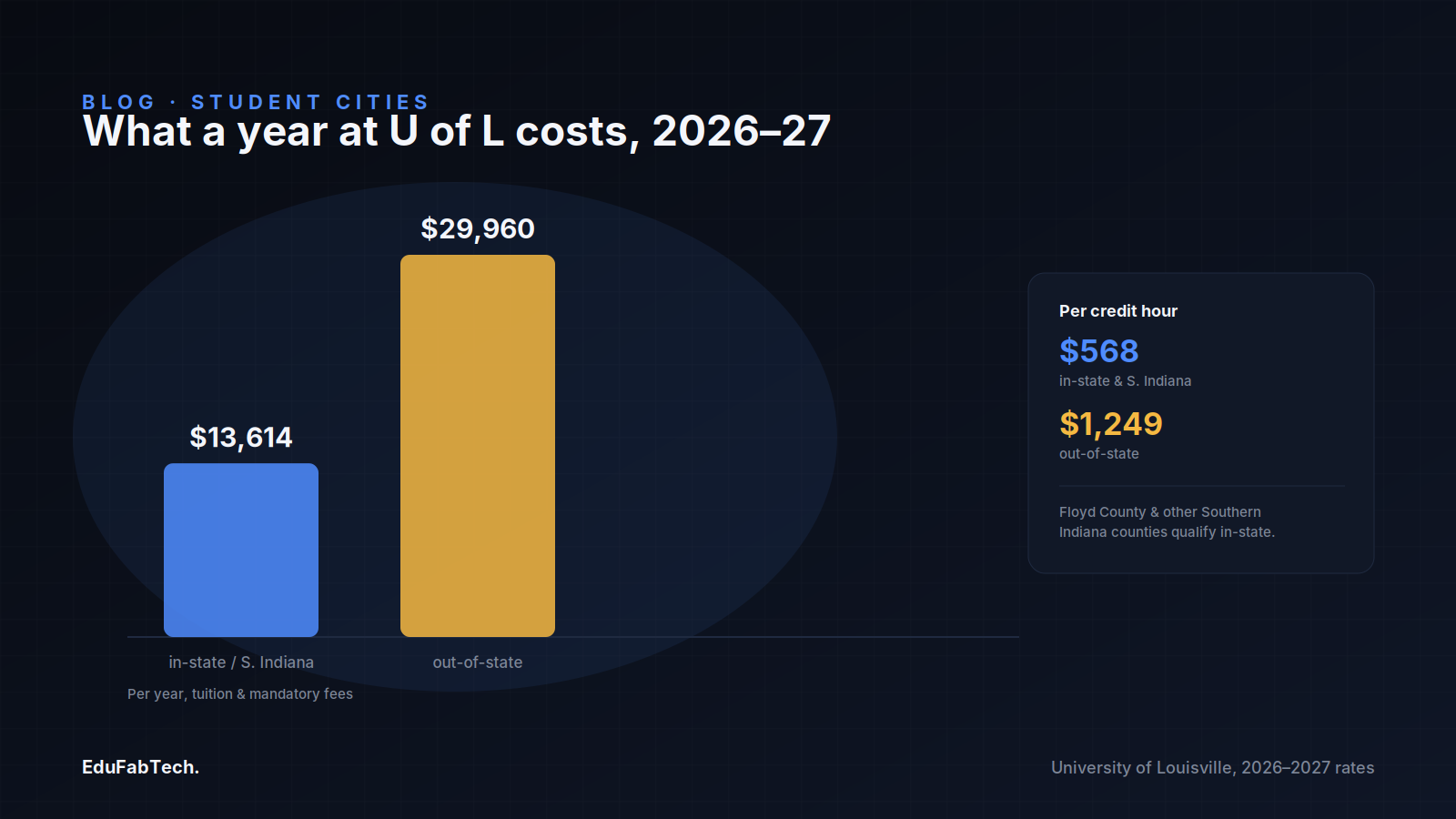
Costs depend heavily on where you are from. For 2026–2027 the University of Louisville lists tuition and mandatory fees of $13,614 a year for Kentucky and Southern Indiana residents and $29,960 a year for out-of-state students — the equivalent of $568 and $1,249 per credit hour respectively (University of Louisville, 2026). The in-state rate extends to residents of several Southern Indiana reciprocity counties, Floyd County among them, which is one reason students from the New Albany side cross the river to study at U of L.
For housing, the clearest dated figure is the university's own. Its housing office lists projected 2026–2027 residence-hall rates — still subject to approval by the Board of Trustees — starting at $3,337 per semester for a double room in Louisville Hall, with single rooms in the newer halls running past $5,000 per semester (University of Louisville, 2026). Those are per-semester figures for the nine-month academic year, so a full year roughly doubles them; private shared rooms in Old Louisville or New Albany are often cheaper per month but add utilities and a lease you negotiate yourself.
On part-time work, the rules differ sharply by immigration status, and this is guidance to check, not legal advice. The U.S. Department of Homeland Security's Study in the States service states plainly that an F-1 student doing on-campus employment "may not work more than 20 hours per week when school is in session," that such work must be on campus or at an educationally affiliated location, and that students may apply up to 30 days before classes start and must apply for a Social Security Number (U.S. Department of Homeland Security). Off-campus work generally requires separate authorisation, so always confirm your own situation with your university's international student office before you accept a job. Domestic students face no such cap; current openings around the city are listed under jobs in Louisville.
Libraries, study spaces and getting around
Each campus has its own libraries, and the city library system is a genuinely useful second home for studying. The Louisville Free Public Library runs a network of branches across the metro; its branches page shows the downtown Main Library closed for renovation and a dedicated Library Computer Center at 721 South Brook Street — a short walk from the U of L Belknap campus — among the locations offering computers and printing (Louisville Free Public Library, 2026). Neighbourhood branches in the Highlands and across the river give you quiet, free alternatives when campus buildings close for the night. More desks and study spots posted locally are gathered at study spaces in Louisville.
Getting around is one area where Louisville rewards students. The local bus operator is the Transit Authority of River City, known as TARC, and the University of Louisville confirms that its students, faculty and staff can ride TARC for free by showing their U of L ID (University of Louisville). That free benefit covers TARC's regular routes, so a car is not essential if you live near a decent one. That said, Louisville remains a car-oriented city: service thins out in the evenings and on weekends, so check the timetable for the specific route you would depend on before you rely on it, and factor the Ohio River bridges into any New Albany commute.
The honest balance
What students tend to like about Louisville is the cost and the texture: housing and everyday life are cheaper than in the big coastal cities, the neighbourhoods have real character, and the music, food and festival calendar — this is a bourbon and horse-racing city, home to the Kentucky Derby — give you somewhere to be when you are not studying. The campuses are human-scaled, and a free transit pass takes real money off a student budget.
What is harder is the sprawl and the seasons. Because the universities are scattered rather than clustered, your daily life is dictated by where you land, and getting between neighbourhoods without a car can be slow once evening service thins. Summers are hot and humid; winters bring cold snaps and the occasional ice storm that snarls the bridges. Old Louisville's beautiful housing stock can hide poor insulation and inconsistent landlords, and the socially desirable Highlands costs more. None of this is a reason to stay away — but it is worth knowing before you sign a lease on looks alone.
A checklist for the first weeks
- Sort transport first. Get your student ID and set up free TARC access, then map the actual route between your room and campus and ride it once before classes start.
- See any private room in person (or via a live video walk-through) before paying, and never wire a deposit or pay by gift card or crypto to "hold" a place.
- International students: visit your university's international student office in the first week to confirm work rules and start the Social Security Number process before taking any on-campus job.
- Furnish second-hand. Check the Flea Off Market, the Peddler's Mall halls and local free-stuff listings before buying new; aim for the end-of-term clear-out if your timing allows.
- Find your study base. Pick a campus library and a nearby Louisville Free Public Library branch so you always have somewhere open and quiet.
- Explore beyond your campus. Old Louisville, the Highlands, downtown and New Albany each feel different; see what is on through events in Louisville and work out which part of the city is yours.
A quick question for readers
Do you work part-time while you study?
Many students work to pay the bills. See how common it is — and how many hours people really do.
Pick an answer, create a free account in a minute, and your vote counts. Already a member? Sign in
Comments 0
CommentNo comments yet. Members start the conversation.
Source: University of Louisville
Sources (5)
- University of Louisville. Costs of Living (2026–2027 residence hall rates). University of Louisville, 2026. louisville.edu ↗ · checked 11 Oct 2026
- University of Louisville. Annual Undergraduate Tuition & Fees. University of Louisville, 2026. louisville.edu ↗ · checked 11 Oct 2026
- U.S. Department of Homeland Security. Working in the United States (Study in the States). U.S. Department of Homeland Security, 2025. studyinthestates.dhs.gov ↗ · checked 11 Oct 2026
- Indiana University Southeast. About IU Southeast. Indiana University, 2025. southeast.iu.edu ↗ · checked 11 Oct 2026
- Louisville Free Public Library. Branches. Louisville Free Public Library, 2026. lfpl.org ↗ · checked 11 Oct 2026