Studying in Lowell: universities, housing and student life
A practical guide to studying in Lowell, Massachusetts — UMass Lowell and its three riverside campuses, the neighbourhoods students pick, how to rent without losing a deposit, getting around, and what it costs.
A planned mill city on the Merrimack
Lowell was built on purpose. In the 1820s, investors dammed the Merrimack River where it drops past the mouth of the Concord, dug canals to carry the falling water to rows of brick textile mills, and turned a farming district into one of the first factory cities in the United States. The National Park Service, which preserves that landscape as Lowell National Historical Park, describes how the city's water-powered mills drew in immigrant families and early female factory workers and pushed the country into an industrial age. Those mills, canals and worker boarding houses still define the street grid you will walk to class.
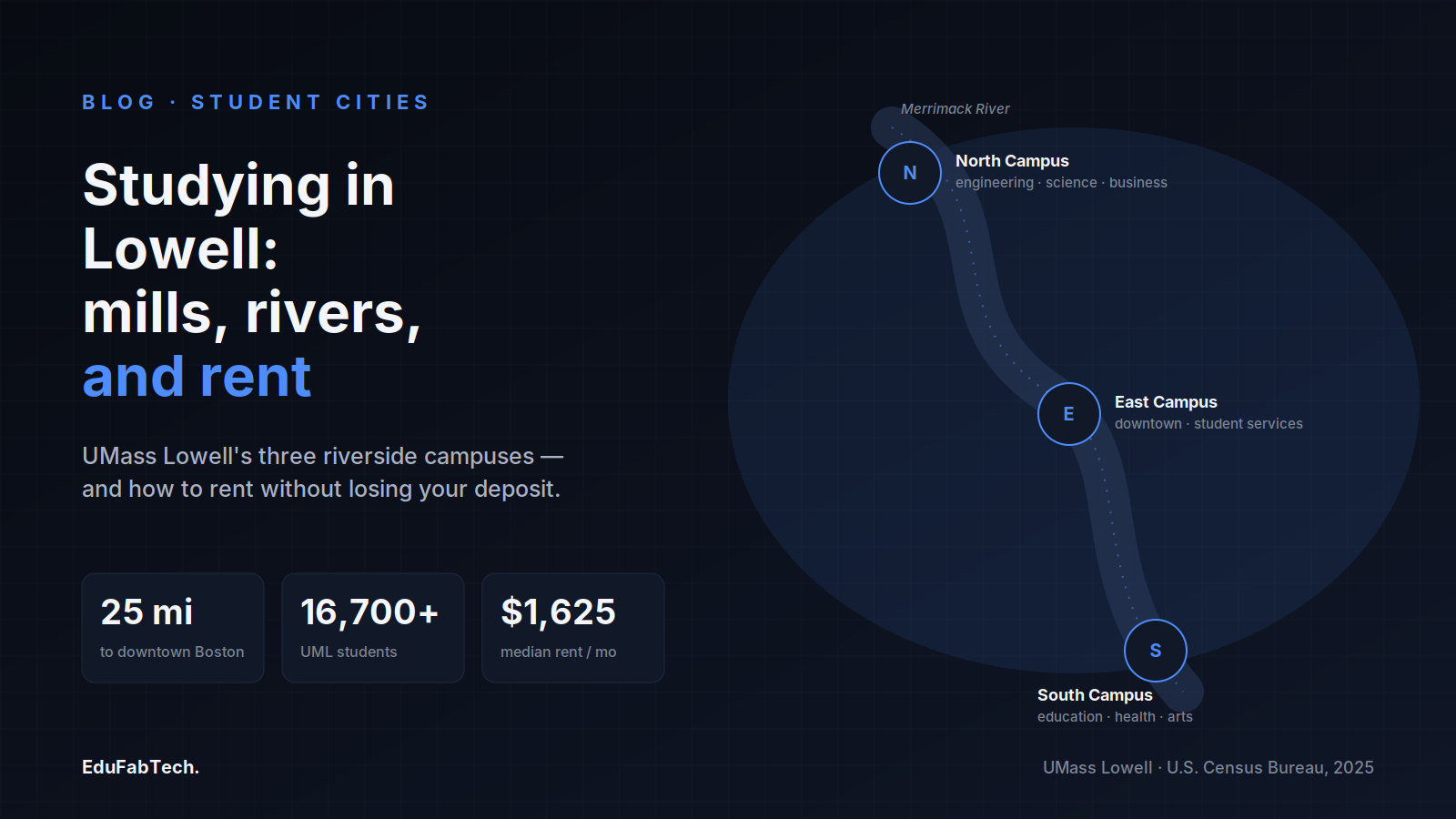
The city today is mid-sized and dense by American standards: the U.S. Census Bureau's QuickFacts for Lowell records 115,554 residents at the 2020 Census and a population estimate near 120,000 for 2025. It sits about 25 miles (40 km) northwest of Boston, close enough to feel the pull of the larger city but cheaper and smaller in its own right. Many of the old mills are now lofts, offices and studios, and the downtown around the canals is compact enough to cross on foot in fifteen minutes.
For a student, Lowell offers a working city rather than a campus bubble. Rents are lower than in Boston or Cambridge; the public university is woven through three riverside neighbourhoods; and the immigrant history the Park Service describes is still visible in the restaurants, shops and faces of the Acre and the Highlands. It is not a glossy college town, and that is much of the point.
UMass Lowell and the colleges in town
The University of Massachusetts Lowell is the city's main institution and the reason most students come. Its own About page describes a public research university of more than 16,700 undergraduate and graduate students, with 120-plus undergraduate programmes, set "on both sides of the Merrimack River" about 25 miles from Boston. The university is strongest in engineering, the sciences, health and business, and is classified as a Research 1 institution. It grew out of two older Lowell schools — a textile institute and a teachers' college — which is why the campus is spread across the city rather than gathered on one quadrangle.
That campus comes in three parts, and knowing them shapes where you should live. North Campus, on the Pawtucketville side of the river along University Avenue, holds most of the engineering, science and business facilities. South Campus, up in the Highlands, is home to education, health sciences, humanities, social sciences and the fine and performing arts. East Campus, close to downtown, is the student-services heart, with the Meehan Student Center, the bookstore and admissions. Free university shuttles link the three, but your daily walk depends on which one your department sits on.
Lowell also has a large two-year public college: Middlesex Community College, whose Lowell campus sits at Kearney Square by the Merrimack downtown and grants associate degrees and certificates. Many students start there and transfer to UMass Lowell or elsewhere. Boston's and Cambridge's universities are a commuter-rail ride away, but they are not in Lowell, and you should not plan your housing around them.
The neighbourhoods students pick
Pawtucketville is the obvious first choice if you study on North Campus. It is the city's largest neighbourhood, spread along the north bank of the Merrimack, and its triple-decker houses and small apartments put you within walking distance of the engineering buildings. It is residential and quieter than downtown, with the river path on one side and a mix of long-term families and students on the other.
The Highlands, in the southwest of the city, wraps around South Campus at its northern edge. It is one of Lowell's most diverse neighbourhoods and one of its most affordable for rooms, though it is large and uneven — the blocks nearer campus are the ones students favour. If your classes are in education, health or the arts, this is the natural place to look.
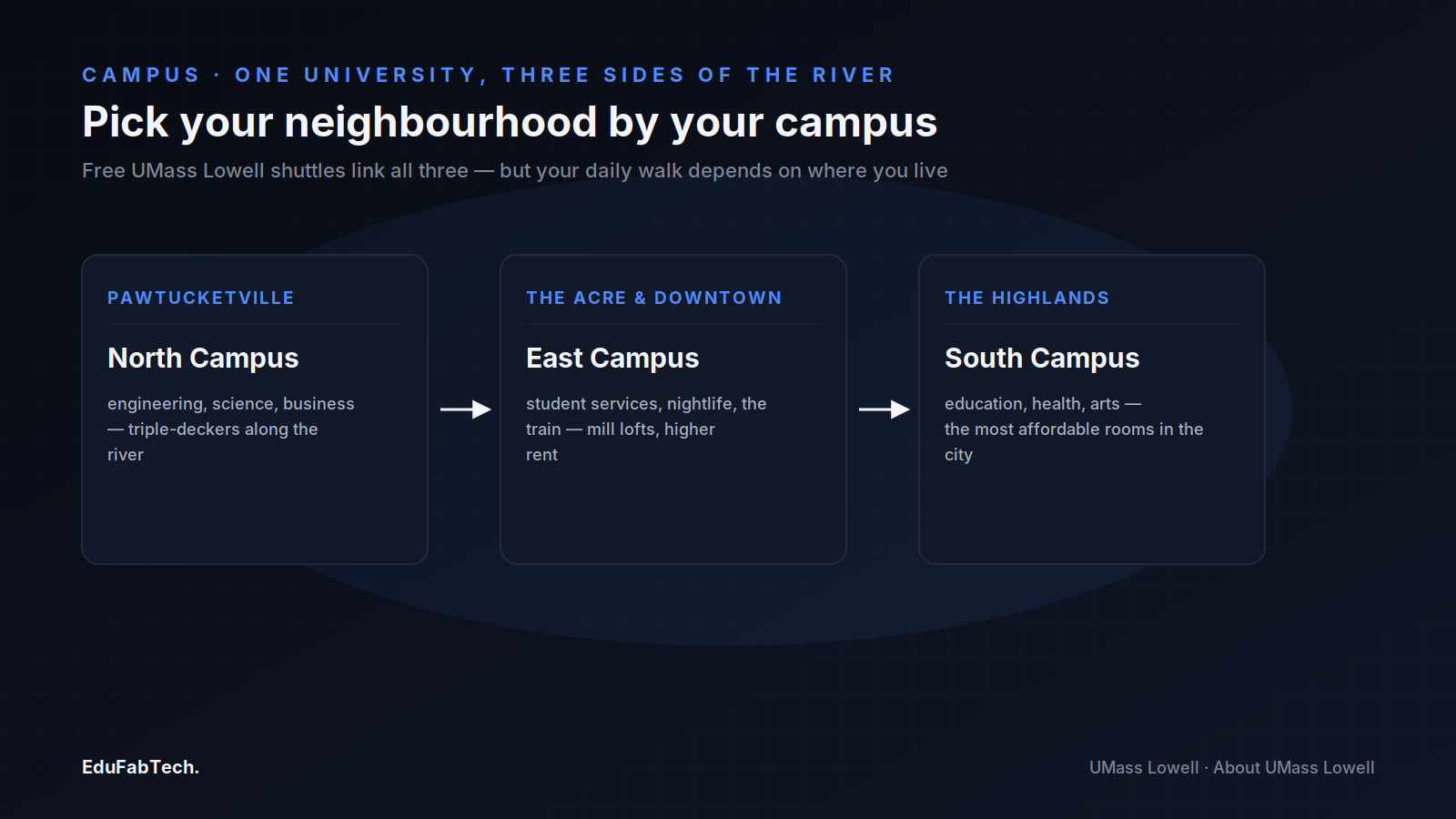
Downtown and the Acre suit students who want to be near East Campus, the restaurants and Middlesex Community College. Downtown has the mill-conversion lofts and the canals; the Acre, just west of it, is a small, densely populated, historically immigrant neighbourhood full of small businesses and cheaper flats. Both put you closest to nightlife, buses and the train, at the cost of more noise and, for the lofts, higher rents.
Centralville sits across the river to the northeast, cut off from the rest of the city by the Merrimack and from Pawtucketville by Beaver Brook. It is residential and green, with the riverfront bike path, and a short bridge crossing from downtown. Belvidere, on the eastern side beyond the Concord River, is the city's more established residential district — leafier and generally pricier, better for graduate students or those sharing a house than for a cheap single room. Back Central, a small neighbourhood south of downtown, is quieter and often overlooked, which sometimes makes it cheaper.
Finding a room without losing a deposit
Most Lowell students either live in UMass Lowell housing or rent a room in one of the triple-deckers and mill lofts described above. Start looking early — rooms near North and South Campus turn over fastest in the weeks before the autumn term, and the cheapest listings go first. If you are arriving from abroad, consider a few weeks in university housing or a short sublet while you view places in person.
The firm rule in Massachusetts protects you here. According to MassLegalHelp, a legal-aid resource run by the Massachusetts Law Reform Institute, at or before move-in a landlord may lawfully collect only four things: the first month's rent, the last month's rent, a security deposit of no more than one month's rent, and the actual cost of a new lock and key. Anyone demanding more than that, or a large "holding fee" before you have seen the place, is outside the law.
In Lowell, the listings to treat with suspicion are the too-cheap downtown lofts and the student sublets advertised near South Campus — a converted mill flat priced well below the others, from someone who cannot meet you, is the classic bait. See the actual room before you pay anything, in person or at least over a live video call that shows the real address. Never send money by bank wire, gift card or cryptocurrency to "hold" a room; those payments cannot be reversed, and no legitimate Lowell landlord needs them. EduFabTech's own rooms listings for Lowell and the wider city page are a place to start, and UMass Lowell runs an off-campus housing service for enrolled students.
What a room costs, on and off campus
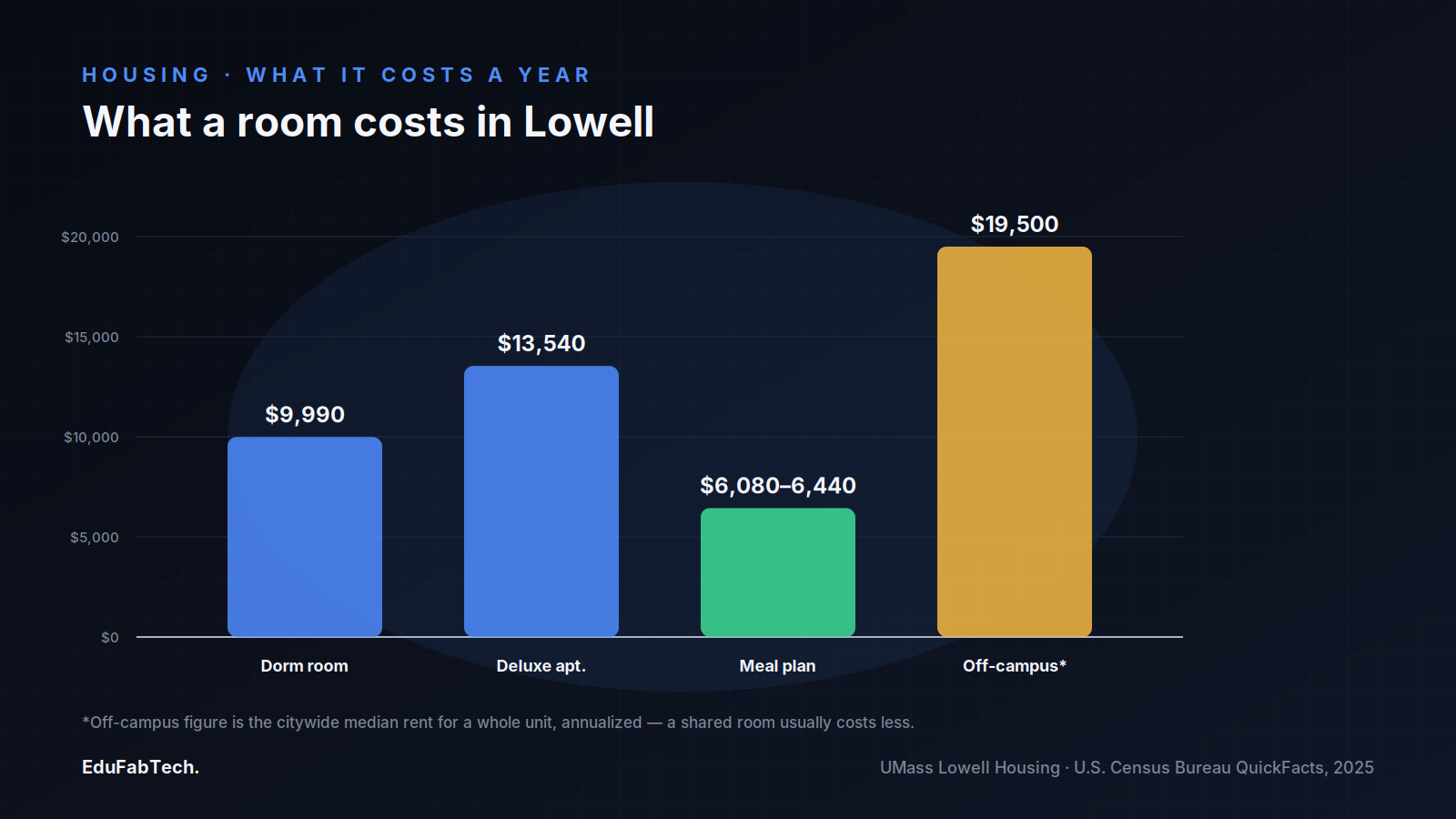
For an on-campus benchmark, UMass Lowell publishes its rates. The university's proposed 2026-2027 housing rates — pending approval by the UMass Board of Trustees and subject to change — run from $9,990 per year for a standard room in the traditional halls (Bourgeois, Concordia, Fox and Leitch) up to $13,540 per year for a deluxe apartment or townhouse at River Hawk Village or 1 Merrimack Plaza. Residents of the traditional and suite buildings must also buy an unlimited meal plan, which the same page prices at $6,080 to $6,440 per year for 2026-2027.
Off campus, the city-wide figure is the U.S. Census Bureau's: its QuickFacts for Lowell put the median gross rent at $1,625 a month for 2020-2024. That is a whole-unit figure, so a room in a shared triple-decker usually costs well below it, but it tells you the market you are entering — lower than Boston, higher than much of the rest of the country.
Furnishing a room and shopping second-hand
A room in a Lowell triple-decker often comes unfurnished, so plan to pick up a bed, desk and kitchen basics cheaply. The mills give the city an unusual second-hand culture. Mill No. 5, an indoor streetscape of salvaged shopfronts on the upper floor of a nineteenth-century mill at 250 Jackson Street, runs a year-round indoor farm market on Sundays alongside its independent shops, a cinema and a café — a good place to find local food and the sort of small vendors that turn over used and handmade goods.
For the furniture itself, the cheapest routes are students leaving at the end of term and giveaways. EduFabTech keeps separate Lowell pages for second-hand things and used furniture, which fill up fastest in May and June as leases end. Buy a mattress new if you can; almost everything else — desks, shelves, pans, bikes — moves second-hand around the campuses every semester.
Getting around: buses, the train and your feet
Lowell is walkable, and the public buses are, for now, free. The Lowell Regional Transit Authority (LRTA) runs the city's buses out of the Kennedy Center terminal downtown, and it currently runs a fare-free programme that the LRTA says has been extended, with Massachusetts state funding, through July 1, 2027 — meaning every LRTA route is free to ride, subject to that funding. Independently of that, UMass Lowell's transportation office states that enrolled students and employees ride the LRTA at no cost simply by scanning their UMass Lowell UCard.
For Boston, the train runs from the same complex: the MBTA Commuter Rail's Lowell Line leaves Gallagher Terminal for Boston's North Station. Be clear-eyed about the cost — the university's transit page states plainly that UMass Lowell offers no discount or pass for the MBTA Commuter Rail, and the MBTA's own fares page lists one-way commuter-rail fares of $2.40 to $13.25 for 2026 depending on zone, with Lowell in one of the outer zones. You can, however, pick up an unloaded CharlieCard free at the terminal for the Boston subway and buses, as the university's page notes. For most day-to-day student life, the free LRTA bus and your own feet will do.
Work, libraries and study spaces
If you are an international student, the rules on work are strict and are not the university's to waive. UMass Lowell's International Students & Scholars Office states that an F-1 student may work on campus up to 20 hours per week in total across all jobs while school is in session, and full-time during recognised vacation periods, and that any off-campus work, paid or unpaid, needs prior approval from the ISSO and/or USCIS and an updated Form I-20 before it begins. Treat the ISSO and the federal authorities — SEVP and USCIS — as the final word, and do not act on second-hand advice. On-campus jobs are posted through the university's JobHawk system; EduFabTech also lists part-time work in Lowell. This is general information, not legal advice.
For study space, the university runs two libraries, one on each of the main campuses: Lydon Library on North Campus and O'Leary Library on South Campus, which for the current academic year keep the same long hours — open until 11 p.m. on weeknights and on weekends on a reduced schedule. Off campus, the city's public library is the Pollard Memorial Library at 401 Merrimack Street downtown, descended from a public library founded in 1844, with free wi-fi and quiet reading rooms open to anyone. Downtown cafés in the mill district and EduFabTech's study-spaces listings fill the gaps when the libraries close.
The honest trade-offs, and a checklist
What is good about Lowell for a student is real: rent well below Boston's, a compact and walkable centre, currently free city buses, a university spread through neighbourhoods rather than walled off from them, and a train to a major city when you want it. The mill-and-canal setting is genuinely distinctive, and the city's immigrant food and markets are a daily pleasure rather than a weekend novelty.
What is hard is also real. Costs are moderate for the United States but not low — the Census median rent of $1,625 is a reminder that eastern Massachusetts is expensive. The three-campus layout means you will commute between buildings even as a resident. New England winters are long and cold, and the commuter rail to Boston is neither cheap nor discounted for students. The best student rooms near campus go early, and the cheapest downtown lofts are where rental scams cluster.
A short checklist for the first weeks:
- Confirm which campus your department sits on — North, South or East — and look for a room within walking distance of it.
- Get your UMass Lowell UCard early; it is your free LRTA bus pass as well as your ID.
- Before paying for any room, see it in person or by live video, and refuse any demand beyond first month, last month, a one-month deposit and the lock-and-key cost.
- Never wire money, buy gift cards or send cryptocurrency to hold a room.
- International students: visit the ISSO before taking any job, and keep your Form I-20 current.
- Register for a free CharlieCard at the terminal if you expect to visit Boston, and budget separately for the commuter rail.
- Check EduFabTech's Lowell listings early to meet people and furnish a room before term starts.
A quick question for readers
Do you work part-time while you study?
Many students work to pay the bills. See how common it is — and how many hours people really do.
Pick an answer, create a free account in a minute, and your vote counts. Already a member? Sign in
Comments 0
CommentNo comments yet. Members start the conversation.
Source: University of Massachusetts Lowell
Sources (5)
- University of Massachusetts Lowell. Housing & Food Rates 2026-2027. UMass Lowell, 2026. uml.edu ↗ · checked 12 Oct 2026
- U.S. Census Bureau. QuickFacts: Lowell city, Massachusetts. U.S. Census Bureau, 2024. census.gov ↗ · checked 12 Oct 2026
- Lowell Regional Transit Authority. News: Fare-Free Program Extended Through July 1, 2027. LRTA, 2026. lrta.com ↗ · checked 12 Oct 2026
- Massachusetts Law Reform Institute. Security deposit basics for Massachusetts tenants. MassLegalHelp, 2025. masslegalhelp.org ↗ · checked 12 Oct 2026
- National Park Service. Lowell National Historical Park. U.S. National Park Service, 2026. nps.gov ↗ · checked 12 Oct 2026