Studying in Manhattan, Kansas: universities, housing and student life
A practical, honest guide to studying in the Little Apple — Kansas State University, where students live, what a room costs, work rules for international students, study spaces and getting around.
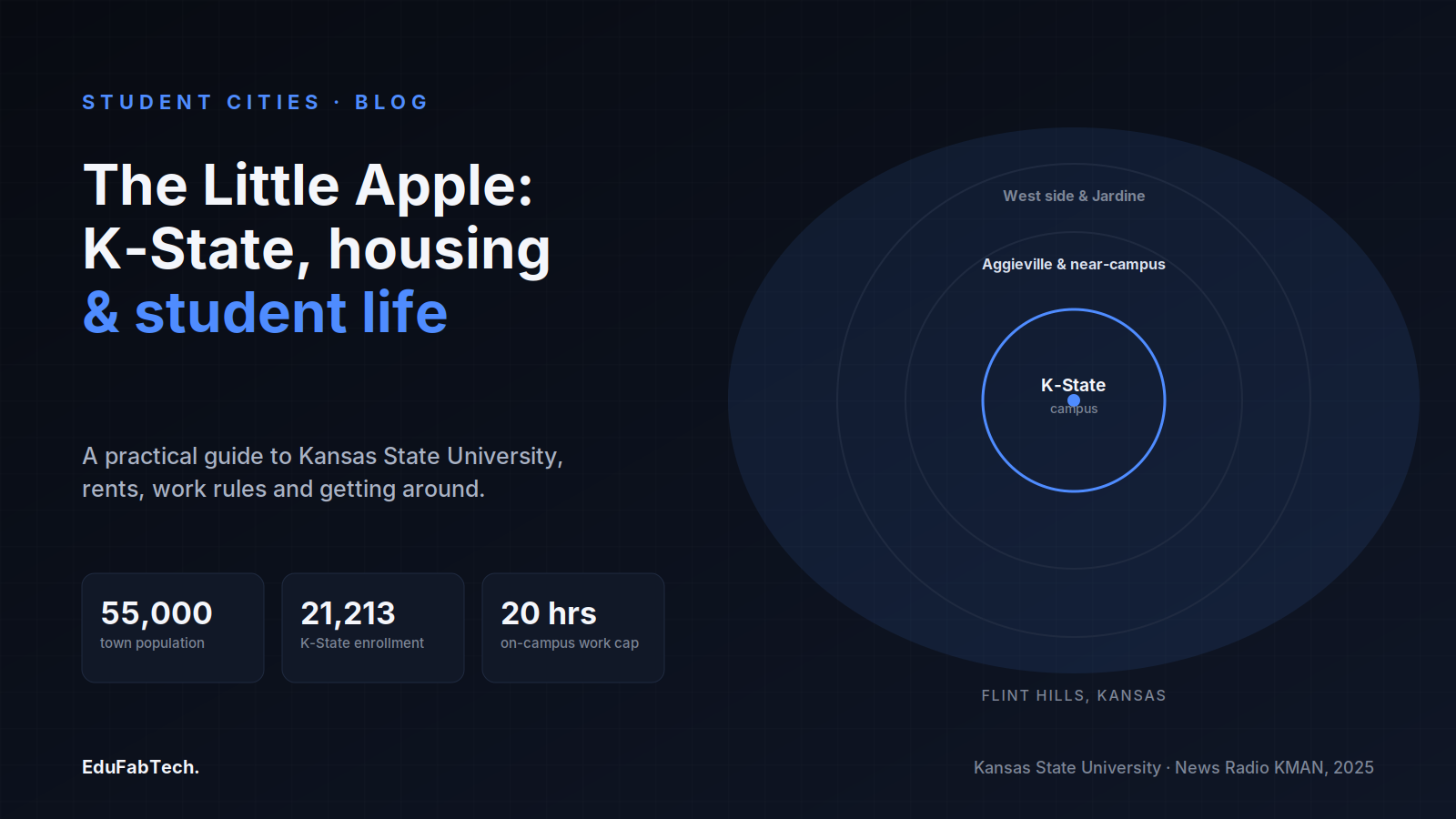
Manhattan, Kansas sits where the Kansas and Big Blue rivers meet, in the tallgrass prairie of the Flint Hills, and almost everything about student life here follows from one fact: this is a university town first and a city second. Kansas State University describes the surrounding town as having a population of about 55,000 (2020 Census) and explains the local nickname, "the Little Apple," as a play on New York's Manhattan (Kansas State University). With more than a fifth of that population enrolled at the university, the rhythm of the place — when rents move, when Aggieville fills up, when the buses run — tracks the academic calendar.
That makes Manhattan unusual among American cities of its size. It is small enough to cross on a bike, far enough from any large metropolis that students rarely commute in from elsewhere, and dominated by a single land-grant institution whose colleges of agriculture, engineering and veterinary medicine draw people from across the world. If you are weighing a place here, local or international, the questions worth answering are concrete: what does a room cost, what may you do for work, where can you study, and how do you move around without a car.
Kansas State University and what studying here is like
Kansas State University is the reason the town exists in its modern form. The university describes itself as a land-grant institution founded in 1863, now enrolling more than 21,000 students across campuses in Manhattan, Salina and Olathe and offering over 250 academic programs (Kansas State University). News Radio KMAN, reporting the university's own figures, put total enrolment at 21,213 in autumn 2025, up 4.5% from 20,295 a year earlier (News Radio KMAN, 2025).
The main campus occupies a large limestone-building site on the north edge of town, and its reputation rests heavily on agriculture, engineering and veterinary medicine — the classic strengths of a land-grant university. Athletics matter here too: K-State competes in NCAA Division I in the Big 12 Conference as the Wildcats, and on football Saturdays the town reorganises itself around the stadium. For an international student, the practical anchor is International Student and Scholar Services (ISSS), the office that issues immigration documents and advises on work and travel; you will deal with it often, so learn where it is early.
Where students actually settle in the Little Apple
Housing in Manhattan falls into a few recognisable bands. First-year students commonly live in the university residence halls on the northern campus — Goodnow, Haymaker, Marlatt, Boyd, Moore, West, Van Zile, Wefald — each with its own character and price. Beyond the halls, most undergraduates drift toward the blocks around Aggieville and the near-campus streets north and west of downtown, where older houses are split into student rentals and newer apartment blocks have gone up alongside the district's redevelopment. Graduate students and couples tend to look a little farther out, toward quieter west-side neighbourhoods and Jardine, the university's own apartment community for continuing and graduate students.
The city's shape helps here. Aggieville sits directly across from campus and is, by the Aggieville Business Association's account, the oldest shopping district in Kansas, serving the campus since 1889 (Aggieville Business Association). Living within walking distance of it means you can reach class, groceries, a bar and a bookstore on foot — which in a town with limited transit is worth more than square footage. The trade-off is noise: the blocks closest to Aggieville are lively at night, and a cheap room there is cheap for a reason.
Finding a room without losing your deposit
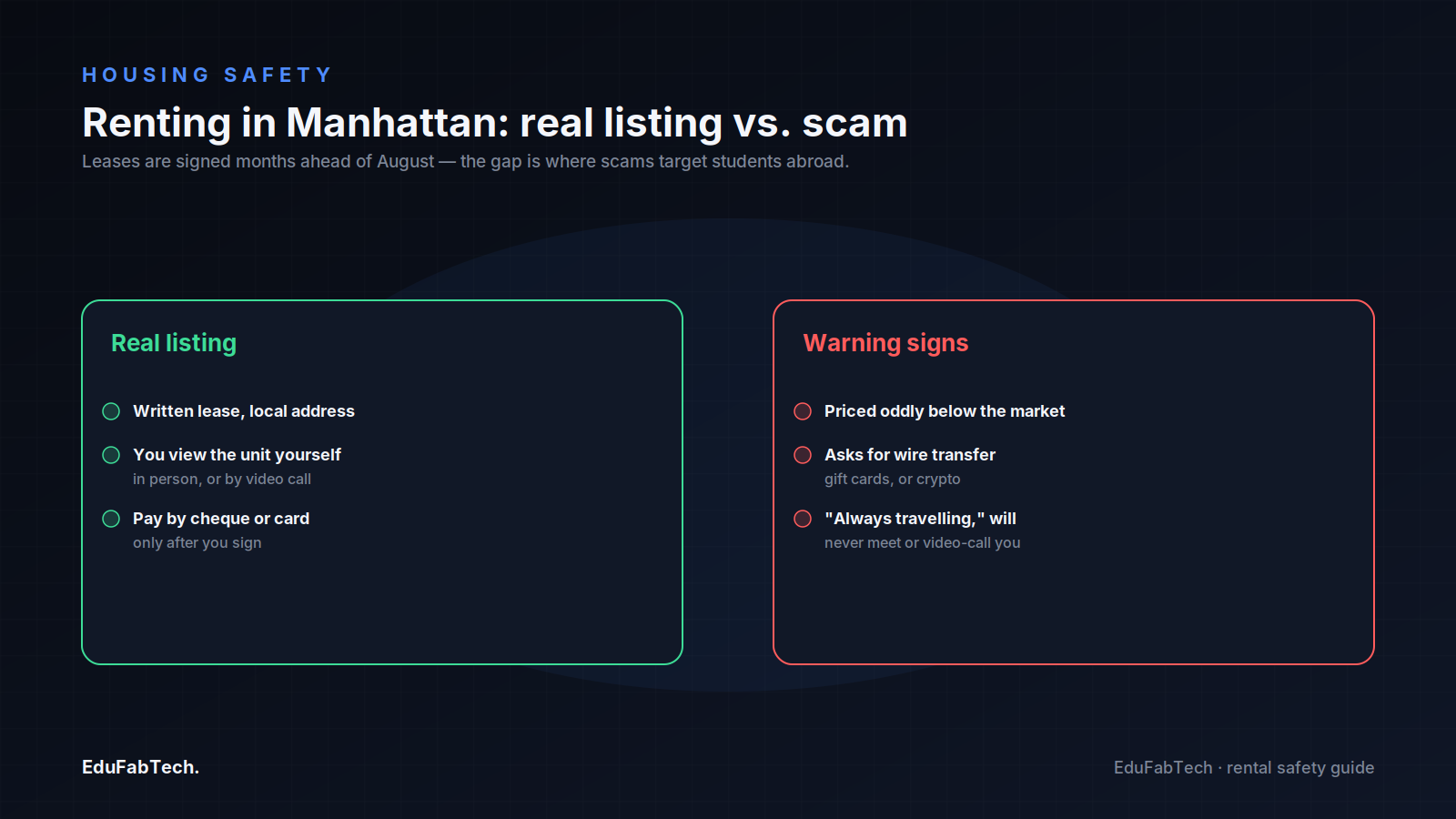
Manhattan's rental market runs on an academic clock. Leases for houses and near-campus apartments are typically advertised and signed months ahead, often in late winter and spring for a lease starting in August, so if you wait until you arrive in August you will be choosing from what is left. International students who cannot visit in person are the most exposed to the one real hazard here: the listing that looks perfect, is priced slightly below everything else, and belongs to someone who does not actually control the property.
The protections are ordinary and effective. See the specific unit before you pay anything — in person, or by asking a current tenant, a classmate or an ISSS peer to walk through it and video-call you. A genuine Manhattan landlord will have a written lease, a local address and no objection to you viewing first. Treat as a warning sign any request to wire money, buy gift cards, or send cryptocurrency to "hold" a room before you have seen it and signed; a real deposit is paid by cheque or card against a signed lease, not transferred abroad to a stranger. If a deal exists only over messaging and the owner is conveniently always travelling, walk away. EduFabTech keeps local listings for the city at Manhattan on EduFabTech and rooms specifically at rooms and places to stay; listings near the main campus are grouped at near Kansas State University.
Furnishing a room cheaply, and the markets worth knowing
A room near campus often comes unfurnished, and the cheapest way to fill it is the student turnover itself: every May, as leases end, Manhattan sheds desks, chairs, lamps and mini-fridges faster than anyone can buy them. The Downtown Farmers' Market of Manhattan, established in 1979 and held at 3rd and Leavenworth in the Dillard's parking lot on Saturdays from 8 a.m. to 1 p.m. from April through October, is the city's main public market for food, with produce, meat, baked goods, honey and crafts (Downtown Manhattan Inc.) — useful for eating well on a budget even if it is not where you buy a bookshelf.
For furniture and household goods, the reliable sources in a town this size are thrift stores, end-of-semester giveaways and student-to-student resale. It is worth timing a furniture hunt to early August, when outgoing tenants are offloading, and again to the week after spring finals. EduFabTech collects local resale and giveaways — furniture, appliances and the rest — at second-hand things in Manhattan. Buying nothing new until you have checked there is the single easiest way to keep setup costs down.
Working while you study
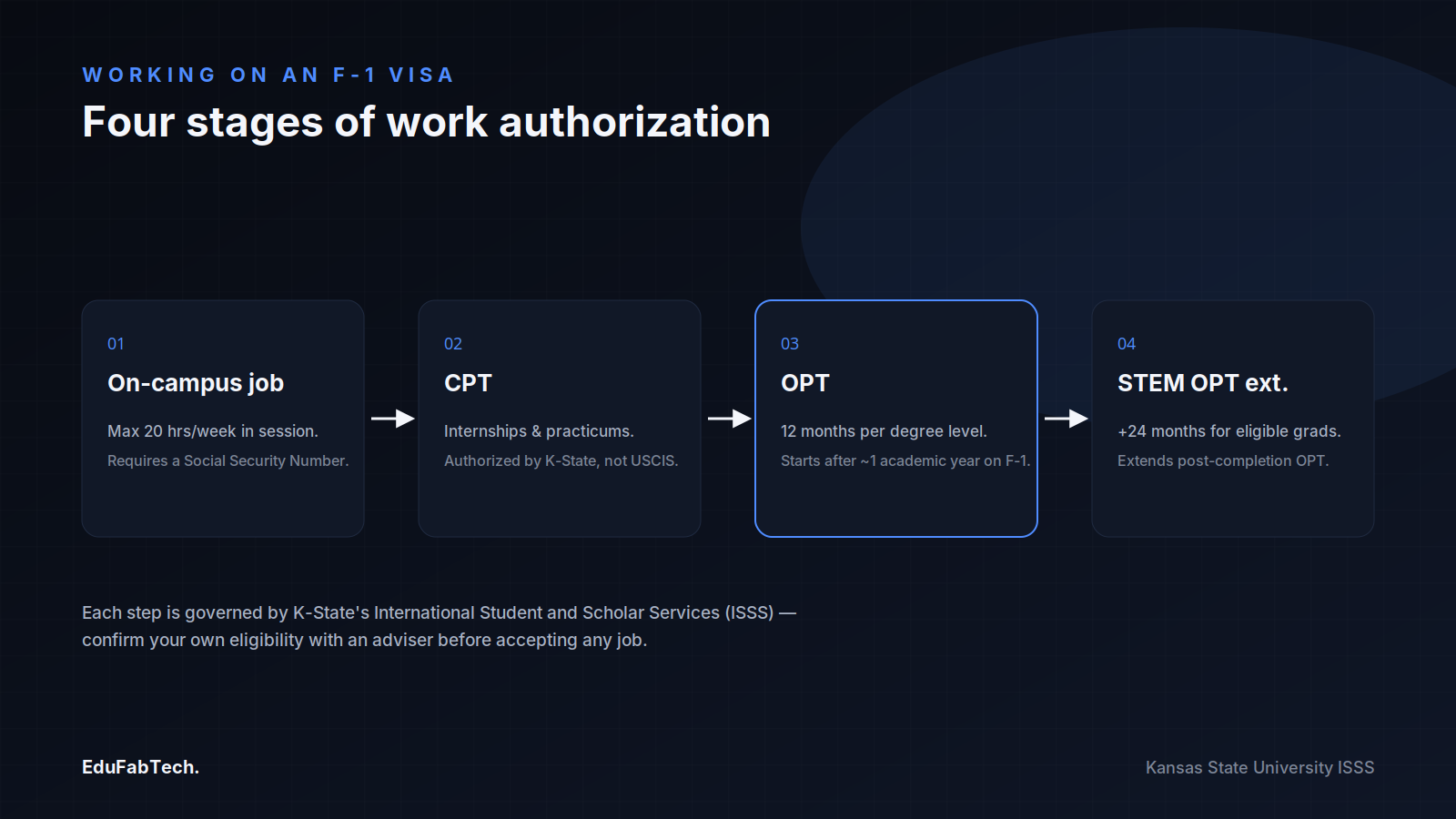
Work rules depend entirely on your status, and this is one area where you should rely on the official source rather than hearsay. For students on an F-1 visa, Kansas State University's ISSS states that USCIS allows on-campus employment of a maximum of 20 hours per week when school is in session, that you must obtain a Social Security Number to work on campus, and that Curricular Practical Training (CPT) for internships and practicums is authorised by the university — not by USCIS — while Optional Practical Training (OPT) requires having completed about one academic year in F-1 status and provides 12 months of work authorisation per degree level, with a possible 24-month STEM extension for eligible graduates (Kansas State University ISSS). These are the rules as the university states them; this is not legal advice, and you should confirm your own situation with an ISSS adviser before you accept any job. On-campus jobs — dining, the library, research labs, the student union — are the usual starting point because they require the least paperwork. Current openings in the city are listed at jobs and part-time work in Manhattan.
Libraries and places to study
The centre of academic study is Hale Library on campus, whose five floors all reopened in August 2021 after a lengthy renovation; the university describes quiet study on the fourth floor and in the historic Great Room, graduate study rooms on the third floor, collaboration rooms, and a Sunderland Foundation Innovation Lab with a media studio and equipment checkout (Kansas State University). Its term-time hours run late — into midnight on Sundays through Thursdays — which matters during exam weeks. The K-State Student Union offers additional lounge and group space in the middle of campus.
Off campus, the Manhattan Public Library at 629 Poyntz Avenue downtown is open to everyone; a library card is free, and the library's site explains you can register online and then bring identification and proof of address to the desk (Manhattan Public Library). It is a useful alternative when campus is crowded or closed, and its downtown location pairs well with errands. For a wider list of desks and quiet rooms around town, EduFabTech maintains study spaces in Manhattan.
Getting around without a car
Manhattan is walkable and bikeable in its core, which is fortunate because public transport is limited. The local operator is the aTa Bus (Flint Hills Area Transportation Agency), which runs fixed routes across the city. Kansas State's ISSS explains the arrangement students need to understand: you ride free on campus by showing a valid Wildcat ID to the driver, but you pay the fare on fixed routes and demand-response trips off campus, and international students can apply for a half-fare card (Kansas State University ISSS). In other words, do not assume the whole network is free — the free zone is the campus.
Beyond the bus, the same university page points to the Green Apple bike-share, ride-hailing apps and taxis. For leaving town, Manhattan Regional Airport offers daily flights to Chicago O'Hare and Dallas–Fort Worth (Kansas State University), which is a genuine advantage over many towns this size — an international student can reach two major hubs without a long drive to Kansas City.
Costs and the honest trade-offs
Start with a figure you can rely on. For 2026–27, Kansas State University's own housing office lists a traditional double room in Goodnow, Haymaker or Marlatt hall at $3,055 per semester per person, a small single in Haymaker at $3,670, and single suite rooms ranging up to $5,385 in Wefald; a $100 access fee is included each semester, and a meal plan is required, with the "Every Meal" plan at $2,805 per semester (Kansas State University Housing and Dining Services, 2026–27). Off-campus rents in Manhattan are generally lower than in large American cities, but they are set by the student market and rise around the August lease season; reliable, dated figures for private rents in this specific city are harder to source than the university's published rates, so treat any single rent number cautiously and compare several current listings before signing.
The honest balance for a student: Manhattan is affordable, compact and safe-feeling by the standards of a mid-sized American town, and the campus-and-Aggieville core means you can live well without a car. Against that, it is isolated — the nearest big city is a drive away — and the town's smallness cuts both ways, offering a close community but fewer off-campus jobs, nightlife options and rental choices than a large city. Winters on the prairie are cold and summers hot, and the rental supply tightens sharply in August, so timing your search matters more here than the headline price does. For students who want a focused, outdoorsy, tightly-knit college town, Manhattan delivers exactly that; for those who want the anonymity and variety of a metropolis, it will feel small.
A checklist for your first weeks
- Register with ISSS (if international) and confirm, in person, what you may do for work before accepting any job.
- Get your Wildcat ID — it is your free ride on the on-campus aTa Bus and your library access.
- If on F-1 and planning an on-campus job, start the Social Security Number process early, as the university's ISSS requires it.
- Never send money abroad, by wire, gift card or crypto, to hold a room you have not seen; view the unit first and sign a written lease.
- Set up a free Manhattan Public Library card downtown as a backup to Hale Library.
- Delay buying furniture: check end-of-semester giveaways and second-hand listings first.
- Learn the walking and cycling routes between your room, campus and Aggieville — they will matter more than the bus map.
- Walk Aggieville and Poyntz Avenue downtown in your first week, mapping where groceries, study spots and the Saturday farmers' market are.
A quick question for readers
Do you work part-time while you study?
Many students work to pay the bills. See how common it is — and how many hours people really do.
Pick an answer, create a free account in a minute, and your vote counts. Already a member? Sign in
Comments 0
CommentNo comments yet. Members start the conversation.
Source: Kansas State University
Sources (5)
- Kansas State University Housing and Dining Services. 2026-2027 Residence Hall Rates and Meal Plans. Kansas State University, 2026. housing.k-state.edu ↗ · checked 13 Oct 2026
- Kansas State University International Student and Scholar Services. Working On/Off Campus (F-1 Employment). Kansas State University, 2026. k-state.edu ↗ · checked 13 Oct 2026
- Kansas State University International Student and Scholar Services. Transportation. Kansas State University, 2026. k-state.edu ↗ · checked 13 Oct 2026
- Kansas State University. Life in Manhattan (English Language Program student handbook). Kansas State University, 2026. k-state.edu ↗ · checked 13 Oct 2026
- Aggieville Business Association. About Aggieville. Aggieville Business Association, 2026. aggieville.org ↗ · checked 13 Oct 2026